How to Write Numbers in Scientific Notation (With Steps)
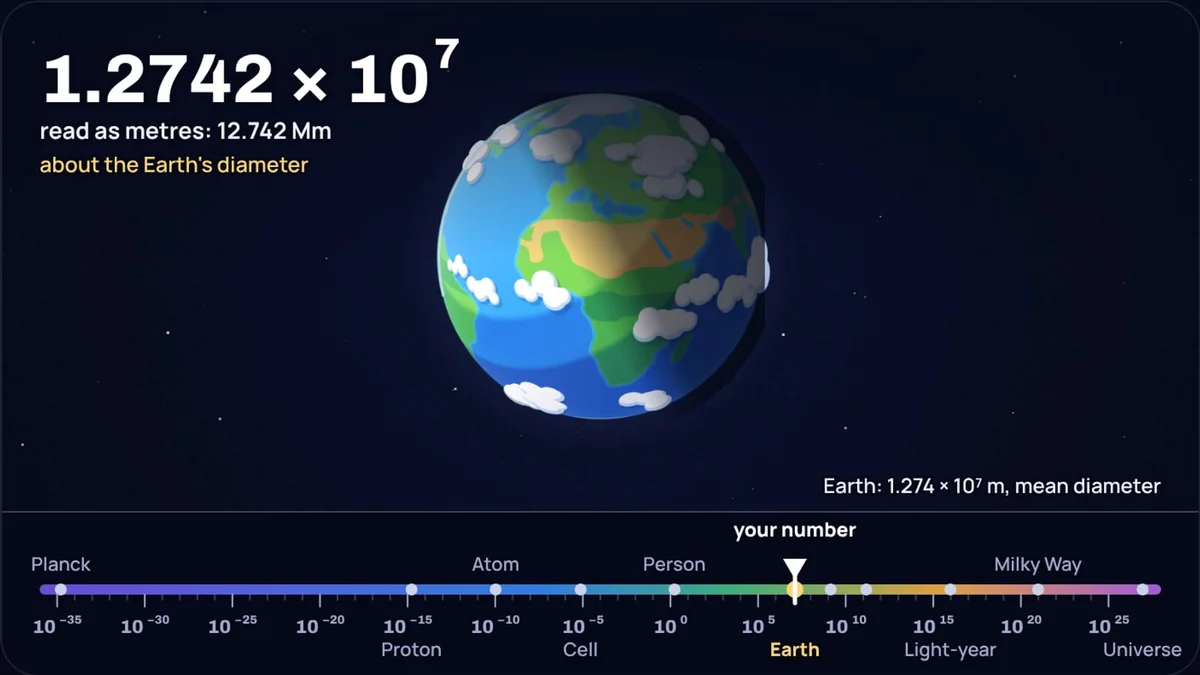
Earth is 12,742,000 metres across. A red blood cell is 0.0000075 metres across. Both numbers are easy to mistype: drop one zero from either and you are off by a factor of ten, and nobody reading it will notice. Scientific notation fixes that by moving the zeros into a small number on the side: m and m. The exponent tells you the size at a glance, and the digits in front tell you what was actually measured.
Here is the method, with the cases that trip people up and worked examples you can check in the scientific notation converter. It takes any number in any form and gives standard form, E notation, engineering notation and the SI prefix, and it places the number on a powers-of-ten scale so you can see how big it is.
What does scientific notation look like?
Every number in scientific notation has the same shape:
where and is a whole number.
The number is the coefficient (some books say mantissa or significand). It carries the digits you measured. The exponent carries the size. Each step of 1 in is a factor of ten, so is a thousand and is a thousandth.
How do you write a large number in scientific notation?
Find where the decimal point is (for a whole number it is at the end, even if it is not written). Move it left until only one digit is left in front of it. Count the moves.
Example 1: Earth's diameter, 12,742,000 m
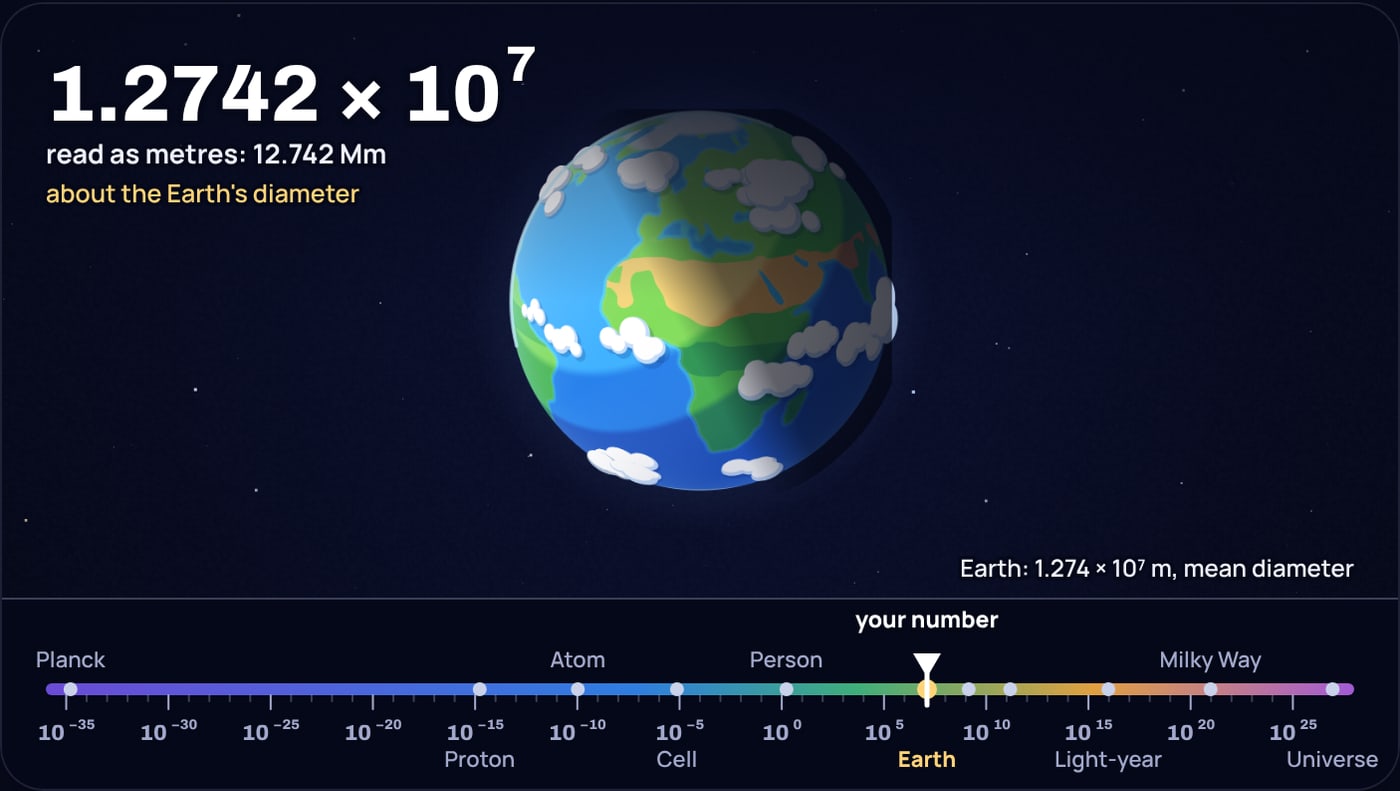
NASA gives Earth's mean radius as 6,371.000 km, so the diameter is 12,742 km, which is 12,742,000 m. The point starts after the last zero and moves 7 places left to sit after the 1:
Moving left makes the exponent positive. The three trailing zeros were only holding the place, so they are dropped. If they were real measured digits, you would keep them: .
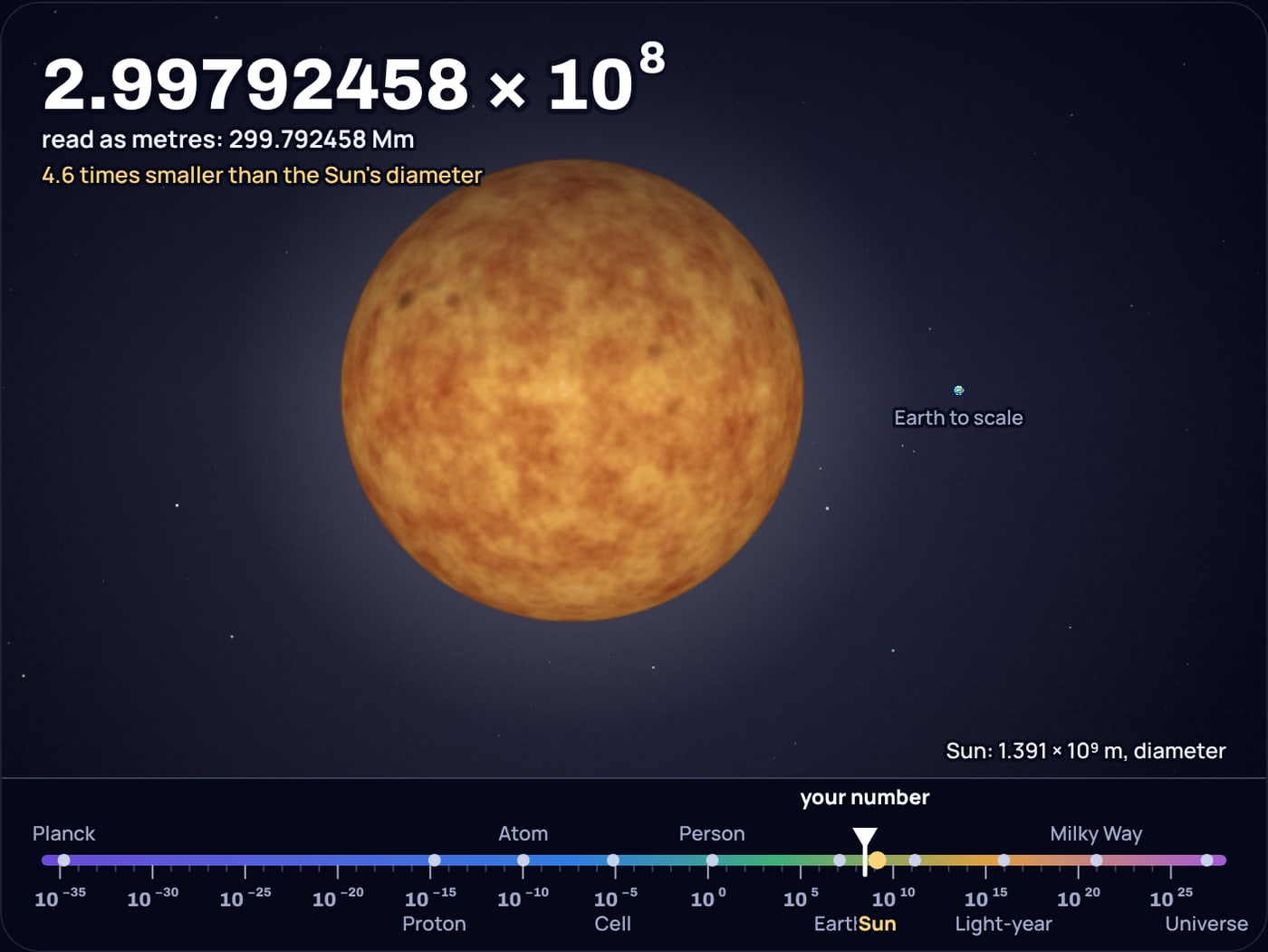
The speed of light works the same way. 299,792,458 m/s has its point after the 8; move it 8 places left and you get m/s. Every one of those nine digits is significant, because since 1983 the metre has been defined so that this number is exact.
How do you write a small number in scientific notation?
For a number less than 1, move the point right until the first non-zero digit is in front of it. Moving right makes the exponent negative.
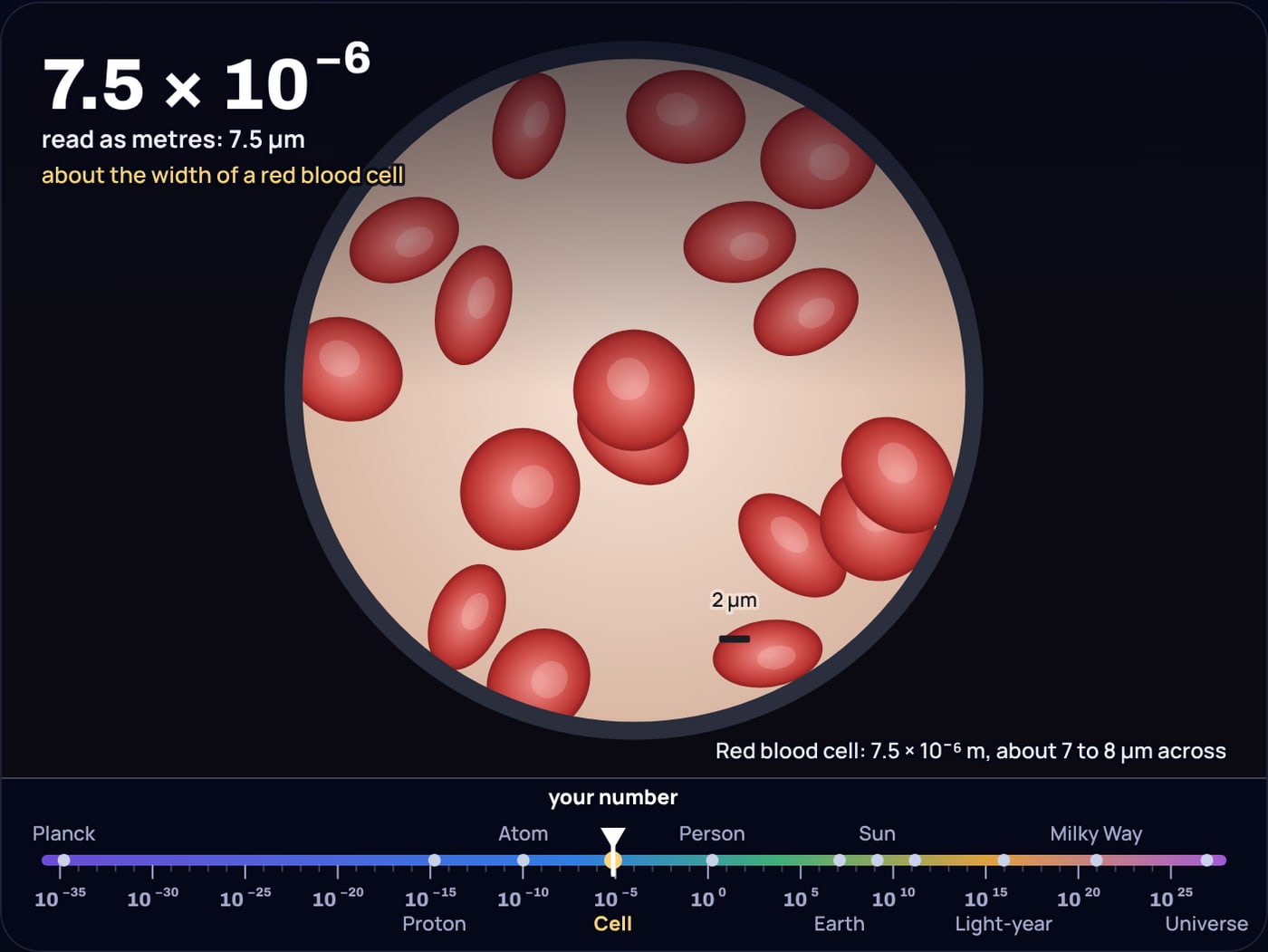
Example 2: a red blood cell, 0.0000075 m
OpenStax's anatomy text gives a mean diameter of about 7 to 8 micrometres. Take 7.5 µm, which is 0.0000075 m. The point has to move 6 places right to sit after the 7:
A quick check: a negative exponent should always go with a number smaller than 1, and the size of the exponent should be one more than the number of zeros straight after the point (here 5 zeros, exponent −6).
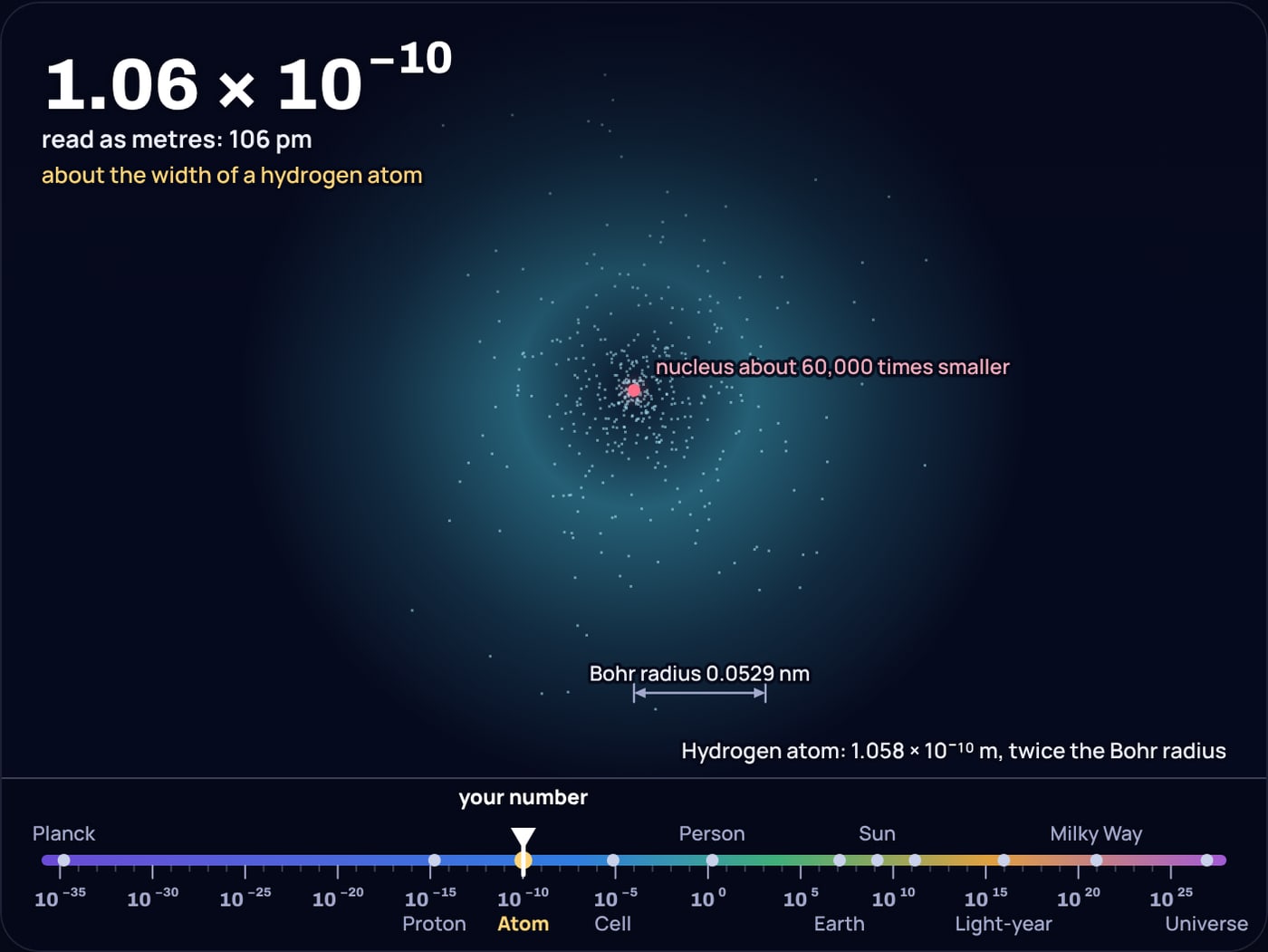
Go smaller and the exponent becomes the only sensible way to write the number. Twice the Bohr radius, NIST's 5.29177210544 × 10⁻¹¹ m, gives a hydrogen atom about m across. The Planck length, in NIST's CODATA 2022 tables as m, would need 34 zeros after the point before the first digit. Nobody writes that out.
What about numbers between 1 and 10?
They need no moves, so the exponent is zero: , because . People sometimes think scientific notation is only for huge or tiny numbers, but writing every value in a table in the same form makes the table easier to scan.
Converting back to an ordinary number
Reverse the move. A positive exponent moves the point right (the number gets bigger); a negative one moves it left. Fill any gaps with zeros.
Example 3: back to decimals
The last one is the Avogadro constant, exact since 2019. It shows why the short form exists: the written-out number has 24 digits and only 9 of them carry information.
What are E notation and engineering notation?
Calculators and spreadsheets cannot print a raised exponent, so they write the power after a letter E. means , and means . The E has nothing to do with Euler's number 2.718; it stands for exponent.
Engineering notation keeps the exponent a multiple of 3, so the front number runs from 1 to 999. That lines it up with SI prefixes, which is how engineers and lab equipment actually label things.
| Decimal | Scientific | E notation | Engineering | SI prefix |
|---|---|---|---|---|
| 0.00045 | 4.5 × 10⁻⁴ | 4.5E-4 | 450 × 10⁻⁶ | 450 µ |
| 0.025 | 2.5 × 10⁻² | 2.5E-2 | 25 × 10⁻³ | 25 m |
| 1,500 | 1.5 × 10³ | 1.5E3 | 1.5 × 10³ | 1.5 k |
| 12,300 | 1.23 × 10⁴ | 1.23E4 | 12.3 × 10³ | 12.3 k |
| 6,371,000 | 6.371 × 10⁶ | 6.371E6 | 6.371 × 10⁶ | 6.371 M |
| 299,792,458 | 2.99792458 × 10⁸ | 2.99792458E8 | 299.792458 × 10⁶ | 299.792458 M |
The SI prefixes come from the BIPM, which in 2022 added ronna (10²⁷), quetta (10³⁰), ronto (10⁻²⁷) and quecto (10⁻³⁰). So the Planck length is too small for any prefix at all.
How do you multiply and divide in scientific notation?
This is where the notation really pays off. Because , you can handle the digits and the sizes separately:
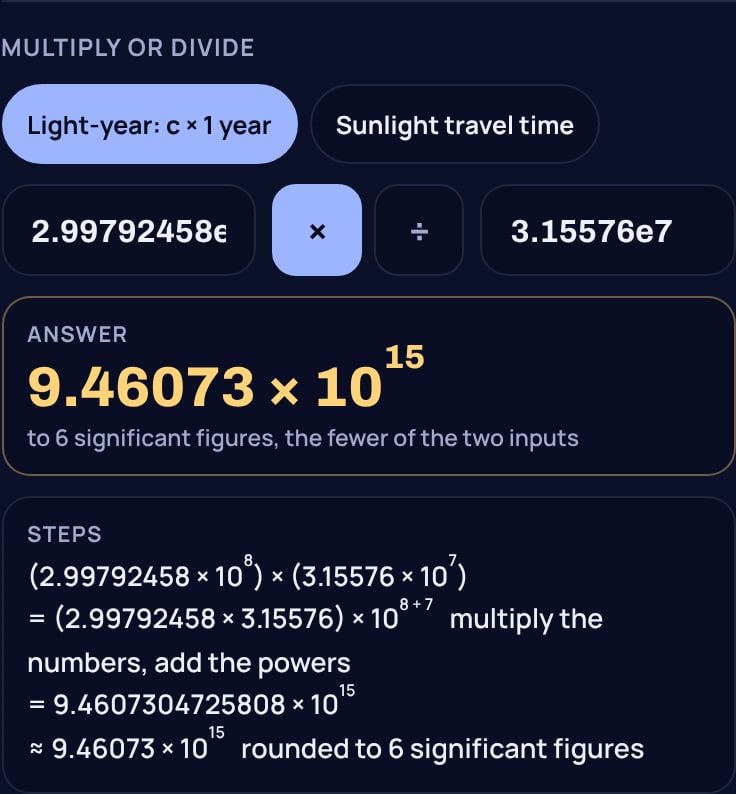
Example 4: how far is a light-year?
A light-year is the distance light travels in a Julian year of 365.25 days, 31,557,600 s, or s.
The coefficient came out below 10, so no tidying was needed. Written out, that is 9,460,730,472,580,800 m, the exact IAU value.
Example 5: how long does sunlight take to reach us?
The coefficient fell below 1, so the point moves one place right and the exponent drops by one. 499 s is 8 minutes and 19 seconds. The Earth to Sun figure, 149.598 million km, is NASA's mean distance, which has 6 significant figures, so the answer is rounded to 6.
Addition and subtraction need one extra step: rewrite both numbers with the same power of ten first, then add the coefficients. .
What are the common mistakes?
- Reading a negative exponent as a negative number. is 0.001, a small positive number. A negative value has its minus sign in front of the coefficient: .
- Leaving the coefficient out of range. is the right value, but standard form is . Each place the point moves left in the coefficient adds 1 to the exponent.
- Counting leading zeros as significant. In 0.0000075 the zeros only position the point. The scientific form, 7.5 × 10⁻⁶, shows honestly that there are 2 significant figures. The significant figures calculator colours each digit to show which count.
- Typing 10 × 10ⁿ into a calculator. On most calculators, 4.5E-4 is entered with the EE or EXP key. Typing 4.5 × 10 EXP -4 gives a value ten times too big.
Scientific notation is the everyday language of physics: the strain in LIGO's arms is around 10⁻²¹, and the energy in one gram of matter is 9 × 10¹³ J. If you want to practise, open the converter with the Planck length, then type your own number in any form, 0.00045, 4.5e-4 or 4.5 × 10^-4, and watch the marker move along the scale.
Sources
- NASA NSSDC, Earth fact sheet (mean radius 6,371.000 km; Earth to Sun 149.598 million km): nssdc.gsfc.nasa.gov/planetary/factsheet/earthfact.html
- NASA NSSDC, Sun fact sheet (radius 695,700 km): nssdc.gsfc.nasa.gov/planetary/factsheet/sunfact.html
- NIST CODATA 2022: Planck length, Bohr radius, proton charge radius, Avogadro constant, speed of light
- BIPM, SI prefixes: bipm.org/en/measurement-units/si-prefixes
- OpenStax, Anatomy and Physiology 18.3, Erythrocytes: openstax.org
- NASA Science, the Milky Way is about 100,000 light-years across: science.nasa.gov
Frequently asked questions
How do you write a number in scientific notation?
Move the decimal point until there is exactly one non-zero digit in front of it. The number of places you moved is the power of ten: positive if you moved left (a big number), negative if you moved right (a small number). 12,300 becomes 1.23 × 10^4 and 0.00045 becomes 4.5 × 10^-4.
What is 0.0005 in scientific notation?
5 × 10^-4. The point moves 4 places to the right to reach 5, so the power is negative 4. In E notation that is 5E-4.
Does the number in front have to be less than 10?
Yes, in standard scientific notation the coefficient is at least 1 and less than 10. 45 × 10^3 has the right value but is written 4.5 × 10^4 in standard form. Engineering notation relaxes this to between 1 and 1,000 so the power stays a multiple of 3.
Is 10^0 equal to 1?
Yes. Any number from 1 up to (but not including) 10 has a power of zero, so 7 is 7 × 10^0. The point does not move at all.
How do you multiply numbers in scientific notation?
Multiply the coefficients and add the powers, then move the point if the coefficient is 10 or more. (3 × 10^4) × (5 × 10^3) = 15 × 10^7 = 1.5 × 10^8. To divide, divide the coefficients and subtract the powers.