How many significant figures does a number have?
Count every digit from the first non-zero digit to the last digit that was actually measured. Non-zero digits always count, zeros between them count, leading zeros never count, and trailing zeros count only when there is a decimal point. So 12.35 has 4, 0.0450 has 3, 100.20 has 5 and 1500 has 2 (or 4 if written 1500.).
Significant figures are a quick way of saying how precisely something was measured. The last one is always the estimated digit: the one you judged by eye between two marks on a ruler, or the one that wobbles on a balance display. The calculator shows that directly, and does sums with the two rules that trip people up. For the rules in more depth with practice examples, see significant figures rules with examples.
Key results from the calculator
- Leading zeros never count: 0.0450 has 3 significant figures; the first two zeros only place the decimal point, the last one was measured.
- Whole numbers are ambiguous: 1500 is read as 2 significant figures. Write 1500. or 1.500 × 10³ if all four were measured.
- Multiply or divide: keep the fewest significant figures. 2.5 × 3.42 = 8.55, reported as 8.6.
- Add or subtract: keep the least precise decimal place. 12.11 + 0.3 = 12.41, reported as 12.4.
Seven examples that cover the rules
Each button loads the example in the calculator, with the ruler or the balance showing where the digits came from.
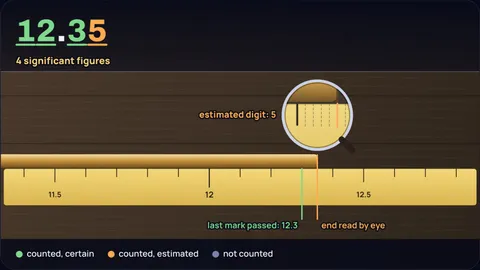
Reading 12.35 cm from a ruler
Certain and estimated digitsA ruler with millimetre marks lets you read 12.3 cm for certain: the end of the rod is past the 12.3 mark. The next digit, the 5, is your judgement of how far it is between 12.3 and 12.4. That makes 4 significant figures, with the last one estimated.
Writing 12.350 would claim you could judge hundredths of a millimetre by eye, which a ruler cannot do. Writing 12.3 would throw away a real reading.
A balance reading of 0.0450 g
Leading and trailing zerosThe two zeros in front only place the decimal point: in milligrams the same reading is 45.0 mg, and they vanish. The final zero is different. The balance displayed it, so it was measured: the mass is 0.0450 g, not 0.0449 or 0.0451. That gives 3 significant figures.
On a digital balance the last displayed digit is the uncertain one; watch it wobble by one when someone walks past the bench.
The ambiguous whole number 1500
Trailing zeros, no decimal pointWas 1500 measured to the nearest 100, 10 or 1? The number alone cannot say. The usual convention, and the calculator's, is to count the zeros only when a decimal point shows they were measured, so 1500 has 2 significant figures and 1500. has 4.
Scientific notation removes the doubt: 1.5 × 10³, 1.50 × 10³ and 1.500 × 10³ have 2, 3 and 4 significant figures. Some textbooks use an overbar on the last significant zero instead.
Zeros inside and at the end: 100.20
Captive and trailing zerosThe two zeros between the 1 and the 2 are captive: they sit between non-zero digits, so they count. The final zero comes after a decimal point, so it counts too. That is 5 significant figures.
This is the kind of number a good analytical balance or a burette reading produces. Rounded to 3 significant figures it becomes 100.
Multiplying: 2.5 m × 3.42 m
Fewest significant figuresThe area of a 2.5 m by 3.42 m floor is exactly 8.55 m² on the calculator, but 2.5 m was only measured to 2 significant figures. The answer can be no more precise than that, so it is 8.6 m².
8.55 sits exactly halfway. The school rule rounds halves up, giving 8.6; the round-half-to-even rule NIST uses also gives 8.6 here, because 5 is odd and rounds up to the even 6.
Adding: 12.11 g + 0.3 g
Least precise decimal placeFor sums the count of significant figures does not matter; the decimal places do. 12.11 is known to the hundredths, 0.3 only to the tenths, so the total 12.41 is only good to the tenths: 12.4 g.
Notice that 0.3 has 1 significant figure and the answer has 3. Applying the multiplication rule here, as many students do, would wrongly give 10 g.
Dividing: density from 25.0 g and 3.2 cm³
Fewest significant figuresDensity is mass over volume: 25.0 ÷ 3.2 = 7.8125 g/cm³. The volume has 2 significant figures, so the density does too: 7.8 g/cm³.
In a multi-step calculation, keep all the digits until the very end and round once. Rounding each step separately can shift the last digit.
How many significant figures? Common cases
| Number | Significant figures | Why |
|---|---|---|
| 4.56 | 3 | all non-zero |
| 0.0072 | 2 | leading zeros do not count |
| 3.040 | 4 | captive and trailing zeros after a point count |
| 207 | 3 | captive zero counts |
| 5000 | 1 | trailing zeros without a point are not counted |
| 5000. | 4 | the point makes them count |
| 5.00 × 10³ | 3 | all digits in the coefficient count |
| 0.50 | 2 | trailing zero after a point counts |
| 1.0080 | 5 | captive and trailing zeros count |
Exact numbers, such as 12 eggs in a dozen, 100 cm in a metre or the 2 in 2πr, have unlimited significant figures and never limit a result.
How the calculator works
It reads the number exactly as typed, including a decimal point, commas and scientific notation, and classifies each digit with the standard rules. The last significant digit is marked as the estimated one, because in any measurement it is.
Rounding to n significant figures keeps n digits from the first non-zero digit. When the dropped part is exactly 5, it rounds up by default, the rule most school courses use, or to the nearest even digit if you pick that option, which is the rule in NIST SP 811 and ISO 80000-1 (12.25 becomes 12.2, 12.35 becomes 12.4). It keeps significant trailing zeros (2.996 to 3 figures is 3.00), and when a whole number would hide them it also gives the scientific notation form.
For multiplication and division the answer keeps the smaller number of significant figures of the two inputs. For addition and subtraction it keeps the decimal place (more exactly, the place value) of the less precise input.
All arithmetic is exact decimal arithmetic with whole numbers, so 0.1 + 0.2 really is 0.3 before any rounding. Rounding happens once, at the end.
What the model leaves out
- Real uncertainty: significant figures are a shorthand. A proper lab report gives the uncertainty itself, such as 12.35 ± 0.05 cm, and propagates it through the calculation.
- Logarithms and pH: for a logarithm, the number of decimal places in the answer equals the significant figures in the input. The calculator does not do logs.
- Rounding in steps: round once at the end. Rounding 8.546 first to 8.55 and then to 8.6 gives a different answer from rounding 8.546 straight to 8.5.
- Exact numbers: it cannot tell that a number is exact (a count or a definition). Leave such numbers out of the precision decision.
Common misconceptions
"Zeros never count." Only leading zeros never count. 100.20 has five significant figures and three of them are zeros.
"Use the fewest significant figures for every operation." That rule is for multiplying and dividing. Adding and subtracting go by decimal places, which can give an answer with more significant figures than an input.
"More digits means a better answer." Copying all ten digits from a calculator claims a precision the measurement never had. It is a mistake, not extra care.
Frequently asked questions
How many significant figures are in 0.0450?
Three. The two leading zeros only place the decimal point. The 4, the 5 and the final zero count; the final zero counts because it comes after the decimal point and was measured.
Do trailing zeros count as significant figures?
Only when there is a decimal point. 2.50 has 3 significant figures and 1500. has 4, but 1500 written without a point is ambiguous and is usually counted as 2.
How do you round to 3 significant figures?
Start at the first non-zero digit, keep three digits, and look at the next one: round up if it is 5 or more. 0.012345 becomes 0.0123 and 2.996 becomes 3.00.
What is the rule for significant figures when multiplying?
The answer has as many significant figures as the input with the fewest. 2.5 × 3.42 = 8.55, which is reported as 8.6 because 2.5 has only 2.
What is the rule for significant figures when adding?
Round the answer to the last decimal place that every input has. 12.11 + 0.3 = 12.41, reported as 12.4, because 0.3 is only known to the tenths.
Keep learning
Significant Figures Rules With Examples (and Why They Exist)
The significant figures rules with worked examples: which zeros count, how to round, and the different rules for multiplying and for adding.
How to Write Numbers in Scientific Notation (With Steps)
Write any number in scientific notation: move the point, count the places, read the sign. Worked examples, E notation, engineering notation and multiplying.
What Is a Good Percent Error in a Physics Lab?
There is no single cut-off. How to judge a percent error against your uncertainty, with worked pendulum, speed of sound and specific heat examples.