Significant Figures Rules With Examples (and Why They Exist)
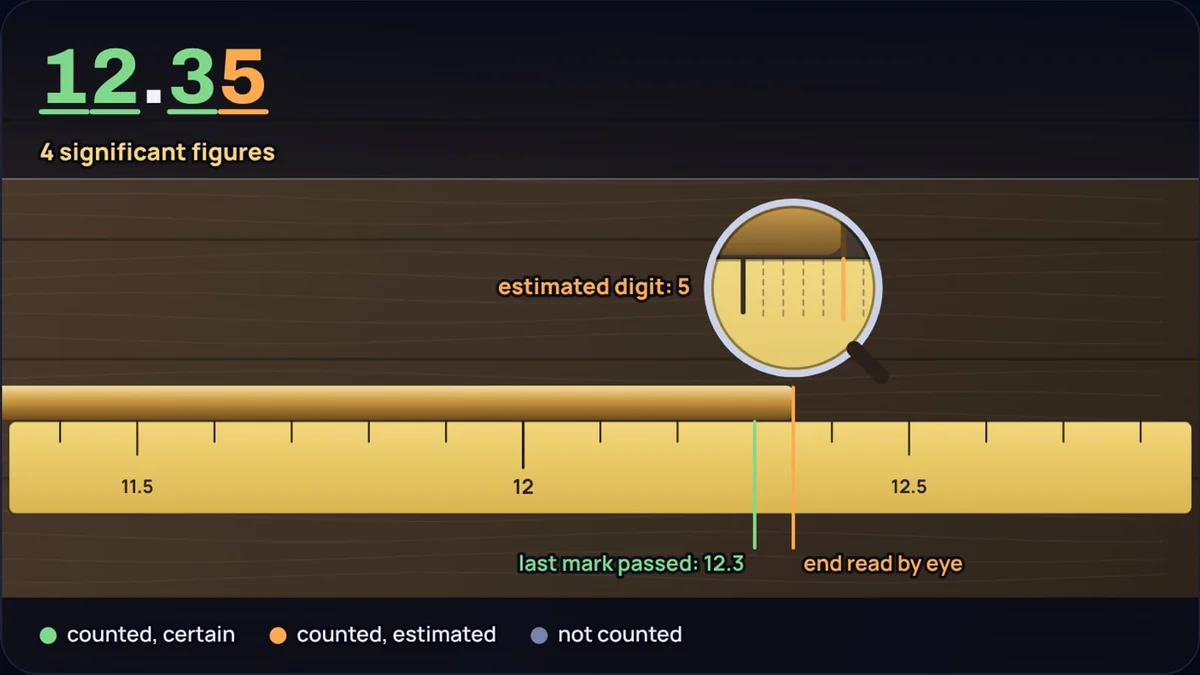
Lay a pencil along a school ruler and read its length. You can say for certain that it ends past the 12.3 cm mark, and you can see it is roughly halfway to 12.4. So you write 12.35 cm. That last 5 is a guess, an honest one, and the four digits together say how carefully you measured. Significant figures are nothing more than that: the digits you actually know, plus one you estimated.
Every rule below follows from that idea. Each example can be checked in the significant figures calculator, which colours every digit of your number as counted or not, shows the rule that applies, rounds to any number of figures and does sums with the right precision.
Where do significant figures come from?
From the instrument. A ruler with millimetre marks lets you read the millimetres for certain and estimate one more digit between the marks. A digital balance shows its last digit wobbling by one when you breathe near it. In both cases the final digit is uncertain and every digit before it is not.
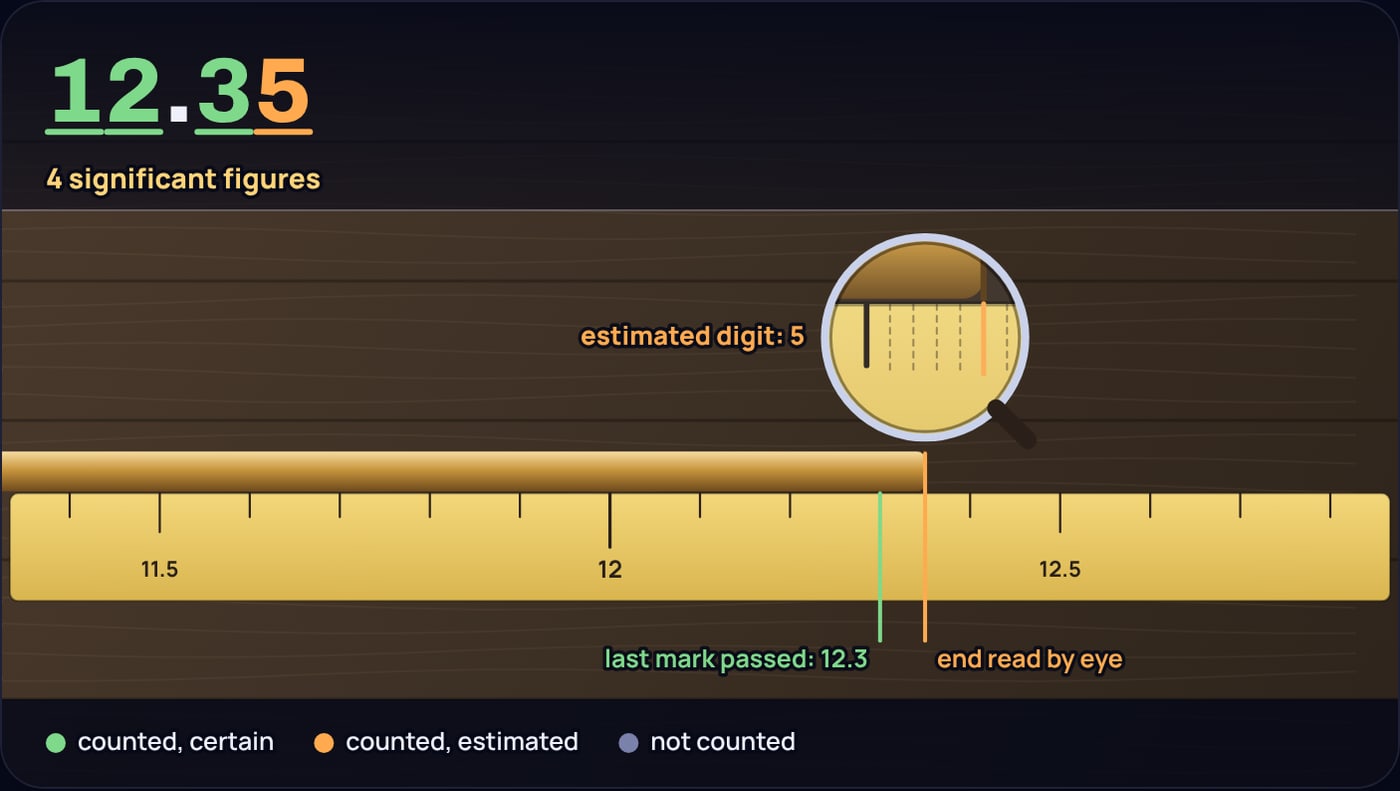
Writing 12.350 would claim you judged hundredths of a millimetre by eye. Writing 12.3 would throw away a reading you genuinely made. The number of digits is a statement about precision, which is why your teacher cares about it.
What are the rules for counting significant figures?
There are five, and the first four are about zeros, because zeros do two different jobs: they can be measured digits, or they can just hold the decimal point in place.
- Non-zero digits always count. 4.56 has 3.
- Zeros between non-zero digits count. They are called captive zeros. 207 has 3 and 1.0080 has 5.
- Leading zeros never count. They only position the point. 0.0072 has 2.
- Trailing zeros count only if there is a decimal point. 3.040 has 4 and 5000. has 4, but 5000 written without a point is ambiguous and is counted as 1.
- In scientific notation every digit of the coefficient counts. 5.00 × 10³ has 3.
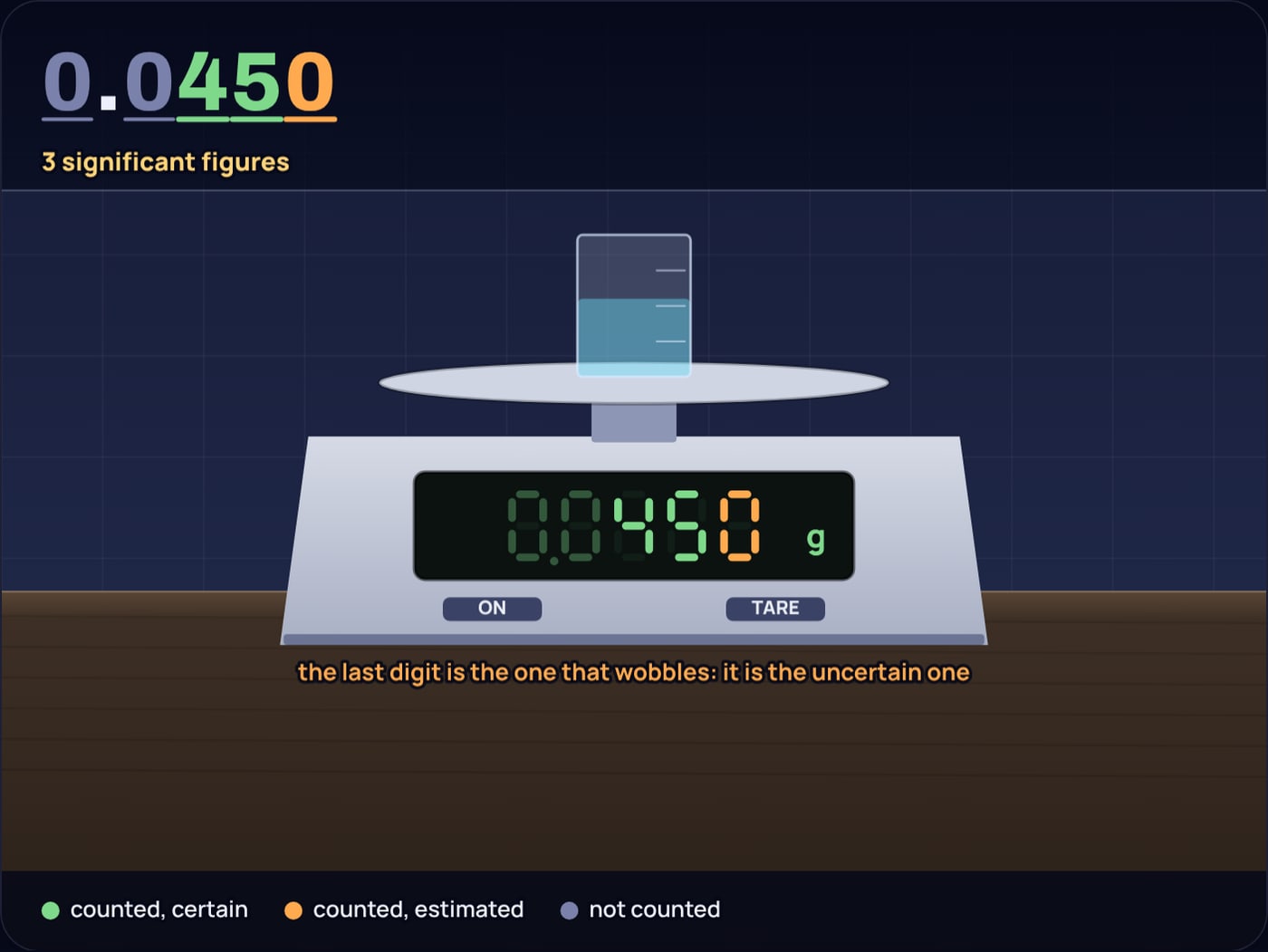
Example 1: how many significant figures in 0.0450 g?
The first two zeros are leading zeros: write the same mass as 45.0 mg and they disappear, so they cannot carry information. The 4 and the 5 are non-zero. The final zero is a trailing zero after a decimal point, so it counts: the balance displayed it, which means the mass is 0.0450 g and not 0.0449 or 0.0451.
Why is 1500 a problem?
Because the number cannot tell you whether the zeros were measured. A crowd estimate of 1500 people is probably good to the nearest hundred; a length of 1500 mm read off a steel tape is good to the millimetre. The usual convention, and the one the calculator follows, is to count trailing zeros in a whole number only when a decimal point shows they were measured. So:
| Written as | Significant figures | Meaning |
|---|---|---|
| 1500 | 2 | known to the nearest 100 |
| 1.50 × 10³ | 3 | known to the nearest 10 |
| 1500. | 4 | known to the nearest 1 |
| 1.5000 × 10³ | 5 | known to the nearest 0.1 |
Scientific notation removes the ambiguity, which is one of the best reasons to use it; the scientific notation guide shows how to convert.

How do you round to a number of significant figures?
Start at the first non-zero digit, count off the figures you want, and look at the next digit. If it is less than 5, drop everything after. If it is more than 5, or 5 followed by anything that is not zero, round up.
Example 2: rounding to 3 significant figures
Keep the zeros in 3.00: they are the second and third significant figures, and dropping them would leave 1. For 45,700 the zeros are placeholders, so write 4.57 × 10⁴ if you need the count to be clear.
The only disputed case is a dropped part of exactly 5, as in 12.25 to three figures. Most school courses round up, to 12.3. NIST's Guide to the SI (SP 811, section B.7) and ISO 80000-1 round to the even digit instead, giving 12.2, so that over many roundings the halves do not all push the same way. The calculator lets you pick either.
What is the rule for multiplying and dividing?
Keep as many significant figures as the input with the fewest.
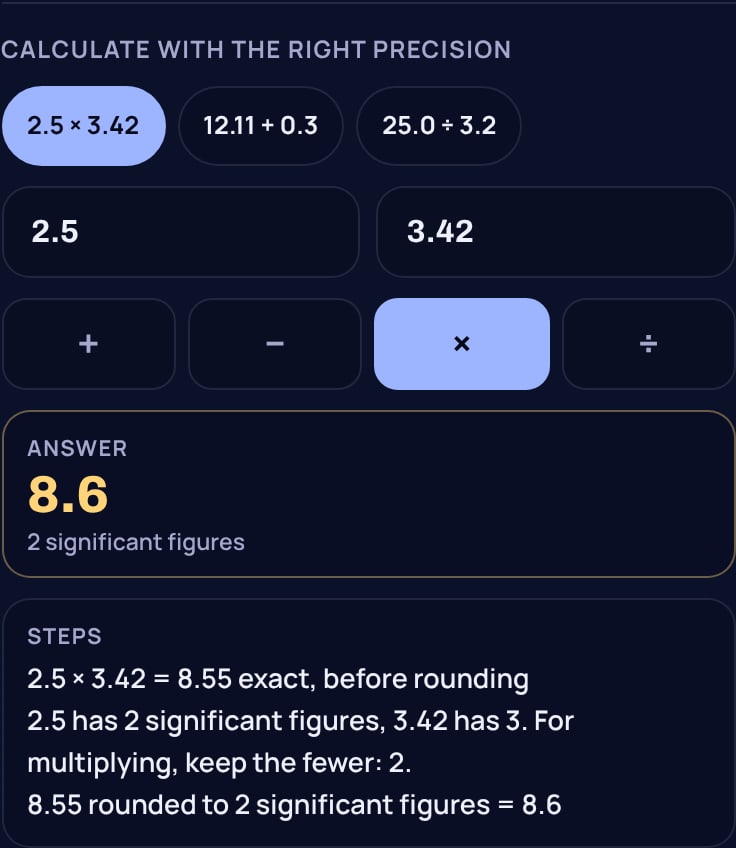
Example 3: area of a 2.5 m by 3.42 m floor
The 2.5 m side was measured to 2 significant figures, so the area cannot be known better than that. 8.55 sits exactly on a half; both rounding conventions give 8.6 here.
Example 4: density from 25.0 g and 3.2 cm³
The volume has 2 significant figures, so the density gets 2, even though the mass had 3.
What is the rule for adding and subtracting?
Here significant figures do not matter; decimal places do. Round the answer to the last place that every input actually has.
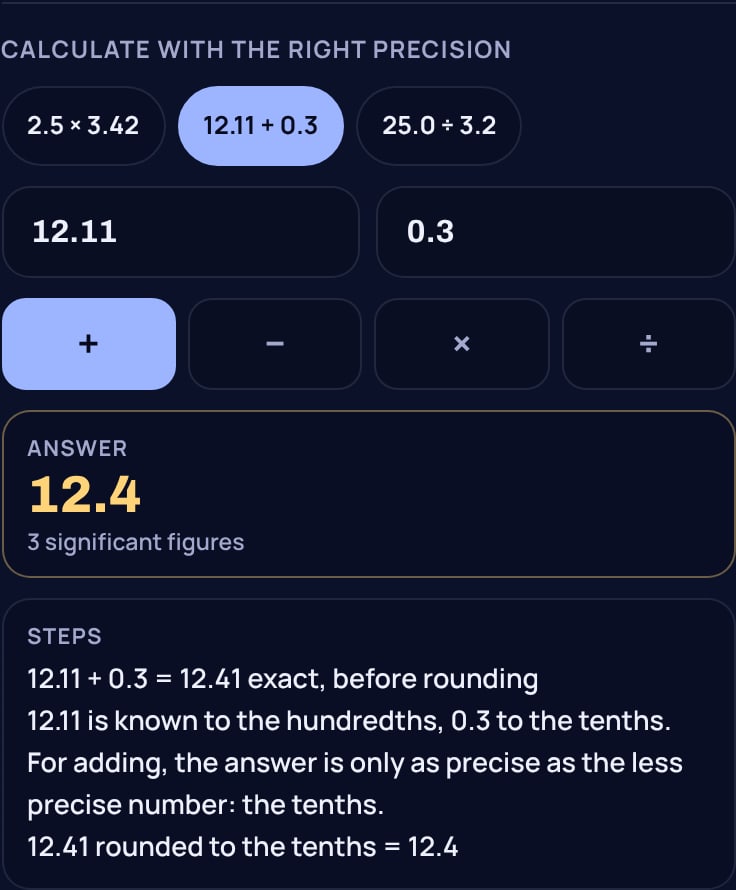
Example 5: 12.11 g of salt plus 0.3 g more
0.3 has only 1 significant figure, yet the answer has 3. That is correct: the 0.3 g is only known to the nearest tenth, and that limits the total to the tenths, not to one figure. Using the multiplication rule here would wrongly give 10 g.
Subtraction can wipe out precision completely. 10.0 − 9.95 = 0.05, but 10.0 is only known to the tenths, so the answer is 0.1, with a single significant figure. Two good measurements that are close together give a poor difference. This is the main reason experiments that subtract nearly equal numbers, such as finding a small temperature rise, need very careful readings.
Why are the two rules different?
Because uncertainties combine differently. When you add, absolute uncertainties add: ±0.05 g plus ±0.005 g is about ±0.05 g, dominated by the cruder measurement, so it is the place value that matters. When you multiply, relative (percentage) uncertainties add, and the number of significant figures is a rough measure of relative uncertainty: 2.5 is uncertain by about 2%, 3.42 by about 0.15%, so the product is uncertain by about 2%, which is two figures' worth.
That is also why significant figures are only a rule of thumb. A proper lab report states the uncertainty itself, such as 12.35 ± 0.05 cm, and carries it through the calculation. If your lab compares a result with an accepted value, the guide to percent error covers the next step.
What are the common mistakes?
- Rounding at every step. Keep all the digits until the end, then round once. 8.546 rounded straight to 2 figures is 8.5; rounded first to 8.55 and then to 2 figures it becomes 8.6.
- Counting exact numbers. The 2 in , the 100 in "100 cm in a metre" and 12 eggs in a dozen are exact. They have unlimited significant figures and never limit an answer.
- Copying the whole calculator display. Ten digits from a calculator is not extra care; it claims a precision the measurement never had.
- Dropping meaningful zeros. 3.00 and 3 are different results. If the measurement supports the zeros, keep them.
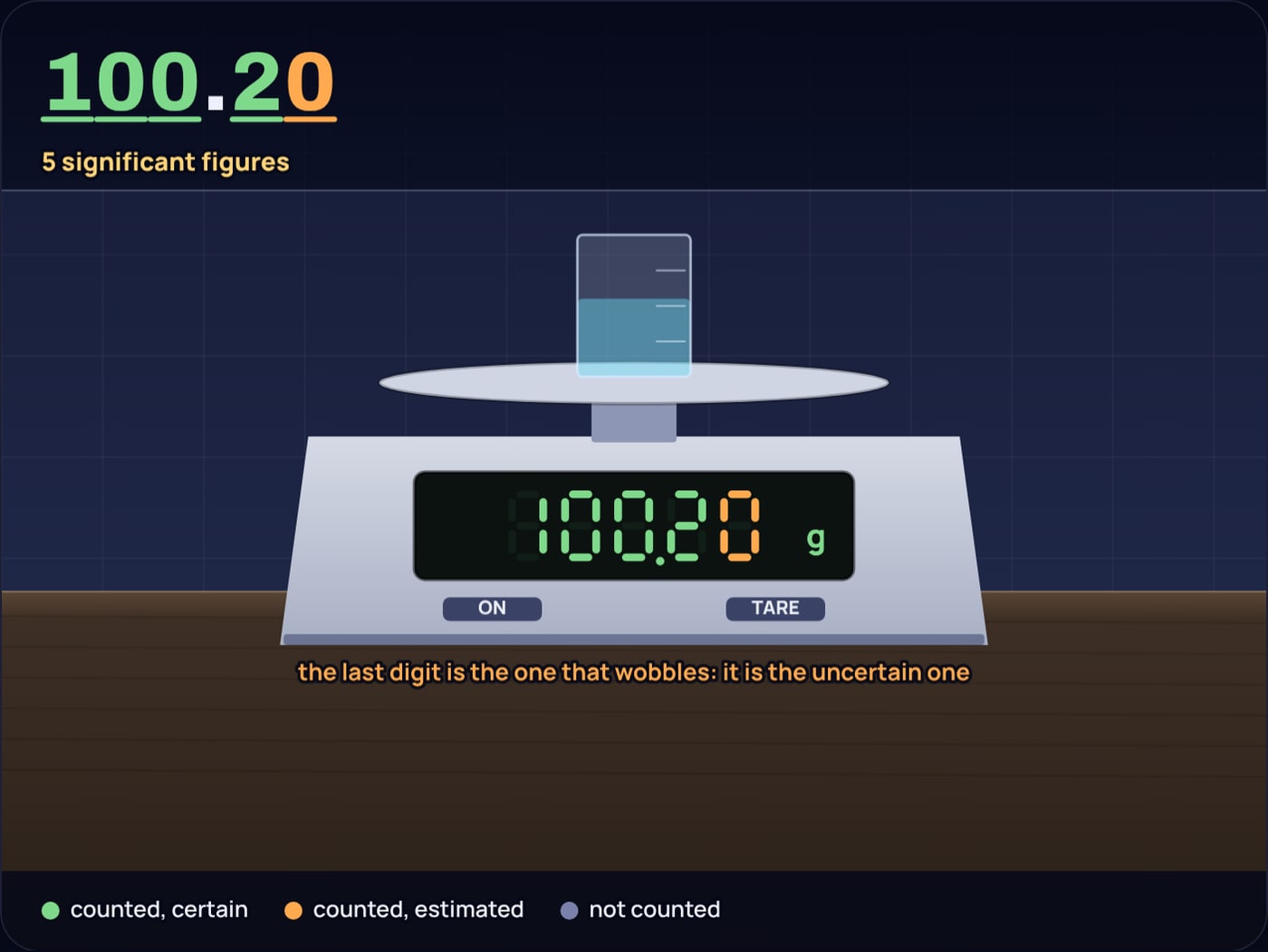
The fastest way to make the rules stick is to try them on your own data. Open the calculator with 100.20 on the balance, then type the numbers from your last lab sheet and see which zeros turn grey.
Sources
- NIST Special Publication 811, Guide for the Use of the International System of Units, Appendix B.7 (rounding numbers and rounding converted values): nist.gov/pml/special-publication-811
Frequently asked questions
What are the rules for significant figures?
Non-zero digits always count. Zeros between non-zero digits count. Leading zeros never count. Trailing zeros count only if there is a decimal point. In scientific notation every digit of the coefficient counts.
How many significant figures does 0.00340 have?
Three. The three zeros in front only place the decimal point. The 3, the 4 and the final zero count; the final zero counts because it comes after a decimal point, which means it was measured.
Is 100 one or three significant figures?
Written as 100 it is ambiguous, and the usual convention is to count 1. If all three digits were measured, write 100. with a point or 1.00 × 10^2.
Why do you use decimal places for adding but significant figures for multiplying?
When you add, absolute uncertainties add, so the answer is limited by the least precise place value. When you multiply, relative uncertainties combine, and the number of significant figures is a rough measure of relative uncertainty.
Should I round in the middle of a calculation?
No. Keep all the digits until the end and round once. Rounding at every step can change the last digit of the final answer.