What Is a Good Percent Error in a Physics Lab?
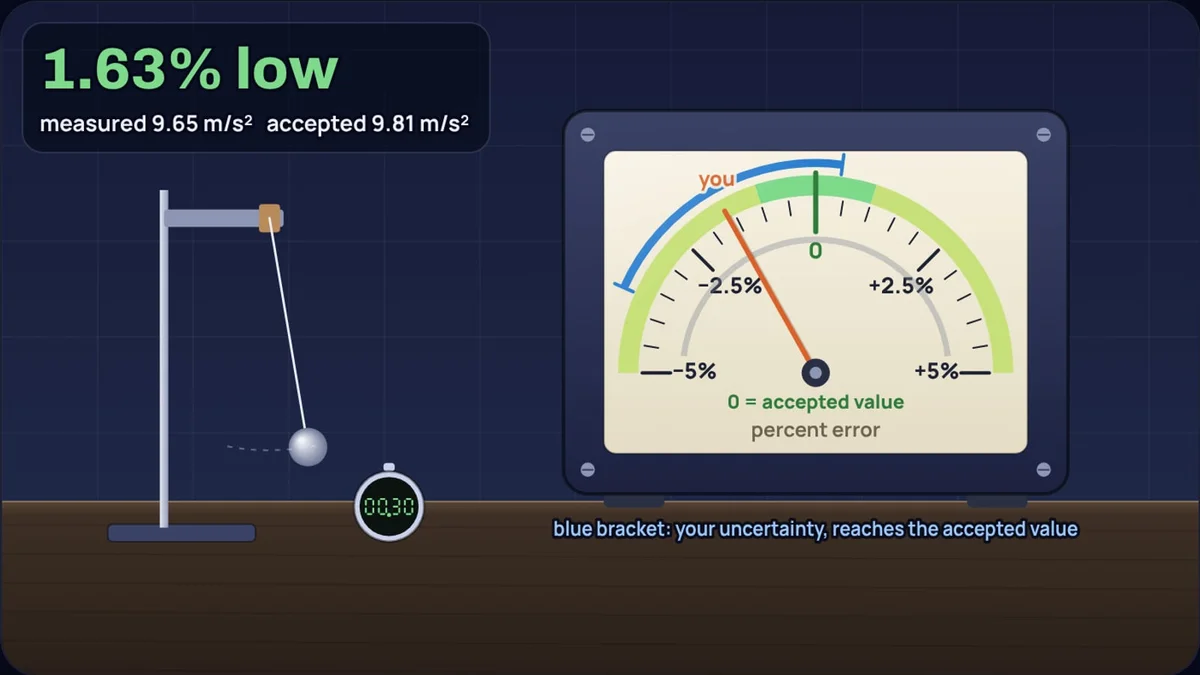
You timed the pendulum, did the sums and got g = 9.65 m/s². The textbook says 9.81 m/s². Is that good? The usual answer is a percentage, and the usual follow-up from students is which percentage counts as good enough. The honest answer is that it depends on the experiment, and there is a better test than any fixed number: whether the gap fits inside your uncertainty.
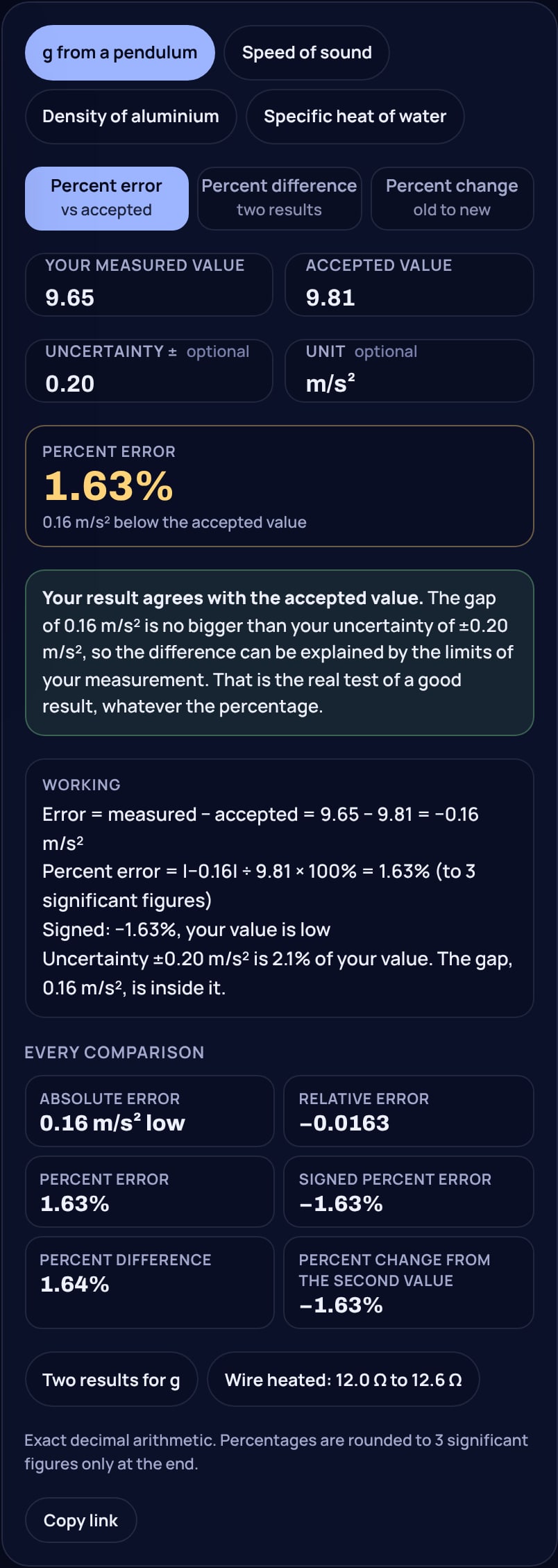
Every example here can be loaded in the percent error calculator, which works out percent error, absolute and relative error, percent difference and percent change with exact arithmetic, shows the working, and checks the result against your uncertainty on an analogue meter.
How do you calculate percent error?
Take the difference between your result and the accepted value, ignore its sign, and express it as a share of the accepted value.
The accepted value goes on the bottom because it is the reference: you are asking how wrong you are compared with the true size of the thing. Dividing by your own result is a common slip and gives a slightly different answer.
Example 1: percent error in g from a pendulum
Measured g = 9.65 m/s², accepted g = 9.81 m/s².
Dividing by 9.65 instead would give 1.66%, which is the wrong formula.
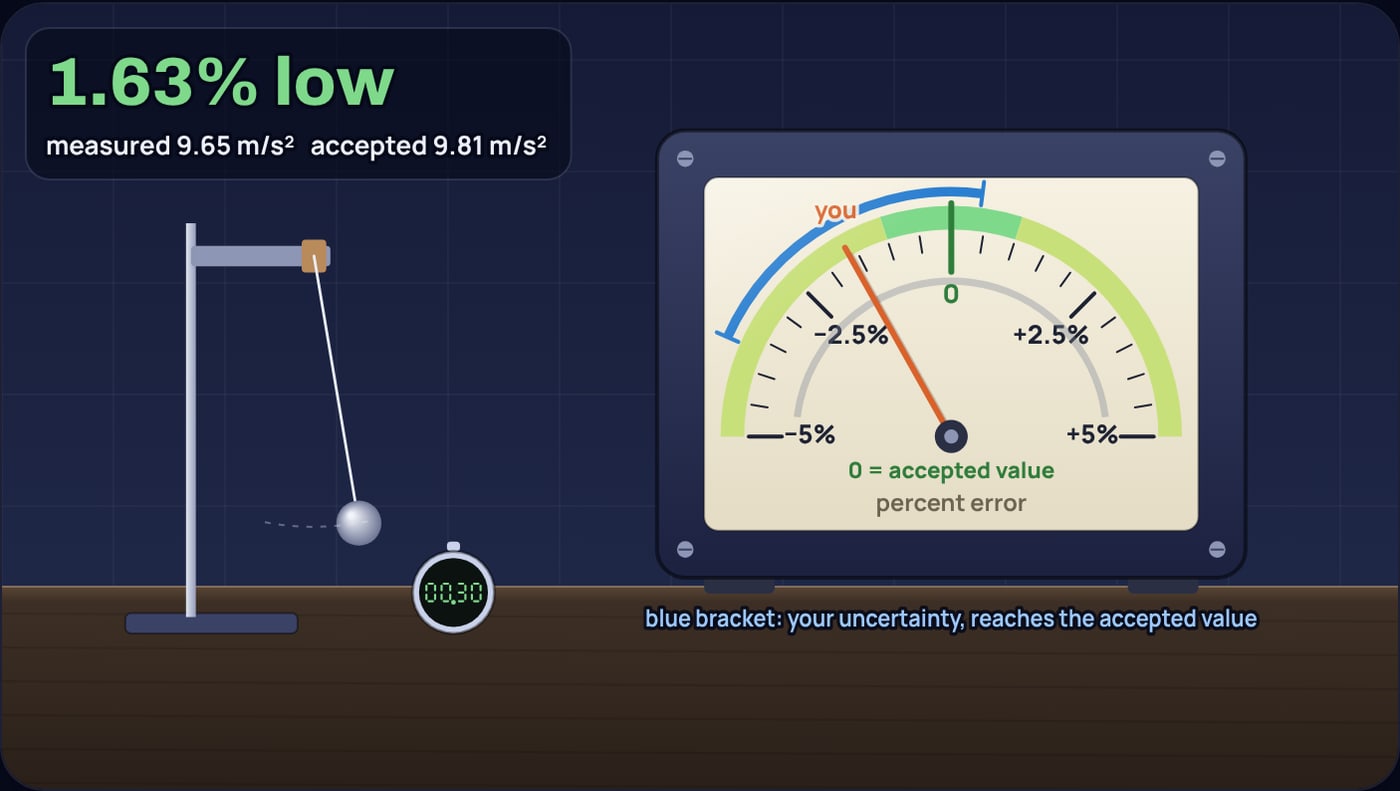
Some teachers want the signed version, without the absolute value bars. Then a negative percent error means your result was low and a positive one means it was high. The sign is useful, because it often tells you which effect caused the error.
A note on the accepted value itself. The standard acceleration of gravity is defined as exactly 9.80665 m/s², and the real value where you stand differs slightly with latitude and height above sea level. That is why school labs round it to 9.81. For a percent error of a percent or two, the difference does not matter; for a very precise experiment, use your local value. The same g sets how long things take to fall, so a drop timed with a stopwatch is another way to measure it.
Is there a percent error that counts as good?
Not one that applies to every experiment. A 2% error is excellent for a measurement of g with a stopwatch and a metre rule, and poor for a measurement of a resistor with a decent multimeter. The percentage alone cannot tell you whether the experiment went well, because it does not know how precise your apparatus was.
Still, students and teachers both use rough bands, and the calculator colours its meter with them as a guide:
- Under 1%: about as close as most school apparatus can get. If you are this close with a stopwatch, check that you did not round too early or copy the accepted value somewhere.
- 1 to 5%: typical of a careful experiment with simple apparatus.
- 5 to 10%: often acceptable, but worth explaining. Look for one effect that pushed the whole result in one direction.
- Over 10%: usually a mistake in method, units or arithmetic rather than ordinary scatter. Check those first.
Treat these as a starting point, not a mark scheme. Your course or lab manual may set its own expectations, and the fair test is the next one.
Does your result agree with the accepted value?
Every measurement has an uncertainty: a range either side of your result within which you expect the true value to lie. If the accepted value falls inside that range, your result agrees with it, whatever the percentage. If it falls outside, something pushed your result away by more than the apparatus can explain.
This is the test lab reports usually ask for, and it is fairer than a fixed percentage because it is built from your own apparatus. A careful experiment with crude apparatus can agree at 6%; a careless one with good apparatus can fail at 1%.
Example 2: the uncertainty in the pendulum result
The pendulum was 0.640 m long, measured to ±0.002 m. Twenty swings took 32.36 s, and starting and stopping the watch by hand adds about ±0.3 s. Since g = 4π²L/T², the percent uncertainty in g is the percent uncertainty in L plus twice the percent uncertainty in T.
The gap from 9.81 is 0.16 m/s², inside ±0.2 m/s². The result agrees with the accepted value.
Notice where most of the uncertainty came from: the timing, doubled because T is squared. That is why you time twenty swings and not one. A single swing timed with the same ±0.3 s would have an uncertainty twenty times bigger in T.
What if the error is small but outside the uncertainty?
Then the experiment has a systematic error: an effect that pushes every reading the same way, which averaging cannot remove. This is the case where a low percent error is misleading.
Example 3: speed of sound from a resonance tube
Measured speed = 336 m/s, accepted 343 m/s, uncertainty ±5 m/s.
A 2% error looks fine, but 7 m/s is outside ±5 m/s, so random scatter does not explain it.
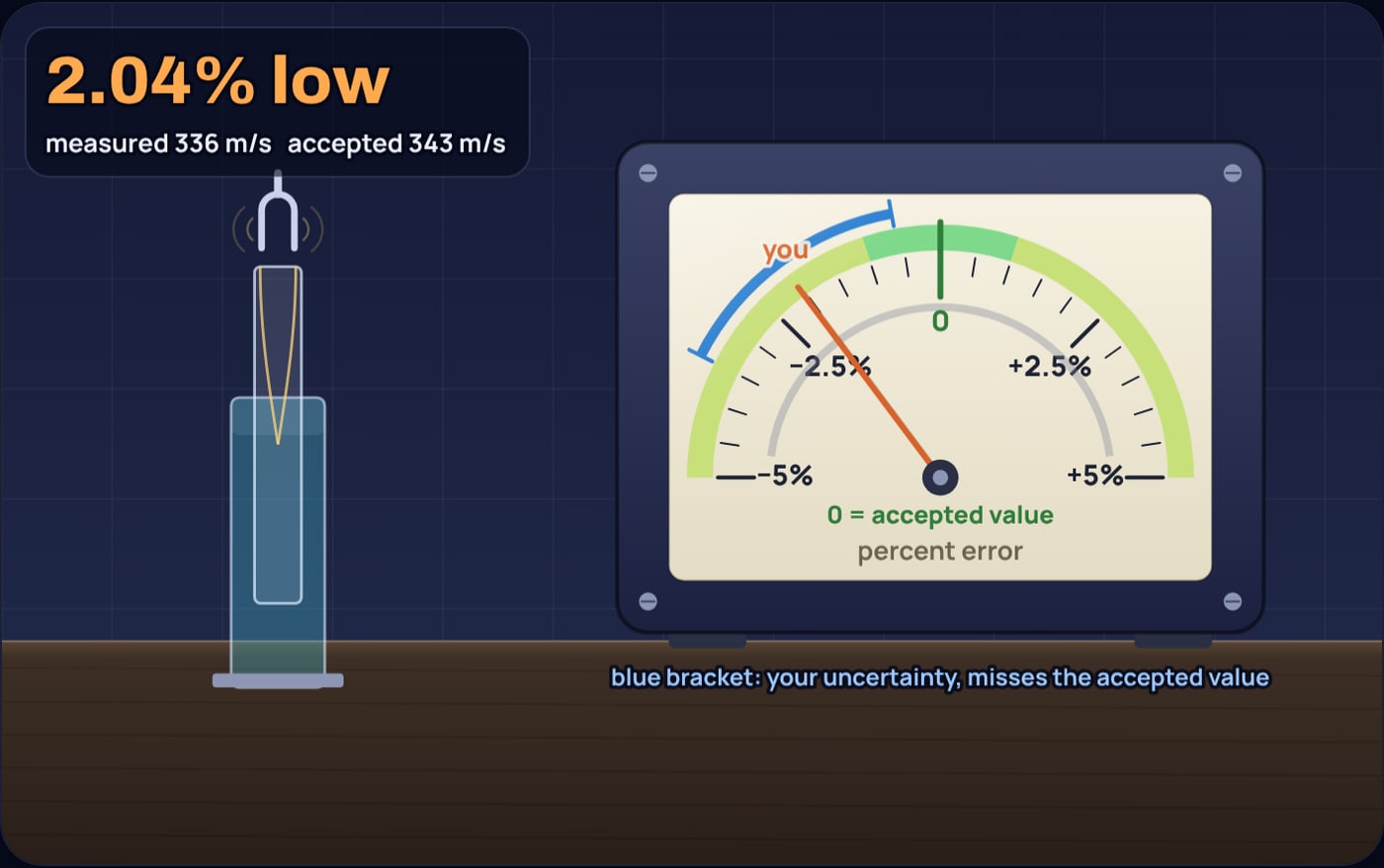
The likely cause here is not the method but the accepted value. 343 m/s is the speed of sound in air at 20 °C. The speed depends on the square root of the absolute temperature, and from 331.39 m/s at 0 °C it works out at about 336 m/s at 8 °C. A cold lab explains the whole gap. The fix is to measure the room temperature and correct the accepted value before calculating the error.
Which direction did the error go?
The sign of the error is evidence. A systematic error usually has a known direction, and if your result went that way, you have probably found the cause.
The classic case is measuring the specific heat of water with an immersion heater, a joulemeter and a thermometer. The meter counts every joule supplied, but some of that energy warms the beaker, the heater and the room. The water warms less than it should, so the calculated specific heat comes out too high.
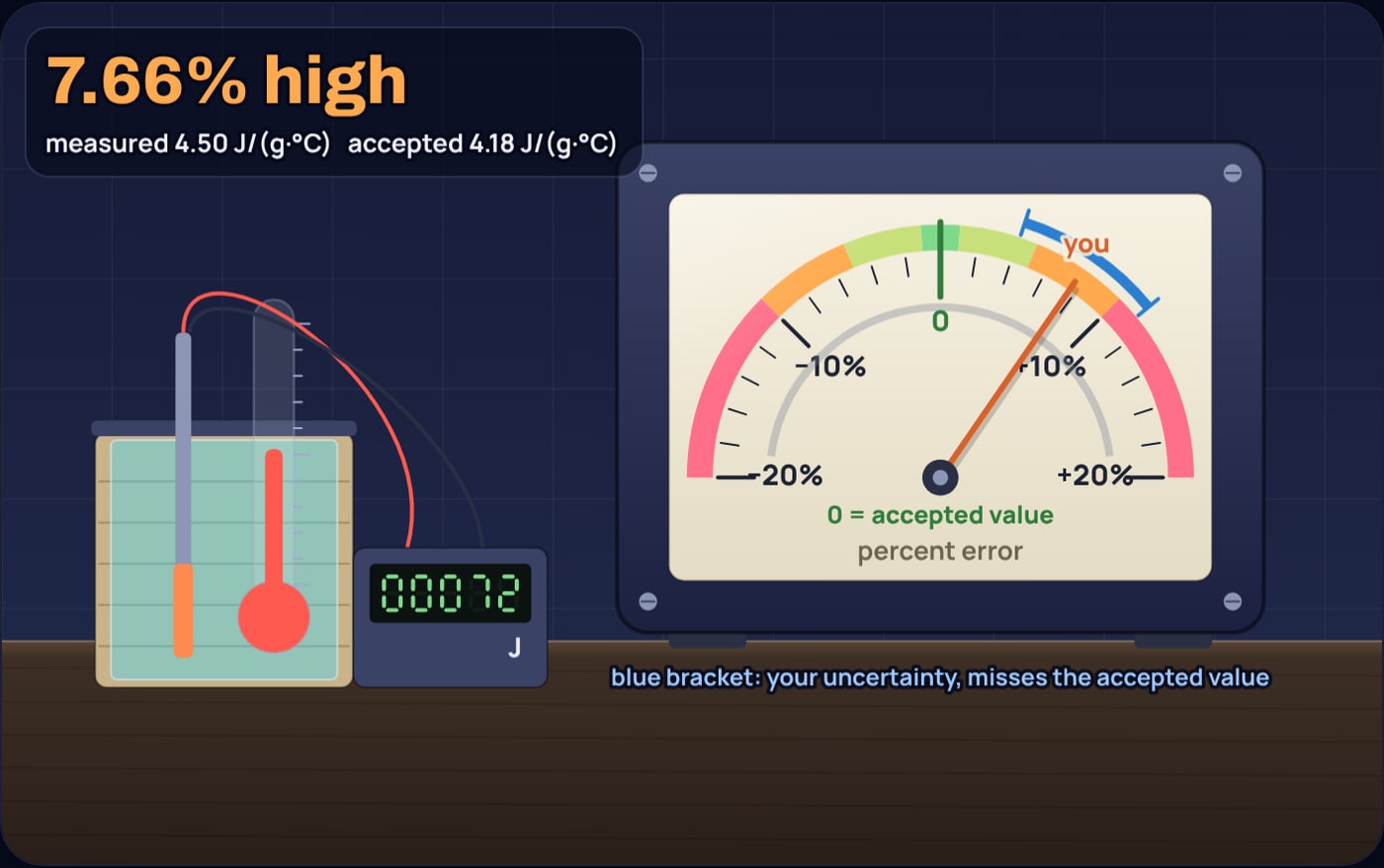
A result of 4.50 J/(g·°C) against the accepted 4.18 J/(g·°C) is 7.66% high. In a report, that is a good result if you explain it: the error is in the predicted direction, it has a known cause, and lagging the beaker and adding a lid would reduce it. A result that came out low instead would be harder to explain, and more worrying. The article on water's high specific heat explains where the 4.18 comes from.
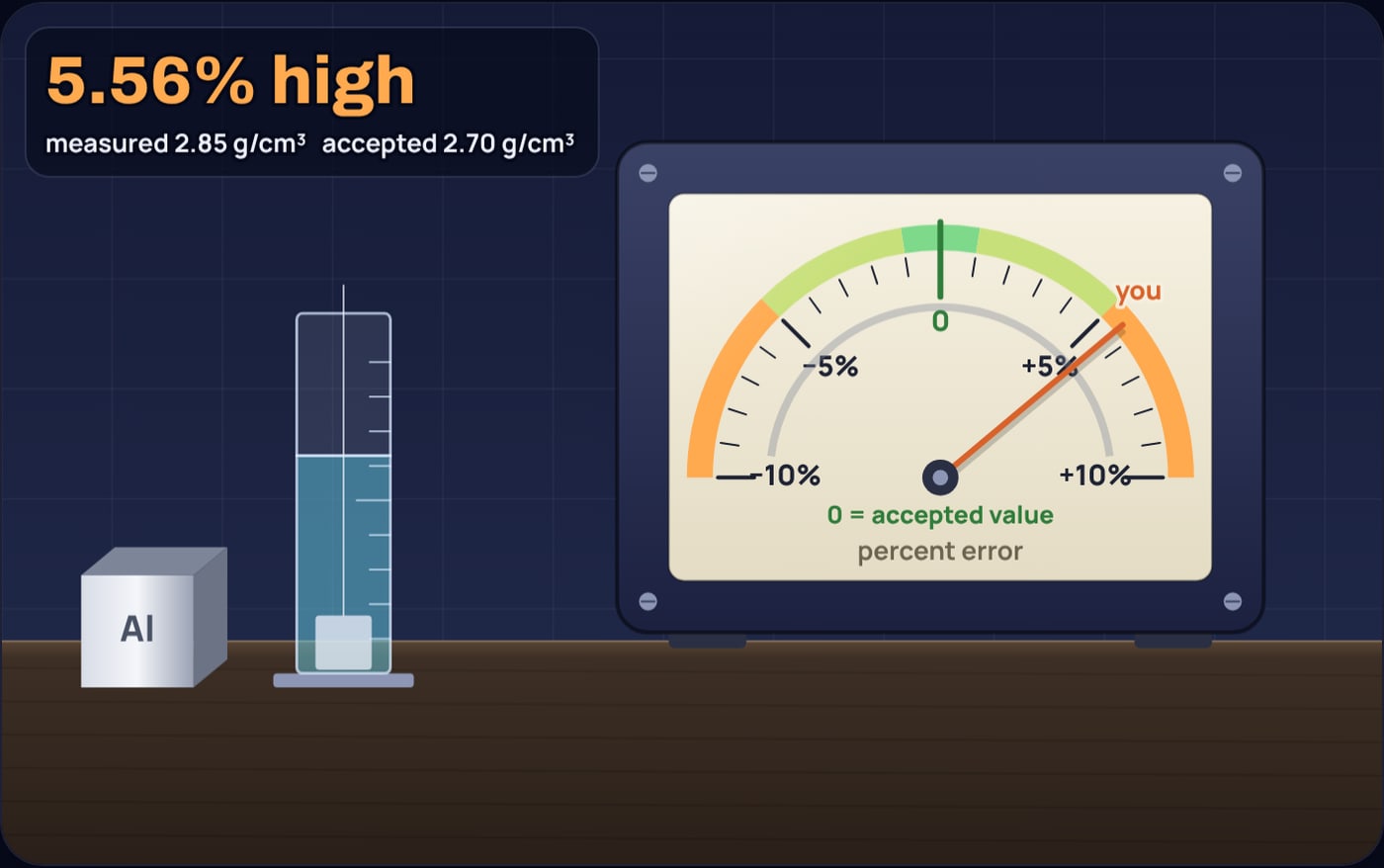
The same reasoning works for density. An aluminium block measured at 2.85 g/cm³ against 2.70 g/cm³ is 5.56% high, which means the volume came out too small or the mass too big. Reading a measuring cylinder at the top of the meniscus instead of the bottom gives exactly that, and so does a block made of an alloy rather than pure aluminium.
When should you use percent difference instead?
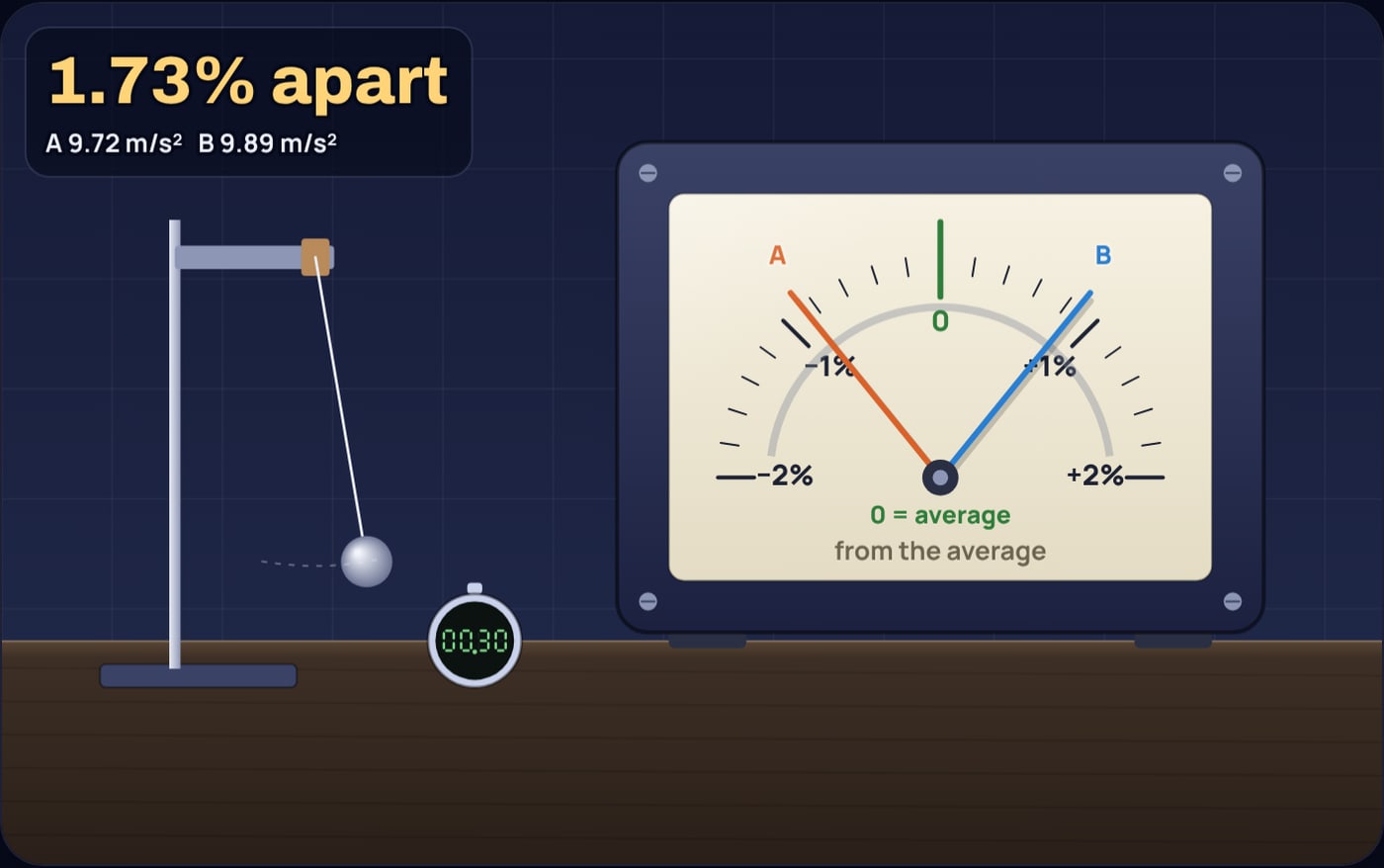
Percent error needs a true value. When you compare two results of equal standing, such as two groups' values of g or the same measurement made two ways, neither is the true value, and you should use percent difference. It divides the gap by the average of the two, so it gives the same answer whichever one you call first.
Example 4: two groups' values of g
Group A got 9.72 m/s², group B got 9.89 m/s².
Percent change is the third relative of the family. It uses the same sum as signed percent error, with the original value on the bottom, but it describes how much a quantity moved rather than how wrong a result is. A wire whose resistance rises from 12.0 Ω to 12.6 Ω when heated has changed by +5%, and nothing about that is an error.
What should go in the lab report?
A good discussion of error has four parts, and the calculator gives you the numbers for each:
- The percent error, with the working: measured value, accepted value, gap and percentage, quoted to two or three significant figures.
- Your uncertainty, and whether the gap is inside it. Say plainly whether your result agrees with the accepted value.
- The direction of the error, high or low, and the effect that would push it that way.
- A specific improvement that targets that effect, such as timing more swings, lagging the beaker or correcting for room temperature. "Be more careful" is not one.
Round sensibly as you go. Keep all digits through the calculation and round the percent error once at the end; the significant figures guide explains why. And be wary of a percent error far smaller than your percent uncertainty. It is not wrong, but it means the close agreement was partly luck, and saying so shows you understand your own data.
If you want to check a result before writing it up, put your measured value, the accepted value and your uncertainty into the percent error calculator and read the meter: if the blue uncertainty bracket reaches the zero mark, your result agrees.
Sources
- NIST, CODATA value: standard acceleration of gravity, 9.80665 m/s² exact: physics.nist.gov
- NIST X-Ray Mass Attenuation Coefficients, Table 1, density of aluminium 2.699 g/cm³: physics.nist.gov
- NIST Chemistry WebBook, water, condensed phase heat capacity (Shomate equation, Chase 1998), which gives 75.4 J/(mol·K), or 4.18 J/(g·K), at 25 °C: webbook.nist.gov
- HyperPhysics, Georgia State University, sound speed in gases: 331.39 m/s at 0 °C and 343 m/s at 20 °C: hyperphysics.gsu.edu
- NASA Glenn Research Center, speed of sound, a = √(γRT): grc.nasa.gov
- Clemson University physics labs, percent error and percent difference: science.clemson.edu
Frequently asked questions
What is a good percent error in a physics lab?
There is no universal number. A result is good when the gap between it and the accepted value is no bigger than your measurement uncertainty. As a rough guide for simple school apparatus, under about 5% is a careful result, but your course may expect more or less.
How do you calculate percent error?
Subtract the accepted value from your measured value, take the size of the result, divide by the accepted value and multiply by 100. For 9.65 m/s² against 9.81 m/s²: 0.16 ÷ 9.81 × 100% = 1.63%.
Can a percent error be too small?
It can be suspicious. If your percent error is far smaller than your percent uncertainty, the agreement was partly luck, and a teacher may ask whether the accepted value was used somewhere in the calculation.
What is the difference between percent error and percent difference?
Percent error compares your result with an accepted value and divides by that value. Percent difference compares two results when neither is the true value, and divides by their average.
Is a high percent error always a failed experiment?
No. A large error with a clear, explained cause, such as heat loss in a calorimetry experiment, is a useful result. A lab report is marked on how well you explain the error, not only on its size.