How do you calculate percent error?
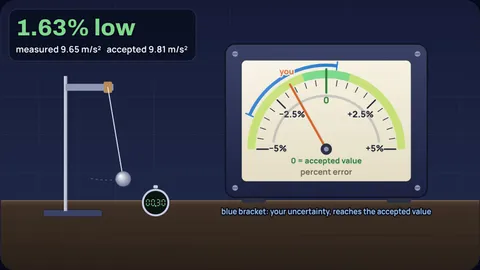
Subtract the accepted value from your measured value, ignore the sign, divide by the accepted value and multiply by 100. A pendulum giving g = 9.65 m/s² against the accepted 9.81 m/s² is 0.16 m/s² out, which is 1.63%.
Percent error tells you how far a result is from the accepted value as a share of that value, so results in different units can be compared. Whether it is good depends on the experiment: the fair test is whether the gap fits inside your measurement uncertainty, which the calculator checks if you give it one. For what counts as good in practice, see what is a good percent error in a physics lab.
Key results from the calculator
- Pendulum g: 9.65 m/s² against 9.81 m/s² is 1.63% low, but with an uncertainty of ±0.20 m/s² it still agrees with the accepted value.
- Speed of sound: 336 m/s against 343 m/s is only 2.04%, yet it is outside a ±5 m/s uncertainty, which points to a systematic error such as a cold room.
- Percent difference compares two results with no true value: 9.72 and 9.89 m/s² are 1.73% apart.
- Percent change keeps the sign: a wire going from 12.0 Ω to 12.6 Ω changed by +5%.
Six lab results, worked through
Each button loads the example in the calculator with the apparatus on the bench and the meter showing the error.
g from a simple pendulum: 9.65 m/s²
Percent error with an uncertaintyTiming a pendulum and using T = 2π√(L/g) gave 9.65 m/s². Against 9.81 m/s² that is 0.16 m/s² low, a percent error of 1.63%.
The spread of repeat timings gave an uncertainty of ±0.20 m/s². The gap of 0.16 is inside it, so the result agrees with the accepted value. The standard value of g is 9.80665 m/s², and the real value where you stand differs from it slightly with latitude and height, which is why 9.81 is the usual school figure.
Speed of sound from a resonance tube: 336 m/s
Small error, still a problemA tuning fork over a tube in water gave 336 m/s, 2.04% below 343 m/s. That looks excellent, but the stated uncertainty was ±5 m/s and the gap is 7 m/s, so random scatter does not explain it.
343 m/s is the speed in air at 20 °C. Sound is slower in colder air, by about 0.6 m/s for each degree, so a lab at about 8 °C would explain the whole gap. Correct the accepted value for the room before blaming the method.
Density of an aluminium block: 2.85 g/cm³
Percent error with no uncertainty givenMass on a balance and volume by displacement in a measuring cylinder gave 2.85 g/cm³, 5.56% above the accepted 2.70 g/cm³.
A high density means the volume came out too small or the mass too large. Reading the cylinder at the top of the meniscus instead of the bottom is a common cause, and most school blocks are an alloy, not pure aluminium.
Specific heat of water: 4.50 J/(g·°C)
A systematic error with a known directionAn immersion heater, a joulemeter and a thermometer gave 4.50 J/(g·°C), 7.66% above the accepted 4.18 J/(g·°C).
That direction is expected. Some of the energy the meter counts warms the beaker and the room instead of the water, so the temperature rises less and the calculated specific heat comes out high. A lid and lagging bring it down.
Two groups, two values of g
Percent differenceGroup A got 9.72 m/s² and group B got 9.89 m/s². Neither is the true value, so compare them with percent difference: the gap of 0.17 m/s² divided by their average, 1.73%.
Percent difference does not care which result you call A. Percent error would give a different answer depending on which one you pretend is correct, which is why it is the wrong tool here.
A wire heated from 12.0 Ω to 12.6 Ω
Percent changeWarming a coil of wire in a water bath raised its resistance from 12.0 Ω to 12.6 Ω, a change of +5%.
The arithmetic is the same as signed percent error, with the original value in place of the accepted one. The meaning is different: nothing is wrong here, the quantity simply moved.
Which comparison to use
| Quantity | Formula | Use it when |
|---|---|---|
| Absolute error | |measured − accepted| | you want the gap in the units of the measurement |
| Relative error | (measured − accepted) ÷ accepted | you want the gap as a fraction, with its sign |
| Percent error | |measured − accepted| ÷ accepted × 100% | there is an accepted or theoretical value |
| Percent difference | |A − B| ÷ average of A and B × 100% | you compare two results and neither is the true value |
| Percent change | (new − original) ÷ original × 100% | a quantity moved from a starting value |
| Percent uncertainty | uncertainty ÷ measured × 100% | you state how precise your own result is |
Percent error and percent change divide by the accepted or original value, so they are undefined when that value is zero. Some courses keep the sign of percent error; check which your teacher wants.
How the calculator works
It reads both numbers exactly as typed and does the subtraction and division in exact decimal arithmetic, so 9.81 − 9.65 is 0.16, not 0.16000000000000014. Percentages are rounded to 3 significant figures once, at the end, and exact answers such as 5% are shown as they are.
Percent error divides the size of the gap by the size of the accepted value. The signed version keeps the direction: negative means your result is low. Relative error is the same ratio before multiplying by 100.
If you give an uncertainty, it checks whether the gap is no bigger than it. That is the test lab reports usually ask for: a result agrees with the accepted value when the accepted value falls inside its uncertainty range.
Percent difference divides by the average of the two sizes, so it is symmetric. Percent change divides by the original value and keeps the sign.
What the model leaves out
- Combining uncertainties: it uses the single uncertainty you type. Working that out from the uncertainties in each measured quantity is a separate step.
- Statistical tests: professional work compares the gap with the combined standard uncertainty and quotes how many of them it is. The simple inside or outside check here is the school version of that idea.
- Local accepted values: it uses the accepted value you type. Correct it for conditions where needed, such as the speed of sound at your room temperature.
- Rounding rules for your report: quote the percent error to 2 or 3 significant figures, or as your course asks.
Common misconceptions
"A small percent error means a good experiment." A tiny error with a tiny uncertainty can still disagree with the accepted value, and a lucky result can hide a bad method.
"Divide by the measured value." Percent error divides by the accepted value. Dividing by your own result gives a slightly different, wrong answer.
"Percent error and percent difference are the same." Percent error needs a true value to compare with. Percent difference is for two results of equal standing.
Frequently asked questions
What is the formula for percent error?
Percent error = |measured − accepted| ÷ accepted × 100%. For a measured 9.65 m/s² and an accepted 9.81 m/s²: 0.16 ÷ 9.81 × 100% = 1.63%.
Can percent error be negative?
The usual formula takes the absolute value, so it is never negative. Some teachers ask for the signed version, where a negative percent error means your result was below the accepted value.
What is a good percent error?
There is no single cut-off. A result is good when the gap from the accepted value is inside your measurement uncertainty. As a rough guide for simple school apparatus, under about 5% is a careful result, but check what your course expects.
What is the difference between percent error and percent difference?
Percent error compares a result with an accepted value and divides by that value. Percent difference compares two results and divides by their average: 9.72 and 9.89 m/s² differ by 1.73%.
What if the accepted value is zero?
Then percent error is undefined, because it divides by zero. Quote the absolute error instead, in the units of the measurement.
Keep learning
What Is a Good Percent Error in a Physics Lab?
There is no single cut-off. How to judge a percent error against your uncertainty, with worked pendulum, speed of sound and specific heat examples.
Significant Figures Rules With Examples (and Why They Exist)
The significant figures rules with worked examples: which zeros count, how to round, and the different rules for multiplying and for adding.
Why Does Water Have Such a High Specific Heat?
Water needs 4.184 J to warm one gram by 1 °C, over nine times as much as iron. Light molecules and hydrogen bonds explain why, with worked numbers.