How do you convert a number to scientific notation?
Move the decimal point until exactly one non-zero digit sits in front of it, then count how many places you moved it. That count is the power of ten: positive if you moved left, negative if you moved right. So 12,300 = 1.23 × 10⁴ and 0.00045 = 4.5 × 10⁻⁴. The number in front, called the coefficient or mantissa, is always at least 1 and less than 10.
The converter does it for any number you can type, in either direction, and also gives E notation (what calculators and spreadsheets show), engineering notation (powers in steps of three) and the matching SI prefix. It works in exact decimals, so 0.1 × 0.2 comes out as 0.02, not 0.020000000000000004. For the rules with practice examples, see how to write numbers in scientific notation.
Key results from the converter
- Big numbers have positive powers: the speed of light, 299,792,458 m/s, is 2.99792458 × 10⁸ or 2.99792458E8 in E notation.
- Small numbers have negative powers: 0.0000075 m, the width of a red blood cell, is 7.5 × 10⁻⁶ m, or 7.5 µm with an SI prefix.
- Engineering notation keeps the power a multiple of 3 so it lines up with prefixes: 12,742,000 m is 12.742 × 10⁶ m, which is 12.742 Mm, or 12,742 km.
- Multiplying means multiplying the coefficients and adding the powers: (2.99792458 × 10⁸) × (3.15576 × 10⁷) = 9,460,730,472,580,800 m, one light-year.
Six numbers worth converting
Each button loads the number into the converter. The scale reads it as metres and draws the nearest real object of that size.
The speed of light: 299,792,458 m/s
A big exact numberNine digits, all significant, because the metre is defined from this number. Moving the point 8 places left gives 2.99792458 × 10⁸. In E notation that is 2.99792458E8, and with a prefix it is 299.792458 Mm/s, almost exactly 300,000 km/s.
Read as a length, 3 × 10⁸ m sits between the size of Earth and the Sun on the scale: light covers about 23 Earth diameters in one second.
Avogadro's number: 6.02214076 × 10²³
Too long to write out comfortablySince 2019 the Avogadro constant is exactly 6.02214076 × 10²³ per mole. Written out it is 602,214,076,000,000,000,000,000, which is why nobody writes it out. With a prefix it would be 602.214076 Z, using zetta (10²¹).
As a length, 6 × 10²³ m is more than 600 times the width of the Milky Way. It is also roughly the number of atoms in 12 grams of carbon.
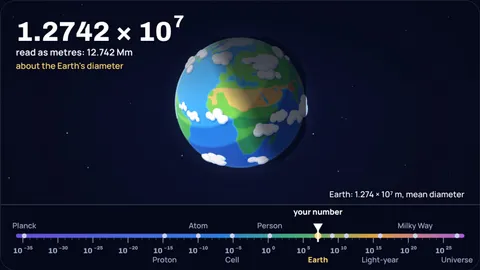
Earth's diameter: 12,742,000 m
Trailing zerosNASA gives Earth's mean radius as 6,371.000 km, so the diameter is 12,742 km or 12,742,000 m. The converter writes it as 1.2742 × 10⁷: the three trailing zeros of a whole number are treated as placeholders, not measured digits, so they are not counted as significant.
If you mean all eight digits, type 12742000. with a point, or 1.2742000 × 10⁷. That is the whole difference between 5 and 8 significant figures.
A red blood cell: 0.0000075 m
A small numberRed blood cells are about 7 to 8 micrometres across. 0.0000075 m needs the point moved 6 places right to get 7.5, so it is 7.5 × 10⁻⁶ m. The leading zeros only place the point; they are never significant.
With an SI prefix it is 7.5 µm, which is how a biologist would write it. Engineering notation gives the same thing as 7.5 × 10⁻⁶.
The Planck length: 1.616255 × 10⁻³⁵ m
The smallest length in physicsNIST's CODATA 2022 value is 1.616255 × 10⁻³⁵ m. Written as a decimal there are 34 zeros after the point before the first 1. No SI prefix reaches it: quecto, the smallest, is 10⁻³⁰.
On the scale, the Planck length sits 20 powers of ten below a proton. Nothing we know of lives in that gap, which is why the scene shows only a warped grid of space itself.
Multiplying: how long is a light-year?
Multiply with stepsA light-year is the distance light travels in a Julian year of 365.25 days, which is 31,557,600 s. Multiply the coefficients, 2.99792458 × 3.15576 = 9.4607304725808, and add the powers, 8 + 7 = 15: one light-year is exactly 9,460,730,472,580,800 m.
Dividing works the other way round. Sunlight crossing 1.49598 × 10¹¹ m at 2.99792458 × 10⁸ m/s takes 4.99005 × 10² s, about 8 minutes 19 seconds.
Common numbers in every notation
| Decimal | Scientific notation | E notation | Engineering | SI prefix |
|---|---|---|---|---|
| 0.000000001 | 1 × 10⁻⁹ | 1E-9 | 1 × 10⁻⁹ | 1 n |
| 0.00045 | 4.5 × 10⁻⁴ | 4.5E-4 | 450 × 10⁻⁶ | 450 µ |
| 0.025 | 2.5 × 10⁻² | 2.5E-2 | 25 × 10⁻³ | 25 m |
| 0.5 | 5 × 10⁻¹ | 5E-1 | 500 × 10⁻³ | 500 m |
| 7 | 7 × 10⁰ | 7E0 | 7 × 10⁰ | 7 |
| 42 | 4.2 × 10¹ | 4.2E1 | 42 × 10⁰ | 42 |
| 1,500 | 1.5 × 10³ | 1.5E3 | 1.5 × 10³ | 1.5 k |
| 12,300 | 1.23 × 10⁴ | 1.23E4 | 12.3 × 10³ | 12.3 k |
| 6,371,000 | 6.371 × 10⁶ | 6.371E6 | 6.371 × 10⁶ | 6.371 M |
| 299,792,458 | 2.99792458 × 10⁸ | 2.99792458E8 | 299.792458 × 10⁶ | 299.792458 M |
| 9,460,730,472,580,800 | 9.4607304725808 × 10¹⁵ | 9.4607304725808E15 | 9.4607304725808 × 10¹⁵ | 9.4607304725808 P |
Trailing zeros in whole numbers (1500, 12,300, 6,371,000) are treated as placeholders, so the scientific form drops them. SI prefixes from the BIPM list, which since 2022 runs from quecto (10⁻³⁰) to quetta (10³⁰).
How the converter works
It reads what you type as an exact decimal: a string of digits and a power of ten. It understands commas and spaces, a decimal point, E notation (4.5e-4), written powers (4.5 × 10^-4, 4.5x10^-4, 4.5 × 10⁻⁴) and an SI prefix letter on the end (4.7k, 12 µ).
Scientific notation puts the point after the first non-zero digit; the power of ten is the number of places that point moved. Engineering notation rounds the power down to a multiple of 3 and leaves 1 to 3 digits in front of the point, which lines up with the SI prefixes kilo, mega, milli, micro and so on.
Significant figures follow the usual school rules: leading zeros never count, zeros between digits always count, and trailing zeros count only if there is a decimal point or the number is already in scientific notation.
Multiplication and division are done on whole numbers with JavaScript BigInt, so there is no binary rounding at all. A division that does not terminate is carried to 15 significant figures and marked with an ellipsis. The final line rounds to the fewer significant figures of the two inputs, half away from zero.
What the model leaves out
- Units: the converter handles the number only. The scale reads it as metres to show its size, but the conversions apply to any unit.
- Addition and subtraction: for those, the powers must match first. The significant figures calculator adds and subtracts with the right precision.
- Very long numbers: a decimal longer than 400 characters is not written out in full; scientific notation is the point of the exercise there.
- Ambiguous trailing zeros: whether 1500 has 2 or 4 significant figures depends on how it was measured. The converter assumes 2 unless you add a point.
Common misconceptions
"A negative exponent means a negative number." It means a small number. 10⁻³ is 0.001, positive; a negative number has a minus sign in front of the coefficient, as in −4.5 × 10⁻³.
"45 × 10³ is scientific notation." It is a correct value, but not standard form: the coefficient must be between 1 and 10, so it becomes 4.5 × 10⁴. It is, however, perfectly good engineering notation.
"E means the number e." On a calculator, 6.02E23 means 6.02 × 10²³. It has nothing to do with Euler's number 2.718.
Frequently asked questions
How do you write 0.00045 in scientific notation?
Move the point 4 places right to get 4.5, so the power is −4: 4.5 × 10⁻⁴. In E notation that is 4.5E-4.
How do you convert scientific notation back to a normal number?
Move the decimal point by the power of ten: right for a positive power, left for a negative one, filling gaps with zeros. 3.2 × 10⁵ becomes 320,000 and 3.2 × 10⁻⁵ becomes 0.000032.
What is E notation?
E notation is scientific notation for keyboards and screens: 6.02E23 means 6.02 × 10²³ and 4.5E-4 means 4.5 × 10⁻⁴. Calculators, spreadsheets and programming languages all use it.
What is the difference between scientific and engineering notation?
Scientific notation keeps one digit before the point (1.2742 × 10⁷). Engineering notation keeps the power a multiple of 3 so it matches SI prefixes (12.742 × 10⁶, read as 12.742 mega).
How do you multiply numbers in scientific notation?
Multiply the coefficients and add the powers, then tidy up. (3 × 10⁴) × (5 × 10³) = 15 × 10⁷ = 1.5 × 10⁸. For division, divide the coefficients and subtract the powers.
Keep learning
How to Write Numbers in Scientific Notation (With Steps)
Write any number in scientific notation: move the point, count the places, read the sign. Worked examples, E notation, engineering notation and multiplying.
How to Convert Wavelength to Frequency (With Examples)
Convert wavelength to frequency with f = v/λ: worked examples for a red laser, FM radio, Wi-Fi and a 440 Hz note, plus photon energy and the unit traps.

How Much Energy Is in 1 Gram of Matter? E = mc² Worked
One gram of mass is 9 × 10¹³ J, about 21 kilotons of TNT. Why bombs convert under 0.1% of their fuel, plotted from a fitted binding-energy curve.

How Does LIGO Detect Gravitational Waves? The Real Numbers
LIGO times laser light in two 4 km arms. GW150914 shifted their difference by 4×10⁻¹⁸ m, 1/420 of a proton. Optics, chirp and the stretched-light puzzle.