Twin Paradox Explained: Why the Traveller Ages Less

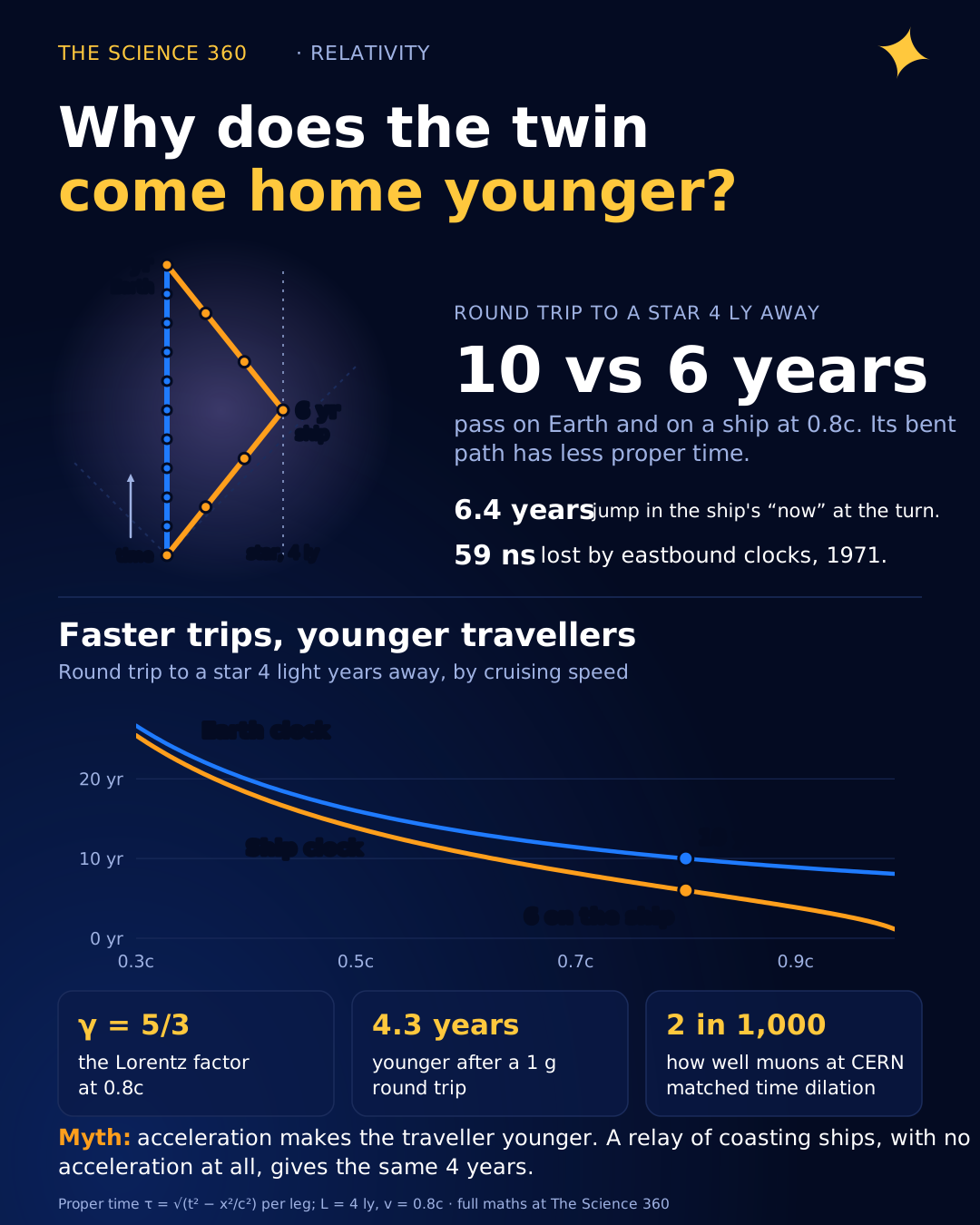
In October 1971 two physicists took four caesium clocks around the world on ordinary commercial flights. Joseph Hafele and Richard Keating flew east, then west, and when they compared their clocks with the ones left behind at the US Naval Observatory, the eastbound clocks were 59 billionths of a second behind and the westbound ones 273 billionths ahead. Two sets of clocks set off together, took different routes through spacetime and came back disagreeing about how much time had passed.
That is the twin paradox in miniature. The usual version has one twin board a fast rocket to a distant star and back while the other stays home, and the traveller returns younger. Almost every explanation online then says "because the travelling twin accelerated". That is the misconception this post is about. Acceleration is how the traveller changes direction, but it is not what makes them younger, and you can prove it with nothing more than a ruler and a pencil.
What is the twin paradox, and why does it look like a contradiction?
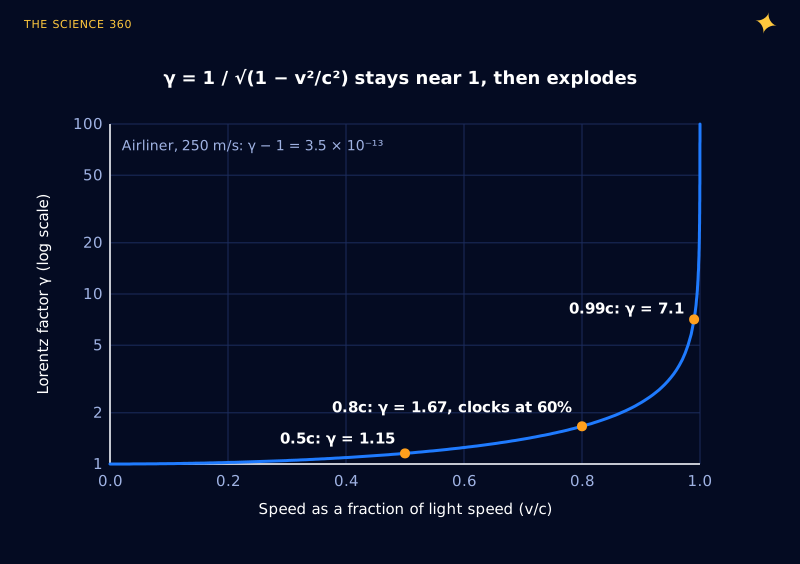
Special relativity says a clock moving relative to you ticks slow by the Lorentz factor:
At :
A moving clock runs at = 60% of your rate.
Here is the puzzle. During the outbound leg, the Earth twin says the ship's clock runs at 60%. The ship twin, who is equally entitled to consider herself at rest, says the Earth clock runs at 60%. Motion is relative, so each should conclude the other is younger. They cannot both be right when they meet face to face at the end, because then they can just compare birthday candles. Something has to break the symmetry.
The worked trip: 0.8c to a star 4 light years away
Let us use the numbers that most textbooks use, because they come out clean. The star is 4 light years from Earth in Earth's frame, and the ship cruises at 0.8c. We will ignore the time spent speeding up and slowing down for now and come back to it.
Earth's account
Ship's account, outbound leg
In the ship's frame the Earth to star distance is length-contracted: . The star approaches at 0.8c:
Same for the return: 3 years. Total: 6 years.
Both frames agree the ship twin ages 6 years. That agreement is the first clue that the answer is not frame-dependent at all. The quantity that decides it is the proper time along each twin's worldline, the path each one traces through spacetime, and every observer computes it the same way:
Proper time along each straight segment:
Each of the ship twin's two legs takes 3 years, so the ship total is 6 years.
Notice the minus sign. In ordinary geometry, the straight line between two points is the shortest path. In spacetime geometry, because of that minus sign, the straight worldline between two events has the longest proper time. Any detour, out to the star and back, makes your clock read less. The twin who stays put takes the straight line and ages most.
Where does the symmetry break? A spacetime diagram with lines of simultaneity
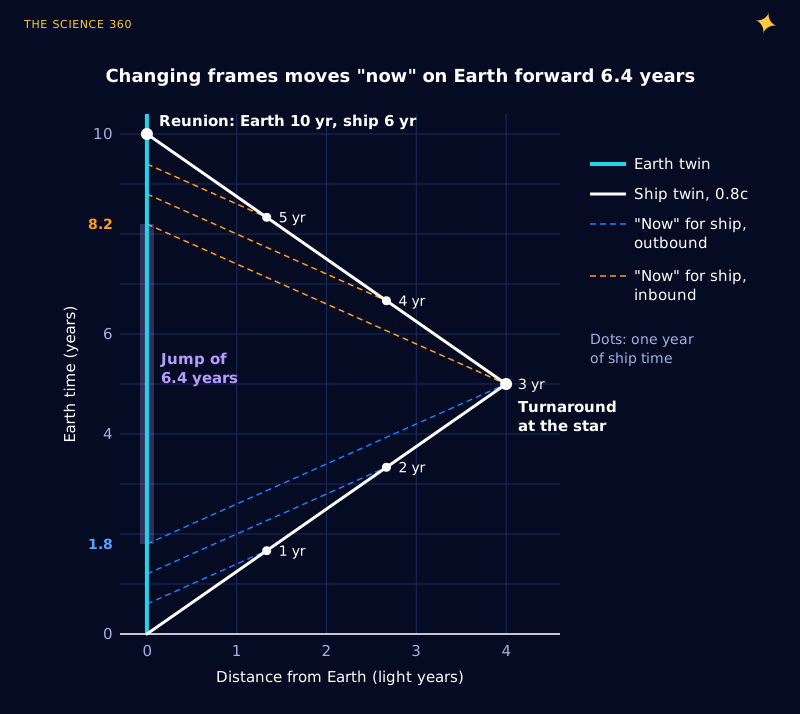
So what was wrong with the ship twin's argument that Earth's clock runs at 60%? Nothing, while she coasts. On the outbound leg, the Earth clock really does run at 60% in her frame. On the inbound leg, it again runs at 60%. The catch is the word "now". In relativity, which distant events count as happening "now" depends on your velocity. That is the relativity of simultaneity, and when the ship turns around, her "now" on Earth swings dramatically.
Earth's clock as the ship twin reckons it
Earth's clock reading at ship time 3 years, just before and just after the turnaround:
Check:
Ship twin's total for Earth: 1.8 + 6.4 + 1.8 = 10 yr. Consistent.
That is the asymmetry. The Earth twin uses one inertial frame for the whole trip, so her "now" on the ship sweeps smoothly. The ship twin uses two frames, and the change between them shifts her assignment of "now" on Earth by 2vL/c². The Earth twin never changes frames, so there is no equivalent jump for her. Max von Laue made this argument in 1913.
Be careful with the interpretation. Nothing physical happens to the Earth twin during the turnaround; she does not suddenly age. The jump is a change in the ship twin's bookkeeping of which distant events are simultaneous with her. The physics is in the proper time along each worldline. The lines of simultaneity just show why the ship twin's coasting-phase reasoning left out a piece.
The misconception: “acceleration makes the traveller younger”
The popular explanation goes: the traveller feels acceleration, the stay-at-home twin does not, therefore acceleration causes the age gap. The first part is true and does tell you which twin is which. The second does not follow, for three reasons.
The size of the gap does not depend on the acceleration. In the formula above, the gap is in the ship's bookkeeping, or 10 − 6 = 4 years overall. Neither number contains the acceleration. Turn around in a day at a crushing acceleration or over a month at a gentle one, and the extra ageing from the turn shrinks toward zero as the turn gets shorter; the 4 year gap stays. What matters is how long you spent at what speed, and how far from home you were.
You can remove the acceleration entirely. Replace the traveller with two ships. Ship A flies out at 0.8c, already moving when it passes Earth, and syncs its clock with Earth's as it goes by. At the star it passes ship B, already coasting home at 0.8c, and B sets its clock to A's reading: 3 years. When B passes Earth, its clock reads 6 years and Earth's reads 10. No clock ever accelerated. The gap is the same.
Experiments show acceleration does not affect clock rates. In 1977, Bailey and colleagues at CERN measured the lifetimes of muons circling a storage ring at . Holding them on that circle meant a transverse acceleration of up to about 1018 g. Their lifetimes were stretched by exactly the factor , with the time dilation factor confirmed to 2 parts in 1000. A clock's rate depends on its speed, not on how hard it is being shoved. That is called the clock hypothesis.
Einstein's 1918 treatment does use acceleration, but in a different way: in the ship's accelerating frame there is an apparent gravitational field during the turn, and Earth sits "uphill" by , so its clock runs fast by a factor of about for the duration of the turn. The extra Earth time is about . Since is roughly the change in velocity, about , this gives roughly again, and done exactly it gives the same 6.4 years, whatever is. Even the acceleration-based explanation ends up independent of the acceleration.
Counting Doppler signals: the explanation that needs no “now” at all
If simultaneity feels slippery, here is a version with no interpretation in it, only things the twins can actually observe. Each twin sends a radio pulse every year of their own time. Because the ship is moving, each twin receives the other's pulses Doppler shifted. The relativistic Doppler factor for 0.8c is:
Receding:
Approaching:
Both twins see the same two rates: one pulse every 3 years while moving apart, three pulses per year while closing. The difference is when each twin sees the switch.
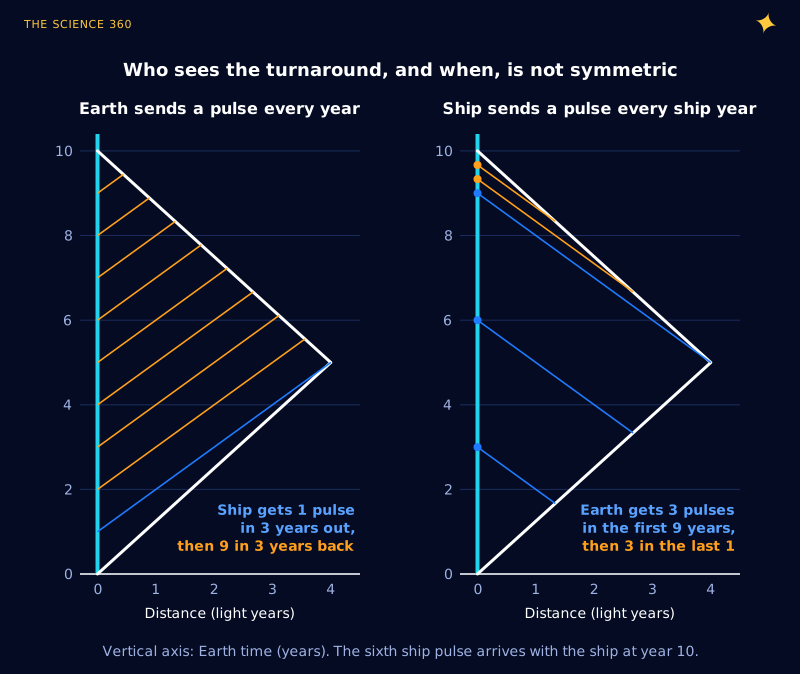
Ship twin receives Earth's pulses
Each leg lasts 3 ship years; pulses arrive at 1/3 per year going out and 3 per year coming back.
Total: 10 pulses, so Earth has aged 10 years.
Earth twin receives the ship's pulses
Light from the turnaround reaches Earth at year 5 + 4 = 9.
Total: 6 pulses, so the ship twin has aged 6 years.
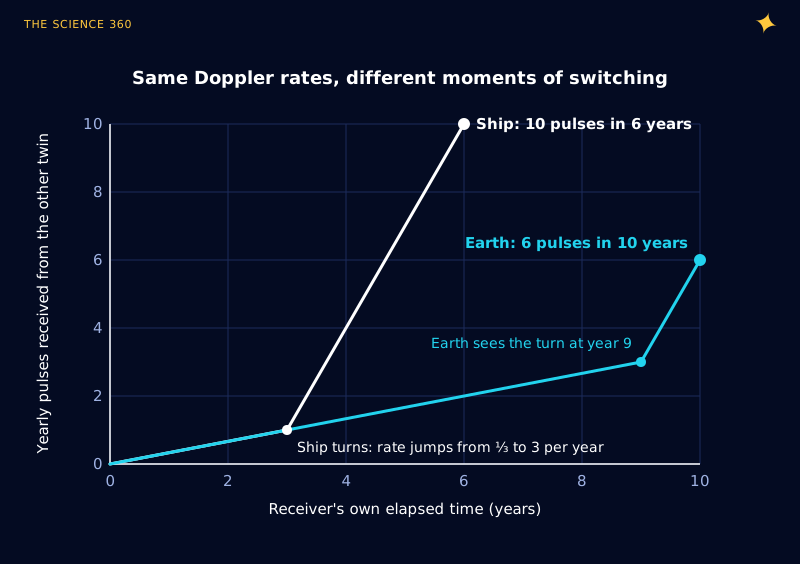
This is the cleanest answer to "but isn't it symmetric?" The ship twin turns around at the star and immediately starts receiving blueshifted signals. The Earth twin can only learn about the turnaround when its light arrives, 4 years later. Nobody needs to agree on what "now" means, and the two counts come out 10 and 6.
What if the ship accelerates at a comfortable 1 g?
Real ships cannot snap to 0.8c. Suppose the ship accelerates at 1 g (9.81 m/s², which is 1.03 light years per year squared) for the first 2 light years, decelerates at 1 g for the next 2, and does the same in reverse coming home. For constant proper acceleration, the proper time to cover distance from rest is .
1 g trip to a star 4 ly away and back, my own calculation
Each quarter (2 ly), in years and light years with :
Round trip: 6.9 years on the ship, 11.2 years on Earth.
The traveller spent the whole trip accelerating and comes back 4.3 years younger, almost the same gap as the coasting version. If acceleration were the cause, a trip that is nothing but acceleration ought to look very different. It does not, because what matters is still the speed history. For what 1 g for years would do to a body, see how many g a human can survive; 1 g is exactly what you feel standing on Earth.
Has it been tested? Hafele and Keating, and why GPS cares
Flying clocks around the world is the twin paradox at airliner speeds, with one twist. The "stay at home" clock in Washington is not at rest either: it rides Earth's rotation eastward at a few hundred metres per second. The right frame is one centred on Earth's axis that does not rotate. An eastbound plane adds its speed to Earth's rotation and moves faster than the ground clock, so it loses time. A westbound plane partly cancels the rotation, moves slower than the ground clock, and gains. On top of that, both planes sit about 9 km higher in Earth's gravity, which makes their clocks run fast.
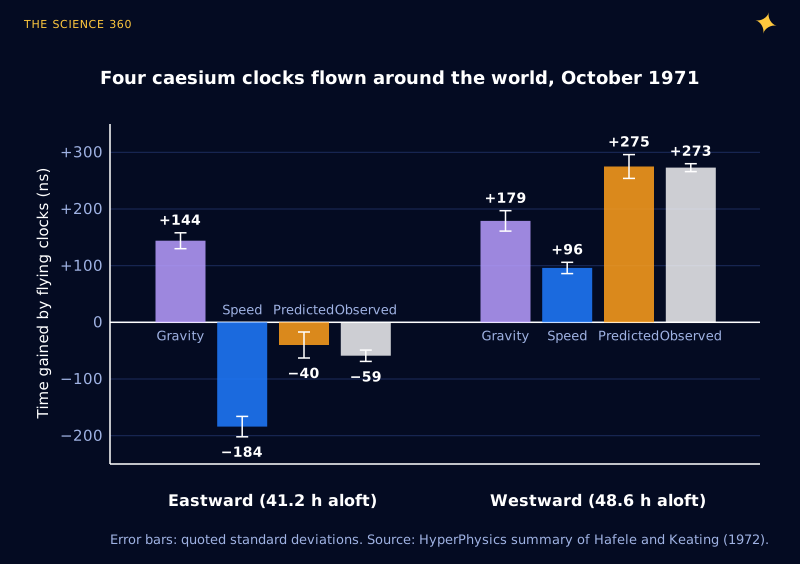
You can reproduce their predictions to within about 10% with a rough model. The assumption here, a constant latitude of 35°, is mine; the real flights wandered.
Rough Hafele-Keating estimate, my own calculation
Ground speed at 35° latitude: ; circumference there 32,800 km. Eastbound: 32,800 km in 41.2 h, so 221 m/s. Westbound: 48.6 h, so 188 m/s.
Speed term:
Hafele and Keating reported −184 ns east and +96 ns west for this term.
Gravity term, :
Hafele and Keating: +144 ns and +179 ns.
The measured results, −59 ± 10 ns and +273 ± 7 ns, agree with the predictions within the experiment's uncertainties. The same two effects, one from speed and one from gravity, are why GPS satellite clocks have to be corrected by about 38 microseconds a day, which we work through in why GPS needs relativity. And when gravity rather than speed does all the work, you get the extreme case in the time dilation on Miller's planet.
FAQ
What is the twin paradox in simple terms?
One twin flies to a star at high speed and comes back; the other stays on Earth. When they meet, the traveller is younger. It seems paradoxical because each twin sees the other's clock running slow during the trip. It is resolved because only the traveller changes from one inertial frame to another, so the two situations are not symmetric.
Does acceleration cause the twin paradox?
No. Acceleration is how the traveller changes frames, but the size of the age gap does not depend on how hard or how briefly they accelerate. A version with three clocks, where an outbound clock hands its reading to an inbound one, gives the same gap with no acceleration at all. Muons accelerated at about 1018 g in a storage ring show exactly the time dilation expected from their speed alone.
How much younger is the travelling twin at 0.8c?
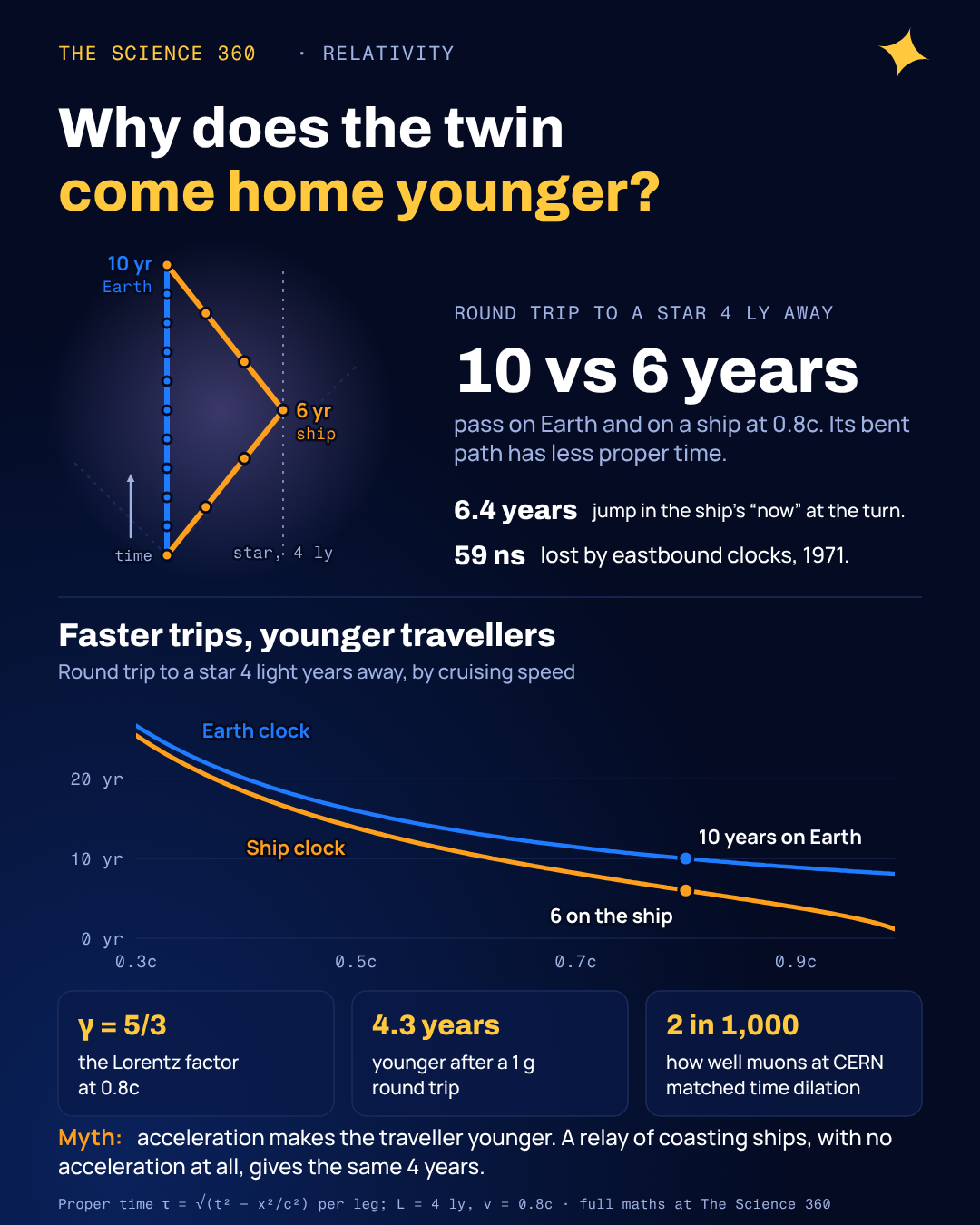
For a round trip to a star 4 light years away at 0.8c, 10 years pass on Earth and 6 years pass on the ship, because the Lorentz factor at 0.8c is 5/3. The traveller comes home 4 years younger than their twin.
Has the twin paradox been proven experimentally?
Yes. In 1971 Hafele and Keating flew caesium clocks around the world. The eastbound clocks lost 59 nanoseconds and the westbound clocks gained 273 nanoseconds relative to a clock at the US Naval Observatory, matching predictions of −40 and +275 nanoseconds. Muons circulating in storage rings live longer by their Lorentz factor, to about 0.2 percent.
Related on The Science 360
Sources
- HyperPhysics (Georgia State University), "Hafele and Keating Experiment" (flight times, altitudes, predicted and observed offsets): hyperphysics.phy-astr.gsu.edu
- J. C. Hafele and R. E. Keating, "Around-the-World Atomic Clocks", Science 177, 166 and 168 (1972), as summarised in the US Naval Observatory 50th anniversary release: dvidshub.net
- J. Bailey et al., "Measurements of relativistic time dilatation for positive and negative muons in a circular orbit", Nature 268, 301 (1977): nature.com
- Wikipedia, "Experimental testing of time dilation" (the muon storage-ring acceleration and the clock hypothesis): en.wikipedia.org
- Wikipedia, "Twin paradox" (Einstein 1905, Langevin 1911, von Laue 1913, Einstein 1918, the 0.8c worked example and the Doppler analysis): en.wikipedia.org
- Scientific American, "How does relativity theory resolve the Twin Paradox?": scientificamerican.com
Method note: all trip numbers use special relativity in flat spacetime. Lines of simultaneity are the ship's instantaneous rest-frame planes, . The 1 g trip uses the standard hyperbolic-motion formulas with a = 9.81 m/s². The Hafele-Keating estimate assumes constant latitude and altitude, so it is a check on the size of the effects, not a reanalysis.
Header image: NASA/Bill Ingalls (image 201503260026HQ), regraded for this article.