Could the Atomic Bomb Ignite the Atmosphere? The Math
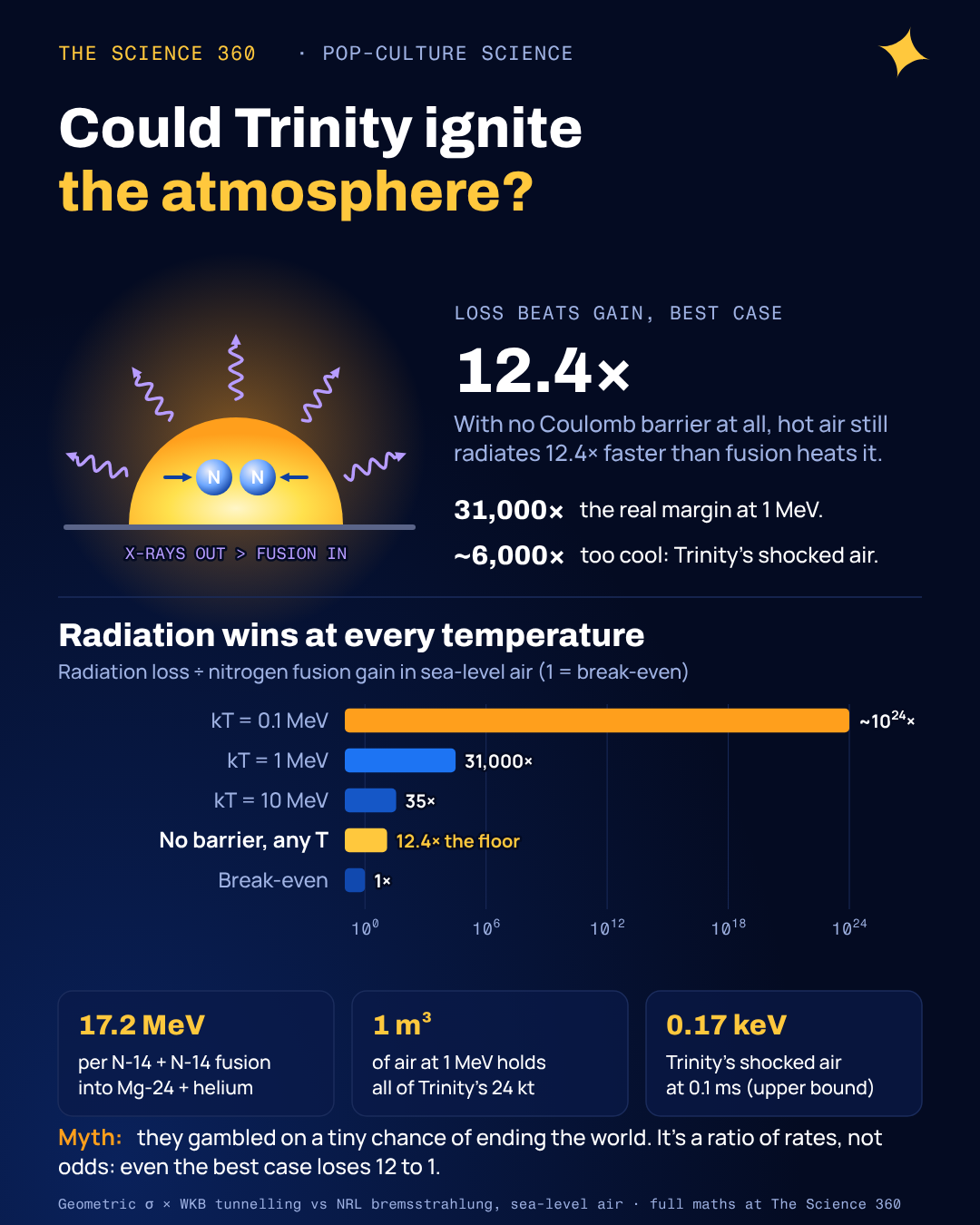
Twenty-four kilotons of TNT is a lot of energy: 1 × 10¹⁴ joules, enough to flatten a city. It is also, almost exactly, the energy needed to heat a single cubic metre of air to the temperature at which nitrogen nuclei start to fuse at a useful rate. That one comparison is most of the answer to the question that hangs over the Trinity scene in Oppenheimer. The first atomic bomb had about enough energy to bring one cubic metre of the sky to fusion temperature, briefly, and that cubic metre would then have cooled in a few millionths of a second.
The film gets the history roughly right: Edward Teller raised the possibility in 1942, Oppenheimer took it to Arthur Compton, and Hans Bethe showed quickly that it was not going to happen. What the film and most articles on the subject leave out is why. "The calculations said no" is not an explanation. Below, we redo the core of the Los Alamos argument with modern nuclear data, and you will see that the margin was not a coin flip. It was enormous, and it does not depend on details nobody knew in 1945.
What exactly were they afraid of?
Not fire. Nitrogen does not burn in the chemical sense, and nobody at Los Alamos thought the air would catch light like petrol. The worry was nuclear. Air is 78% nitrogen, and two nitrogen-14 nuclei that collide hard enough can fuse and rearrange into heavier pieces, releasing energy. The most energetic common outcome is magnesium-24 plus an alpha particle.
Energy released by (NIST atomic masses)
If the bomb heated a patch of air enough that these reactions happened often, each one would dump 17 MeV of fast particles into the surrounding gas, heating more air, triggering more reactions. That is ignition: a burn front that feeds itself and runs away through the atmosphere. Physics Today's 2024 account of the episode says Teller raised it among the theorists at a meeting in Berkeley in 1942, and Compton, the leading expert on how hot gases cool by scattering radiation, was consulted almost immediately.
Why the margin was large: losses beat gains at any density
For a self-sustaining burn, a hot parcel of air has to make energy from fusion faster than it loses it. The 1946 Los Alamos report LA-602, by Emil Konopinski, Cloyd Marvin and Teller, framed it exactly this way. Physics Today quotes its summary: "The energy losses to radiation always overcompensate the gains due to reactions."
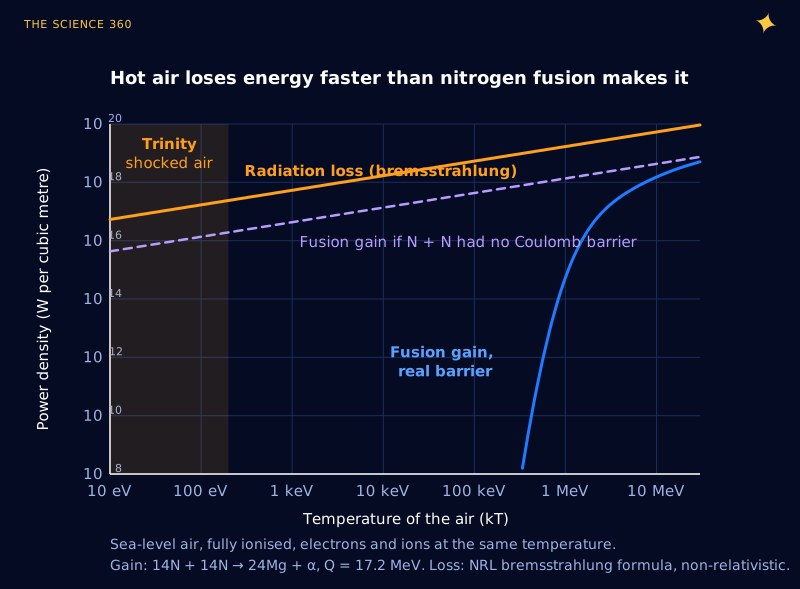
The main loss is bremsstrahlung. At these temperatures the air is fully ionised, and free electrons swinging past nitrogen nuclei emit X-rays. Air is transparent enough to hard X-rays that they leave the hot region and take their energy with them. The key point, which most explanations miss, is how the two rates scale:
How gain and loss scale with density n
Fusion power per m³:
Bremsstrahlung per m³, also proportional to n²:
Ratio of loss to gain: depends on temperature only.
Both processes need two particles to meet, so compressing the air speeds up both by the same factor. You cannot win by squeezing. Some popular accounts say fusion needs "great pressure" that the atmosphere lacks, but for the energy balance that is the wrong lever. What decides the question is temperature, through the term : how often nitrogen nuclei actually fuse when they collide.
The worked calculation: an absurdly generous fusion rate still loses
Start with the most generous assumption possible. Suppose every collision in which two nitrogen nuclei touch causes fusion, with no Coulomb repulsion at all. The nuclear radius is about , so two nitrogen nuclei touch when their centres are 5.78 fm apart.
Step 1: a no-barrier cross-section
Step 2: sea-level air (1.225 kg/m³)
Step 3: at kT = 1 MeV
Bremsstrahlung uses the NRL formula, with over N, O and Ar.
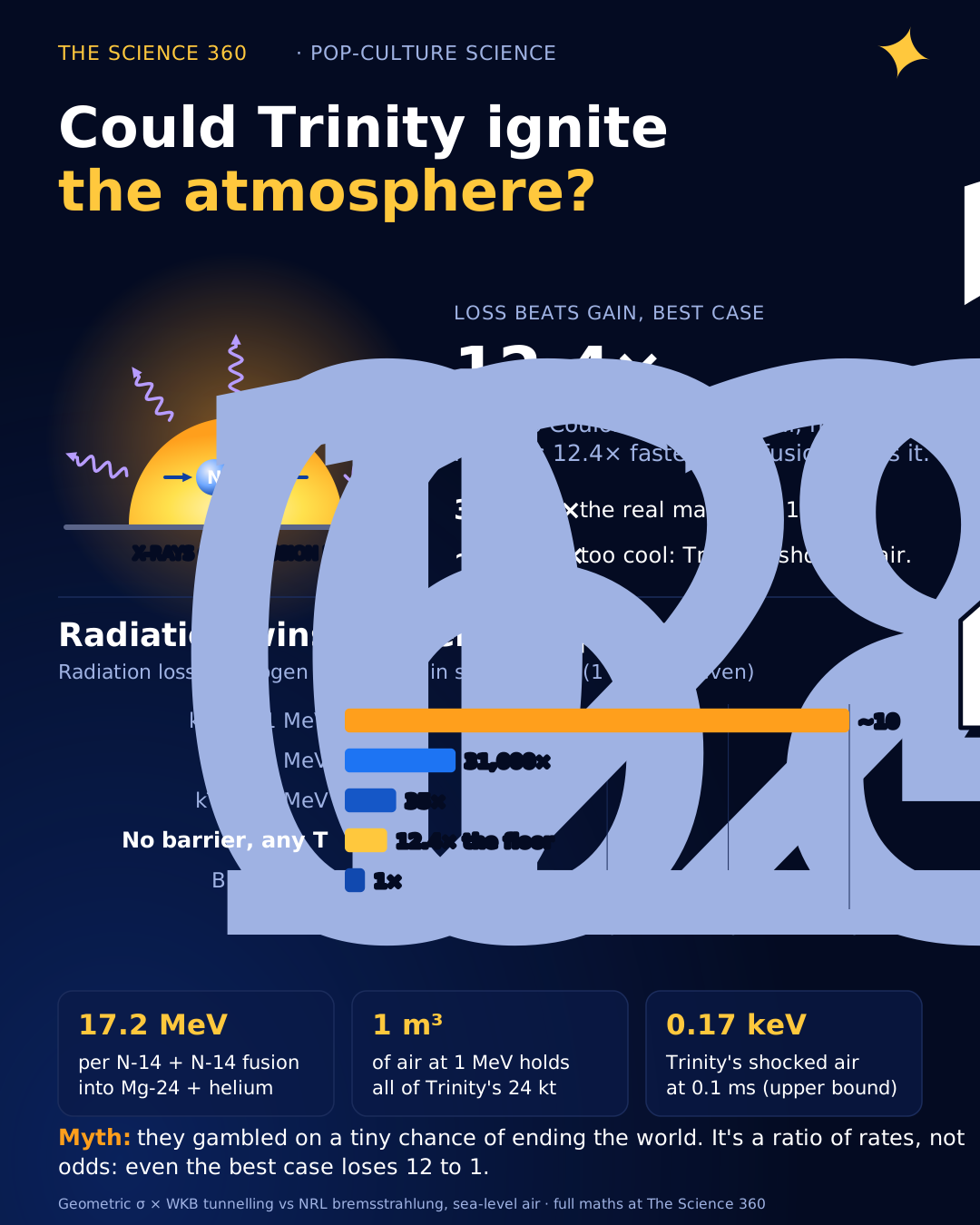
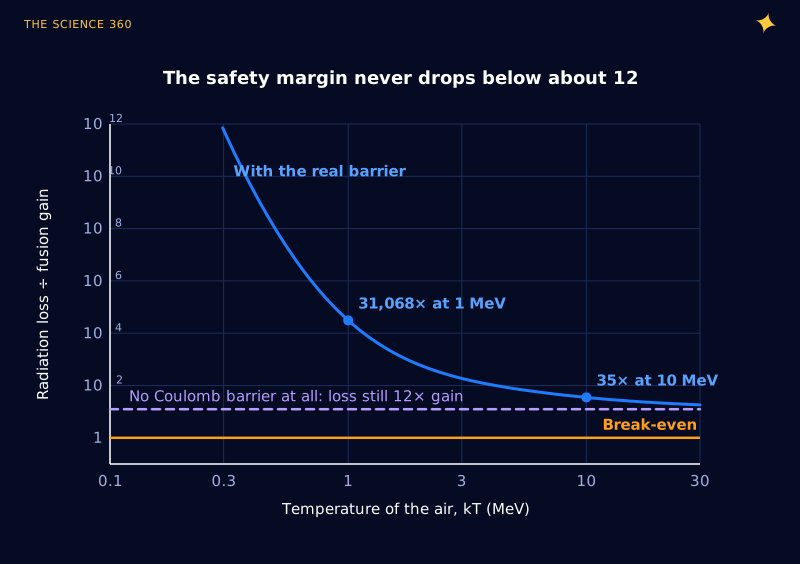
Because both rates grow as the square root of temperature in this no-barrier case, that factor of 12.4 is the same at 1 keV, 1 MeV or 10 MeV. Pure nitrogen would do a bit better, a ratio of 6.7, because oxygen and argon add radiating charge without adding fuel. But that is the ceiling. No temperature, no density and no bomb size makes a nitrogen plasma burn if it radiates freely, even in a world where the Coulomb barrier does not exist.
Now put the barrier back. Two nitrogen nuclei each carry a charge of +7, and their electric repulsion at touching distance is . At a temperature of 1 MeV, only nuclei in the far tail of the thermal distribution, or those that tunnel through the barrier, ever fuse. Using the standard WKB tunnelling probability for a Coulomb barrier, averaged over a thermal distribution:
With the Coulomb barrier, sea-level air
Loss ÷ gain at each temperature kT:
At very high temperature the ratio creeps down toward the no-barrier floor of 12.4, never below it.
This is a simplified version of the Los Alamos approach, with three choices you should know about. It treats electrons and nuclei as having the same temperature. It uses the non-relativistic bremsstrahlung formula, which underestimates radiation above a few hundred keV, so the real losses are larger. And it ignores inverse Compton cooling, where hot electrons hand energy to the bomb's own X-rays, which again only adds loss. The last two choices make ignition look easier than it is. The equal-temperature assumption is the one that cuts the other way, since cooler electrons radiate less. But cooler electrons also drain heat from the nuclei faster, because Coulomb collisions hand energy to slow electrons more quickly. LA-602 calculated the electron temperature as a function of the nuclear temperature, which Physics Today notes comes out much lower, and the losses still won. The measured cross-sections from Oak Ridge in the early 1950s were also smaller than the geometric estimate LA-602 used, according to the Physics Today account.
What if the radiation can’t escape?
A fair objection: a big enough fireball is opaque, so the X-rays would not leave. Physics Today makes exactly this point about the real Trinity fireball, whose opacity kept its heat inside during the first few milliseconds. But trapping the radiation makes things worse for ignition, not better. Radiation trapped in a region comes into equilibrium with the matter, and at fusion temperatures the radiation field soaks up almost all the energy.
Energy to heat 1 m³ of sea-level air to kT = 1 MeV
Particles per m³ (nuclei + electrons):
Blackbody radiation filling the same 1 m³ at
That is my own estimate. Either the radiation escapes and carries energy away 12 or more times faster than fusion supplies it, or it is trapped and demands a hundred billion times more energy than the air itself holds. There is no third option where the air stays hot and the photons politely stay out of the way.

And the clock is brutal. At 1 MeV, bremsstrahlung alone drains that cubic metre's thermal energy in about 6 microseconds. Fusion with the real barrier would take about 0.2 seconds to produce the same amount. A burn wave cannot outrun a cooling time 30,000 times shorter.
How hot did Trinity actually get the air?
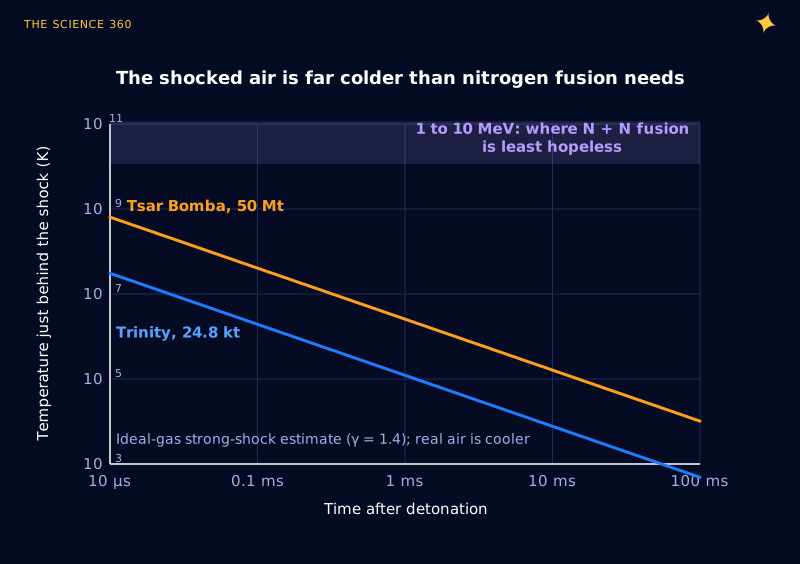
Nowhere near 1 MeV. The device itself is hotter than its surroundings, but the air outside is heated mainly by a shock wave, and we can estimate its temperature from the most famous back-of-envelope calculation in physics. In 1950 G. I. Taylor published Julian Mack's time-stamped photographs of the Trinity fireball and showed that a point explosion of energy E in air of density ρ makes a shock of radius
with S = 1.03 for γ = 1.4 (Taylor computed )
Taylor's fit to the photographs (SI form, from Díaz's reanalysis):
Taylor himself got 16.8 kt for γ = 1.4 and 22.9 kt for γ = 1.3. The official US figure was long 21 kt, and a 2021 Los Alamos reassessment raised it to 24.8 ± 2 kt. The method only needs the radius and the clock in each frame.
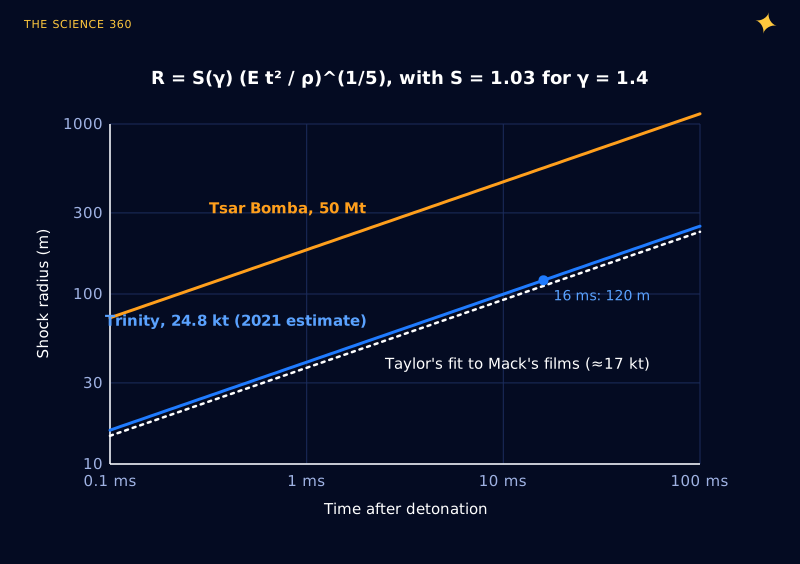
The shock speed is , and a strong shock heats the gas it passes through in proportion to the square of that speed. For ideal air with γ = 1.4, , where m is the mean mass of an air molecule.
Shocked-air temperature, Trinity (24.8 kt), t = 0.1 ms
Needed for the least hopeless case: about 1 MeV, or 11.6 billion K
That is an upper bound, because real air spends shock energy on breaking molecules apart and stripping electrons, so it ends up cooler than an ideal gas would. Physics Today's summary of the same history describes the heated air as reaching "a few million degrees", consistent with this. The gap to 1 MeV is a factor of about 6,000 in temperature, and the loss-to-gain ratio at the temperatures Trinity actually produced (the far left of Figure 1) is astronomically large.
The misconception: “they went ahead with a small chance of ending the world”
The story is usually told as a gamble: the scientists ran the numbers, found a tiny but real chance, and pushed the button anyway. Arthur Compton is often quoted as saying he would have stopped the project if the chance were more than about three in a million.
Whatever Compton said, the physics is not a probability. The question is whether a hot parcel of air gains or loses energy, and that is a ratio of two rates. When the best case, with no Coulomb barrier, still loses by a factor of 12, and the real case at Trinity's temperatures loses by a factor beyond 1020, there is no small chance to calculate. What the physicists were unsure about in 1945 was the nitrogen fusion cross-section, which nobody had measured. LA-602 handled that by assuming generous cross-sections, and still found the answer was no. Its authors were careful enough to add that "the absence of satisfactory experimental foundations makes further work on the subject highly desirable", as Alex Wellerstein quotes it.
What about hydrogen bombs and the oceans?
This is the part where the worry had more substance. Figure 2 shows the safety factor falling as temperature rises, and thermonuclear weapons are hotter and a thousand times bigger. Water also brings hydrogen and deuterium, which fuse far more easily than nitrogen. The Physics Today account says the concern followed the weapons programme through the megaton tests, and that an accelerator was built at Oak Ridge in the early 1950s partly to measure the nitrogen and oxygen fusion rates directly. The experimenters were not told why.
The definitive analysis is a 1979 Physical Review A paper by Thomas Weaver and Lowell Wood. Their abstract concludes that "neither the atmosphere nor oceans of the Earth may be made to undergo propagating nuclear detonation under any circumstances". For seawater, they found a self-sustaining detonation would need deuterium at about 1 part in 300, roughly 20 times its real concentration, and an initiating explosion of about 2 × 10⁷ megatons. That is 400,000 Tsar Bombas.
The Tsar Bomba itself, 50 megatons over Novaya Zemlya in 1961, settled the practical question for the atmosphere. If you want to compare that kind of number with other pop-culture energies, our posts on the energy to destroy a planet and on nuking an asteroid in Armageddon use the same kiloton bookkeeping.
FAQ
Could the atomic bomb have ignited the atmosphere?
No. The worry was that the bomb's heat would start nitrogen nuclei fusing in a self-sustaining chain. Hot, ionised air loses energy to X-ray radiation faster than nitrogen fusion can supply it at every temperature. Even if nitrogen nuclei fused on every contact with no Coulomb barrier, the loss would still be about 12 times the gain, and Trinity's air never got within a factor of thousands of the needed temperature.
What was the LA-602 report?
LA-602, "Ignition of the Atmosphere with Nuclear Bombs", is a Los Alamos report by Emil Konopinski, Cloyd Marvin and Edward Teller dated 14 August 1946, a year after Trinity. It wrote up the wartime analysis and concluded that energy losses to radiation always outweigh the gains from nitrogen fusion, while calling for better experimental data on the reaction rates.
Did Oppenheimer think there was a chance of igniting the atmosphere?
Edward Teller raised the possibility at a 1942 Berkeley meeting, and Oppenheimer took it to Arthur Compton. Hans Bethe's estimates quickly showed the temperatures were far too low. By the time of Trinity in July 1945 the scientists considered it settled, though Enrico Fermi reportedly joked by taking bets on it in the final minutes.
Could a hydrogen bomb ignite the atmosphere or the oceans?
No. The 50 megaton Tsar Bomba did not, and a 1979 analysis by Thomas Weaver and Lowell Wood concluded that neither the atmosphere nor the oceans can sustain a propagating nuclear detonation under any circumstances. Seawater would need about 20 times more deuterium than it has, and even then the trigger would need around 20 million megatons.
Related on The Science 360
Sources
- M. Wiescher and K. Langanke, "Manhattan Project astrophysics", Physics Today 77(3), 34 (2024), describing LA-602, its safety factor, the Oak Ridge cross-section measurements and the Trinity fireball: physicstoday.aip.org
- E. J. Konopinski, C. Marvin and E. Teller, "Ignition of the Atmosphere with Nuclear Bombs", LA-602 (1946), FAS copy (not accessible when checked): sgp.fas.org
- A. Wellerstein, Restricted Data blog, on the history of the ignition question, the Trinity bets and Weaver and Wood (1979): blog.nuclearsecrecy.com
- J. S. Díaz, "Explosion analysis from images: Trinity and Beirut", arXiv:2009.05674 (Taylor's fit and ): arxiv.org/abs/2009.05674
- R. S. Baty and S. D. Ramsey, "On the Symmetry of Blast Waves", LA-UR-20-30042, arXiv:2103.05710 (Taylor's yields for different γ): arxiv.org/abs/2103.05710
- J. I. Katz, "Fermi at Trinity", arXiv:2103.05784 (test date and the 2021 yield of about 25 ± 2 kt): arxiv.org/abs/2103.05784
- NRL Plasma Formulary bremsstrahlung formula, as restated in "MCTrans++: A 0-D Model for Centrifugal Mirrors", arXiv:2304.01496: arxiv.org/abs/2304.01496
- NIST, Atomic Weights and Isotopic Compositions (14N, 24Mg, 4He): physics.nist.gov
Method note: fusion rates use a geometric cross-section () times the WKB Coulomb-barrier transmission, averaged over a Maxwell distribution with reduced mass 7 u. Losses use the non-relativistic NRL bremsstrahlung formula for fully ionised sea-level air with electrons and ions at one temperature. Shock temperatures use the ideal strong-shock relation with γ = 1.4. The relativistic and inverse Compton corrections, both left out, would only increase the losses.
Header image: NASA (image S100E5498), regraded for this article.