How many units does each appliance use, and what will the bill be?
Multiply each appliance's watts by the hours it runs, divide by 1,000, and you have kilowatt-hours, which is what an Indian bill calls units. A 1.5 ton 3 star inverter AC averages about 528 W, so 8 hours a day is 4.2 units a day and 127 units a month, or ₹1,013 at ₹8 a unit. A typical two bedroom flat with one AC, a fridge, a geyser and three fans comes to about 309 units a month in summer.
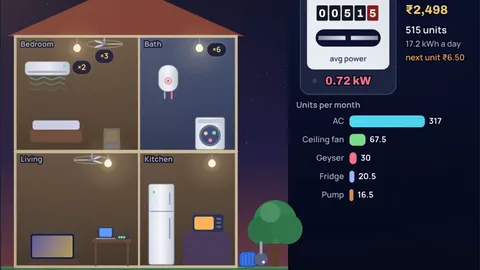
The calculator draws your home with each appliance in its room and turns the meter disc at the average power. Change the count and hours for any row, pick a flat rate in rupees, dollars, pounds or euros, or switch to the Delhi slab tariff, where the price of each extra unit climbs as you use more. The AC almost always dominates, so the AC row has tonnage and star rating built in. For a coding take on the same sum, see how to write an electricity bill program in Python.
Key results from the calculator
- 1 unit = 1 kWh: a 1,000 W appliance running for 1 hour uses one unit. A 9 W LED bulb takes about 111 hours to use the same unit.
- The AC is the bill: in the example flat the AC is 41% of all units. A 1.5 ton AC averages 409 W at 5 star, 528 W at 3 star and 819 W for an old non-inverter unit, while running.
- A geyser is big but brief: at 2,000 W it uses 2.0 units in an hour of heating, about 60 units a month. The fridge runs all day yet uses only 0.68 units a day.
- Slabs punish the last units: in Delhi a 515 unit month costs ₹2,498, and every unit above 400 is billed at ₹6.50, more than twice the ₹3.00 of the first 200.
Six homes, six bills
Each section is a preset in the calculator. The numbers below are what it shows. Use the button to load the home, then change any appliance to see what moves the bill.
A two bedroom flat in summer: 309 units
Flat rate ₹8 per unit · ₹2,469 a monthOne 1.5 ton 3 star AC for 8 hours, a 240 litre frost-free fridge, a 2 kW geyser for 30 minutes, three ceiling fans for 10 hours, six LED bulbs, a TV, a washing machine, a laptop, a Wi-Fi router, a microwave and an iron. That adds up to 10.3 kWh a day and 309 units in a 30 day month. At a flat ₹8 per unit the bill is ₹2,469.
The AC alone is 127 units, 41% of the total. The three fans come second at 68 units, more than all the lights, TV and laptop put together. If everything were switched on at once the house would draw about 6.8 kW, which is why sanctioned load matters even though the average is only 429 W.
Delhi in May with two ACs: 515 units
DERC slabs · ₹2,498 a monthAdd a second AC, run both for 10 hours, and add a half HP water pump for an hour. The month jumps to 515 units. On the Delhi domestic tariff the first 200 units cost ₹3.00 each (₹600), the next 200 cost ₹4.50 (₹900), and the last 115 units fall in the ₹6.50 slab (₹748). With a 5 kW sanctioned load the fixed charge is ₹250, so the bill is ₹2,498 before surcharges and tax.
That works out to ₹4.85 per unit on average, but the number that matters for decisions is the marginal rate: every extra unit this month costs ₹6.50. Cutting 100 units saves ₹650, not ₹485. Real Delhi bills also carry a power purchase adjustment surcharge and electricity tax; use the surcharge slider to add them.
Same house, 5 star ACs and BLDC fans: 405 units
Saves 110 units and ₹713 a monthKeep the Delhi summer exactly as it was but swap the two ACs for 5 star inverter models and the fans for BLDC fans. The ACs drop from 528 W to 409 W average each, the fans from 75 W to 32 W. The month falls to 405 units and the bill to ₹1,785, a saving of ₹713.
The saving is bigger than the drop in units suggests because the cut comes off the top slab first. Most of the 110 units saved were ₹6.50 units, and the house is now just over the 400 unit line. Over a four month summer that is about ₹2,851, which pays a real part of the price gap between a 3 star and a 5 star AC.
No AC, an air cooler instead: 195 units
DERC slabs · ₹626 a monthTake the AC out, put in a 180 W desert cooler for 8 hours, and skip the geyser in summer. The house uses 6.5 kWh a day and 195 units a month, which stays inside Delhi's first slab. The energy charge is ₹586 and a 2 kW connection adds ₹40 fixed.
Staying under 200 units also matters for the Delhi Government's subsidy, which households below that line have received for years. The calculator shows the tariff before any subsidy, because subsidies are a state budget decision that can change and they are not part of the regulator's tariff schedule.
A US home with two 2 ton ACs: 490 kWh
18.2 cents per kWh · $89.13 a monthSwitch the tariff to the US average residential price, 18.2 cents per kWh for 2026 from the EIA's Short-Term Energy Outlook. Two 2 ton (24,000 BTU/h) room units for 8 hours, plus the same fridge, fans and electronics, come to 490 kWh and $89.13 for the month.
US bills are flat per kWh in most states, though many utilities add a fixed customer charge of a few dollars to more than ten dollars a month and some use tiers or time of use pricing. The physics is identical: a 703 W average AC for 8 hours is 5.6 kWh a day wherever it is plugged in.
A UK home without AC: 85 kWh
Ofgem cap 26.32p + 54.83p a day · £38.71A UK household on the Ofgem price cap for October to December 2026 pays 26.32p per kWh plus a standing charge of 54.83p per day (Direct Debit, GB average). With no AC, no fans and no geyser, the same fridge, lights, TV, washing machine and electronics use 85 kWh a month.
The energy part is £22.26 but the standing charge adds £16.45 whatever you use, so the total is £38.71. On a small bill the fixed part is 42% of it. Most UK homes heat with gas, which this calculator does not cover.
Units used by common appliances
| Appliance | Power | Typical use | kWh per day | Units per month | Cost per month at ₹8 |
|---|---|---|---|---|---|
| AC 1.5 ton, 3 star | 528 W average | 8 h | 4.22 | 126.6 | ₹1,013 |
| Refrigerator | 250 kWh/yr | 24 h (label) | 0.68 | 20.5 | ₹164 |
| Geyser | 2,000 W | 30 min | 1.00 | 30.0 | ₹240 |
| Ceiling fan | 75 W | 10 h | 0.75 | 22.5 | ₹180 |
| LED bulb | 9 W | 6 h | 0.05 | 1.6 | ₹13 |
| TV (43 in LED) | 80 W | 4 h | 0.32 | 9.6 | ₹77 |
| Air cooler | 180 W | 8 h | 1.44 | 43.2 | ₹346 |
| Washing machine | 400 W | 1 h | 0.40 | 12.0 | ₹96 |
| Laptop | 50 W | 6 h | 0.30 | 9.0 | ₹72 |
| Wi-Fi router | 10 W | 24 h | 0.24 | 7.2 | ₹58 |
| Microwave | 1,200 W | 15 min | 0.30 | 9.0 | ₹72 |
| Water pump 0.5 HP | 550 W | 1 h | 0.55 | 16.5 | ₹132 |
| Iron | 1,000 W | 15 min | 0.25 | 7.5 | ₹60 |
One unit of each appliance at the hours used in the Indian 2BHK preset (geyser 30 minutes, fans 10 hours, AC 8 hours). The AC figure is the average draw while switched on, from BEE label data; the fridge figure is a 240 litre frost-free 3 star label value divided over the year.
How the calculator works
Each row is count × watts × hours per day ÷ 1,000 = kWh per day. The sum over all rows times the days in the billing month gives units per month. The meter on the stage turns at a speed proportional to the average power (kWh per day ÷ 24 h), and the bar chart ranks appliances by units per month.
An AC does not draw its full rated power all the time: an inverter compressor slows down once the room is cool. The calculator uses the method behind the BEE label. Average draw = tons × 3.517 kW × 0.45 ÷ ISEER, where 3.517 kW is one ton of cooling, 0.45 is the average share of full capacity needed across BEE's 1,600 hour Indian cooling season, and ISEER is the seasonal efficiency on the label (5.8 for a typical 5 star unit, 4.5 for 3 star, 2.9 for an old fixed-speed unit). For a 1.5 ton 5 star AC that gives 409 W, and 655 kWh over 1,600 hours, close to the 663 kWh on a real 2026 label.
The fridge uses its BEE label figure (250 kWh a year for a 240 litre frost-free 3 star model) spread over 24 hours, because its compressor switches itself on and off. Other appliances use nameplate power: a 2,000 W geyser, a 75 W regular or 32 W BLDC ceiling fan, a 9 W LED bulb, an 80 W 43 inch TV.
For Delhi the energy charge is telescopic. Units 1 to 200 are billed at ₹3.00, 201 to 400 at ₹4.50, 401 to 800 at ₹6.50, 801 to 1,200 at ₹7.00 and above that ₹8.00, from the DERC tariff schedule. The fixed charge is per kW of sanctioned load: ₹20 per kW up to 2 kW, ₹50 per kW from 2 to 5 kW (₹250 for 5 kW), ₹100 per kW up to 15 kW. The surcharge slider adds a percentage on top for the purchase cost adjustment and tax.
What the model leaves out
- Heatwaves: the AC model is a typical cooling day. At 45 °C outdoors an AC runs near full load, about 1,599 W for a 1.5 ton 3 star unit, so May afternoons in north India can use 50 to 100 percent more than the calculator shows.
- Your exact appliance: wattage varies by model. Read the BEE label (annual kWh) or the nameplate (watts) and adjust. A 32 inch TV uses about half the power of the 43 inch set used here.
- Standby power: set-top boxes, chargers and microwaves draw a few watts all day. Together they can add 10 to 30 units a month.
- Surcharges, tax and subsidy: Delhi bills add a fuel and power purchase adjustment surcharge (around 16 percent in 2026), pension trust surcharge and electricity tax, and the Delhi Government subsidy can wipe out the bill below 200 units. Set the slider to match your last bill.
- Other states: Indian tariffs differ by state and change every year or two. Use the flat rate with your own average rupees per unit, which is your last bill divided by its units.
- Time of day pricing: some tariffs charge more at peak hours. The calculator assumes one rate per slab.
Common misconceptions
“Turning the AC to 16 °C cools faster.” It does not. The compressor runs at the same full speed either way; a lower setting only makes it run longer and overshoot. Every degree higher saves roughly 6 percent of AC energy, by the Ministry of Power's estimate, which is why the default on new Indian ACs is 24 °C.
“The fridge is the biggest load because it is always on.” A modern 240 litre frost-free fridge uses about 0.68 units a day, less than one hour of a 1.5 ton AC (0.53 kWh). Always on is not the same as high power.
“Average price per unit tells you what a saving is worth.” On a slab tariff the units you save come off the top slab. In the Delhi example each saved unit is worth ₹6.50, not the ₹4.85 average.
Frequently asked questions
How many units does a 1.5 ton AC use in 1 hour?
About 0.53 units an hour on average for a 3 star inverter AC and 0.41 for a 5 star one, on a typical day once the room has cooled. At full load in a heatwave a 1.5 ton AC can draw 1.60 kW. An old non-inverter 1.5 ton AC averages about 0.82 units an hour.
1 unit of electricity is how many watts?
One unit is 1 kilowatt-hour (kWh), which is energy, not power. It is 1,000 watts used for one hour, or 100 watts for 10 hours, or 10 watts for 100 hours. To get units, multiply watts by hours and divide by 1,000.
How do I calculate my electricity bill from units?
Add up kWh per day for each appliance (watts × hours ÷ 1,000), multiply by the days in the billing month to get units, then apply your tariff. On a flat rate multiply by the rate. On a slab tariff bill the first slab at its rate, the next slab at its rate and so on, then add the fixed charge, surcharges and tax.
How many units does a geyser use per day?
A 2,000 W storage geyser uses 2 units for every hour its element is on. Heating a 15 litre tank from 20 °C to 45 °C takes about 0.45 kWh, roughly 13 minutes. A family that heats water for about 30 minutes a day uses 1 unit a day, about 30 units a month.
How many units does a fridge use per month?
A 240 litre frost-free 3 star fridge is labelled at about 250 kWh a year, which is 0.68 units a day and 21 units a month. A 5 star model or a smaller single door fridge uses less; an old fridge with a worn door seal can use twice as much.
What is the average electricity rate per unit in India?
There is no single national rate because each state regulator sets its own tariff. Domestic energy charges mostly fall between about ₹3 and ₹9 per unit depending on the state and slab, before fixed charges and surcharges. Divide your last bill by its units to get your own average, and enter it as the flat rate.
Keep learning
How Many Units Do an AC, Fridge and Geyser Use Per Day?
A 1.5 ton AC uses about 4.2 units in 8 hours, a 240 L fridge 0.7 a day, a 2 kW geyser 2 an hour. The maths, a real Delhi slab bill and what to change.

write a program to calculate electricity bill in python
Introduction In our increasingly digitized world, the ability to automate mundane tasks through programming has become an invaluable skill. One such p

Why Is Three-Phase Power Used? The Real Reasons
Three-phase power delivers constant power and a rotating field for motors. The copper saving is real but depends on what you compare. Worked numbers here.

A bigger kettle is not the problem. Heating extra water is
A reproducible Python model separates water volume, kettle power and assumed efficiency to show what changes the energy used for a cup of hot water.