How long will an inverter battery last?
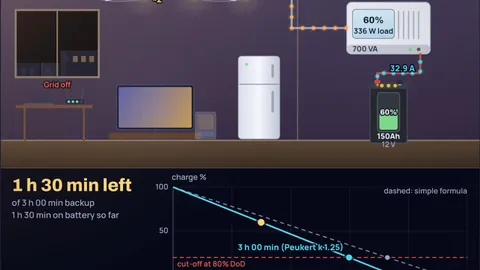
A 150 Ah 12 V tubular battery running two fans, four LED bulbs, a TV, a Wi-Fi router and a fridge (about 336 W on average) lasts about 3 h 00 min before the inverter cuts off at 80 percent depth of discharge. The simple brochure formula, battery volts × Ah × depth of discharge × inverter efficiency ÷ load watts, says 3 h 39 min. The gap is the Peukert effect: lead acid batteries deliver less of their rated Ah when you draw current faster than the 10 hour rate they are rated at.
The calculator shows both. Pick the loads, the battery type and size, 12 V or 24 V, the inverter efficiency and how deep you let the battery go. The battery drains in a time-lapse until the lights go out, and the chart puts the Peukert curve next to the simple straight line. For what the same appliances cost when the grid is on, see the electricity cost calculator.
Key results from the calculator
- Backup ≈ usable watt-hours ÷ load watts: a 150 Ah 12 V battery stores 1,800 Wh. At 80 percent depth of discharge and 85 percent inverter efficiency that is about 1,224 Wh at the sockets, so a 300 W load gets roughly 4 h 05 min by the simple rule and 3 h 27 min with Peukert.
- Heavy loads shrink the battery: at 100 W the same battery gives 13 h 37 min, more than its rated 10 hour capacity suggests. At 800 W it gives only 1 h 01 min, 34 percent less than the simple rule.
- Fans are the big lever: swapping two 75 W fans for 32 W BLDC fans stretches backup from 3 h 00 min to 4 h 20 min on the same battery.
- VA is not watts: home inverters are rated in VA at a power factor of about 0.8. A 426 W load needs 533 VA, so a 700 VA inverter is the sensible size.
Six setups people actually run
Each section is a preset in the calculator, with the numbers it shows. The button loads it so you can change one thing at a time.
150 Ah with fans, TV and a fridge: 3 h 00 min
336 W average · 700 VA inverterTwo ceiling fans (150 W), four LED bulbs (36 W), a 43 inch TV (80 W), a router (10 W) and a 240 litre fridge. The fridge compressor draws about 150 W but runs roughly 40 percent of the time, so it averages 60 W. Total: 336 W on average, 426 W when the compressor is on.
From a 12 V battery through an 85 percent efficient inverter that is 32.9 A. A 150 Ah C10 battery rated for 15 A over 10 hours, asked for 32.9 A, delivers about 123 Ah in total, and stopping at 80 percent depth of discharge leaves 3 h 00 min. The fridge start is the hidden risk: for a moment it can ask for 1,095 VA, so a 700 VA inverter with a decent surge rating matters more than its continuous number.
Three fans and five lights: 3 h 46 min
280 W · 27.5 A from 12 VThe most common Indian power cut setup: three regular ceiling fans, five LED bulbs and the router. That is 280 W, 27.5 A from the battery, and 3 h 46 min of backup at 80 percent depth of discharge.
The fans are 80 percent of the load. The lights hardly matter: five 9 W bulbs together use less than one fan.
Same house with BLDC fans: 4 h 20 min
86 W less loadReplace the two 75 W fans in the first setup with 32 W BLDC fans. The load falls from 336 W to 250 W and backup rises from 3 h 00 min to 4 h 20 min, with the same battery.
Because of Peukert, cutting the current helps twice: you need fewer watt-hours, and the battery delivers more of its rated capacity at the lower current. For a household that runs fans through every power cut, BLDC fans are usually cheaper than a bigger battery.
Laptop, router, one fan: 8 h 00 min
153 W · right at the C10 rateA laptop (50 W), the router (10 W), one fan (75 W) and two bulbs (18 W) make 153 W. From 12 V at 85 percent efficiency that is 15.0 A, exactly the 15 A at which a 150 Ah C10 battery is rated. So the battery delivers its full 150 Ah and you get 8 h 00 min to 80 percent depth of discharge, the same answer as the simple formula.
That is a useful check on any calculator: at the rated current Peukert and the simple rule must agree. Below it the battery gives a little more than its label, above it less.
A 100 Ah lithium battery vs 150 Ah tubular: 2 h 55 min
LiFePO4 · 90% DoD · 90% efficientRun the first setup from a 100 Ah 12.8 V LiFePO4 battery instead. It stores only 1,280 Wh against the tubular battery's 1,800 Wh, yet gives 2 h 55 min, almost the same as the 150 Ah lead acid battery's 3 h 00 min.
Three things close the gap: lithium is routinely used to 90 percent depth of discharge, it barely suffers from the Peukert effect (we use k = 1.05 against 1.25 for lead acid), and lithium-ready inverters run a little more efficiently. It also lasts thousands of cycles where a tubular battery lasts hundreds to about a thousand at this depth.
A bigger home on 24 V: 2 h 21 min
817 W · two 150 Ah batteriesFive fans, ten lights, a TV, the fridge, a cooler and the router: 817 W on average and 1,134 VA running. That is beyond a 12 V inverter, so this uses a 1450 VA inverter on a 24 V bank of two 150 Ah batteries in series (3,600 Wh).
The current is 40.0 A, so each battery works at more than twice its C10 rate and Peukert takes a bite: 2 h 21 min against 3 h 00 min from the simple rule. Two batteries in series double the voltage, not the Ah; it is the doubled voltage that halves the current for the same watts.
Backup time of one 150 Ah 12 V battery at different loads
| Load | Inverter VA | Battery current | Tubular, Peukert | Simple formula | LiFePO4 150 Ah |
|---|---|---|---|---|---|
| 100 W | 600 VA | 9.8 A | 13 h 37 min | 12 h 14 min | 15 h 59 min |
| 200 W | 600 VA | 19.6 A | 5 h 43 min | 6 h 07 min | 7 h 43 min |
| 300 W | 600 VA | 29.4 A | 3 h 27 min | 4 h 05 min | 5 h 03 min |
| 400 W | 700 VA | 39.2 A | 2 h 24 min | 3 h 04 min | 3 h 44 min |
| 500 W | 900 VA | 49.0 A | 1 h 49 min | 2 h 27 min | 2 h 57 min |
| 600 W | 1100 VA | 58.8 A | 1 h 27 min | 2 h 02 min | 2 h 26 min |
| 800 W | 1450 VA | 78.4 A | 1 h 01 min | 1 h 32 min | 1 h 48 min |
Tubular: C10 rated, Peukert k = 1.25, 80 percent depth of discharge, 85 percent inverter efficiency. LiFePO4: 12.8 V, k = 1.05, 90 percent depth of discharge, 90 percent efficiency. Inverter size is the next standard rating above the running VA plus 25 percent.
How the calculator works
The load is the sum of count × watts for each appliance. The fridge is the exception: its compressor draws about 150 W but runs about 40 percent of the time, so it adds 60 W on average (close to its 250 kWh a year label) while the inverter must still handle the full 150 W and a start surge of several times that.
The inverter's VA is the running watts divided by a power factor of 0.8, the figure Indian home UPS ratings assume. The suggested inverter is the next standard size (600, 700, 900, 1,100, 1,450 VA and up) above the running VA plus 25 percent headroom.
Battery current is load watts ÷ (battery volts × inverter efficiency). Indian inverter batteries are rated at C10, the Ah they deliver over a 10 hour discharge. Peukert's law scales the time to empty at any other current: t = 10 h × (Ah ÷ (I × 10 h))^k, with k = 1.25 for flooded lead acid (Victron's default for lead acid) and 1.05 for LiFePO4. Backup is that time multiplied by the depth of discharge you allow.
The time-lapse plays a full discharge in 8 seconds. The battery window and the gold dot on the chart show the charge left; the dashed line is the simple formula, which assumes the battery gives its rated Ah at any current.
What the model leaves out
- Voltage sag: a lead acid battery’s voltage drops as it discharges and under heavy current, so the inverter may cut off before the nominal depth of discharge. The model treats the cut-off as a fixed share of capacity.
- Battery age and temperature: a three year old tubular battery may hold 70 to 80 percent of its new capacity, and capacity falls in the cold. Scale the Ah down for an old battery.
- Changing loads: fans get switched off, the fridge cycles, the TV goes off at night. The calculator uses a constant average load.
- Inverter idle draw: a home inverter uses 10 to 30 W just being on, which matters at very light loads. Lower the efficiency slider to account for it.
- Peukert is an approximation: it fits a single exponent to real discharge curves. It is good within a factor of a few around the rated current, and less exact for very light or very heavy loads.
Common misconceptions
“A 150 Ah battery gives 150 A for one hour.” No. The rating is over 10 hours (15 A). At 150 A a lead acid battery would deliver far less than 150 Ah and the voltage would collapse. Ah ratings only mean something with their hour rate.
“Two batteries in series double the backup.” Only because they double the stored energy. Series doubles the voltage (24 V) at the same Ah; the inverter then draws half the current for the same watts. Backup roughly doubles for the same load, and Peukert makes it slightly more than double.
“Bigger inverter, longer backup.” The inverter rating limits how much load you can connect, not how long it lasts. Backup comes from the battery; a bigger inverter only adds a little idle loss.
Frequently asked questions
How long will a 150Ah battery last?
It depends on the load. On a 12 V tubular battery at 80 percent depth of discharge: about 13 h 37 min at 100 W, 5 h 43 min at 200 W, 3 h 27 min at 300 W and 1 h 49 min at 500 W. Two fans, four LED bulbs, a TV and a fridge (about 336 W) get about 3 h 00 min.
How do I calculate inverter battery backup time?
Backup hours ≈ battery volts × Ah × depth of discharge × inverter efficiency ÷ load watts. For 12 V, 150 Ah, 80 percent and 85 percent at 300 W that is 1,224 ÷ 300 = 4.1 hours. Lead acid batteries give less than this at high current (the Peukert effect), so the real figure is closer to 3.5 hours.
What size inverter do I need for a fan, lights, TV and fridge?
Add the running watts (fans 75 W each, LED bulbs 9 W, TV 80 W, fridge about 150 W while running), divide by 0.8 to get VA and add about 25 percent headroom. Two fans, four bulbs, a TV, a router and a fridge come to 426 W, 533 VA, so a 700 VA inverter fits. Check that its surge rating covers the fridge starting.
Should I choose a 12 V or 24 V inverter?
Up to about 1,100 VA a 12 V inverter with one battery is normal. Above that, use 24 V with two batteries in series: the same power then needs half the current, which keeps cables, fuses and the battery within comfortable limits and improves backup through the Peukert effect.
Is a lithium inverter battery worth it?
Often, if you have frequent power cuts. A 100 Ah LiFePO4 battery gives about the same backup as a 150 Ah tubular battery (2 h 55 min against 3 h 00 min for a 336 W load) because it can be used to 90 percent and barely loses capacity at high current. It also lasts several times more cycles, but costs more up front and needs a lithium-compatible inverter.
Keep learning
How Long Will a 150Ah Battery Last With Fans, TV and a Fridge?
Two fans, four bulbs, a TV and a fridge get about 3 hours from a 150Ah tubular battery, not the 3.6 the brochure formula says. Here is the maths and the fixes.

LiPo C Rating Explained: Current, Sag and Real Limits
A 5000 mAh 50C LiPo is rated for 250 A, but at 3 milliohms per cell that current sags each cell by 0.75 V. What the C rating means and how to check it.

What Gauge Wire for 12V? Size for Voltage Drop
At 12 V, voltage drop, not ampacity, picks the wire. How to size 12 V wire from round-trip length and a 3% limit, with LED strip and fridge examples.
How Many Units Do an AC, Fridge and Geyser Use Per Day?
A 1.5 ton AC uses about 4.2 units in 8 hours, a 240 L fridge 0.7 a day, a 2 kW geyser 2 an hour. The maths, a real Delhi slab bill and what to change.