How Many Solar Panels Do I Need for My House?
Most people size rooftop solar backwards. They start from the roof, or from a figure a neighbour mentioned, and then hope the panels cover the bill. It works far better the other way round: start with the units on your electricity bill, find out how much sunshine your city gets, and the number of panels falls out of a single division.
This post walks through that division with real sunshine data for twelve Indian cities, then adds the roof area, the PM Surya Ghar subsidy and the payback. Every example opens in the rooftop solar calculator, which draws your house with the right number of panels and plots the years until the system pays for itself.
How many solar panels do I need for my house?
Three numbers decide it: how many units you use, how much sunlight reaches the panels where you live, and how much of that sunlight the system turns into units on your meter.
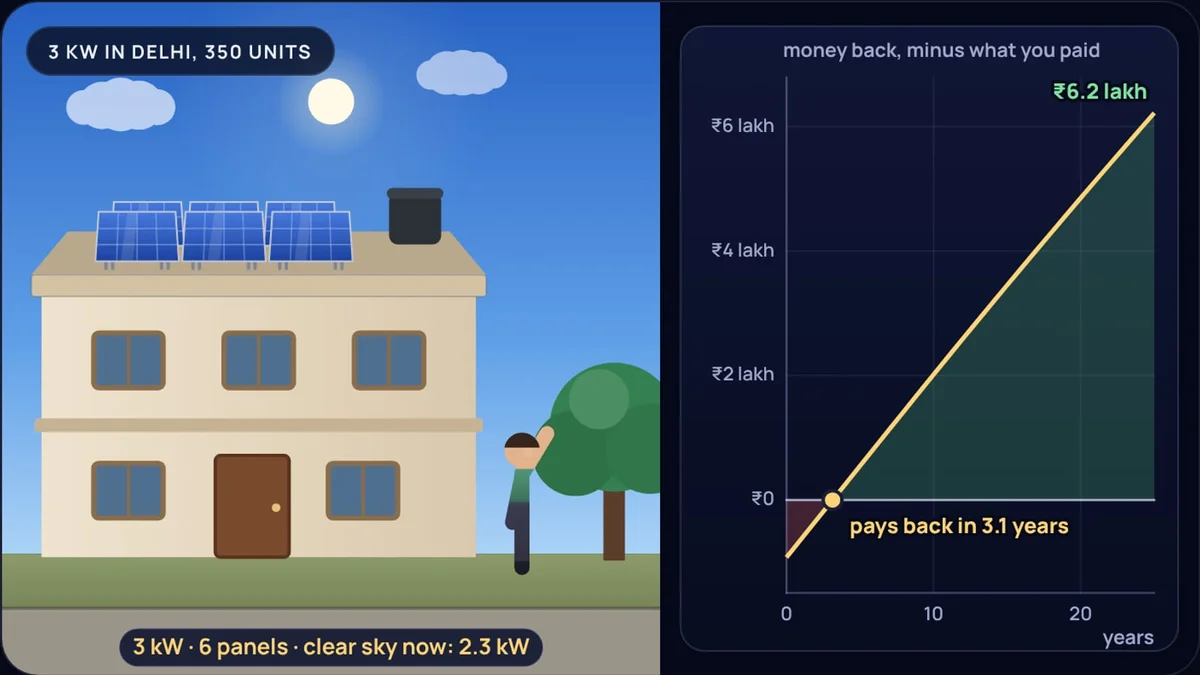
Worked example: a Delhi home using 350 units a month
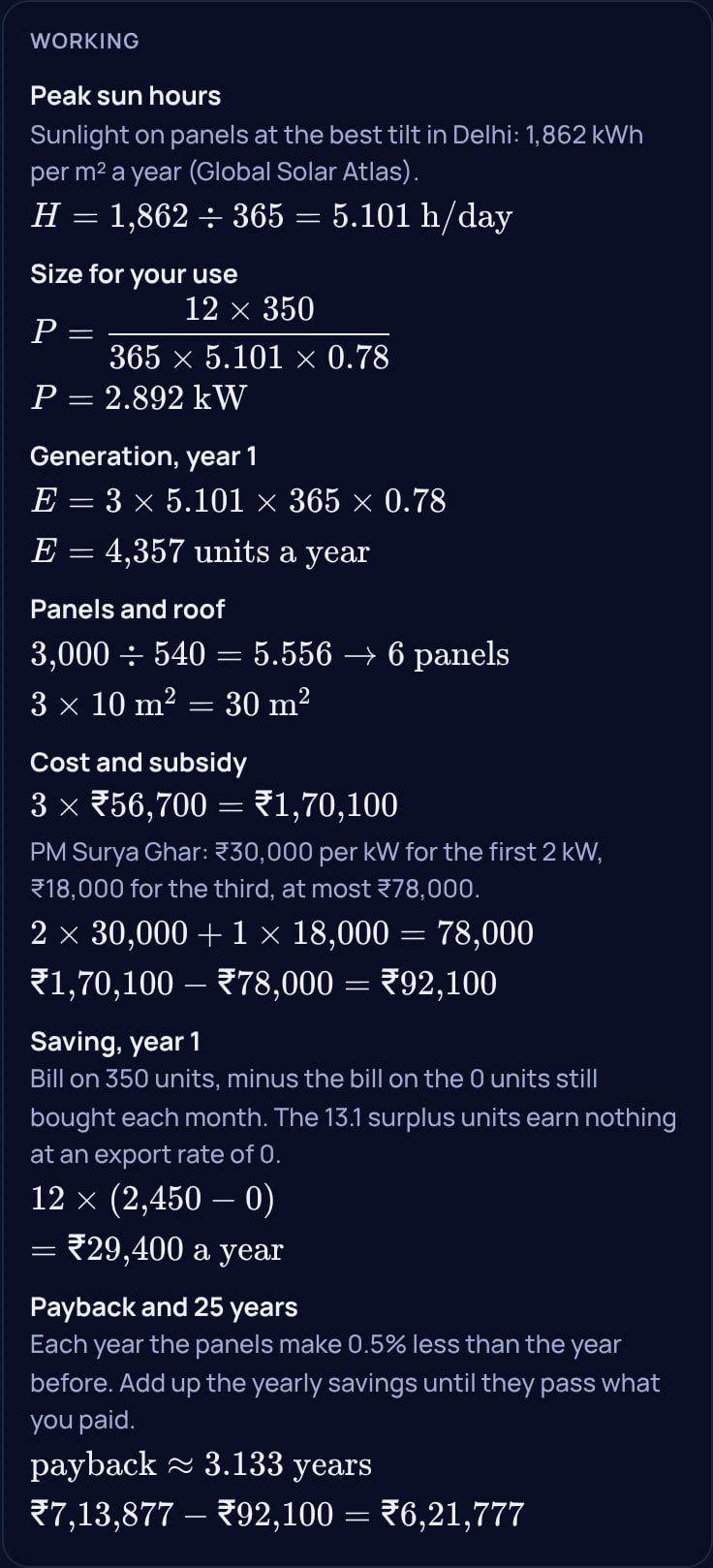
A year of use is 12 × 350 = 4,200 units. Delhi gets about 5.10 peak sun hours a day on well-tilted panels, and a typical system delivers about 78 percent of that sunlight as units. So 1 kW makes
The size that covers 4,200 units is
Round up to 3 kW. With 540 W panels that is 3,000 ÷ 540 = 5.6, so six panels, which make about 4,357 units a year.
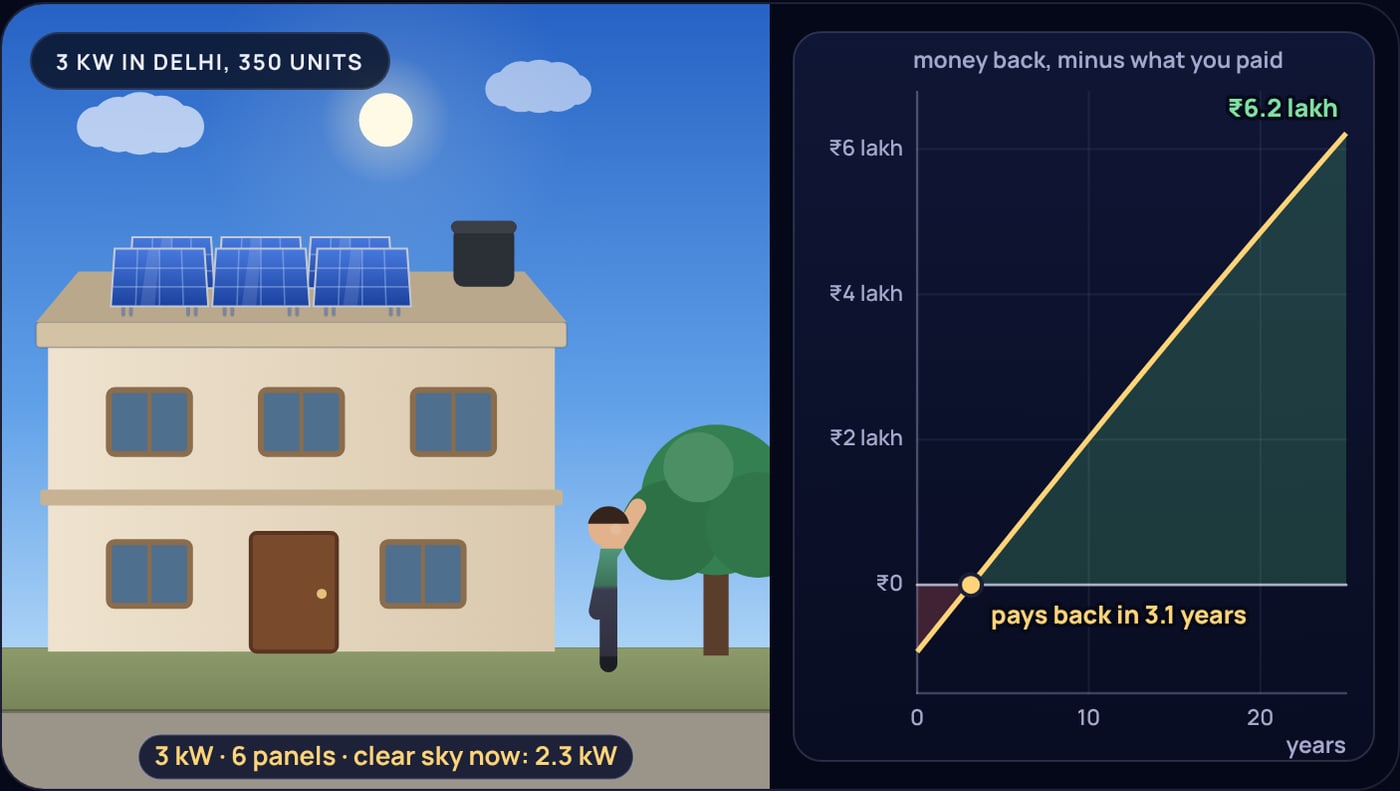
Your units are printed on every bill, usually as "units consumed" or "kWh". Take a yearly average if you can, because summer months with an AC running can be twice the winter ones. If you only know the amount, the calculator can work the units back from the bill on a flat or slab tariff.
What is a peak sun hour?
Sunlight on a panel varies from nothing at dawn to about 1,000 watts per square metre at a clear noon. A peak sun hour packs a day's sunlight into hours of that full 1,000 W/m². If a tilted panel collects 5.1 kWh of sunlight per square metre in a day, that day had 5.1 peak sun hours, even though the sun was up for twelve.
The calculator takes its figures from the Global Solar Atlas, a free map published by the World Bank with data from Solargis. For each city it gives the long-term yearly sunlight on panels tilted at the best angle. Dividing by 365 gives peak sun hours. Here is what that means for 1 kW of panels with a 78 percent performance ratio:
| City | Peak sun hours | 1 kW, units a year | kW for 300 units a month |
|---|---|---|---|
| Ahmedabad | 6.01 | 1,712 | 2.10 |
| Jaipur | 5.70 | 1,622 | 2.22 |
| Pune | 5.58 | 1,589 | 2.27 |
| Hyderabad | 5.57 | 1,587 | 2.27 |
| Mumbai | 5.56 | 1,584 | 2.27 |
| Chennai | 5.48 | 1,559 | 2.31 |
| Bengaluru | 5.47 | 1,556 | 2.31 |
| Delhi | 5.10 | 1,452 | 2.48 |
| Kolkata | 4.88 | 1,388 | 2.59 |
| Guwahati | 4.84 | 1,378 | 2.61 |
The performance ratio covers everything between sunlight and your meter: panels lose output when hot, and wiring, the inverter and dust take their share. The 78 percent default is close to what the Atlas's own output estimate implies in every city above. For Delhi the Atlas puts the output of 1 kW at 1,466 units a year, within 1 percent of the 1,452 here.
How many units does 1 kW of solar make in a day?
Divide the yearly figures by 365: about 3.8 units a day in Kolkata and Guwahati, about 4 in Delhi and Lucknow, and up to 4.7 in Ahmedabad. MNRE's consumer FAQ says a 1 kW plant makes 4 to 5.5 units on a clear sunny day, which fits, since the yearly average includes cloudy and monsoon days.
A related fact surprises people: a 3 kW system only produces close to 3 kW in strong midday sun. Averaged over the whole year, day and night, it delivers about 0.5 kW. The inverter's job of pulling the most power out of the panels as the light changes is explained in how an MPPT charge controller works.
How much roof space do solar panels need?
MNRE's guidance is about 10 square metres of shadow-free roof per kW. For 3 kW that is about 30 m², roughly a 5.5 m by 5.5 m patch.
The panels themselves take less. A common 540 W panel, such as Emmvee's 540 W half-cut module, measures 2.278 m by 1.134 m, or 2.58 m². Six of them cover about 15.5 m². The rest of the 30 m² is the gap between rows, so the front row does not shade the one behind when the sun is low, plus room to walk and clean. Shade matters more than most people expect: MNRE warns that a regular shadow on part of a panel cuts its output and shortens its life.
How much does the PM Surya Ghar subsidy cover?
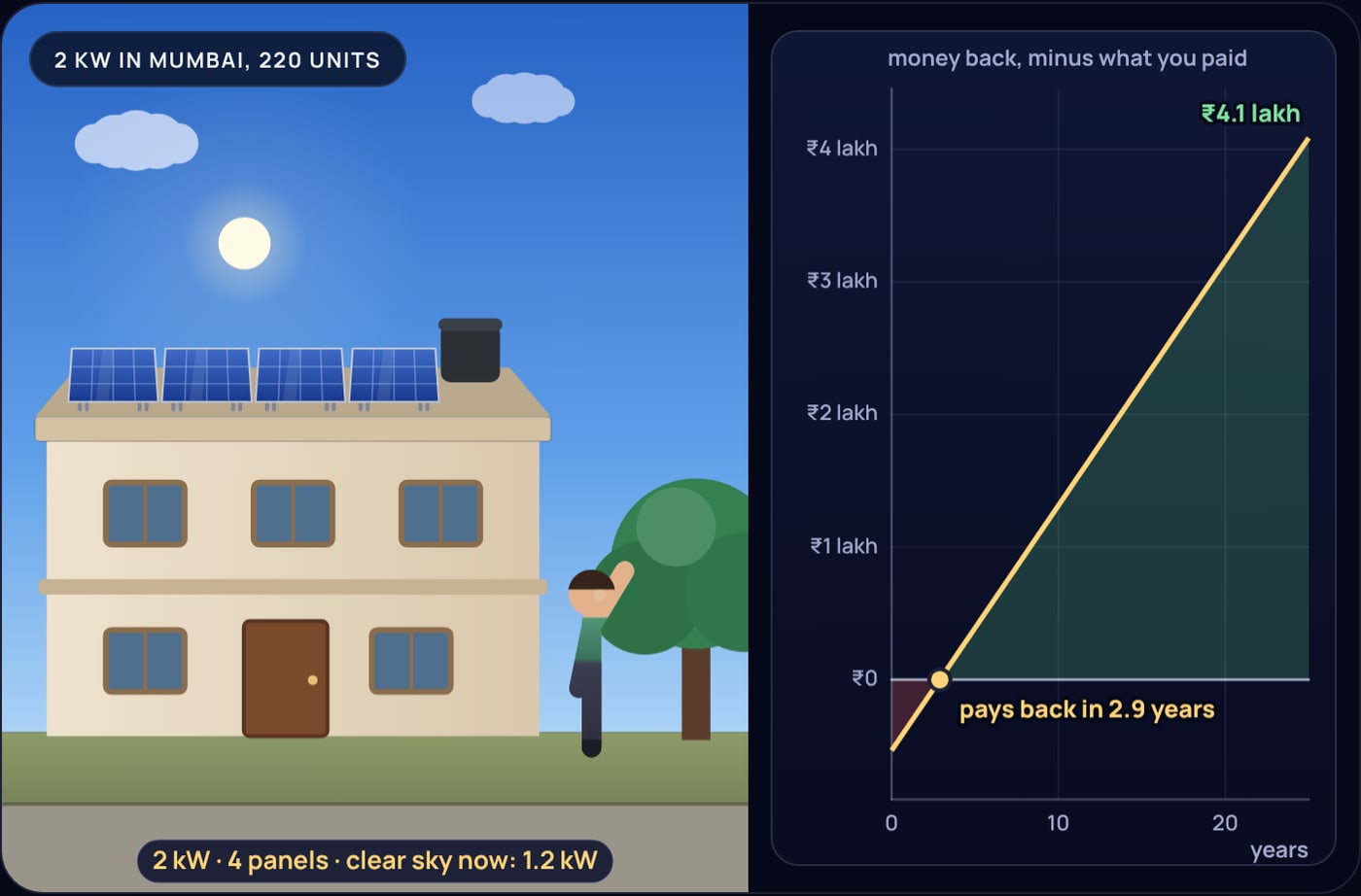
PM Surya Ghar: Muft Bijli Yojana, launched in February 2024, pays a central subsidy to homes that install rooftop solar. The government's one-year note on the scheme lists it by system size:
| Average monthly use | Suitable system | Subsidy |
|---|---|---|
| 0 to 150 units | 1 to 2 kW | ₹30,000 to ₹60,000 |
| 150 to 300 units | 2 to 3 kW | ₹60,000 to ₹78,000 |
| Above 300 units | Above 3 kW | ₹78,000 |
That works out to ₹30,000 per kW for the first 2 kW and ₹18,000 for the third. Above 3 kW the subsidy stays at ₹78,000.
Worked example: what the Delhi 3 kW system costs and saves
The calculator's example price is ₹56,700 per kW, based on IEEFA and JMK Research's figure of ₹1.7 lakh for a 3 kW home system. Your installer's quote may differ.
You pay ₹92,100. The panels make a little more than the 350 units a month the house uses, so at ₹7 a unit (the tariff IEEFA used) the whole energy charge goes:
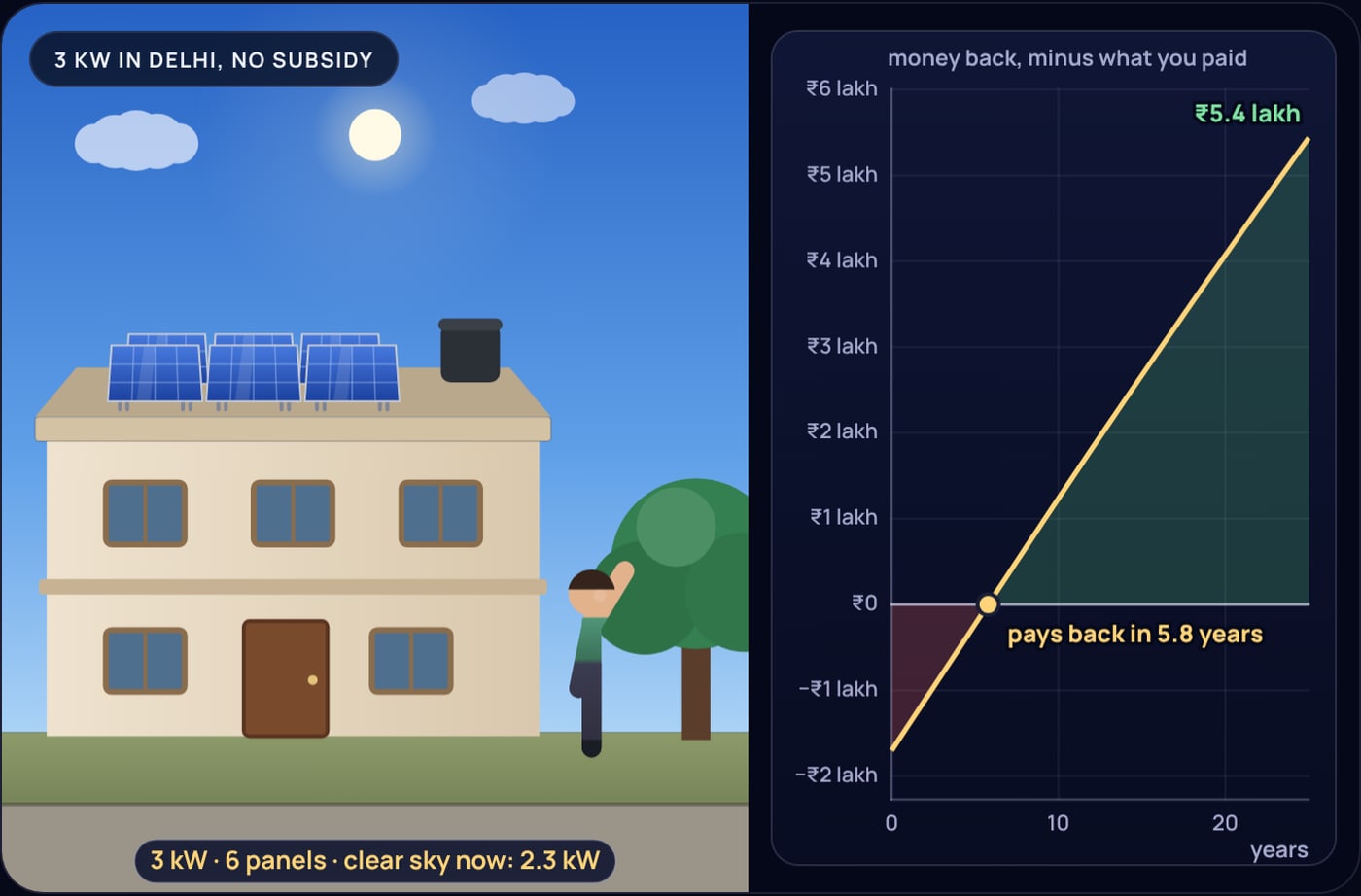
Payback is 92,100 ÷ 29,400 = 3.1 years. Without the subsidy it would be 1,70,100 ÷ 29,400 = 5.8 years.
How long does rooftop solar take to pay back?
Payback is what you paid divided by what you save each year, and what you save depends on what a unit costs you. This is where Indian slab tariffs change the answer. On a slab tariff the first units of each month are cheap, so a home that uses little electricity saves less per unit than a flat-rate example suggests.
Worked example: the same 3 kW on Delhi's slab tariff
Delhi's domestic energy charges, set by the Delhi Electricity Regulatory Commission, are ₹3.00 a unit up to 200 units and ₹4.50 from 201 to 400. For 350 units:
That is only ₹3.64 a unit on average. Solar removes it, saving 12 × 1,275 = ₹15,300 a year, so payback stretches to 92,100 ÷ 15,300 = 6.0 years.
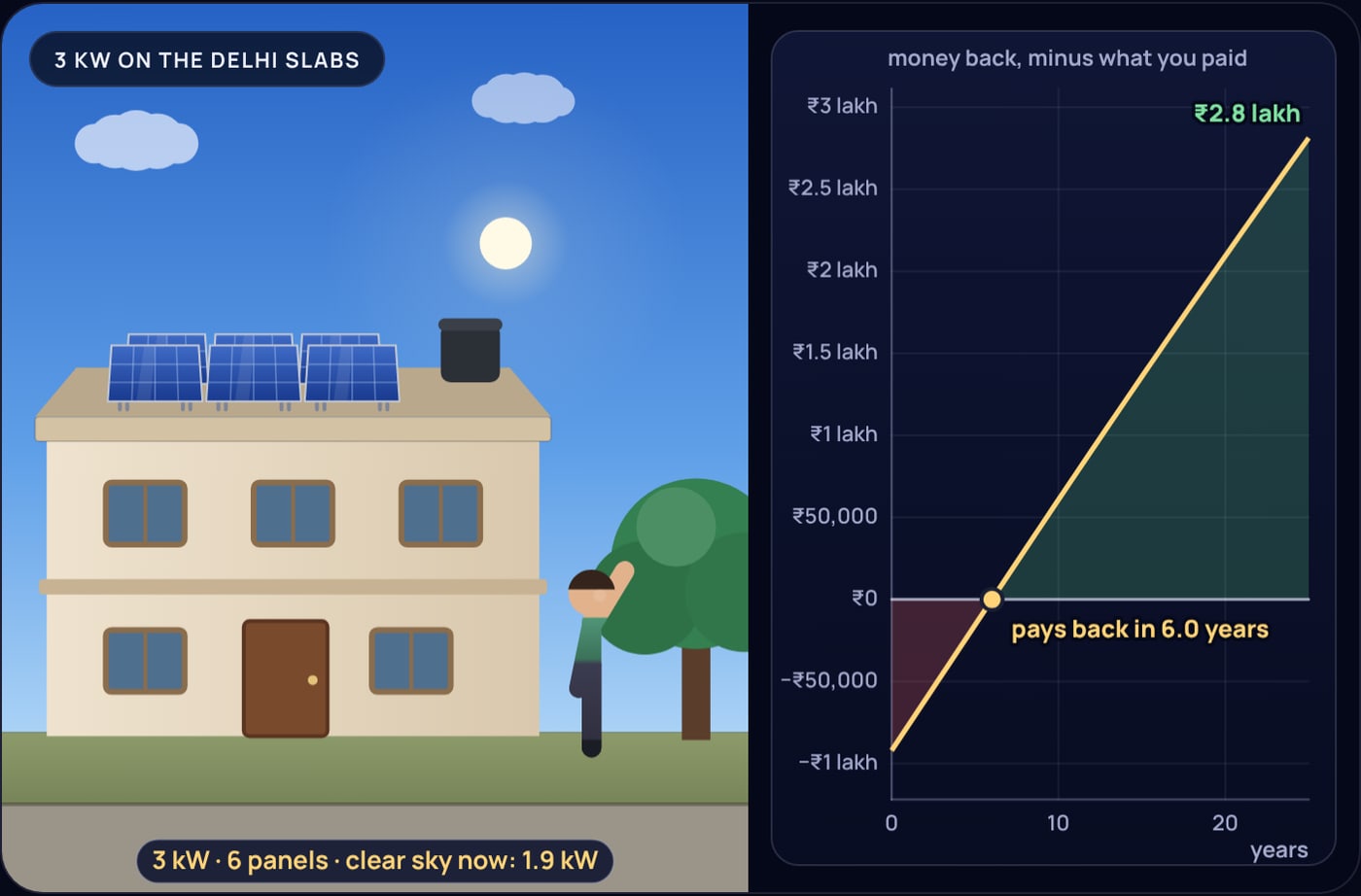
Either way the panels keep working long after payback. The calculator assumes they lose 0.5 percent of their output each year, the median in a review of field measurements by researchers at the US National Renewable Energy Laboratory, so in year 25 they still make about 89 percent of what they did in year 1. Over 25 years the Delhi system at ₹7 a unit comes out about ₹6.2 lakh ahead of what it cost. For a matching estimate of where those units go, the units a 1.5 ton AC uses per hour is often the biggest line on a summer bill.
Should you install more panels than you need?
Usually not. Units your panels make beyond what you use go to the grid, and how much they earn depends on your DISCOM's net metering rules. MNRE's FAQ notes that the bill falls to zero only in states that pay for surplus power. The calculator counts surplus units at an export rate you type, which is zero by default, so oversizing shows up as a longer payback.
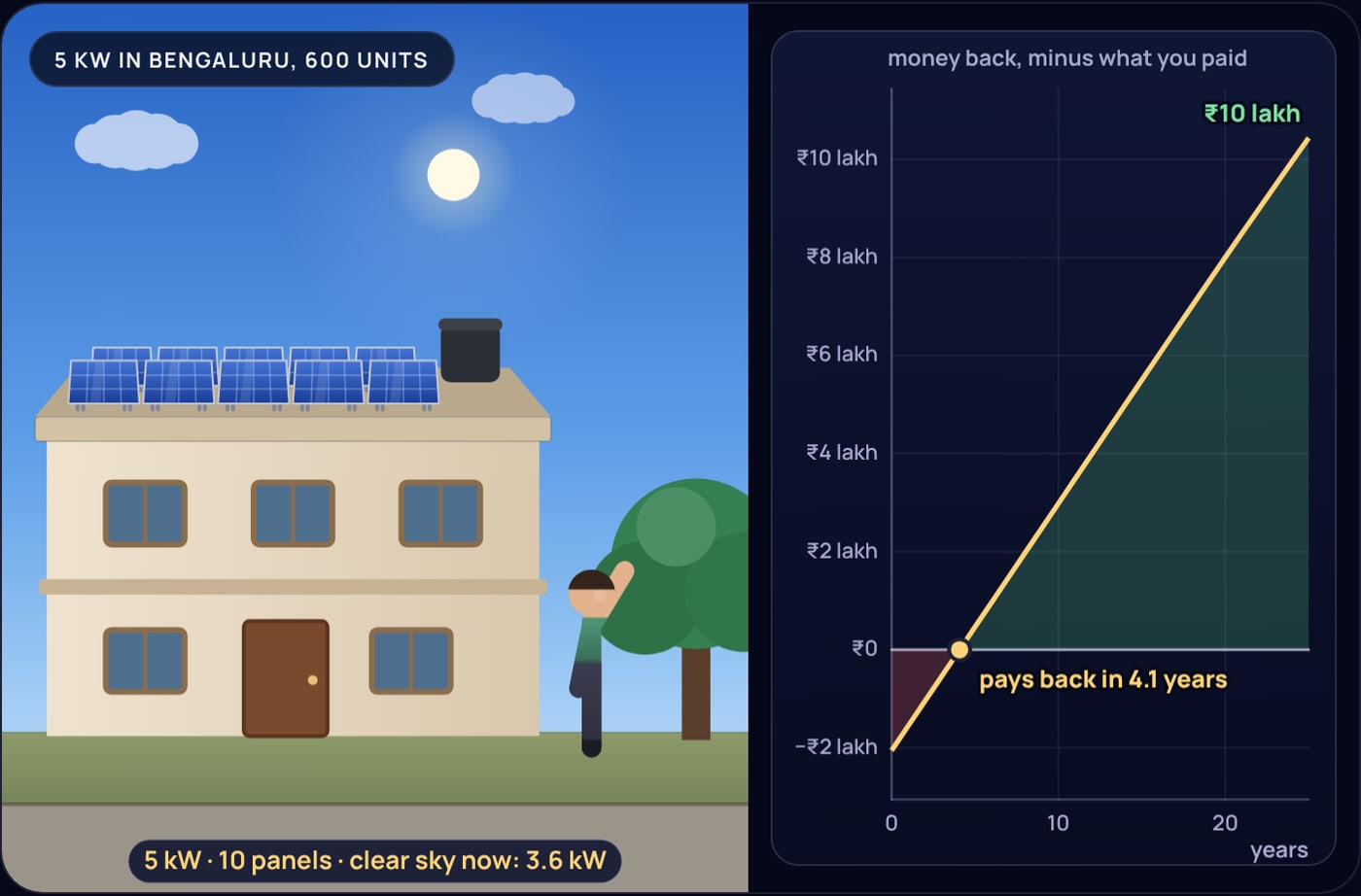
The subsidy also stops growing at 3 kW. A 5 kW system for a Bengaluru home using 600 units a month still makes sense because the house needs the units, but the subsidy covers a smaller share of the cost.
What does this estimate leave out?
- Seasons. The calculator uses a yearly average. Monsoon months make less and dry summer months more, so some bills will be lower than others.
- Your roof. Shade from water tanks, trees or a neighbour's building, and the angle your installer chooses, can cost much more than the 22 percent of losses allowed for.
- Fixed charges and tariff changes. Fixed charges stay on the bill. A future tariff rise would shorten the payback.
- Upkeep and loans. Cleaning, repairs, a replacement inverter during 25 years and loan interest are not counted.
Use the result as a sizing guide and a check on quotes. Energy in all these examples is measured in kWh, the same unit as on your bill; joules, calories and kWh explained shows how it relates to other energy units.
Try it yourself
Open the rooftop solar calculator, pick your city, type your monthly units or bill and your tariff, and slide the system size. It shows the panels and roof area, yearly generation, what you pay after the subsidy, the payback and the full working.
Sources
- World Bank and Solargis, Global Solar Atlas: long-term yearly sunlight at the optimum tilt (GTI) and PV output (PVOUT) for each city, fetched November 2026.
- Ministry of New and Renewable Energy via PIB, PM Surya Ghar: Muft Bijli Yojana turns one (12 February 2025): subsidy table and the note that a 3 kW system can generate over 300 units a month.
- MNRE, FAQ for consumers on rooftop solar: 10 m² of shadow-free area per kW, 4 to 5.5 units per kW on a clear day, net metering and minimum charges.
- IEEFA and JMK Research, Advancing residential rooftop solar adoption in India (October 2025): ₹1.7 lakh for a 3 kW system and ₹7 a unit as assumptions.
- Emmvee, Mono PERC half-cut module datasheet: 540 W model, 2,278 × 1,134 mm.
- D. C. Jordan and S. R. Kurtz, Photovoltaic Degradation Rates: An Analytical Review (NREL): median degradation of 0.5 percent a year.
- Delhi Electricity Regulatory Commission, tariff press note and schedule for 2021-22: domestic energy charges by slab.
Frequently asked questions
How many solar panels do I need for my house?
Divide a year of your units by what 1 kW of panels makes in your city, then divide the watts by the panel size. A Delhi home using 350 units a month needs about 2.9 kW, so a 3 kW system of six 540 W panels.
How many units does a 1 kW solar system make per day?
Averaged over the year, about 3.8 units a day in Kolkata or Guwahati up to about 4.7 in Ahmedabad, using Global Solar Atlas sunshine and a 78 percent performance ratio. MNRE says 4 to 5.5 units on a clear sunny day.
How much roof area do I need for a 3 kW solar system?
About 30 square metres of shadow-free roof, using MNRE’s guidance of 10 square metres per kW. Six 540 W panels cover about 15.5 square metres themselves; the rest is spacing so rows do not shade each other and room to walk.
How much subsidy is given for a 3 kW rooftop solar system?
Under PM Surya Ghar the central subsidy is ₹30,000 per kW for the first 2 kW and ₹18,000 for the third kW, so ₹78,000 for 3 kW. Systems larger than 3 kW still get ₹78,000. Some states add their own subsidy.
How long does rooftop solar take to pay back in India?
With the subsidy, about 3 to 6 years for the home systems worked out here, depending on the tariff and the sunshine. A 3 kW system in Delhi costing about ₹1.7 lakh pays back in about 3.1 years at ₹7 a unit, 5.8 years without the subsidy, and 6 years on Delhi’s cheaper slab tariff.