How Many Units Does a 1.5 Ton AC Use per Hour?
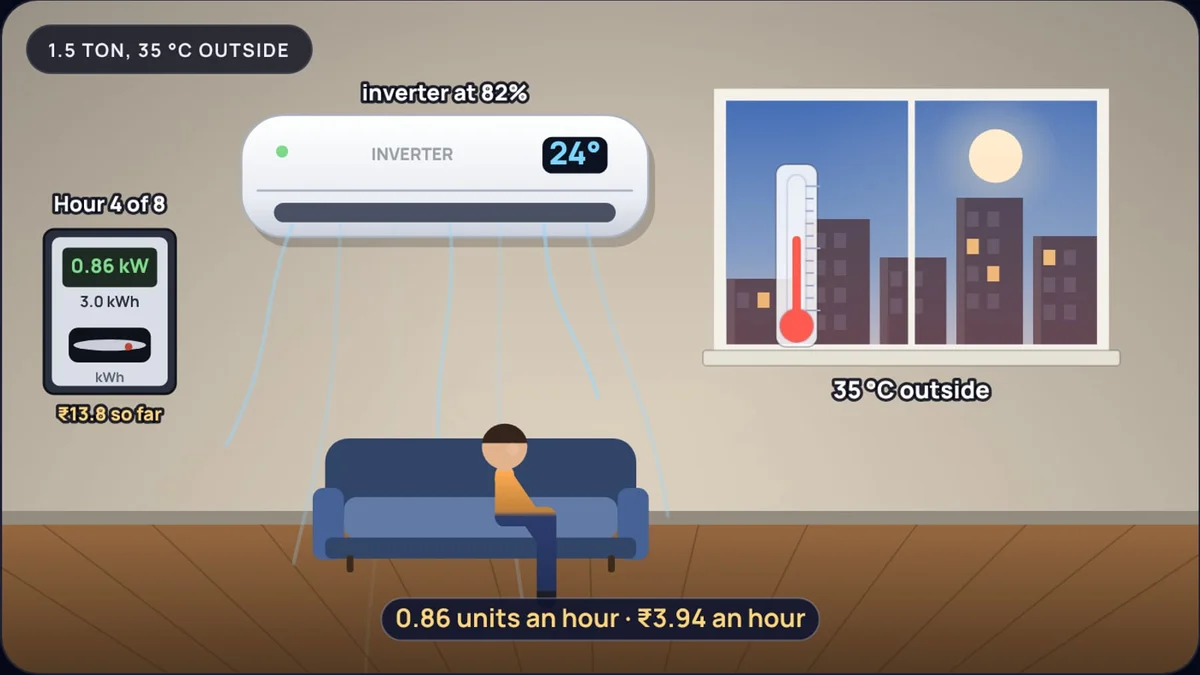
Two neighbours run the same size of AC for the same hours and get very different bills. One has a 5 star inverter model set to 24 °C; the other an older fixed-speed unit set to 18 °C. The first uses well under one unit an hour on a hot day. The second can use close to twice that.
The "1.5 ton" on the box tells you how much heat the AC can pull out of a room, not how much electricity it draws. To get from tons to units on your bill you need two more numbers: the efficiency on the star label, and how hard the AC has to work against the heat outside. This post works through both with real numbers. Every example opens in the AC running cost calculator, which shows the working and lets you type your own tariff.
How many units does a 1.5 ton AC use per hour?
A unit on an Indian electricity bill is one kilowatt-hour (kWh): a 1 kW load running for one hour. So the question is really how many kilowatts the AC draws on average. That depends on three things: how much cooling the AC can give, how efficiently it turns electricity into cooling, and what share of its full capacity the room actually needs.
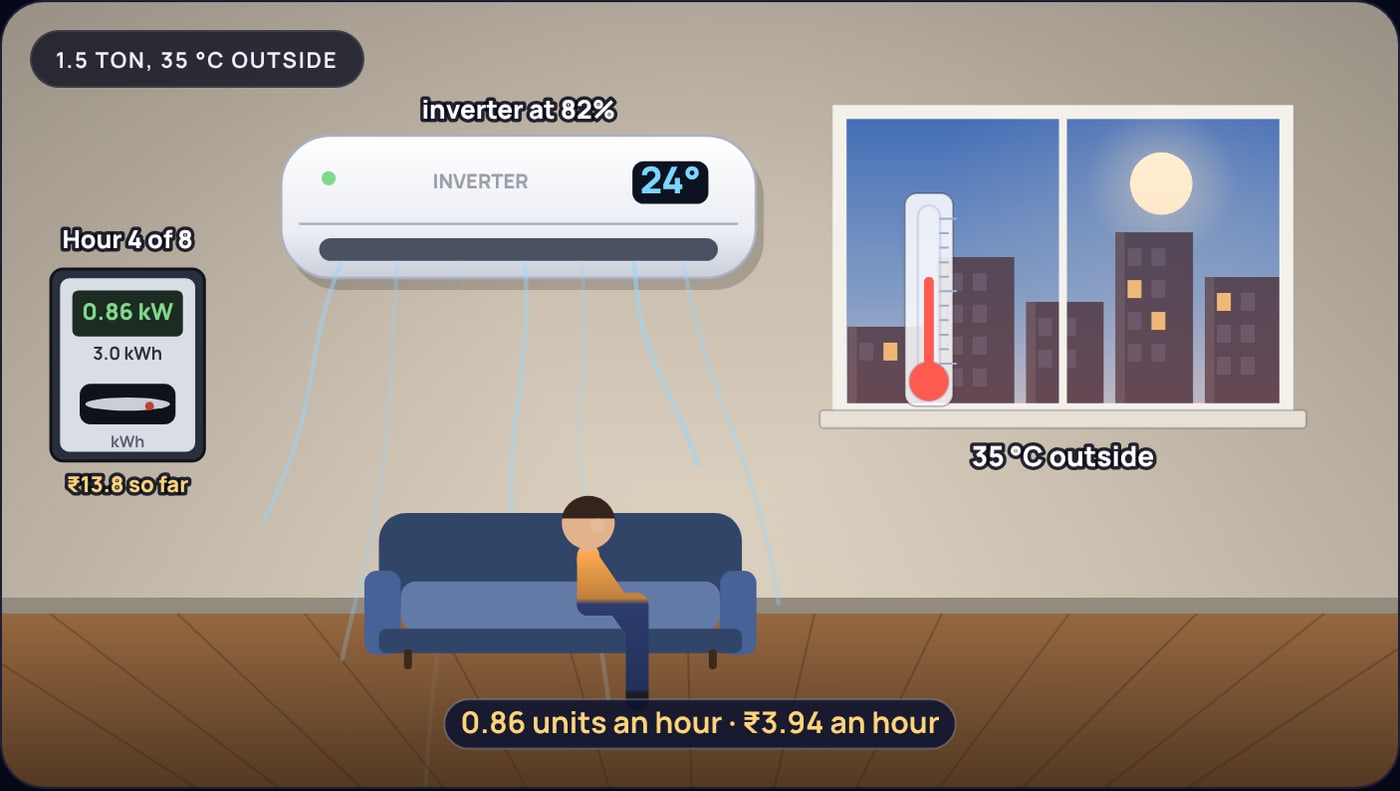
Worked example: a 1.5 ton 5 star inverter AC on a 35 °C day
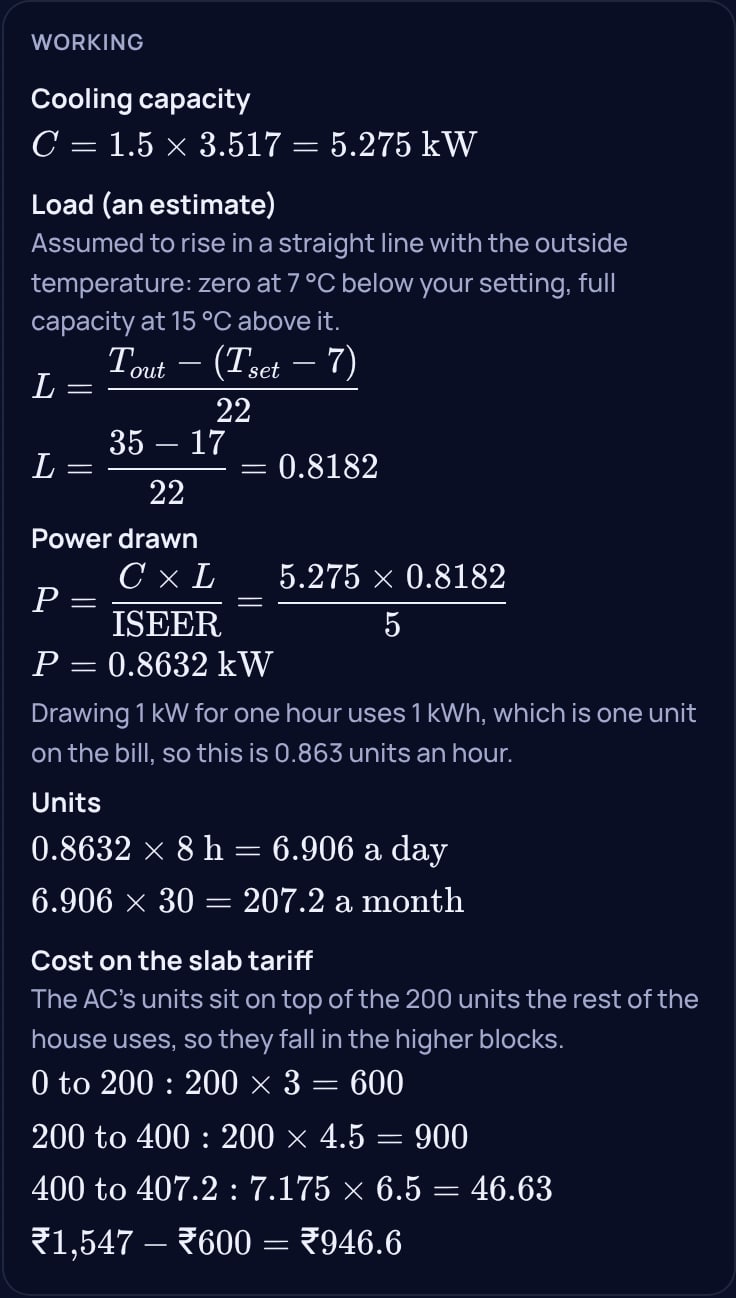
Cooling capacity: one ton of refrigeration is 3.517 kW of heat removal.
Load, as an estimate: with 35 °C outside and the room at 24 °C, the AC needs about 82 percent of its capacity (the next sections explain where this comes from).
Electricity drawn, with an ISEER of 5 from the star label:
Drawing 0.863 kW for an hour uses 0.863 kWh, so about 0.86 units an hour. Over 8 hours that is 6.9 units a day, and over 30 days about 207 units.
What does “1.5 ton” actually mean?
The ton here is a ton of refrigeration, an old unit from the days of cooling with ice. It is the cooling you would get from melting one short ton of ice over a day, defined as exactly 12,000 British thermal units per hour. NIST lists it as 3.516 853 kW. A 1.5 ton AC can therefore remove about 5.3 kW of heat from a room, and a 1 ton AC about 3.5 kW.
That is heat moved, not electricity used. An AC is a heat pump: it uses electricity to carry heat from the cool room to the hot outdoors, and it moves several kilowatts of heat for every kilowatt it draws. This is why a 1.5 ton AC does not use 5.3 units an hour, or 1.5 units an hour either. For more on how kWh relates to joules and other energy units, see joules, calories and kWh explained.
What is ISEER and how do star ratings change the units?
The ratio of heat moved to electricity used is the efficiency. Because an AC spends most of the year below full load and at many outdoor temperatures, India's Bureau of Energy Efficiency (BEE) rates it over a whole season. The Indian Seasonal Energy Efficiency Ratio, ISEER, is the heat removed over the season divided by the electricity used in that season. BEE's Schedule 24 builds that season from 1,600 hours of outdoor temperatures between 24 °C and 43 °C, most of them between 25 °C and 30 °C.
From 1 January 2021 the star bands for split ACs span ISEER values from 3.30 to 5.00, from 1 star to 5 star, according to the government’s announcement of the revised rules. A higher ISEER means fewer units for the same cooling, in direct proportion. Going from ISEER 3.3 to 5.0 cuts the units by a third.
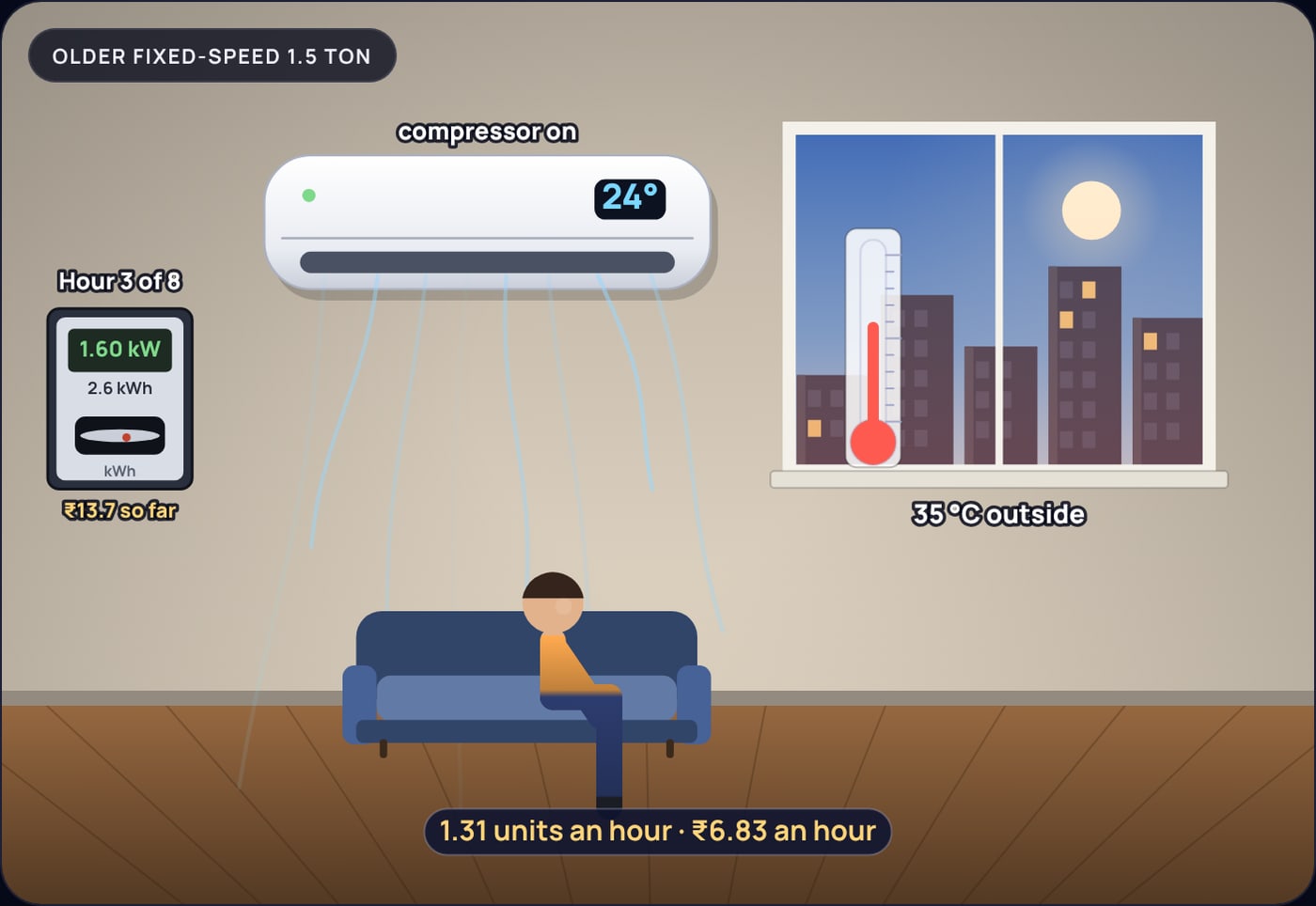
The table shows units per hour at 35 °C outside and 24 °C inside for common sizes and efficiencies. Use the ISEER printed on your AC's label rather than the star count when you can, since the label value is the measured one.
| Size | ISEER 3.3 | ISEER 4.0 | ISEER 4.5 | ISEER 5.0 |
|---|---|---|---|---|
| 1 ton | 0.87 | 0.72 | 0.64 | 0.58 |
| 1.5 ton | 1.31 | 1.08 | 0.96 | 0.86 |
| 2 ton | 1.74 | 1.44 | 1.28 | 1.15 |
Does an inverter AC really use less?
A fixed-speed AC can only be fully on or off. When the room needs 82 percent of its capacity, the compressor runs flat out for about 82 percent of the time and then stops until the room warms up again. An inverter AC slows its compressor down and runs more or less continuously at the speed the room needs.
Both remove the same heat over an hour, so the saving comes from efficiency: compressors work better at part speed, and inverter models tend to carry the higher ISEER values. The ISEER rating already includes the part-load behaviour, which is why the calculator asks for ISEER and uses the inverter switch only for the picture of the compressor cycling.
How does the outside temperature change the units?
The heat that leaks into a room through walls, windows and the roof grows with the gap between outside and inside. An exact figure needs the room's size, insulation and sun, which no simple calculator knows. So the calculator uses a stated estimate: the load rises in a straight line from zero when it is 7 °C cooler outside than your setting, to full capacity when it is 15 °C hotter. For a room at 24 °C, that is zero at 17 °C and full capacity at 39 °C.
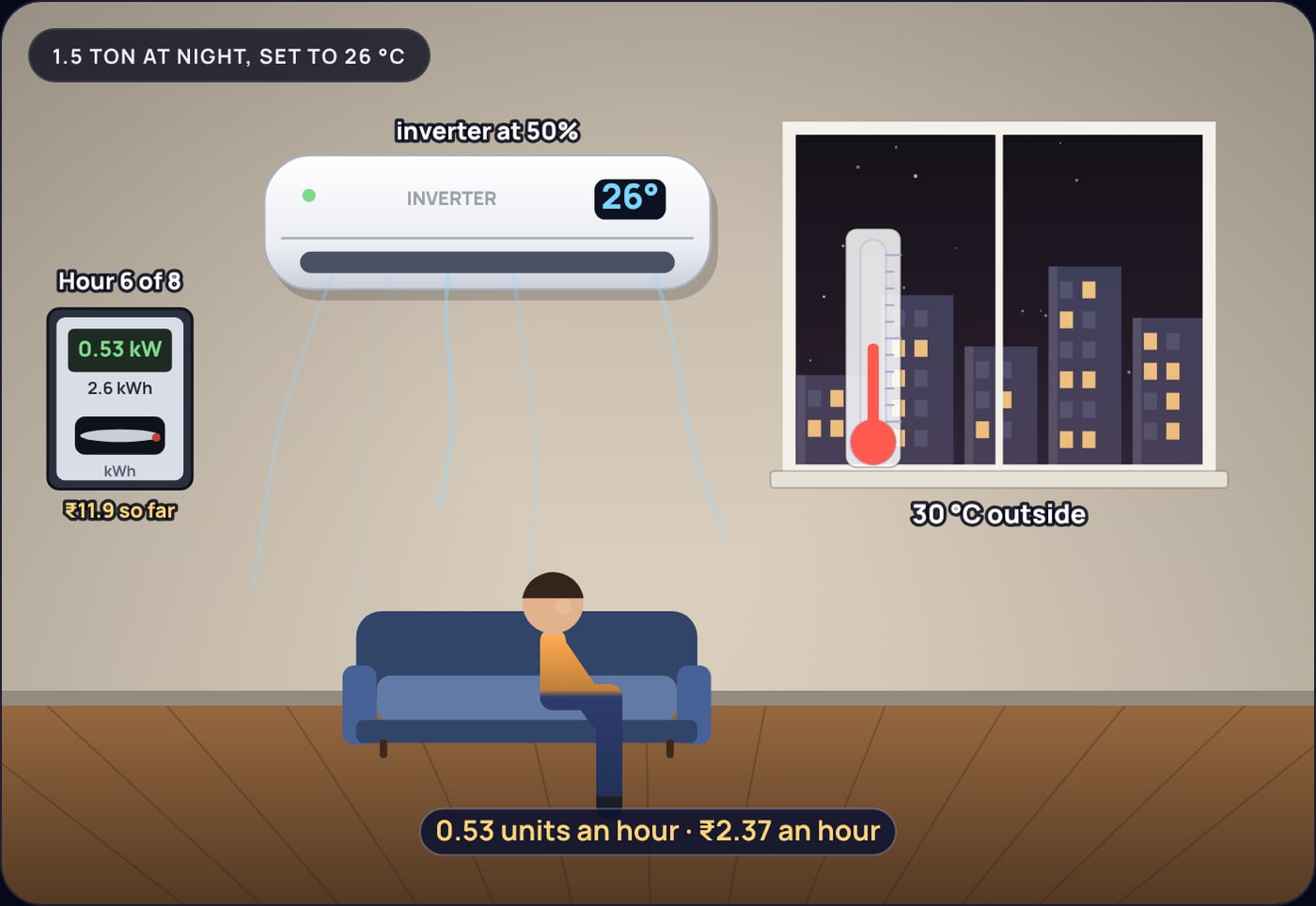
Under this estimate a 1.5 ton 5 star AC uses 1.01 units an hour on a 38 °C afternoon and 0.53 units an hour on a 30 °C night with the remote at 26 °C. Above 39 °C the AC runs flat out at about 1.05 kW and the room drifts warmer than the setting, which is the moment people notice their AC "cannot keep up".
How much does one degree on the remote save?
Raising the setting by one degree shrinks the gap the AC is fighting by one degree, and with it the load.
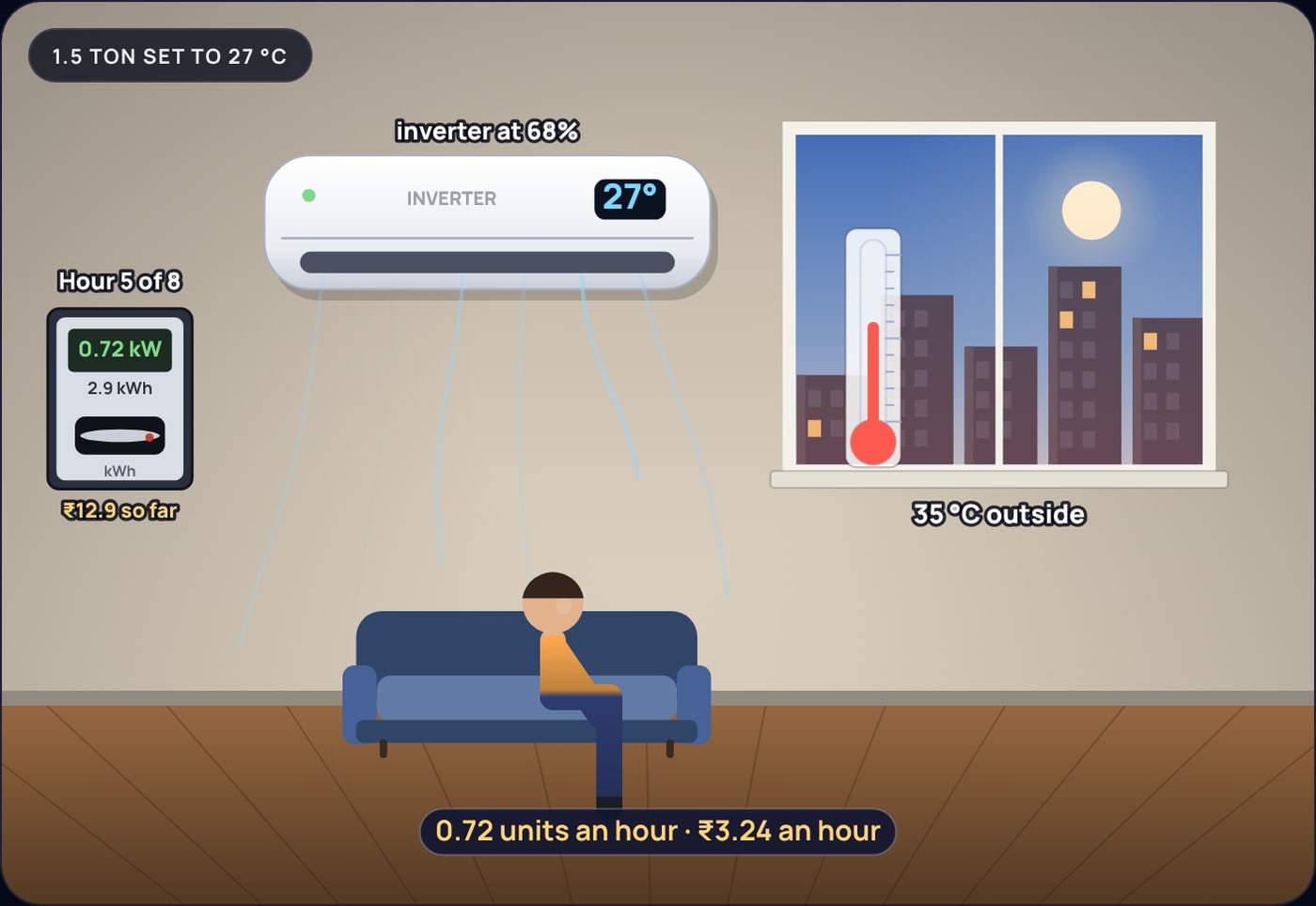
Worked example: 24 °C against 27 °C with 35 °C outside
At 24 °C the load is 18 parts in 22. At 27 °C the zero point moves up to 20 °C, so the load is 15 parts in 22.
Units an hour for the 1.5 ton 5 star AC:
That is 0.72 units an hour against 0.86, a saving of 3 parts in 18, or 17 percent. Each single degree near 24 °C saves 1 part in 18, about 5.6 percent. Over 8 hours a day for 30 days the AC uses 173 units instead of 207.
This is also why BEE made 24 °C the factory default setting for room ACs from 2020. A room set to 18 °C needs a gap of 17 degrees on a 35 °C day, and under the same estimate a 1.5 ton AC would be running flat out for the whole afternoon.
What does an AC cost per month on a slab tariff?
Most Indian states charge for domestic electricity in slabs: the first block of units is cheap, and each later block costs more. The calculator's default is the Delhi domestic schedule set by the Delhi Electricity Regulatory Commission (DERC) for 2021-22, an example as of November 2026. You can type your own state's rates.
| Units in the month | Energy charge per unit |
|---|---|
| 0 to 200 | ₹3.00 |
| 201 to 400 | ₹4.50 |
| 401 to 800 | ₹6.50 |
| 801 to 1,200 | ₹7.00 |
| Above 1,200 | ₹8.00 |
The AC's units do not start at zero. The fridge, fans, lights and TV use some units first, so the AC's share lands in the higher blocks. The calculator assumes 200 other units a month, which you can change. If you have written code for a bill like this, it is the same logic as calculating an electricity bill in Python.
Worked example: 207 AC units on top of 200 household units
The house alone uses 200 units: 200 × ₹3.00 = ₹600. With the AC the month is 407.2 units. The AC's units fill the second block and spill into the third:
So the AC adds about ₹947 a month in energy charges. At a flat ₹8 per unit the same 207 units would cost about ₹1,657. The older ISEER 3.3 AC, at 314 units, adds about ₹1,640 on the slab tariff.
These are energy charges only. Real bills also add a fixed charge per kW of sanctioned load, electricity duty and other taxes, and some states give a subsidy on the first units. DERC's schedule notes that its rates exclude duty and taxes.
How many units do 1 ton and 2 ton ACs use?
A smaller room needs less cooling, and a bigger one more. The calculator's presets give a feel for the range under the same load estimate:
- A 1 ton AC with ISEER 4.5 in a bedroom set to 26 °C, 32 °C outside: 0.46 units an hour, about 111 units a month at 8 hours a day.
- A 1.5 ton AC with ISEER 5 at 24 °C, 35 °C outside: 0.86 units an hour, 207 units a month.
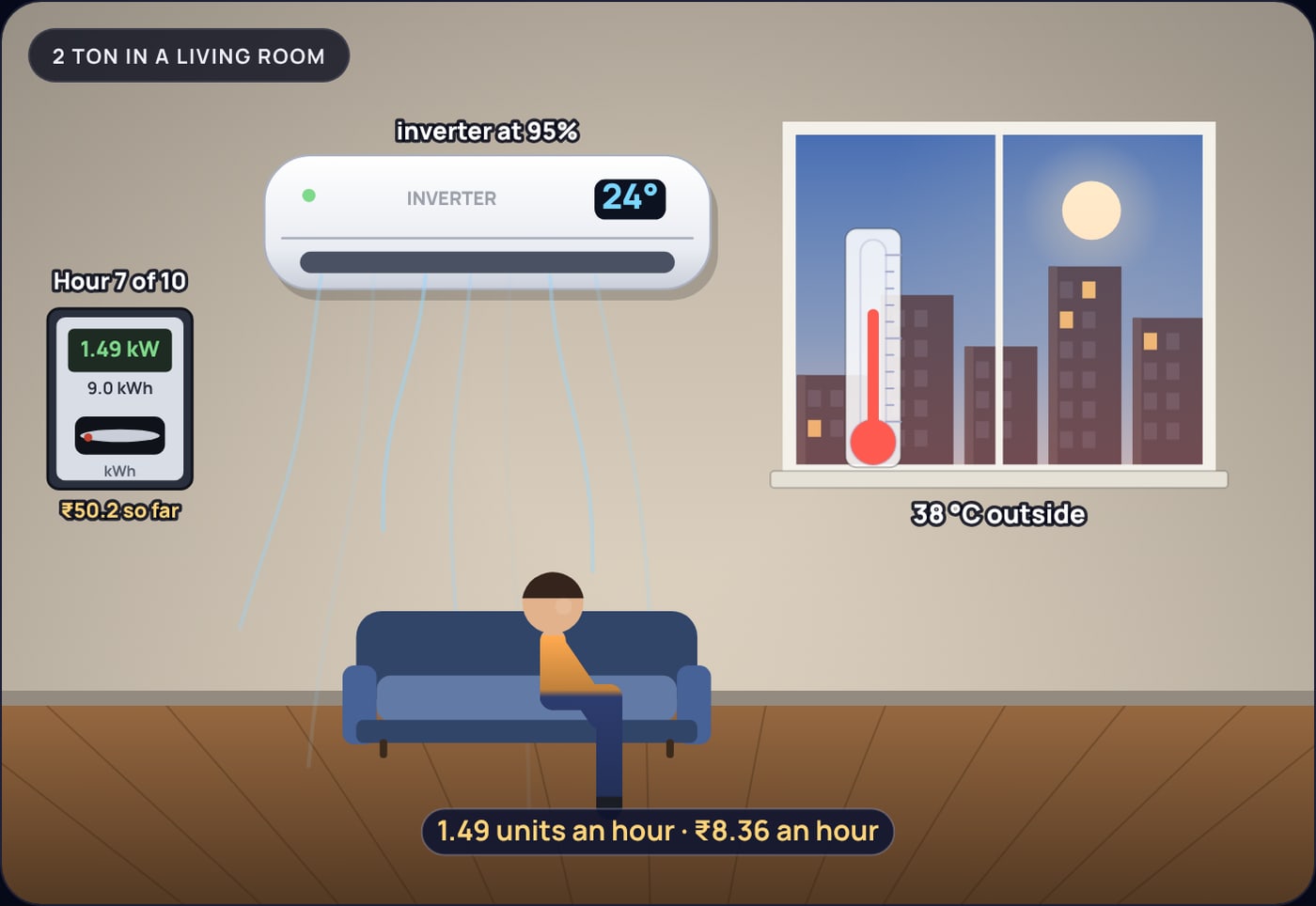
- A 2 ton AC with ISEER 4.5 in a living room on a 38 °C afternoon: 1.49 units an hour, 448 units a month at 10 hours a day, which adds about ₹2,509 on the Delhi slabs.
What does this estimate leave out?
- Your room. The straight-line load is an assumption. A top-floor flat with a west wall in the sun needs far more cooling than a shaded middle-floor bedroom at the same outdoor temperature.
- People and appliances. Each person, TV and cooking stove adds heat the AC has to remove.
- Humidity. Some of the AC's work goes into condensing moisture from the air, which is heavy in coastal cities in the monsoon.
- Efficiency at each temperature. Real ACs lose efficiency as the outdoor air gets hotter. The calculator uses the seasonal ISEER throughout, which is an average.
Use the numbers to compare choices: a better star rating, a warmer setting, fewer hours. For your real figure, read the meter before and after a few hours of AC use. If your building has a three-phase supply, the AC still sits on one phase; why three-phase power is used explains the difference.
Try it yourself
Open the AC running cost calculator, pick your AC size, type the ISEER from its label, set the hours and temperatures, and enter your state's slab rates. It shows the units, the cost, the saving per degree and the full working.
Sources
- Bureau of Energy Efficiency, Schedule 24, star labelling for room air conditioners: definition of ISEER and Table 1, the 1,600 reference bin hours from 24 °C to 43 °C.
- Press Information Bureau, revised energy performance standards for room air conditioners (6 January 2020): ISEER bands of 3.30 to 5.00 for split ACs from 1 January 2021, and the 24 °C default setting.
- Delhi Electricity Regulatory Commission, tariff order press note and schedule for 2021-22: domestic energy charges of ₹3.00 to ₹8.00 per unit by slab, exclusive of duty and taxes.
- NIST Special Publication 811, Appendix B.8 conversion factors: 1 ton of refrigeration (12,000 Btu/h) = 3.516 853 kW.
Frequently asked questions
How many units does a 1.5 ton AC use per hour?
A 1.5 ton 5 star inverter AC with an ISEER of 5 uses about 0.86 units (kWh) an hour when it is 35 °C outside and the room is set to 24 °C. An older fixed-speed AC with an ISEER of 3.3 uses about 1.31 units an hour in the same room. On a cooler night it can drop to about 0.5 units.
How many units does a 1.5 ton AC use in a month?
At 8 hours a day for 30 days, a 1.5 ton 5 star inverter AC uses about 207 units a month on 35 °C days. An older 1 star or fixed-speed AC uses about 314 units for the same cooling.
Does a 1.5 ton AC use 1.5 units per hour?
No. Tons measure cooling, not electricity. A 1.5 ton AC moves about 5.3 kW of heat out of the room, and with an ISEER of 5 it needs only about a fifth of that as electricity at full load, about 1.05 kW. Most of the time it runs below full load, so it uses less.
How much does setting the AC to 27 °C instead of 24 °C save?
With 35 °C outside, about 17 percent of the units. A 1.5 ton 5 star inverter AC drops from 0.86 to 0.72 units an hour, which over 8 hours a day for a month saves about 35 units, or roughly ₹170 on the Delhi slab tariff.
What does ISEER mean on an AC star label?
ISEER is the Indian Seasonal Energy Efficiency Ratio: the heat an AC removes over a cooling season divided by the electricity it uses in that season. BEE rates it over 1,600 hours at outdoor temperatures from 24 °C to 43 °C. Under the rules in force from 2021, the star bands for split ACs span ISEER values from 3.30 (1 star) to 5.00 (5 star).