How many units does an AC use per hour?
Divide the cooling the AC is actually delivering by its efficiency. A 1.5 ton AC has 5.28 kW of cooling capacity (1 ton is 3.517 kW). On a 35 °C day with the remote at 24 °C, the calculator estimates it works at about 82% of capacity, so an AC with an ISEER of 5.0 draws 0.86 kW: 0.86 units an hour, or 207 units a month at 8 hours a day. An older AC with an ISEER of 3.3 uses 1.31 units an hour for the same cooling.
Set your own tonnage, ISEER (printed on the BEE star label), hours, thermostat and outdoor temperature, and your tariff as slabs or a flat rate in any currency. The meter on the stage runs through the AC's day, one second per hour. The load part is an estimate, so treat the answers as a good guide rather than a meter reading. For the longer explanation, read how many units a 1.5 ton AC uses per hour.
Key results from the calculator
- 1.5 ton, ISEER 5.0, 35 °C outside, set to 24 °C: about 0.86 units an hour, 6.9 a day for 8 hours, ₹947 a month on the Delhi example slabs.
- The same AC set to 27 °C: 0.72 units an hour, about 17% less. Each degree warmer saves roughly 6% in this estimate.
- An older 1.5 ton with ISEER 3.3: 1.31 units an hour, 52% more than ISEER 5.0 for the same cooling.
- At night (30 °C outside, set to 26 °C): 0.53 units an hour, about half the afternoon figure.
Six examples, worked
Each example uses 8 hours a day, 30 days a month and, for cost, the Delhi slab rates on top of 200 units of other household use, unless it says otherwise. The button loads it.
A 1.5 ton inverter AC on a 35 °C day
ISEER 5.0, set to 24 °CCapacity: 1.5 × 3.517 = 5.28 kW. Load: (35 − 17) ÷ 22 = 0.82, so the AC delivers about 4.32 kW of cooling. Power: 4.32 ÷ 5.0 = 0.86 kW.
Over 8 hours that is 6.9 units a day and 207 a month. On top of 200 other units, the Delhi slabs charge them at ₹4.50 and ₹6.50, adding ₹947.
The same AC on a 38 °C afternoon
ISEER 5.0, set to 24 °CThree degrees hotter outside raises the load to 0.95, and the power to 1.01 kW. Close to 39 °C this AC reaches its full capacity; beyond that it cannot hold 24 °C and the room warms up.
That is 242 units and ₹1,171 a month if every day were like this.
An older fixed-speed AC with ISEER 3.3
1.5 ton, 35 °C, set to 24 °C3.30 was the lowest ISEER a split AC could have to get a star label from 2021. For the same 4.32 kW of cooling it draws 4.32 ÷ 3.3 = 1.31 kW.
A fixed-speed compressor gives that average by switching on and off, running about 82% of the time. The month costs ₹1,640 against ₹947 for ISEER 5.0.
Turning the thermostat up to 27 °C
1.5 ton, ISEER 5.0, 35 °CAt 27 °C the room is 8 °C cooler than outside instead of 11 °C, so the load falls to 0.68 and the power to 0.72 kW.
The month drops to 173 units and ₹777, a saving of ₹170 against 24 °C.
A 1 ton AC in a bedroom
ISEER 4.5, 32 °C, set to 26 °C1 ton is 3.52 kW. At 32 °C outside and 26 °C inside the load is 0.59, so the power is 2.08 ÷ 4.5 = 0.46 kW.
8 hours a night is 3.7 units, and ₹499 a month on the example slabs.
A 2 ton AC in a living room, 10 hours a day
ISEER 4.5, 38 °C, set to 24 °C2 tons is 7.03 kW. At a load of 0.95 it draws 1.49 kW, 14.9 units over 10 hours.
The month's 448 units push the bill into the ₹6.50 and ₹7.00 blocks, adding ₹2,509.
Units per hour by tonnage and ISEER (35 °C outside, set to 24 °C)
| Tonnage | Capacity | ISEER 3.3 | ISEER 4.0 | ISEER 5.0 | ISEER 5.5 |
|---|---|---|---|---|---|
| 0.75 ton | 2.64 kW | 0.65 | 0.54 | 0.43 | 0.39 |
| 1 ton | 3.52 kW | 0.87 | 0.72 | 0.58 | 0.52 |
| 1.5 ton | 5.28 kW | 1.31 | 1.08 | 0.86 | 0.78 |
| 2 ton | 7.03 kW | 1.74 | 1.44 | 1.15 | 1.05 |
Estimates from the calculator with the load at about 82% of capacity (35 °C outside, 24 °C inside). Multiply by your hours for units a day. Nominal capacity is tons × 3.517 kW; the rated capacity on your label may be a little lower.
How the calculator works
Capacity is the tonnage times 3.517 kW, because 1 ton of refrigeration is 12,000 Btu per hour (NIST SP 811). ISEER, the Indian Seasonal Energy Efficiency Ratio printed on BEE star labels, is the heat an AC removes over a cooling season divided by the electricity it uses over the same season.
The cooling the room needs is the uncertain part, so the calculator estimates it: the load rises in a straight line with the outdoor temperature, from zero at 7 °C below your setting to full capacity at 15 °C above it. With the remote at 24 °C that is zero at 17 °C outside and full capacity at 39 °C. The power drawn is capacity × load ÷ ISEER, and a kilowatt for an hour is one unit (kWh).
Above full load the AC runs flat out and the room drifts above the set point; the calculator flags this. An inverter AC slows its compressor to match a part load; a fixed-speed AC switches on and off. ISEER already averages over part loads, so the calculator uses it for both and the difference shows up through the ISEER you enter.
For cost, a flat rate simply multiplies. On a slab tariff the AC’s units are added on top of the rest of the household’s monthly units, so they are charged at the higher block rates. The defaults are the Delhi domestic energy charges in the DERC tariff schedule (₹3.00 for the first 200 units up to ₹8.00 above 1,200), an example as of November 2026, without fixed charges, surcharges or tax.
As a rough check, the calculator also runs your AC through the hours of BEE’s reference season, 1,600 hours at outdoor temperatures from 24 °C to 43 °C, using the same load estimate with the room at 27 °C. The yearly units printed on a star label come from the same 1,600 hours but from BEE’s own test method, so treat the two as ballpark matches, not equals.
What the model leaves out
- Your room: sun on the walls, insulation, the number of people and how often doors open all change the load. The straight-line load is an estimate, not a measurement.
- Efficiency at each load: ISEER is a season average. An inverter AC is less efficient than its ISEER at full load and more efficient at low load, so hour-by-hour figures are rough.
- Fixed charges, surcharges and taxes: only the energy charge per unit is counted.
- Humidity and standby: removing moisture and the small standby draw are not modelled separately.
Common misconceptions
"A 1.5 ton AC uses 1.5 units an hour." Tons measure cooling, not electricity. A 1.5 ton AC delivers up to 5.3 kW of cooling but draws only a fraction of that, roughly 1 kW at full load for an efficient model.
"Setting 18 °C cools the room faster." The AC cools at its full capacity either way until it reaches the setting; a lower setting just keeps it running longer.
"Inverter ACs always use half the power." The saving depends on how much of the time the AC runs at part load, and it shows up in the ISEER on the label.
Frequently asked questions
How many units does a 1.5 ton AC use per hour?
Roughly 0.53 to 1.01 units an hour for an efficient (ISEER 5.0) inverter model, depending on the weather and thermostat, and about 1.31 for an older ISEER 3.3 model on a 35 °C day. These are estimates; the calculator shows the working.
How much does it cost to run an AC for 8 hours?
A 1.5 ton ISEER 5.0 AC at 35 °C outside and 24 °C inside uses about 6.9 units in 8 hours. At ₹8 a unit that is ₹55; at ₹5 it is ₹35.
What is ISEER?
The Indian Seasonal Energy Efficiency Ratio: the heat an AC removes over a cooling season divided by the electricity it uses. BEE rates it over 1,600 hours at outdoor temperatures from 24 °C to 43 °C. Higher is better; it is printed on the star label.
Does setting the AC to 24 °C save electricity?
Yes. In this estimate each degree warmer cuts the units by about 6% on a 35 °C day, so 27 °C uses about 17% less than 24 °C.
Is an inverter AC worth it?
An inverter AC runs its compressor slower at part load instead of switching on and off, which raises its seasonal efficiency. Compare the ISEER on the two labels: the units scale with 1 ÷ ISEER, so ISEER 5.0 uses about a third less than ISEER 3.3.
Keep learning
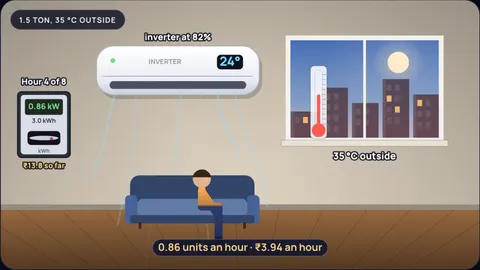
How Many Units Does a 1.5 Ton AC Use per Hour?
A 1.5 ton 5 star inverter AC uses about 0.86 units an hour at 35 °C outside and 24 °C inside. Worked examples for star ratings, thermostat and tariffs.
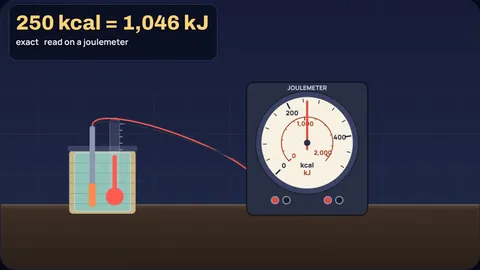
Joules, Calories and kWh: Energy Units Explained
What a joule, a calorie, a food Calorie, a kilowatt hour, an electronvolt and a Btu are, the exact factors between them, and worked conversions.

write a program to calculate electricity bill in python
Introduction In our increasingly digitized world, the ability to automate mundane tasks through programming has become an invaluable skill. One such p

Why Is Three-Phase Power Used? The Real Reasons
Three-phase power delivers constant power and a rotating field for motors. The copper saving is real but depends on what you compare. Worked numbers here.