Is an EV cheaper to run than petrol?
Yes, by a wide margin per kilometre, but the higher purchase price takes years to win back. An Ather 450X charged at home at ₹7 a unit costs about ₹0.27 a km, against ₹1.70 for a Honda Activa 110 at ₹102.12 a litre. At 800 km a month that saves ₹13,793 a year, and the scooter's ₹64,726 higher price comes back in about 4.7 years. A Nexon EV against a Nexon petrol saves more in rupees, ₹76,158 a year at 1,000 km a month.
Change the kilometres, the efficiency of each vehicle, the petrol price, your home tariff (flat or slab) and how much you charge at public fast chargers. The running totals on the stage count through a year of driving. The vehicle figures are examples as of November 2026 with sources below; type your own. For the longer explanation, read is an electric scooter really cheaper to run than petrol.
Key results from the calculator
- Electric scooter: ₹0.27 a km for an Ather 450X charged at home against ₹1.70 for an Activa 110, about 16% of the petrol cost.
- Electric car: ₹1.00 a km for a Nexon EV charged at home against ₹7.35 for the petrol Nexon on Autocar's highway figure.
- Public fast charging cuts the gap: at ₹22 a kWh the Nexon EV costs ₹3.14 a km, still less than half the petrol cost, but the break-even stretches to 7.1 years.
- Break-even takes years, not months: about 4.7 years for the scooter at 800 km a month and 4.7 years for the car at 1,000 km a month.
Six examples, worked
Each example uses petrol at ₹102.12 a litre, home charging at ₹7 a unit, 90% charging efficiency and fast charging at ₹22 a kWh unless it says otherwise. The button loads it.
Ather 450X against Honda Activa 110
800 km a month, home chargingThe 2.9 kWh battery gives 85 km in Ride mode, so 3.41 kWh per 100 km, or 0.0379 kWh a km from the wall after 90% charging efficiency. At ₹7 a unit that is ₹0.27 a km.
The Activa does 60 km a litre, so ₹1.70 a km. At 800 km a month the scooter saves ₹1,149 a month and wins back its ₹64,726 higher price in 4.7 years.
Ola S1 Pro on its certified range
4 kWh over 242 kmOn its certified IDC range the S1 Pro uses 1.65 kWh per 100 km, which makes it look very cheap: ₹0.13 a km. Certified ranges are measured on a slow standard cycle, and real riding uses more.
Even so, the saving is set mostly by the petrol you no longer buy: ₹15,107 a year, against ₹13,793 for the Ather on its real-world range.
The Ather on the Delhi slab tariff
on top of 200 household unitsThe scooter adds only 30 units a month. On top of 200 other units they fall in Delhi's ₹4.50 block, so charging costs ₹136 a month, ₹0.17 a km.
Cheaper units shorten the break-even a little, to 4.4 years.
Tata Nexon EV against the Nexon petrol
1,000 km a month, home charging45 kWh over Tata's real-world estimate of 350 km is 12.86 kWh per 100 km, 0.1429 kWh a km from the wall: ₹1.00 a km at ₹7 a unit. The petrol Nexon at 13.9 km a litre costs ₹7.35 a km.
That saves ₹6,347 a month. The EV's price gap of about ₹3.59 lakh comes back in 4.7 years.
The Nexon pair on certified figures
489 km MIDC against 17.44 km/l ARAIBoth certified figures are kinder than real driving. On them the EV costs ₹0.72 a km and the petrol car ₹5.86.
Because the petrol figure improves more, the yearly saving falls to ₹61,679 and the break-even stretches to 5.8 years.
The Nexon EV charged only at public fast chargers
₹22 a kWhAt ₹22 a kWh instead of ₹7 the same 143 units cost ₹3,144 a month, ₹3.14 a km.
The EV still saves ₹50,438 a year, but the break-even moves out to 7.1 years. Home charging is what makes an EV cheap to run.
Cost per km at different charging prices (Ather 450X and Nexon EV)
| Price per unit | Ather 450X | Nexon EV | Activa 110 (petrol) | Nexon (petrol) |
|---|---|---|---|---|
| ₹5 | ₹0.19 | ₹0.71 | ₹1.70 | ₹7.35 |
| ₹7 | ₹0.27 | ₹1.00 | ₹1.70 | ₹7.35 |
| ₹10 | ₹0.38 | ₹1.43 | ₹1.70 | ₹7.35 |
| ₹15 | ₹0.57 | ₹2.14 | ₹1.70 | ₹7.35 |
| ₹22 | ₹0.83 | ₹3.14 | ₹1.70 | ₹7.35 |
Electric cost per km is kWh per 100 km ÷ 100 ÷ 0.9 charging efficiency × the price per unit. Petrol at ₹102.12 a litre (Delhi, October 2026).
How the calculator works
An EV’s energy use is its battery size divided by the range it gets, in kWh per 100 km. Charging loses some energy in the charger and battery, so the units drawn from the wall are higher: the calculator divides by a charging efficiency, 90% by default, close to the Idaho National Laboratory’s measurement of an onboard charger.
Units from the wall times the price per unit gives the charging cost. Home charging can be a flat rate or a slab tariff, where the EV’s units are added on top of the rest of the household’s units. A share of public fast charging is priced at the fast-charger rate.
Petrol cost per km is the petrol price divided by km per litre. The monthly saving is the petrol bill minus the charging bill for the same distance.
Break-even is the extra purchase price of the EV divided by the monthly saving, shown in months or years, and as the kilometres driven by then.
What the model leaves out
- Insurance, servicing and tyres: EVs usually need less servicing, but none of these costs are counted.
- Battery replacement and resale value: both can change the long-run answer a lot and are hard to predict.
- Subsidies, road tax and loan interest: use the on-road prices you are quoted in the price gap.
- How you drive: traffic, speed, air conditioning and riding mode change both the EV’s and the petrol vehicle’s figures.
Common misconceptions
"Certified range tells you the cost." Certified IDC and MIDC ranges come from slow standard cycles. Real riding uses more energy, so use a real-world range where you can.
"Public charging is as cheap as home charging." Public fast chargers in India cost roughly three times a typical home unit, which can more than triple the cost per km.
"An EV pays for itself in a year." The running saving is large, but on typical distances the higher price takes several years to win back.
Frequently asked questions
Is an electric scooter cheaper to run than petrol?
Yes. An Ather 450X charged at home at ₹7 a unit costs about ₹0.27 a km against ₹1.70 for a Honda Activa 110 at ₹102.12 a litre, about 16% of the petrol cost.
How much does it cost to charge an electric scooter?
A full charge of a 2.9 kWh battery takes about 3.2 units from the wall with 90% charging efficiency, about ₹23 at ₹7 a unit.
What is the cost per km of an electric car in India?
About ₹1.00 a km for a Tata Nexon EV charged at home at ₹7 a unit, and about ₹3.14 at a ₹22 public fast charger.
How long does an EV take to pay back its higher price?
In these examples about 4.7 years for an electric scooter at 800 km a month and 4.7 years for an electric car at 1,000 km a month. The more you drive, the sooner it pays back.
Is fast charging expensive?
Public DC fast chargers typically cost ₹20 to ₹25 a kWh, according to the charging network ChargeZone, about three times a typical home unit. Charging mostly at home is what keeps an EV cheap to run.
Keep learning
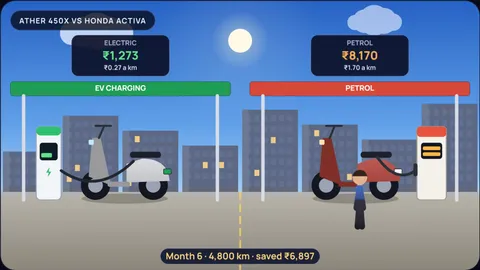
Is an Electric Scooter Really Cheaper to Run Than Petrol?
An Ather 450X costs about ₹0.27 a km charged at home against ₹1.70 for a petrol Activa. Worked examples, break-even on the price, and electric cars.
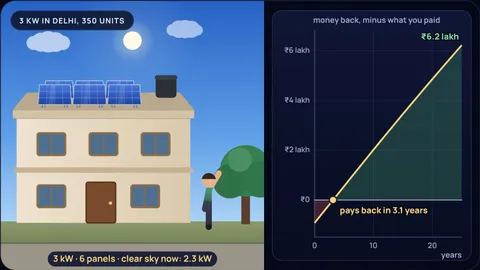
How Many Solar Panels Do I Need for My House?
Size rooftop solar from your bill: 350 units a month in Delhi needs about 3 kW, six 540 W panels. Generation, roof, subsidy and payback worked out.
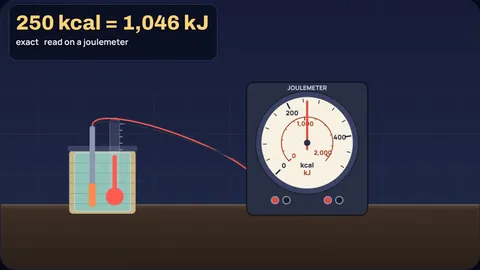
Joules, Calories and kWh: Energy Units Explained
What a joule, a calorie, a food Calorie, a kilowatt hour, an electronvolt and a Btu are, the exact factors between them, and worked conversions.

LiPo C Rating Explained: Current, Sag and Real Limits
A 5000 mAh 50C LiPo is rated for 250 A, but at 3 milliohms per cell that current sags each cell by 0.75 V. What the C rating means and how to check it.