Is an Electric Scooter Really Cheaper to Run Than Petrol?
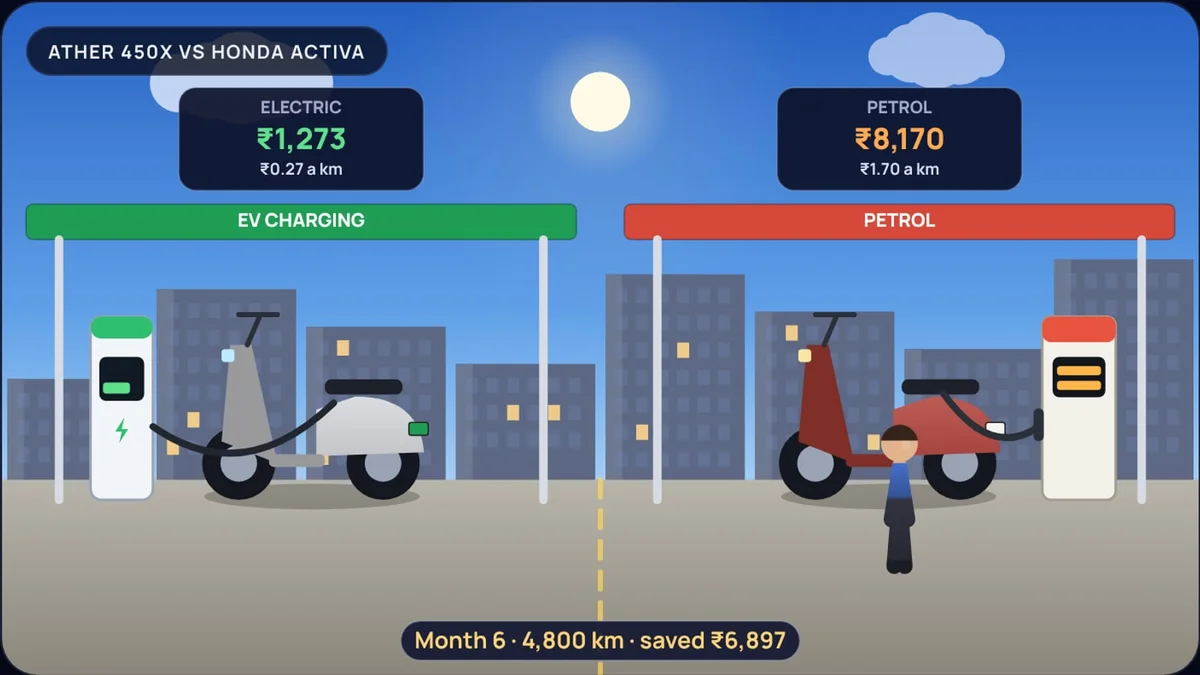
Ask an electric scooter owner what charging costs and you will often hear a number that sounds like a typo: about twenty rupees for a full battery. Ask a petrol scooter owner what a fill-up costs and the answer is several hundred. Both are right. The real question is whether that difference per kilometre makes up for the higher price of the electric scooter, and how long it takes.
This post works it out with figures from maker spec sheets and road tests, using an Ather 450X and a Honda Activa 110 as the main pair, and a Tata Nexon EV and Nexon petrol for comparison. Every example opens in the EV vs petrol calculator, where you can type your own kilometres, petrol price and electricity tariff.
Is an electric scooter really cheaper to run than petrol?
Running cost per kilometre comes down to two divisions. For petrol, divide the price of a litre by the kilometres it takes you. For electricity, divide the battery energy by the range, allow for charging losses, and multiply by the price of a unit.
Worked example: Ather 450X against Honda Activa 110
Ather's spec sheet gives the 450X a 2.9 kWh battery and a TrueRange of 85 km in Ride mode. The Activa returned 60 km a litre in Autocar India's test. Petrol is ₹102.12 a litre in Delhi.
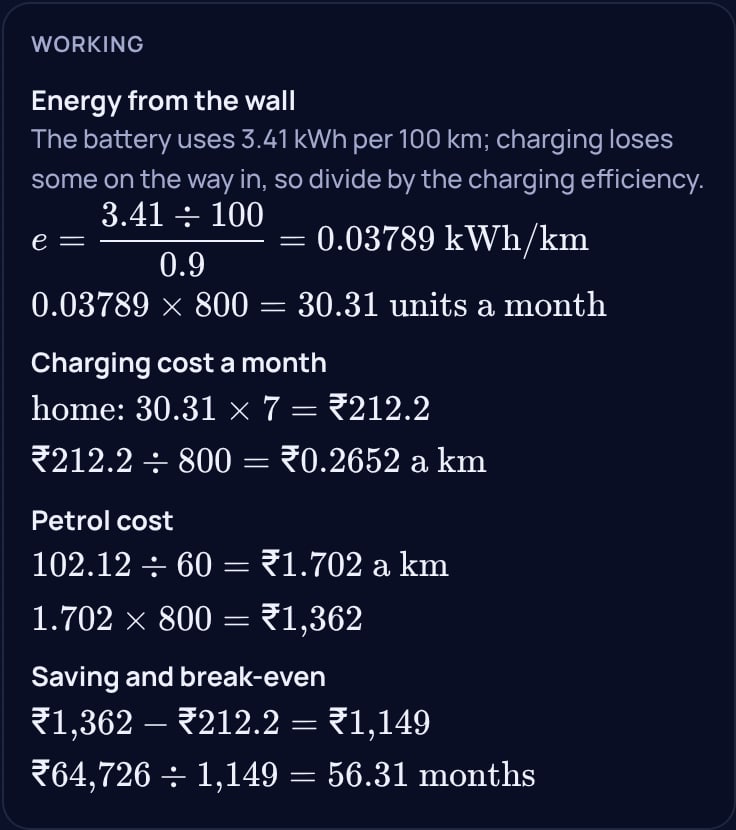
The scooter uses 2.9 ÷ 85 = 0.0341 kWh a km from its battery. Charging loses about a tenth, so it draws 0.0341 ÷ 0.9 = 0.0379 units a km from the wall. At ₹7 a unit:
The electric scooter costs about 16 percent of the petrol one per kilometre. At 800 km a month that is ₹212 of electricity against ₹1,362 of petrol, a saving of ₹1,149 a month.
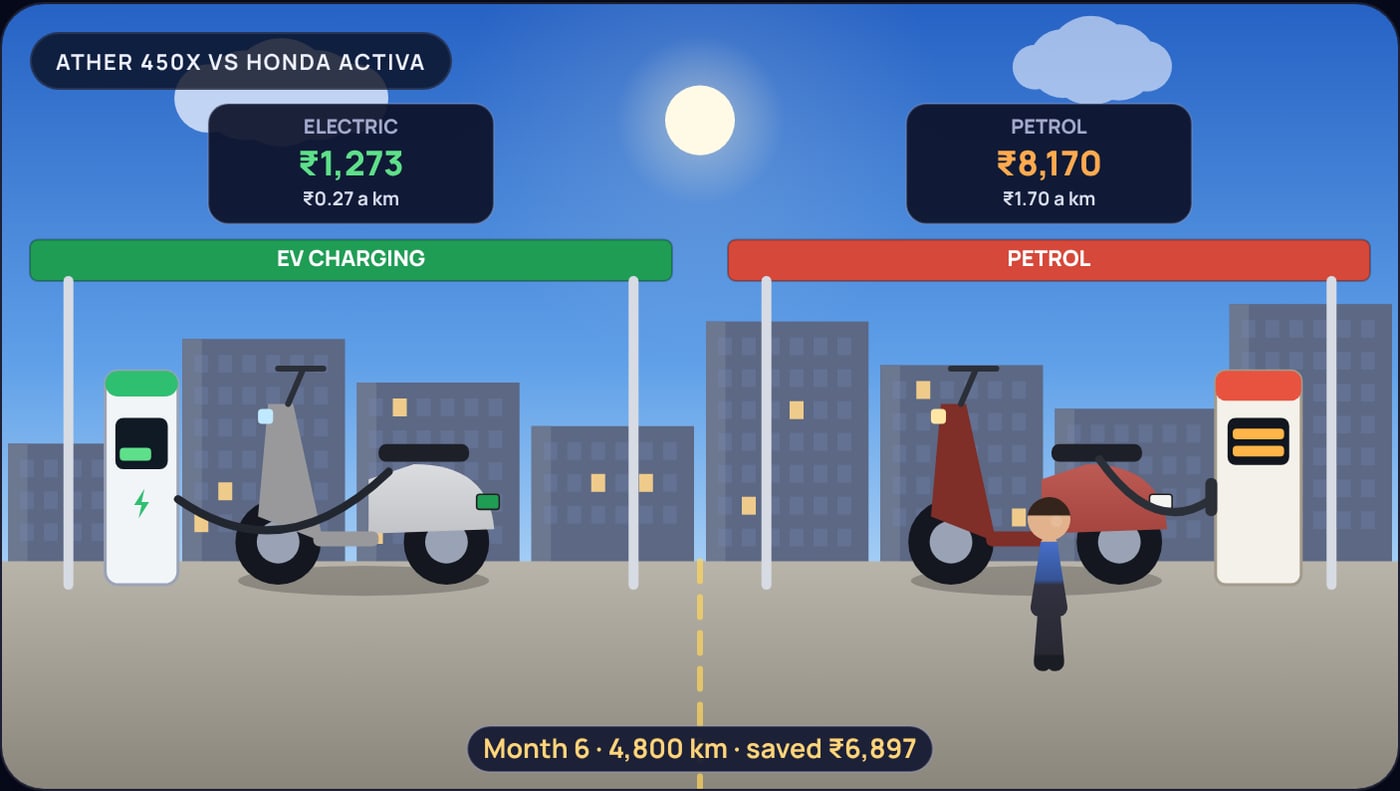
How much electricity does an electric scooter use?
Very little, by household standards. At 0.0379 units a km, 800 km a month adds about 30 units to the bill, about what a 1.5 ton AC uses in four and a half 8-hour days (see how many units a 1.5 ton AC uses per hour). A full charge of the 2.9 kWh battery takes about 3.2 units from the wall, or about ₹23 at ₹7 a unit.
The 10 percent charging loss is a round figure. When the Idaho National Laboratory benchmarked the onboard charger of a Chevrolet Volt, it measured about 90 to 92 percent efficiency from the wall socket to the battery's DC input, and the battery itself loses a little more. The calculator uses 90 percent by default, and you can change it.
Which range you divide by matters more. Indian two-wheelers are certified on the IDC test cycle, which is slow and gentle. Ather's spec sheet lists a certified range of 126 km for the 2.9 kWh 450X, but a TrueRange of 105 km in SmartEco mode and 85 km in Ride mode. Ola lists only the certified figure for the S1 Pro: 242 km from a 4 kWh battery. On that figure it uses 1.65 kWh per 100 km, half what the Ather uses in real riding, which says more about the test than the scooter.
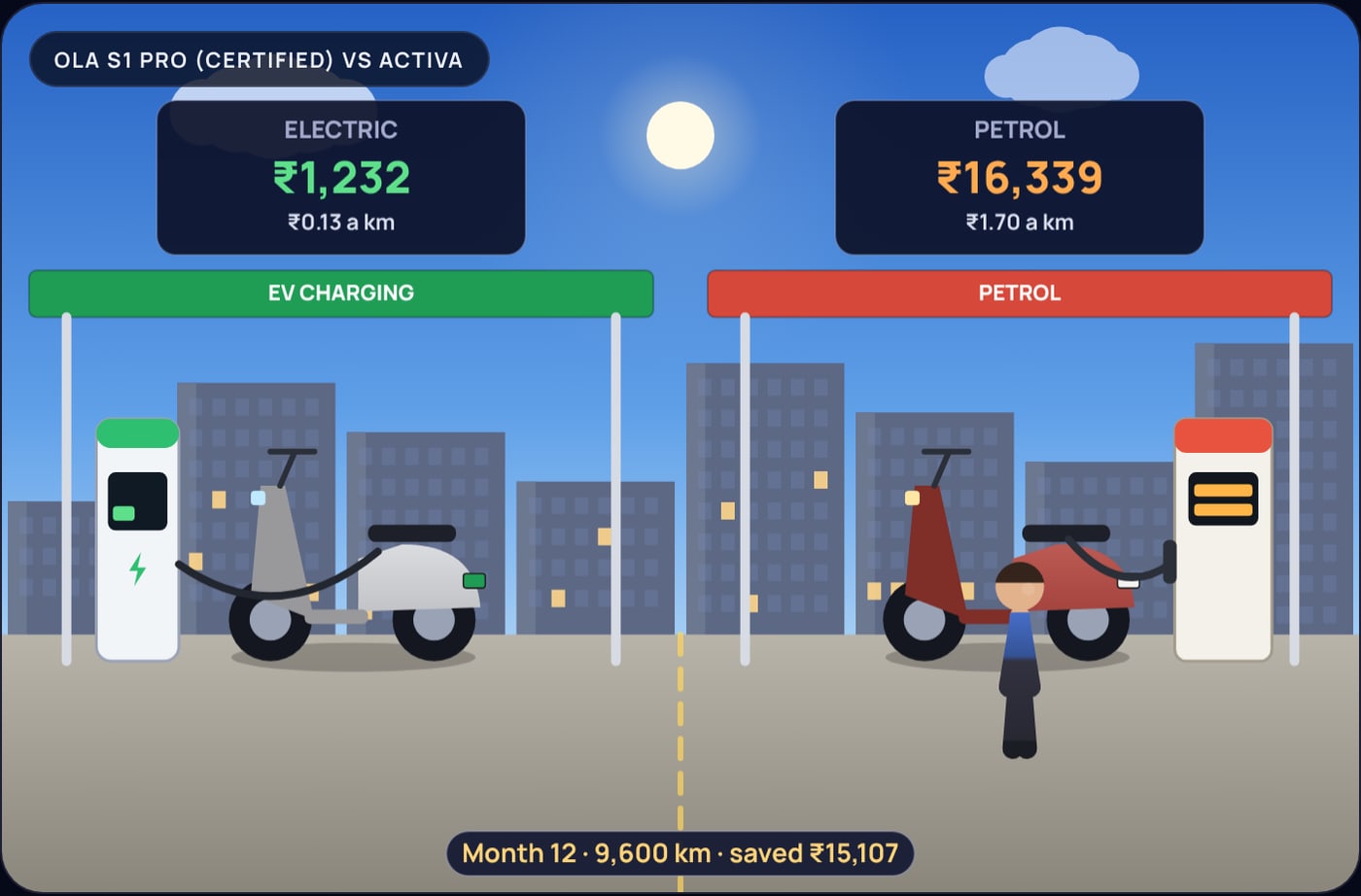
Even with the optimistic figure, the yearly saving only moves from ₹13,793 to ₹15,107. Most of the saving comes from the petrol you stop buying, not from how efficient the electric scooter is.
How long does an electric scooter take to pay back?
The electric scooter usually costs more to buy. Ather lists the 450X from ₹1,48,998, and Autocar India lists the Activa DLX at ₹84,272, a gap of ₹64,726 between these two listed prices. Your on-road quotes, subsidies and the variants you compare will change it.
Worked example: winning back the price gap
At 800 km a month the saving is ₹1,149 a month.
That is about 4.7 years and 45,000 km. At 1,500 km a month the saving is ₹2,155 a month and the gap comes back in 30 months. At 500 km a month it takes 90 months, 7.5 years.
So the answer to "is it cheaper" has two parts. Per kilometre, clearly yes. Over the life of the scooter, yes if you ride enough for the saving to cover the extra price before the battery needs attention. Ather's spec sheet lists a standard battery warranty of 3 years or 30,000 km, with longer cover as an add-on, which is worth comparing with your own break-even.
Does a slab tariff change the answer?
A little, and usually in the scooter's favour. Most Indian homes pay for electricity in slabs, and an electric scooter's 30 units a month sit on top of everything else the house uses. On Delhi's domestic slabs, set by the Delhi Electricity Regulatory Commission, a house that already uses 200 units pays ₹4.50 for the next ones.
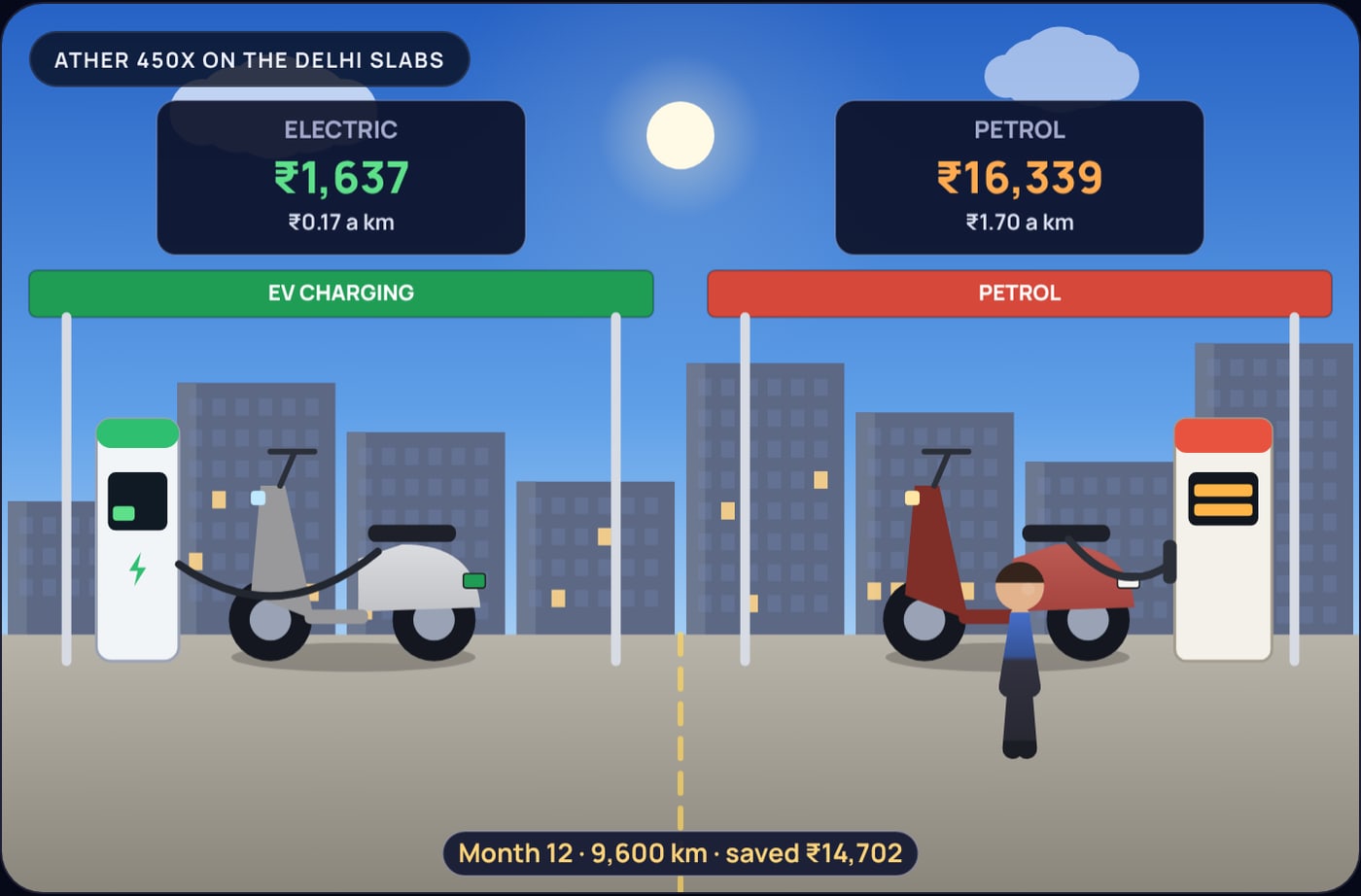
That brings the cost to ₹0.17 a km and the break-even to 52.8 months. A house that already uses 400 units a month would pay ₹6.50 a unit for the scooter, so check where your own bill sits. If you have rooftop panels, those units can cost even less; how many solar panels you need works through the sizing.
What about electric cars?
The same arithmetic works for cars, with bigger numbers on both sides.
Worked example: Tata Nexon EV against the Nexon petrol
Autocar India lists the Nexon EV's 45 kWh battery with Tata's real-world estimate of 350 to 375 km. Using 350 km, it uses 12.86 kWh per 100 km, or 0.1429 units a km from the wall. At ₹7 a unit:
The petrol Nexon managed 13.9 km a litre on Autocar's highway test, so ₹102.12 ÷ 13.9 = ₹7.35 a km. At 1,000 km a month the EV saves ₹6,347 a month, ₹76,158 a year.
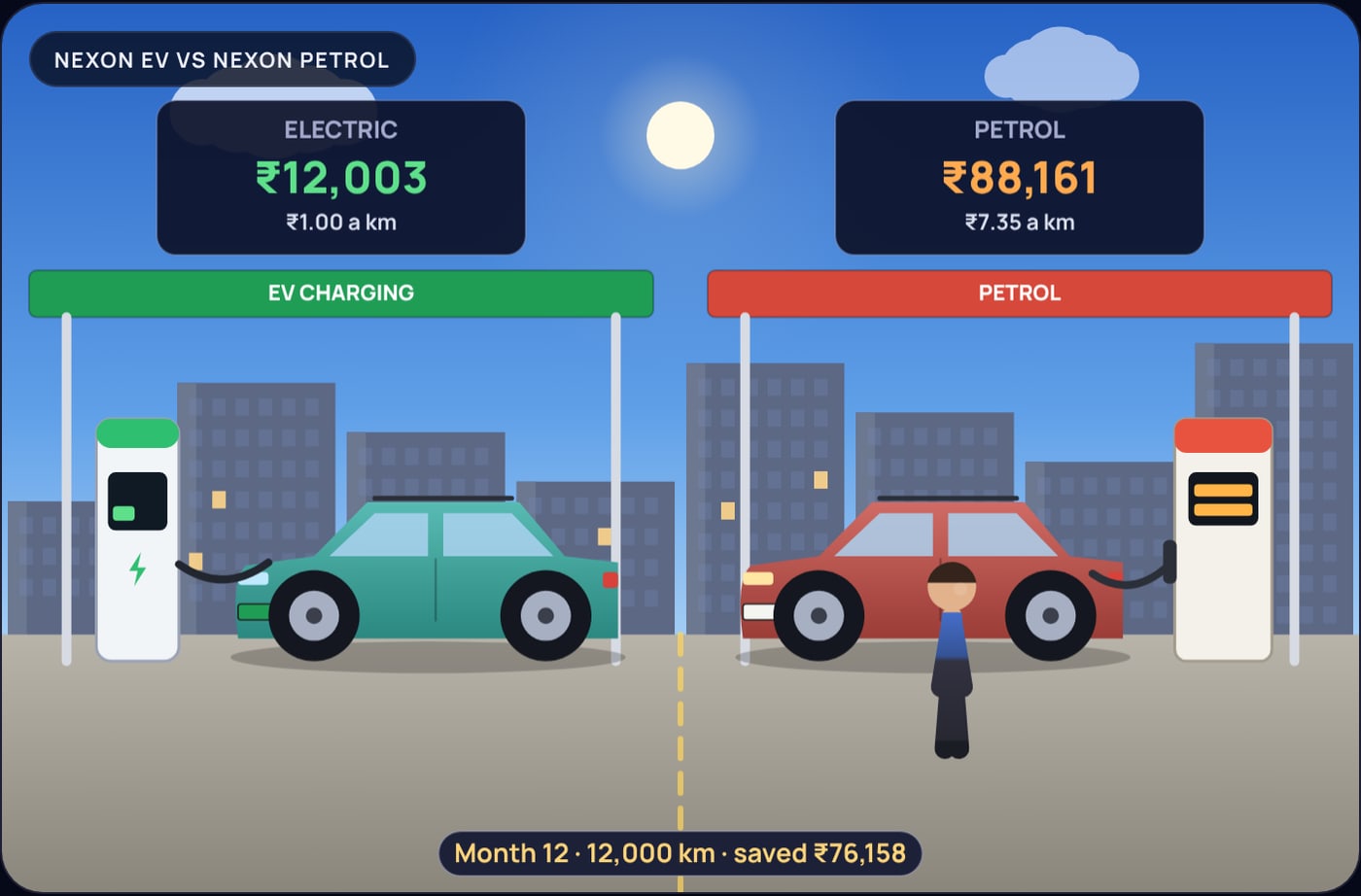
The price gap is bigger too. Autocar lists the Nexon EV Creative 45 at ₹15.21 lakh and the petrol Creative+ S DK AMT at ₹11.62 lakh, about ₹3.59 lakh apart, so break-even takes about 4.7 years at 1,000 km a month.
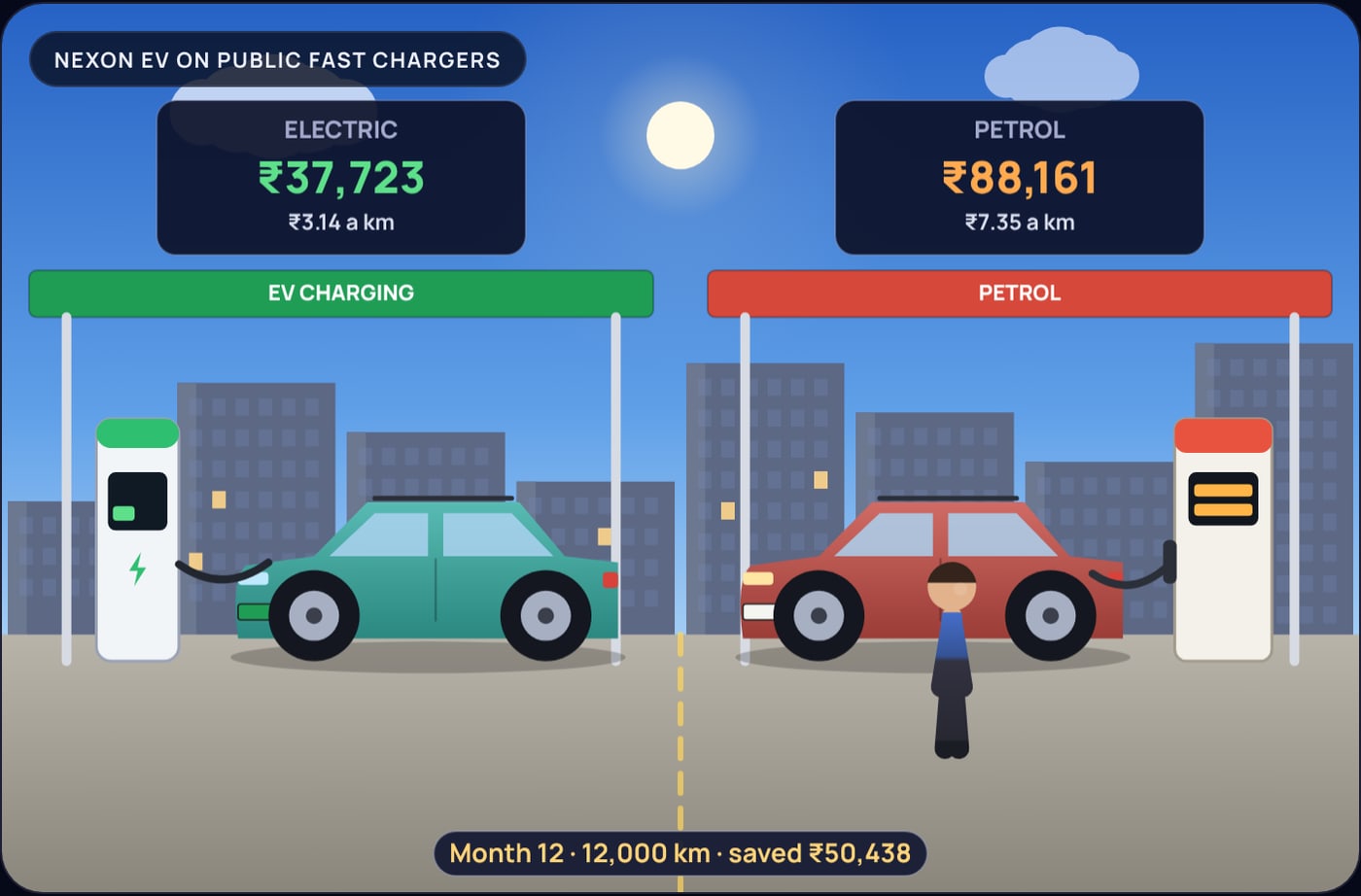
Public fast charging changes the picture most. ChargeZone, a charging network, puts DC fast charging at ₹20 to ₹25 a kWh. At ₹22 the Nexon EV costs ₹3.14 a km, more than three times the home figure, and break-even stretches to about 7 years.
| Price per unit | Ather 450X | Nexon EV |
|---|---|---|
| ₹5 | ₹0.19 a km | ₹0.71 a km |
| ₹7 | ₹0.27 a km | ₹1.00 a km |
| ₹10 | ₹0.38 a km | ₹1.43 a km |
| ₹15 | ₹0.57 a km | ₹2.14 a km |
| ₹22 | ₹0.83 a km | ₹3.14 a km |
For comparison, petrol at ₹102.12 a litre costs ₹1.70 a km in the Activa and ₹7.35 a km in the Nexon. An electric scooter stays cheaper than petrol until electricity reaches about ₹45 a unit, which no tariff in India comes near.
What does this comparison leave out?
- Servicing, insurance and tyres. Electric scooters have fewer moving parts and usually cost less to service, which would shorten the break-even.
- Battery life and resale. A battery replacement outside warranty, or a weak resale price, would lengthen it.
- How you ride. Sport modes, heavy loads and traffic raise the energy per km of both scooters.
- Price changes. Petrol and electricity prices both move; the calculator uses today's figures for every year.
All the energy figures here are in kWh, the unit on your bill; joules, calories and kWh explained shows how it compares with the energy in a litre of petrol.
Try it yourself
Open the EV vs petrol calculator, choose a scooter or car, and type your monthly kilometres, your petrol price, your home tariff and how often you use fast chargers. It shows the cost per km of each, the savings a month and a year, the break-even on the price gap, and the working.
Sources
- Ather Energy, Ather 450 spec sheet: 2.9 and 3.7 kWh batteries, certified IDC range, TrueRange by riding mode, battery warranty.
- Ather Energy, Ather 450 page: 450X starting price ₹1,48,998.
- Ola Electric, S1 Pro page: 4 kWh battery, 242 km IDC range.
- Autocar India, Honda Activa fuel economy tested (November 2025): 60 km a litre overall, and the 2025 Activa review with variant prices.
- Autocar India, Nexon EV range, Nexon mileage, and the Nexon EV and Nexon price pages.
- Business Today, petrol and diesel prices (6 October 2026): petrol ₹102.12 a litre in Delhi.
- IEEFA and JMK Research, residential rooftop solar report (October 2025): ₹7 a unit used as a typical electricity charge.
- ChargeZone, EV charging costs in India (June 2025): ₹20 to ₹25 a kWh at DC fast chargers.
- Idaho National Laboratory, Benchmark testing of the Chevrolet Volt onboard charger (2012): about 90 to 92 percent charging efficiency.
- Delhi Electricity Regulatory Commission, tariff press note and schedule for 2021-22: domestic energy charges by slab.
Frequently asked questions
Is an electric scooter cheaper to run than petrol?
Yes. An Ather 450X charged at home at ₹7 a unit costs about ₹0.27 a km, against ₹1.70 a km for a Honda Activa 110 at ₹102.12 a litre and 60 km a litre. That is about a sixth of the petrol cost.
How much does it cost to fully charge an electric scooter?
A 2.9 kWh battery takes about 3.2 units from the wall once charging losses of around 10 percent are included, so about ₹23 at ₹7 a unit. That is less than a quarter of the price of one litre of petrol at ₹102.12.
How long does an electric scooter take to pay back its higher price?
At 800 km a month, an Ather 450X saves about ₹1,150 a month on running costs against an Activa, so its price gap of about ₹64,700 comes back in about 4.7 years. At 1,500 km a month it takes about 2.5 years.
How many units does an electric scooter use per km?
An Ather 450X uses about 3.4 kWh per 100 km from its battery in Ride mode, or about 0.038 units per km from the wall. That is about 30 units for 800 km.
Is charging an EV at a public fast charger expensive?
Public DC fast chargers in India typically cost ₹20 to ₹25 a kWh, about three times a typical home unit. A Nexon EV charged only at fast chargers costs about ₹3.14 a km instead of ₹1.00, still well under half the cost of petrol.