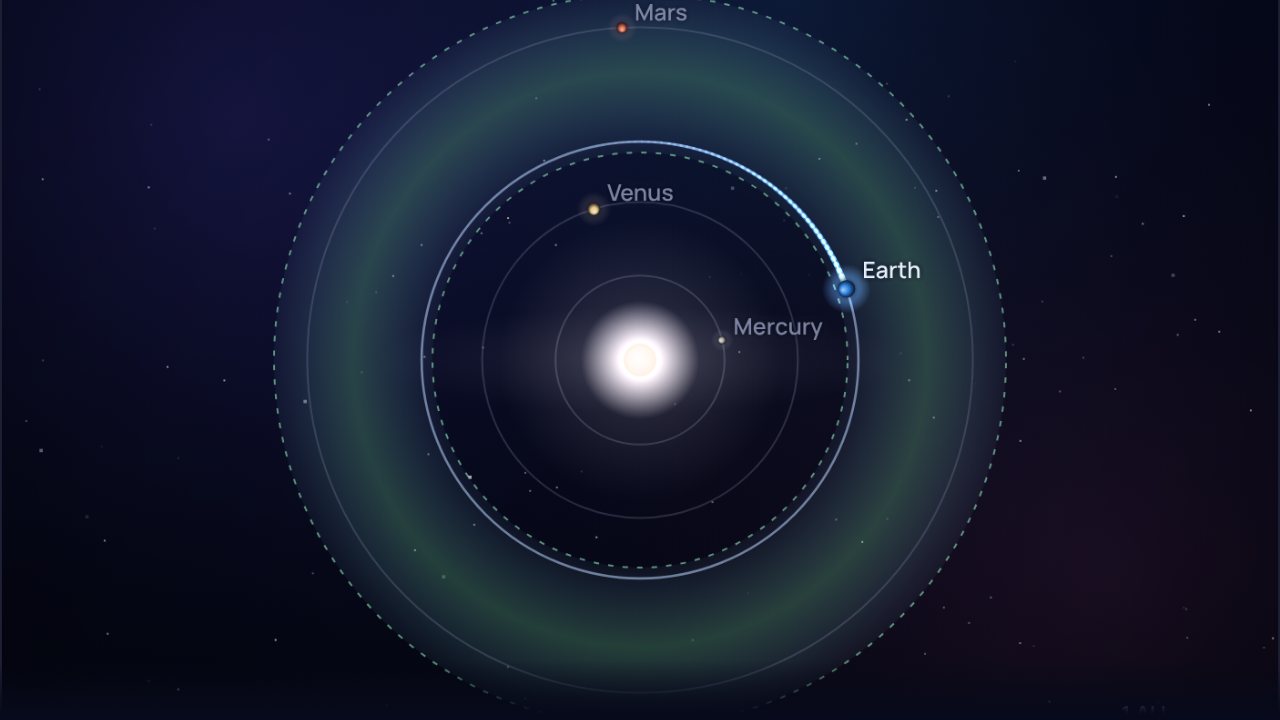
What size of solar system does my house need?
Divide a year of your units by what 1 kW of panels makes in a year where you live. In Delhi, 1 kW of panels at the best tilt makes about 1,452 units a year, so a home using 350 units a month (4,200 a year) needs about 2.9 kW: a 3 kW system of 6 panels of 540 W on about 30 m² of roof. It costs about ₹1.7 lakh, ₹0.92 lakh after the ₹78,000 PM Surya Ghar subsidy, and at ₹7 a unit pays for itself in about 3.1 years.
Change the city, your units or bill, the system size, the price per kW and your tariff. The house on the stage gets the right number of panels and the chart shows when the savings pass what you paid. The defaults are examples as of November 2026 with sources listed below; type your own quotes and rates. For the longer explanation, read how many solar panels you need for your house.
Key results from the calculator
- 3 kW in Delhi: 4,357 units a year, 6 panels, ₹0.92 lakh after subsidy, payback in 3.1 years at ₹7 a unit, and about ₹6.22 lakh ahead after 25 years.
- The subsidy matters: without PM Surya Ghar the same system costs ₹1.7 lakh and pays back in 5.8 years.
- Your tariff matters as much as the sun: on the cheaper Delhi slabs the same 3 kW saves ₹15,300 a year instead of ₹29,400, so payback stretches to 6 years.
- Sunshine varies by city: 1 kW makes about 1,712 units a year in Ahmedabad and 1,388 in Kolkata.
Six examples, worked
Each example uses 540 W panels, a performance ratio of 78%, ₹56,700 per kW installed, a flat ₹7 a unit and the PM Surya Ghar subsidy unless it says otherwise. The button loads it.
A 3 kW system for a Delhi home using 350 units
5.10 peak sun hoursGeneration: 3 × 5.1 × 365 × 0.78 = 4,357 units a year, about 363 a month, a little more than the 350 the house uses. Panels: 3,000 ÷ 540 = 5.6, so 6.
Cost: 3 × ₹56,700 = ₹1,70,100. Subsidy: 2 × ₹30,000 + ₹18,000 = ₹78,000. You pay ₹92,100 and save ₹29,400 in the first year.
A 2 kW system in Mumbai for 220 units
5.56 peak sun hours220 units a month needs 12 × 220 ÷ (365 × 5.56 × 0.78) = 1.67 kW, so 2 kW of 4 panels makes 3,168 units a year.
2 kW costs ₹1,13,400, and the subsidy of ₹60,000 covers more than half of it. Payback is 2.9 years.
A 5 kW system in Bengaluru for 600 units
subsidy capped at ₹78,000600 units a month needs 4.63 kW here, so 5 kW of 10 panels, making 7,781 units a year. It needs about 50 m² of shadow-free roof.
The subsidy stops growing after 3 kW, so on ₹2,83,500 you still get ₹78,000 and pay ₹2,05,500. Payback is 4.1 years.
A 1 kW system in Jaipur for a small home
120 units a monthJaipur gets 5.7 peak sun hours, so 1 kW makes 1,622 units a year, about 135 a month, enough for 120 units. 2 panels of 540 W do it.
1 kW costs ₹56,700; the ₹30,000 subsidy leaves ₹26,700, paid back in 2.6 years.
The Delhi 3 kW system without the subsidy
full priceWithout PM Surya Ghar you pay the whole ₹1,70,100. The savings are the same ₹29,400 a year, so payback stretches from 3.1 to 5.8 years.
Over 25 years the system still comes out about ₹5.44 lakh ahead at ₹7 a unit.
The same 3 kW on the Delhi slab tariff
₹3.00 to ₹8.00 a unitOn the DERC domestic slabs, 350 units cost 200 × ₹3.00 + 150 × ₹4.50 = ₹1,275 a month, an average of only 3.64 a unit.
Solar removes that bill, saving ₹15,300 a year, so payback is 6 years. The cheaper your units, the longer solar takes to pay back.
What 1 kW of panels makes in a year, by city
| City | Peak sun hours | 1 kW, units a year | kW for 300 units a month |
|---|---|---|---|
| Delhi | 5.1 | 1,452 | 2.48 |
| Mumbai | 5.56 | 1,584 | 2.27 |
| Bengaluru | 5.47 | 1,556 | 2.31 |
| Chennai | 5.48 | 1,559 | 2.31 |
| Kolkata | 4.88 | 1,388 | 2.59 |
| Hyderabad | 5.57 | 1,587 | 2.27 |
| Pune | 5.58 | 1,589 | 2.27 |
| Ahmedabad | 6.01 | 1,712 | 2.1 |
| Jaipur | 5.7 | 1,622 | 2.22 |
| Lucknow | 5.09 | 1,450 | 2.48 |
| Bhopal | 5.6 | 1,595 | 2.26 |
| Guwahati | 4.84 | 1,378 | 2.61 |
Peak sun hours are the Global Solar Atlas yearly sunlight on panels at the best tilt divided by 365. Units assume a performance ratio of 78%. Real output varies by month, shading, dust and the angle your installer uses.
How the calculator works
Peak sun hours come from the Global Solar Atlas, a free World Bank map built on Solargis data: the long-term yearly sunlight falling on panels tilted at the best angle, divided by 365. One peak sun hour is one hour of full 1,000 W/m² sunshine.
Generation is system kW × peak sun hours × 365 × performance ratio. The performance ratio covers losses from heat, wiring, the inverter and dust; the default 78% is close to the ratio of the Atlas’s own output estimate to its sunlight figure in every city listed. Each later year the panels make a little less; the default 0.5% a year is the median in NREL’s review of field measurements.
Panels are the system watts divided by the panel watts, rounded up. Roof area uses MNRE’s guidance that 1 kW needs about 10 m² of shadow-free roof.
Cost is kW × price per kW. The PM Surya Ghar central subsidy is ₹30,000 per kW for the first 2 kW and ₹18,000 for the third, so ₹60,000 for 2 kW and at most ₹78,000 for 3 kW and above. You can add a state subsidy.
Savings each month are the bill on your units minus the bill on the units you still buy, plus any surplus units at the export rate you type. Payback is the year the running total of savings passes what you paid. The 25-year gain is the total saving minus what you paid.
What the model leaves out
- Seasons: the calculator uses a yearly average. Monsoon months make less, and summer months more.
- Shade, dust and angle: a partly shaded roof or dirty panels can lose far more than the 22% allowed for.
- Fixed charges, net metering rules and tariff changes: fixed charges stay on your bill; surplus units are paid only at the export rate you type; future tariff rises would shorten the payback.
- Upkeep and the inverter: cleaning, repairs and an inverter replacement during 25 years are not counted.
- Loan interest: the cost is treated as paid on day one.
Common misconceptions
"A 3 kW system makes 3 kW all day." It makes about that much only in strong midday sun. Averaged over a day and a year it is closer to 0.5 kW.
"Bigger is always better." Units beyond what you use earn only the export rate, which can be much lower than what you pay for a unit, and the subsidy stops at 3 kW.
"Solar makes the bill zero." It can remove the energy charges, but fixed charges and taxes usually remain, as MNRE’s own FAQ points out.
Frequently asked questions
How many solar panels do I need for my house?
Divide your yearly units by what 1 kW makes in your city to get the kW, then divide by the panel size. A Delhi home using 350 units a month needs about 2.9 kW, which is 6 panels of 540 W.
How many units does a 1 kW solar system make?
About 3.8 to 4.7 units a day averaged over the year in the 12 cities in this calculator, or 1,378 to 1,712 units a year. MNRE says 4 to 5.5 units on a clear sunny day.
How much is the PM Surya Ghar subsidy?
₹30,000 per kW for the first 2 kW and ₹18,000 for the third kW: ₹30,000 for 1 kW, ₹60,000 for 2 kW and ₹78,000 for 3 kW or more.
How much roof area does a 3 kW solar system need?
About 30 m² of shadow-free roof, using MNRE’s guidance of 10 m² per kW. The panels themselves cover less: six 540 W panels are about 15.5 m², the rest is spacing so rows do not shade each other.
What is the payback period of rooftop solar in India?
With the PM Surya Ghar subsidy, about 3 to 6 years in the examples on this page, depending on your tariff and sunshine. IEEFA and JMK Research estimate about 30 months for a 3 kW system at ₹7 a unit. In this calculator a 3 kW Delhi system pays back in 3.1 years at ₹7 a unit and 6 years on the cheaper Delhi slabs.
Keep learning
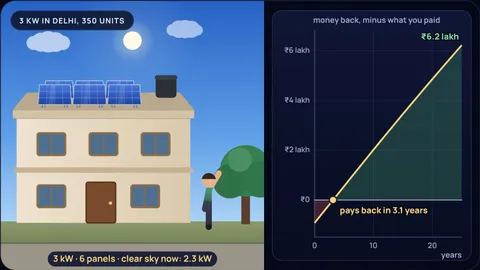
How Many Solar Panels Do I Need for My House?
Size rooftop solar from your bill: 350 units a month in Delhi needs about 3 kW, six 540 W panels. Generation, roof, subsidy and payback worked out.

How Does an MPPT Charge Controller Work? Real Curves
A 100 W panel on PWM gives 82 W at 25 °C. MPPT recovers the rest by running a DC-DC converter at the panel's best voltage. When it helps and when not.
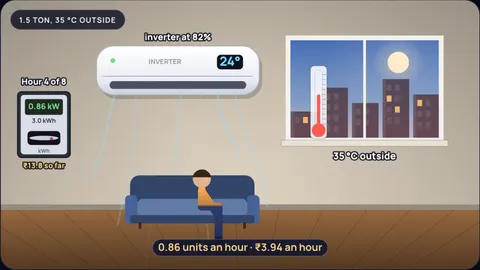
How Many Units Does a 1.5 Ton AC Use per Hour?
A 1.5 ton 5 star inverter AC uses about 0.86 units an hour at 35 °C outside and 24 °C inside. Worked examples for star ratings, thermostat and tariffs.
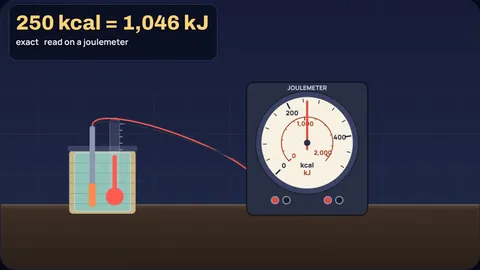
Joules, Calories and kWh: Energy Units Explained
What a joule, a calorie, a food Calorie, a kilowatt hour, an electronvolt and a Btu are, the exact factors between them, and worked conversions.