What is the best tilt angle for solar panels?
For a fixed panel, tilt it at roughly your latitude and point it at the equator: south in India, north in Australia. In Delhi (28.61 degrees north) the clear-sky model in the simulation puts the year-round optimum at 26 degrees, and PVGIS, which uses real weather records, puts it at 32 degrees. Either way the yearly total is so flat near the top that 29 degrees, the latitude, collects within 0.1% of the best. Lying the panel flat loses 8.4% in clear skies and 12.4% with real Delhi weather.
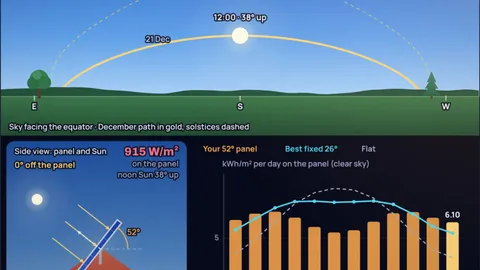
The reason is geometry. The Sun's noon height swings by 47 degrees between June and December, and a fixed panel can only face the middle of that swing. Pick your city above and the gold arc shows this month's path, the side view shows the angle at which the rays strike the panel, and the chart adds up every hour of every month. If you want the physics of the seasons themselves, the seasons simulation shows why the path moves. For month-by-month angles across Indian cities, read the best solar panel angle in India for every month.
Key results from the simulation
- Tilt about equal to latitude: the clear-sky optimum is 26 degrees in Delhi, 18 in Mumbai, 12 in Bengaluru and 44 in London, all within a few degrees of the latitude.
- The peak is flat: in Delhi, 10 degrees off the optimum costs about 1.2% to 1.3% a year. Getting the direction right matters more: facing due east at 29 degrees costs 15.3%.
- Indian weather pushes the tilt up: PVGIS puts the real optimum above the clear-sky value in every Indian city we checked (Delhi 32, Mumbai 25, Bengaluru 17 degrees), because the monsoon clouds over the high summer Sun while the low winter Sun shines in clear skies.
- Adjusting helps a little: re-angling every month gains 6.8% in Delhi; two settings a year (7 degrees in summer, 48 in winter) gain 5.5%.
Six setups worth trying
Each button loads the setup into the simulation. Energies are clear-sky values on one square metre of panel, which is the same number as peak sun hours. Real sites collect less, mainly because of cloud and haze.
Delhi rooftop: 29 degrees facing south
Latitude 28.61° NA panel at the latitude, facing due south, collects 2489 kWh per square metre a year in the clear-sky model. The best fixed angle, 26 degrees, adds almost nothing (2492 kWh). That is why installers use the latitude rule without worrying: the top of the curve is a plateau.
Look at the chart. With a 29 degree tilt the bars are fairly level through the year, from 5.48 kWh per day in December to 7.48 in April. A flat panel swings from 3.64 to 8.46. Tilting trades a bit of summer for a lot of winter.
December in Delhi: steepen the panel
Seasonal adjustmentIn mid December the noon Sun in Delhi is only 38 degrees up. A flat panel at noon gets 591 W per square metre; tilt it to 52 degrees and it gets 915 W, because the rays now hit almost square-on. The best December tilt in the model is 57 degrees.
The old rule "latitude plus 15 degrees in winter" (44 degrees here) lands close. If your mounting frame has two positions, 48 degrees from October to March and 7 degrees from April to September collects 5.5% more than the best fixed angle.
Mumbai in July: why the real optimum is steeper
Weather versus geometryIn July the Sun passes almost overhead in Mumbai, so geometry says lay the panel nearly flat: the best July tilt in the clear-sky model is 0 degrees. But July is the wettest month of the monsoon. PVGIS gives a south-facing panel at its optimum only about 3.24 kWh per square metre per day in July against 7.18 in February.
Since the summer months contribute little anyway, the year is won in the clear winter. That pulls the real optimum up to 25 degrees, steeper than the 18 the clear-sky model gives and steeper than the latitude (19). The same thing happens in every Indian city in the table below.
A roof that faces east
AzimuthTurn the panel to face east at 29 degrees and the morning looks great: at 9 am in March it gets 788 W per square metre. But the afternoon is lost, and over the year it collects 15.3% less than facing south. Facing south-east (135 degrees) costs only 4.3%.
If your roof slopes east and west, the usual fix is to lay the panels flatter: at a low tilt the direction matters less. Try 10 degrees facing east in the simulation and compare.
London: steeper panels and a bigger payoff from tilting
Latitude 51.5° NAt high latitude the winter Sun is low (15 degrees at noon on 21 December), so tilting matters far more than in India. The best fixed angle beats a flat panel by 29.6% in the clear-sky model, against 9.2% in Delhi.
Here the weather pulls the other way. PVGIS puts the real London optimum at 40 degrees, below both the latitude and the clear-sky value of 44, because grey winters make the low-Sun months almost worthless. NREL found the same for cloudy-winter sites in the United States.
Sydney: face north, not south
Latitude 33.87° SSouth of the equator the Sun crosses the northern sky, so panels face north. Sydney's clear-sky optimum is 31 degrees facing north. In June, its winter, the best monthly tilt is 62 degrees.
Point the same panel south by mistake and it collects 46.2% less over the year. The simulation flips the sky view automatically: the centre of the panorama is always the equator.
Best fixed tilt by city: clear-sky model and real weather
| City | Latitude | Clear-sky best | PVGIS best | Gain vs flat | Monthly re-angling |
|---|---|---|---|---|---|
| Delhi | 28.6° N | 26° | 32° | +9.2% | +6.8% |
| Mumbai | 19.1° N | 18° | 25° | +4.0% | +6.5% |
| Bengaluru | 13.0° N | 12° | 17° | +1.8% | +6.0% |
| Chennai | 13.1° N | 12° | 15° | +1.9% | +6.0% |
| Kolkata | 22.6° N | 21° | 28° | +5.6% | +6.7% |
| Jaipur | 26.9° N | 25° | 31° | +8.1% | +6.8% |
| Ahmedabad | 23.0° N | 21° | 28° | +5.9% | +6.7% |
| Srinagar | 34.1° N | 31° | 36° | +13.1% | +6.6% |
| London | 51.5° N | 44° | 40° | +29.6% | +5.7% |
| New York | 40.7° N | 36° | 37° | +18.9% | +6.3% |
| Dubai | 25.2° N | 23° | 26° | +7.1% | +6.8% |
| Sydney | 33.9° S | 31° | n/a | +13.0% | +6.6% |
| Singapore | 1.4° N | 1° | n/a | +0.0% | +3.9% |
Clear-sky values come from the simulation (Meinel beam plus 10 percent diffuse, mid-month days). PVGIS values are the EU Joint Research Centre's optimum fixed angle using its satellite or reanalysis weather data, queried in November 2026. PVGIS does not return an optimum for southern-hemisphere or some equatorial sites, marked n/a.
How the calculator works
For each mid-month day the Sun's declination is δ = −23.45° × cos(360° × (d + 10) ÷ 365), the form PVEducation gives. Every 10 minutes of solar time the hour angle is 15 degrees per hour from noon, and the Sun's altitude follows from sin α = sin φ sin δ + cos φ cos δ cos ω, with φ your latitude. The azimuth comes from the same unit vector.
Clear-sky sunlight uses the Meinel and Meinel fit quoted by PVEducation: direct normal irradiance = 1353 × 0.7^(AM^0.678) W per square metre, where AM is the air mass from the Kasten and Young formula. Straight overhead (AM 1) that is 1353 × 0.7 = 947 W. Diffuse light is taken as 10 percent of the beam on a horizontal surface, spread evenly over the sky, and the ground reflects 20 percent.
The panel receives the beam times the cosine of the angle between the rays and the panel's normal, plus the share of sky and ground it can see: (1 + cos β) ÷ 2 of the sky and (1 − cos β) ÷ 2 of the ground for tilt β. At the March equinox at noon a 29 degree panel in Delhi faces the Sun almost square-on and gets 1012 W per square metre.
The chart sums each day into kWh per square metre per day, which equals peak sun hours. The year total weights each month by its days. The "best fixed tilt" is a search over every whole degree from 0 to 90, facing the equator. Multiply peak sun hours by your panel's kilowatt rating and a performance ratio of about 0.75 to 0.8 for a rough output in kWh.
What the model leaves out
- Clouds, haze and dust: the model is a clear day, every day. Indian cities get noticeably less, especially in the monsoon, and the real optimum shifts. Use the free EU PVGIS tool or NREL PVWatts for a yield estimate at your address.
- Panel temperature and losses: hot panels lose about 0.3 to 0.5 percent of output per degree above 25 °C, and wiring and inverter losses take more. These scale the whole year and barely move the best angle.
- Shading and horizon: trees, water tanks and neighbouring buildings cut off the low winter Sun first. The model assumes a clear horizon.
- Dust and self-cleaning: steeper panels shed dust and rain better. In dusty places a tilt of at least 10 to 15 degrees is common even near the equator.
- Clock time: the time slider is local solar time (12:00 is when the Sun is highest). Clock time differs by the time zone offset and the equation of time, up to about an hour in parts of India.
- The Sun's distance: Earth is about 3 percent closer to the Sun in January. The model uses a fixed constant, as Meinel's fit does.
Common misconceptions
"Panels should point straight at the noon Sun." Only for one day. A fixed panel has to serve the whole year, so it points at the middle of the Sun's seasonal swing, which is the latitude. Following the noon Sun would mean a different angle every week.
"Flat panels are almost as good in India." In clear skies the loss is modest in the south (Bengaluru, about 2 percent) but real Delhi weather makes a flat panel about 12 percent worse than the best tilt, and flat panels also collect dust and standing water.
"South is always right." Only north of the equator. In Australia, South Africa and Brazil the panels face north.
Frequently asked questions
What is the best angle for solar panels in India?
Face due south and tilt by about your latitude, or a few degrees more. Real-weather optima from PVGIS are about 32 degrees in Delhi, 25 in Mumbai, 28 in Kolkata, 17 in Bengaluru and 15 in Chennai. Being 5 degrees off costs under 1 percent a year.
Should solar panel tilt equal latitude?
It is a good rule. In the clear-sky model, a Delhi panel at its latitude (29 degrees) collects within 0.1% of the best fixed angle. Real weather moves the best angle a few degrees: steeper in monsoon climates, flatter where winters are cloudy.
Which direction should solar panels face?
Toward the equator: south in the northern hemisphere, north in the southern. In Delhi, facing south-east costs about 4.3% a year and facing due east about 15.3%, so a small deviation is fine but east or west is a real loss.
Is it worth adjusting solar panel angle every month?
It gains about 6.8% in Delhi in clear skies. Two settings a year (about 48 degrees from October to March and 7 degrees from April to September) gets 5.5%, most of the benefit, for two visits to the roof.
What is the best solar panel angle in winter?
Steeper: roughly latitude plus 15 to 25 degrees. In Delhi the best December angle in the model is 57 degrees, because the noon Sun is only about 38 degrees above the horizon.
Keep learning
Best Solar Panel Angle in India for Every Month
Month-by-month solar panel tilt for Delhi, Mumbai, Bengaluru, Chennai, Kolkata and Jaipur, why the monsoon makes the best fixed angle steeper, with numbers.

What Color Is the Sun Really? White, and Here's Why
The Sun is white: a 5772 K spectrum excites all three cone types almost equally. Why it peaks near green but never looks green, and why it turns orange.

How much does sunlight change around a planetary orbit? A Python comparison
The same inverse-square calculation gives Earth about a 7% close-to-far sunlight increase and Mercury about 130%. Reproduce all eight comparisons.

Why Is Electricity Transmitted at High Voltage? The Math
Why is electricity transmitted at high voltage? We work the I²R loss for a real 345 kV line, show why 1,100 kV is about the ceiling, and when HVDC wins.