Which astronomy course should you choose? Start with the work you want to do
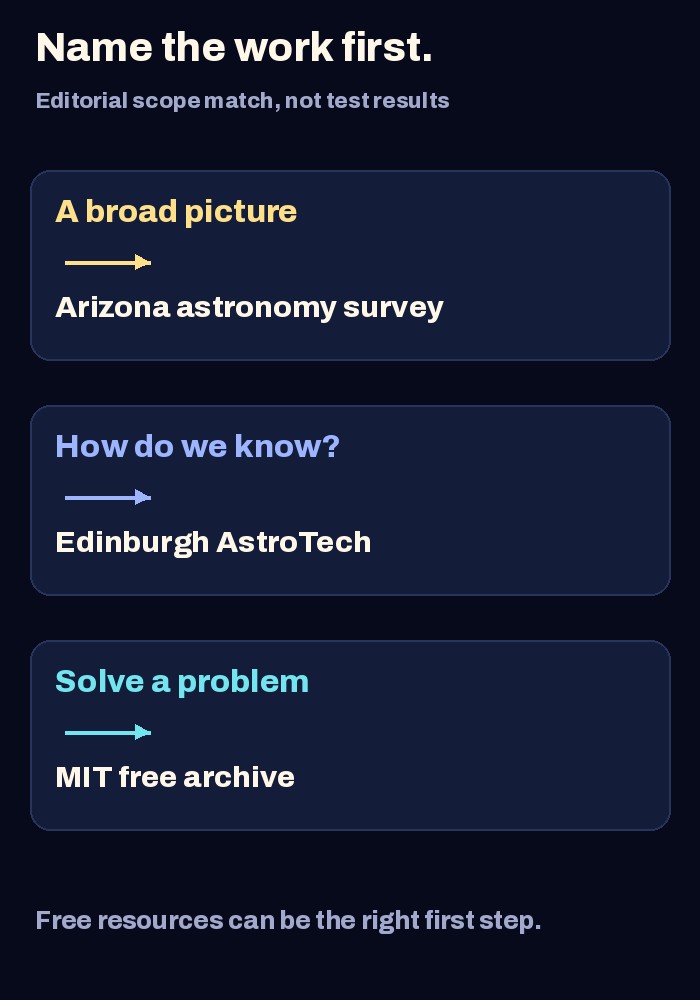
Choose Astronomy: Exploring Time and Space if you want a broad introduction to the subject. Choose AstroTech if you keep asking how instruments turn light into evidence. Choose MIT OpenCourseWare’s Introduction to Astronomy if you want a quantitative challenge and are willing to work through archived materials independently.
Those are three different learning jobs. Buying the longest course, or the one with the most impressive institution attached, does not tell you which job it will do for you.
Affiliate disclosure: We may earn a commission if you make an eligible purchase through the Coursera links below. Recommendations follow syllabus fit, and free alternatives are included. This is a comparison of publicly accessible course information, not a claim that we completed or tested these courses. Course pages and link destinations were rechecked on 28 October 2026 IST.
The comparison that matters
| Route | Best reason to choose it | Evidence available on the provider page | Main limitation for this decision |
|---|---|---|---|
| Arizona: Astronomy: Exploring Time and Space | Build a broad conceptual foundation | Beginner course, eleven modules, topics spanning the night sky and modern astronomy | A survey is not a substitute for operating a telescope or a full mathematical physics sequence |
| Edinburgh: AstroTech | Understand how astronomical discoveries depend on instruments | Six modules connecting telescopes, detectors and computing with scientific interpretation | Instrument-focused scope is narrower than a broad astronomy survey |
| MIT OCW: Introduction to Astronomy | Attempt quantitative university-style work without paying for course access | Spring 2006 undergraduate materials, problem sets, solutions and exams | Archived materials require independent study and do not offer the experience of a current taught class |
The provider listings are the basis for these distinctions: Arizona’s syllabus, Edinburgh’s syllabus and MIT’s course archive. Module counts describe packaging, not measured teaching quality. We have not assigned a numerical quality score or converted enrolment figures into a recommendation.
For the curious beginner: a broad map of the subject
Arizona’s course, taught by Chris Impey, is the most natural fit here for someone whose questions jump from planets to stars to the universe. Its official listing identifies it as introductory and does not require prior experience. The syllabus includes science history and the night sky alongside later astronomy topics.
Choose this route when unfamiliar vocabulary is your main obstacle. A useful personal goal would be to explain one astronomical claim in your own words, identify the observation behind it and state one uncertainty. That is our suggested work product, not a provider promise or an assessment we have inspected behind the enrolment screen.
Skip a paid certificate if your only goal is enjoying astronomy and the available unpaid material already meets that goal. If you specifically want numerical orbital calculations, inspect the assignments before paying; a broad introduction does not automatically mean extensive calculation practice.
Check Arizona’s course access and current local price on Coursera.
For “how can they know that?”: instruments and evidence
AstroTech, from the University of Edinburgh, connects technology with the science it makes possible. Its public syllabus includes telescopes and stars, space observations, detectors, and computers. That makes it a better match for the reader interested in the chain between incoming light, a recorded signal and a scientific inference.
We would choose it over a second broad survey when the missing piece is measurement. For example: can you explain why a detector’s limitations matter even after a telescope has collected the light? Try drawing the chain from source to telescope to detector to inference. Mark which parts you understand and which remain a mystery; use that gap to decide whether the syllabus fits.
Do not buy this course expecting a complete telescope shopping consultation, hands-on access to a particular observatory or training on a particular camera model. Those are different services, and their availability is not established by this syllabus.
Check AstroTech’s access and current local price on Coursera.
For equations and problem sets: try the free route first
MIT’s archived Introduction to Astronomy describes itself as a quantitative introduction. It provides problem sets, solutions and exams. The materials were taught in spring 2006, a date that matters: established methods can remain useful while references to discoveries or the state of the field age.
The archive is a particularly good diagnostic before spending money on another course. Open a problem set, attempt a question without immediately opening the solution, and list what blocked you. Was it algebra, physical reasoning, notation or the astronomy itself? That list is more informative than choosing by a marketing label such as beginner or intermediate.
Use MIT’s free materials if independent study works for you. Choose a more structured learning experience only when you can identify what that structure would add. An archive does not supply personal feedback merely because solutions are available.
What will it cost in India or the US?
We are not quoting one universal Coursera price. Logged-out pages and enrolment buttons do not establish the final charge, included assessments, certificate access or renewal conditions for a particular learner. A free trial is also different from permanent free access. The provider’s enrolment FAQ says available access paths can vary.
For India, check the final INR total and applicable tax in your account. For the US, check the USD total and applicable tax. In either market, establish whether you are buying a one-off course experience or starting a subscription; check what renews, when, and how to cancel. Do not assume one course’s access arrangement applies to another.
Our existing affiliate program permits links for these markets, and the two course-specific destinations resolved correctly when tested. That confirms reachability, not that every payment method, promotion or learner is eligible, or that a purchase will earn commission. No country-specific discount is claimed here.
Before paying, write down the exact feature you need: graded work, certificate, continued access, deadlines or feedback. Verify that feature in your own checkout and account. If you cannot identify a benefit beyond the free material you already use, delay the purchase.
A sensible stopping rule
Choose one route and produce one small piece of work before adding another course: a clear explanation, an instrument-to-evidence diagram or a solved quantitative problem. You do not need all three enrolments to begin astronomy.
We excluded the once-recommended Data-driven Astronomy course because its official course URL returned a 404 during this check. Older course roundups are useful leads, but a historical recommendation is not proof of current availability. We will not direct you toward an enrolment path we could not verify.
For a shorter piece of science to practise with first, try our orbital-sunlight calculation. Read the assumptions, work through a number and decide whether you enjoyed the explanation, the measurement problem or the calculation. That answer should guide what you study next.
Cover: conceptual AI-assisted book sculpture with independently composed type and vector star; it does not depict a particular provider’s textbook or endorsement.