What Was the Moon Phase on the Day You Were Born?
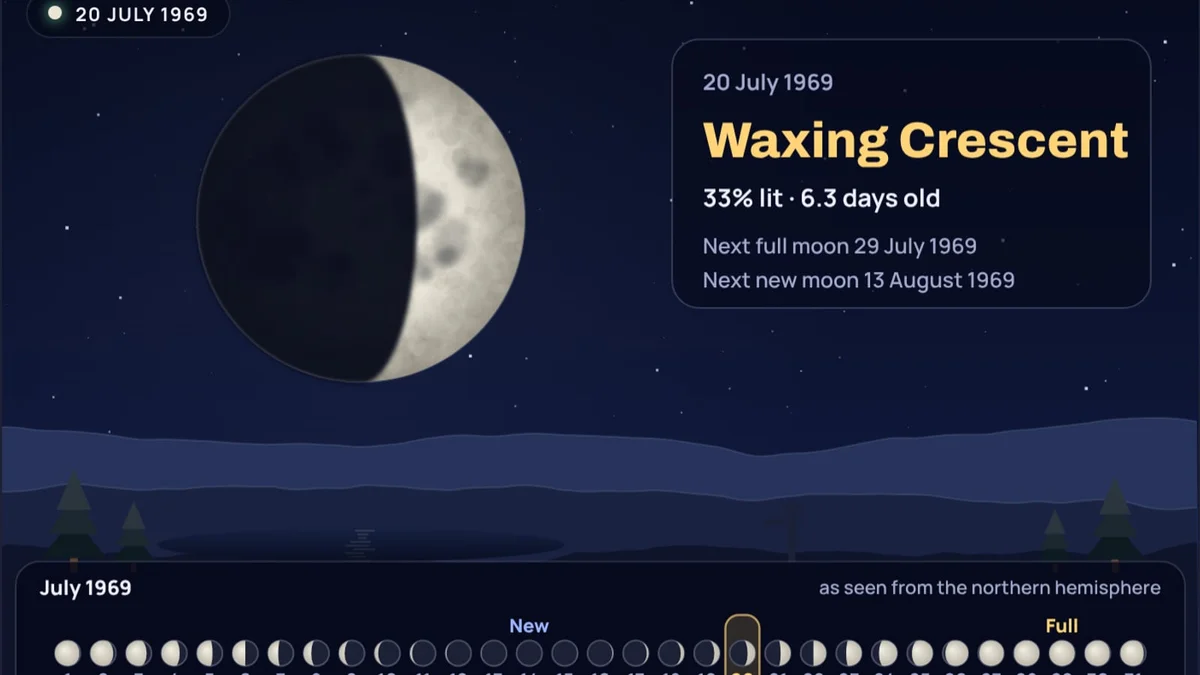
On the night of 14 March 1995, a waxing gibbous Moon 91% lit hung in the eastern sky over India as the Sun went down. Anyone born that evening came into the world under a nearly full Moon, three days before the real thing. That is what a moon phase calculator for any date tells you in a second: the phase, how much was lit, and how many days past new moon it was.
This post explains how to read that answer, why different websites sometimes disagree about your birthday moon, and how to check the result yourself with two short calculations. The calculator behind it uses Jean Meeus's Astronomical Algorithms, and its new and full moon times agree with the US Naval Observatory to within a minute or two.
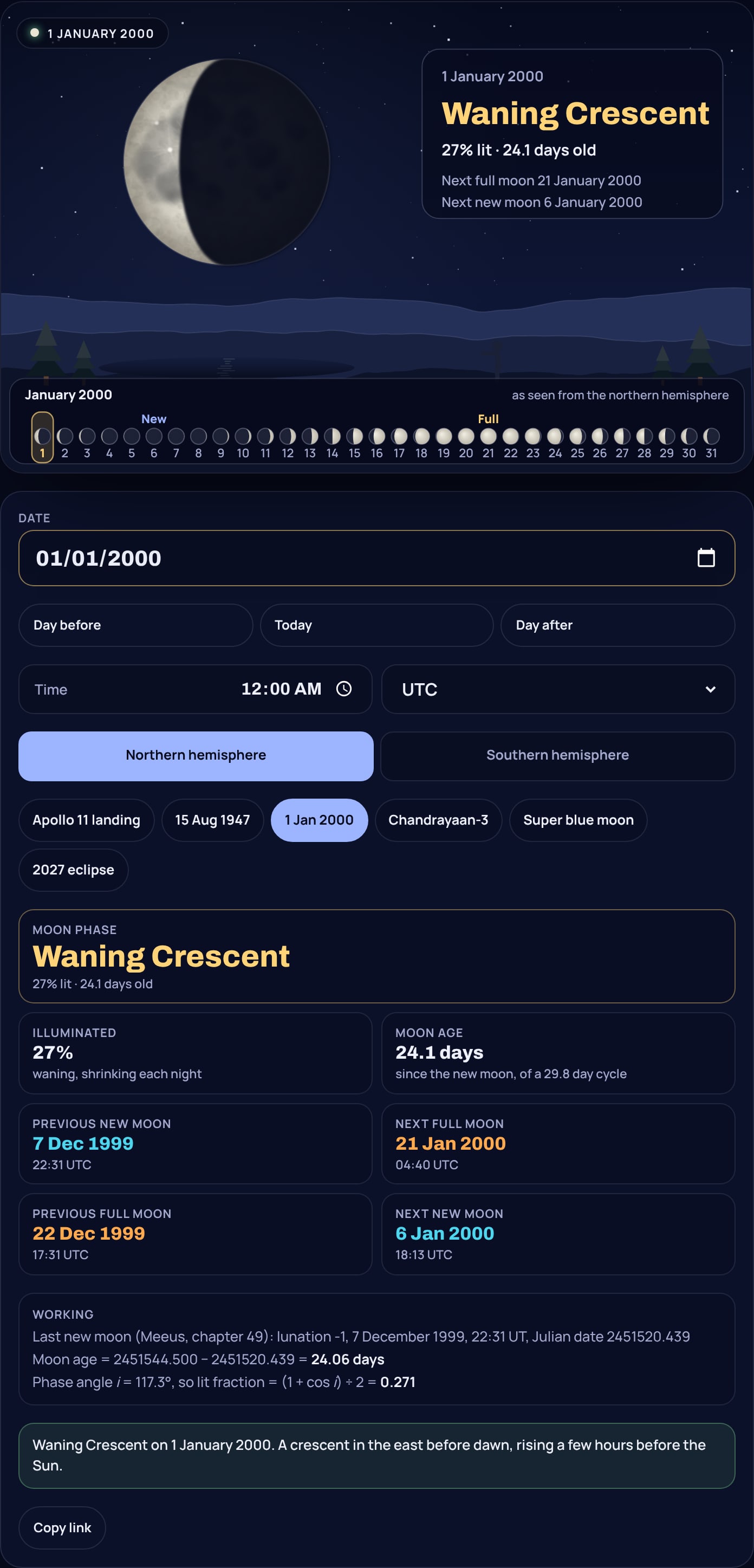
How do you find the Moon phase on a past date?
The Moon goes through its cycle of phases in 29.53 days on average. If you know the time of one new moon, you can count forward or back to any date. The new moon of 6 January 2000 at 18:14 UTC is the usual starting point, and is lunation zero in Meeus's numbering.
Doing only that, with the average month length, gets you within about half a day. Real lunar months vary between about 29.3 and 29.8 days, because the Moon speeds up and slows down on its elliptical orbit and the Sun tugs on it. Meeus's method adds around 40 small periodic terms to correct for that, which brings the predicted times to within a minute of the published ones from 1900 to 2100.
Worked example: the Moon age by hand
Take 14 March 1995 at noon in India, 06:30 UTC. As a Julian date, the astronomer's continuous day count, that is 2449790.771. The reference new moon of January 2000 is at Julian date 2451550.260.
Example 1: rough Moon age for 14 March 1995
The fractional part of the count, 0.418 of a cycle after the last new moon, gives an age of about 12.3 days. The calculator, which finds the actual new moon of 1 March 1995 at 17:17 IST, gives 12.78 days. The rough method is off by about 10 hours because that month's new moon came late compared with the average.
Ten hours does not change the phase name for this date, but for a birthday near a new or full moon it can. That is the gap between a quick formula and a proper ephemeris, and it explains a lot of the disagreement between free websites.
How much of the Moon was lit?
The lit percentage depends on the phase angle , the angle at the Moon between the directions to the Sun and to Earth. At full moon is near 0°, at new moon near 180°. The illuminated fraction is:
Example 2: illuminated fraction on 14 March 1995
The calculator finds a phase angle of 35.0° at noon IST from the Moon's position relative to the Sun.
So 91% of the disc was lit. A shortcut that uses only the age, , gives 95.6% for a 12.78 day old Moon. The 5 point difference comes from the same orbital wobbles that move the new moon times about.
What do the eight phase names mean?
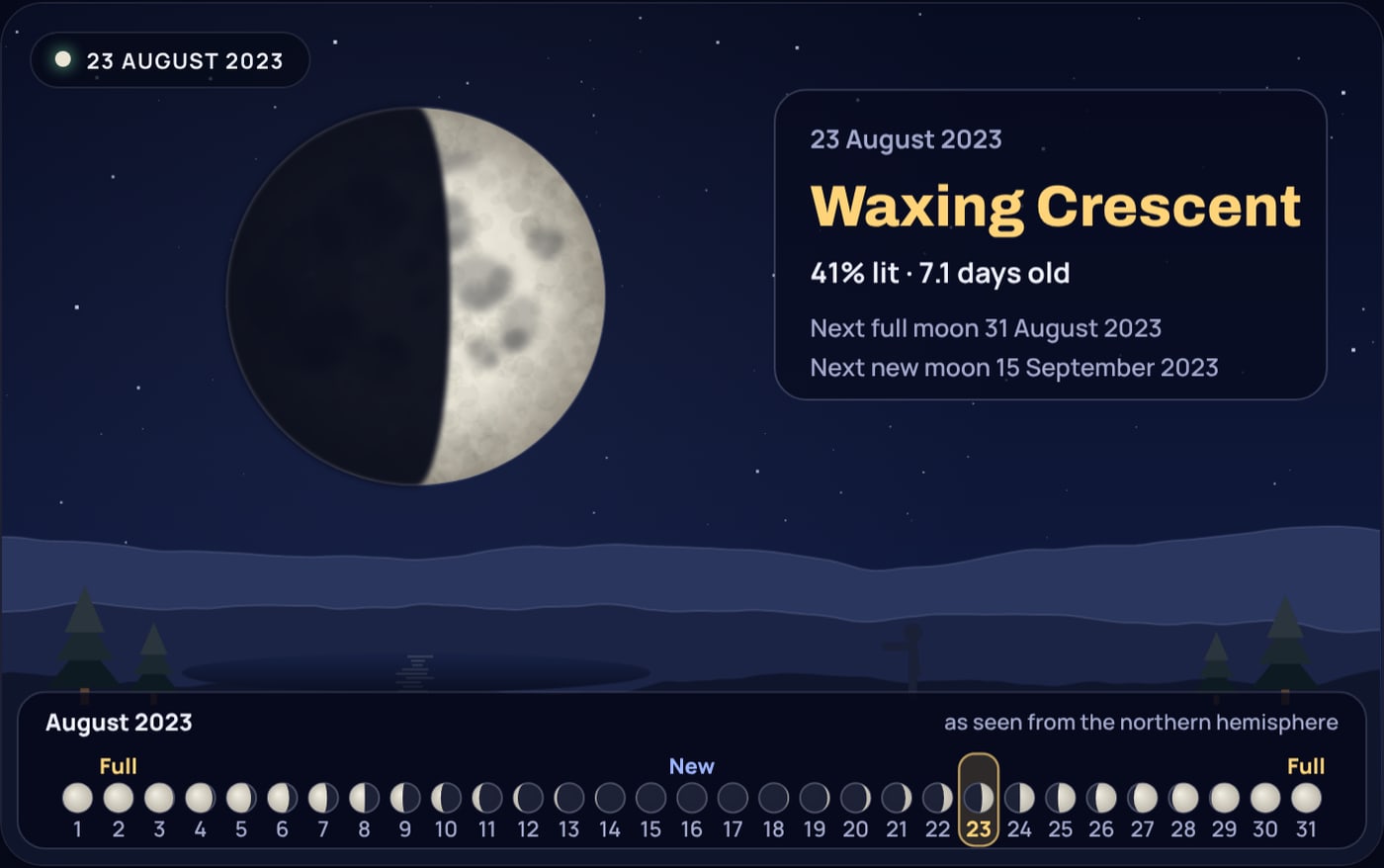
The calculator follows the US Naval Observatory convention. Four phases are instants: new moon, first quarter, full moon and last quarter. If one of those instants falls on your date in your time zone, that is your phase. Every other day gets one of the four in-between names.
| Phase | Moon age (days) | Lit | Where to see it |
|---|---|---|---|
| New Moon | 0 | 0% | Not visible, close to the Sun |
| Waxing Crescent | 0 to 7.4 | 0 to 50% | West, after sunset |
| First Quarter | about 7.4 | 50% | High at sunset, sets near midnight |
| Waxing Gibbous | 7.4 to 14.8 | 50 to 100% | Evening and most of the night |
| Full Moon | about 14.8 | 100% | Rises at sunset, up all night |
| Waning Gibbous | 14.8 to 22.1 | 100 to 50% | Rises in the evening, up in the morning |
| Last Quarter | about 22.1 | 50% | Rises near midnight, high at sunrise |
| Waning Crescent | 22.1 to 29.5 | 50 to 0% | East, before dawn |
The ages are averages; real quarter phases can come several hours early or late. "Quarter" confuses people because the Moon looks half lit. The name refers to the orbit: at first quarter the Moon is a quarter of the way round from new.
Why do websites disagree about my birthday moon?
There are three common reasons, roughly in order of how often they matter.
Time zones. A full moon is a single instant for the whole planet. The full moon of 25 January 2024 came at 17:54 UTC, which was 23:24 on 25 January in India but 06:54 on 26 January in New Zealand. If you were born in Delhi, your calculator needs Indian time; a site that silently uses UTC or US time can put your full moon on the wrong date. The calculator lets you choose the zone you were born in.
Average months. Simple calculators count average 29.53 day months from a reference new moon, as in Example 1. They can be wrong by up to about 14 hours, enough to swap "Full Moon" for "Waxing Gibbous".
What counts as full. Some sites call anything over 97% "full". The calculator only names Full Moon on the day the exact full moon happens, and shows the percentage so you can judge. A day either side, the Moon is still about 98% lit, which the eye cannot tell from full.
Does the hemisphere change what you saw?
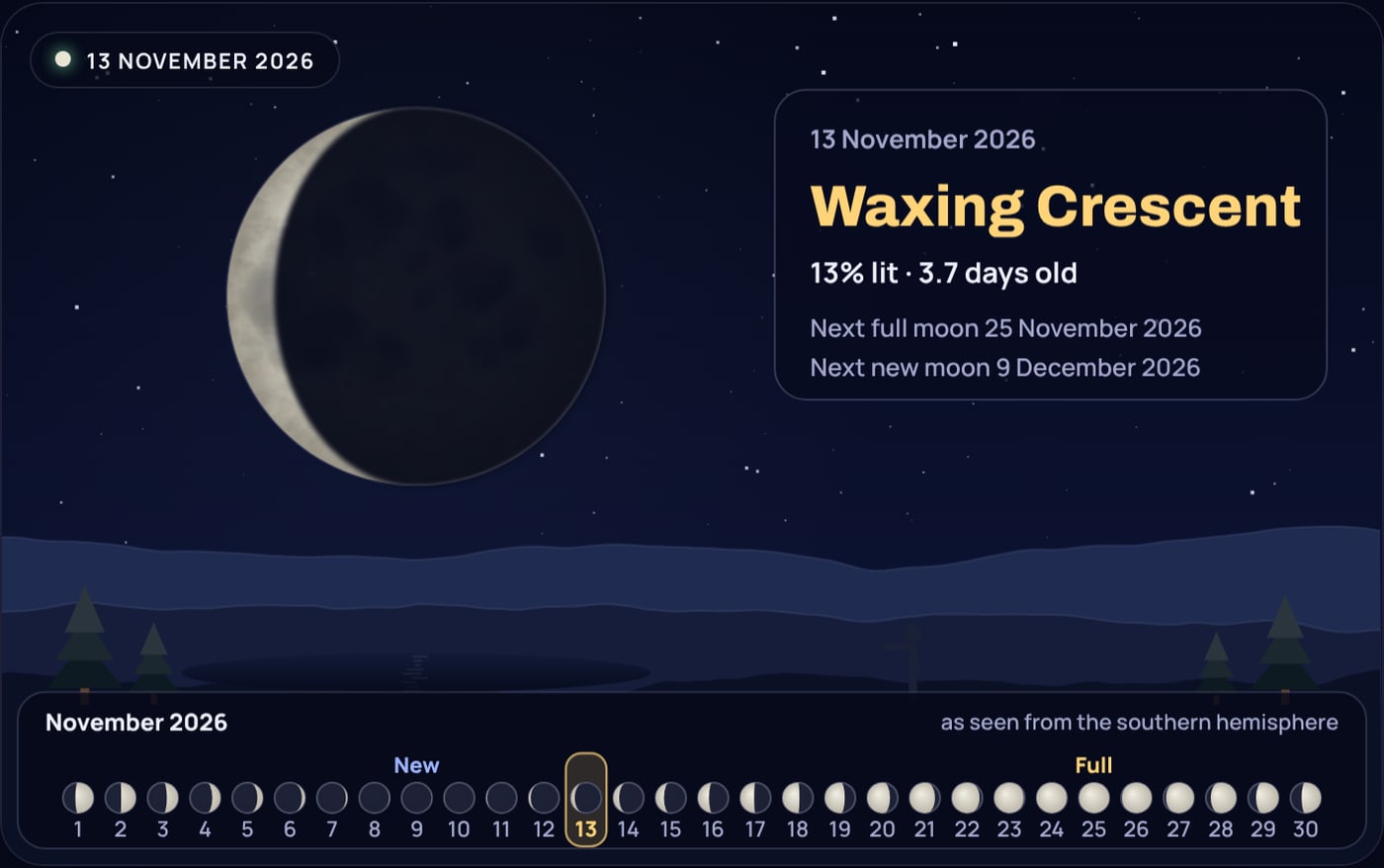
The phase and the lit percentage are the same everywhere on Earth at the same moment. What changes is the orientation. From the northern hemisphere a waxing Moon is lit on the right; from Australia, South Africa or Argentina you are looking at it "upside down", so it is lit on the left. Near the equator, in Singapore or Chennai, a crescent tends to lie on its back like a smile.
The face you see does not change, though. The Moon keeps the same side towards Earth, so the craters and dark seas in a birthday picture are the same ones your grandparents saw. Why we only see one side of the Moon explains the tidal locking behind that.
How often does the Moon repeat on your birthday?
Nineteen calendar years contain almost exactly 235 lunar months, a coincidence called the Metonic cycle. So the Moon on your 19th, 38th and 57th birthdays looks very nearly the same as on the day you were born, often to within a day of phase. Most other years it lands somewhere else in the cycle: twelve lunar months are about 354 days, so each birthday the Moon is about 11 days further on in its cycle than the year before.
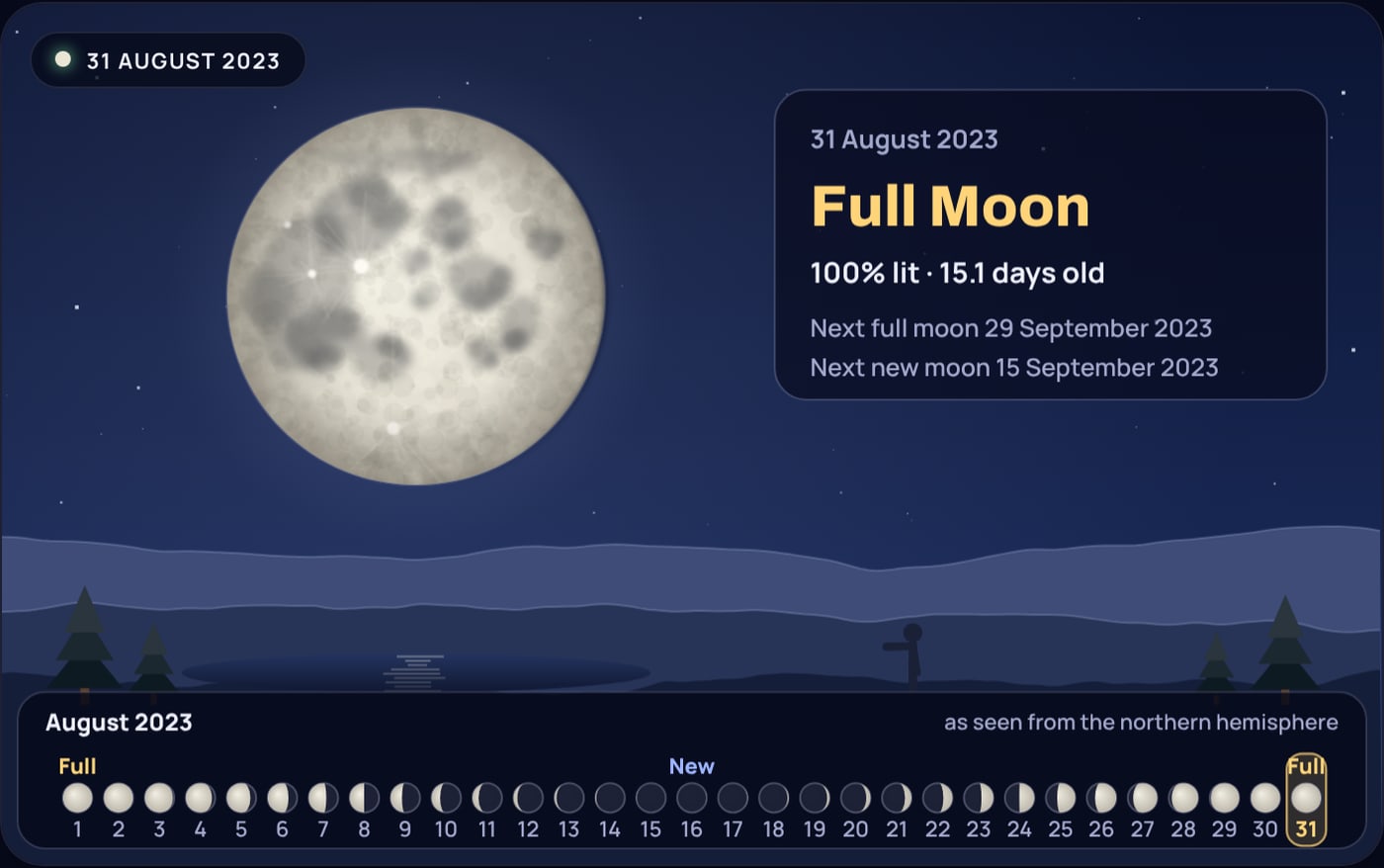
A few dates are worth trying for fun. The super blue moon of 31 August 2023 was the second full moon that month, at 01:35 UTC. India's independence at midnight on 15 August 1947 came under a moonless sky: the Moon was a 4% crescent, below the horizon until shortly before dawn. If your birthday is close to a full moon, the Moon illusion post explains why it looks so huge as it rises, and a full moon in Earth's shadow is the subject of why a lunar eclipse is red.
Try it for your own date
Open the Moon phase calculator, type your birth date, pick the time zone you were born in, and add the time if your birth certificate has it. Then step through the days with the Day after button to watch how fast the lit part grows. For the geometry behind the shapes, the Moon phases simulation shows the Sun, Earth and Moon from above.
Sources
- Jean Meeus, Astronomical Algorithms, 2nd edition (Willmann-Bell, 1998), chapters 47, 48 and 49
- US Naval Observatory: Phases of the Moon (phase times used to check the calculator)
- US Naval Observatory: Sun and Moon data for one day (daily illuminated fraction)
- NASA: Polynomial expressions for Delta T
Frequently asked questions
How do I find the moon phase on my birthday?
Enter your date of birth and the time zone you were born in into a moon phase calculator. It gives the phase name, the percentage of the Moon that was lit and the Moon’s age in days. Add your birth time for the exact illumination at that moment.
Why does my birthday moon differ between websites?
Usually because of time zones. A full moon at 20:00 UTC falls at 01:30 the next day in India, so a site using UTC and one using Indian time can name different phases for the same date. Rough calculators that use an average month can also be off by most of a day.
What does the Moon age mean?
The Moon’s age is the number of days since the last new moon. About 7.4 days is first quarter, 14.8 days is full moon and 22.1 days is last quarter, on an average 29.53 day cycle.
Is a moon phase on my birthday rare?
No. Every phase comes round every 29.5 days, so about one birthday in 30 falls on a full moon and about one in 30 on a new moon. The same phase returns on the same calendar date roughly every 19 years, the Metonic cycle.
Was the Moon full the night I was born?
Only if the calculator names Full Moon or shows more than about 95% lit. The Moon looks full for about three nights, because a day before or after the exact full moon it is still about 98% lit.