Why Are Stars Different Colors? Red, White and Blue Stars
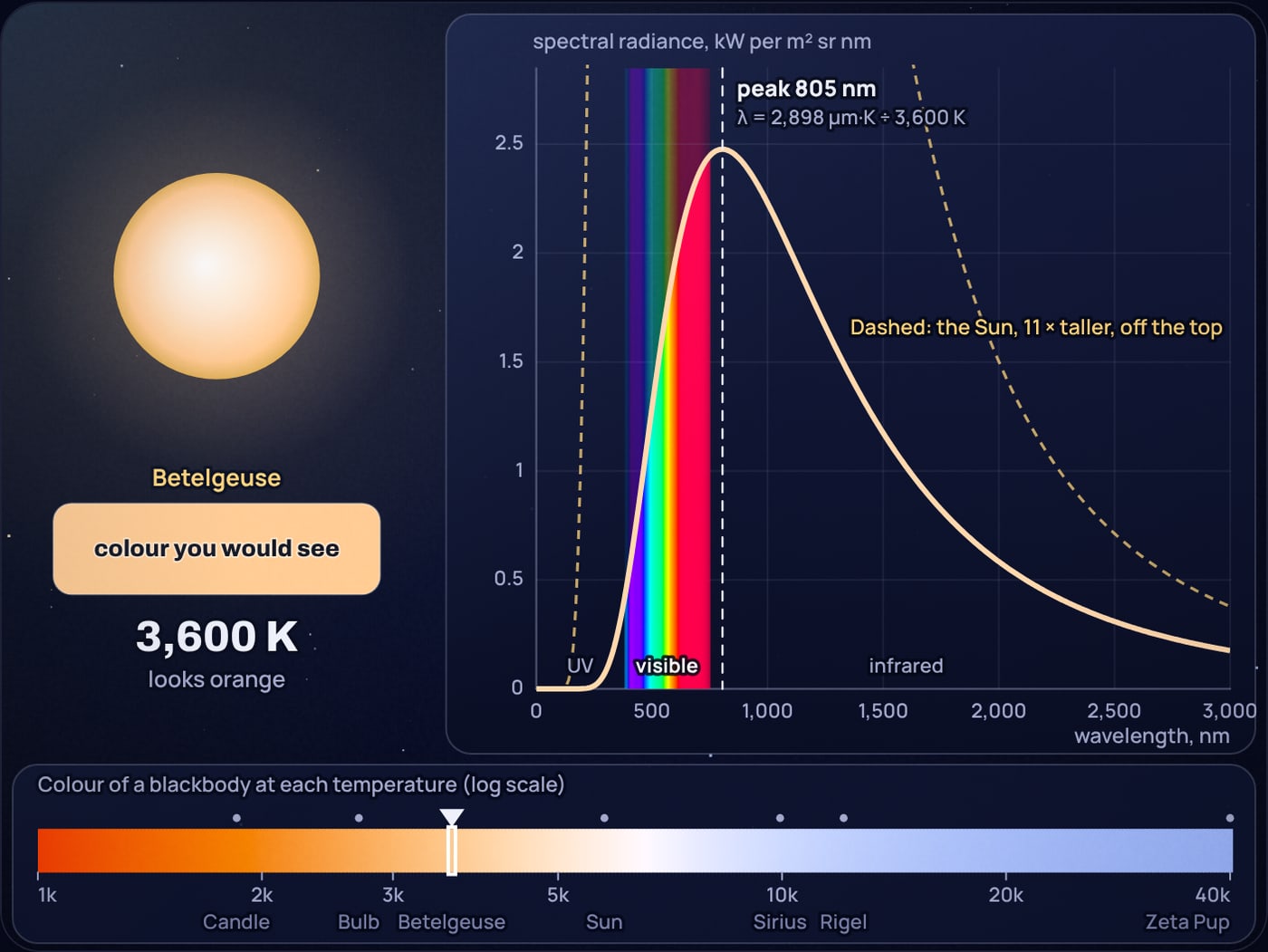
Look at Orion on a winter evening. The star at the top left, Betelgeuse, is a clear orange. The one at the bottom right, Rigel, is a cold blue white. They sit in the same constellation, both are supergiants, both are hundreds of light years away, and the difference you see is a single number: Betelgeuse's surface is at about 3,600 K and Rigel's at about 12,100 K. That gap of 8,500 degrees moves the peak of their light from the infrared to the ultraviolet.
The blackbody star colour simulator lets you drag a temperature slider from 1,000 K to 40,000 K and watch the spectrum and the colour change together. This post explains what it shows, with the numbers worked out.
How does temperature set a star’s colour?
A star's surface is dense, opaque gas that absorbs almost everything that falls on it, which makes it close to what physicists call a blackbody. A blackbody's glow depends on nothing but its temperature, and Max Planck worked out its exact shape in 1900:
Two things happen as goes up. The whole curve rises, at every wavelength. And its peak slides to shorter wavelengths, following Wien's displacement law:
Betelgeuse: , just past the red end of human vision (about 750 nm).
Rigel: , well into the ultraviolet.
Neither star peaks in the visible band at all. Only stars between about 2,898/0.75 = 3,860 K and 2,898/0.38 = 7,630 K do.
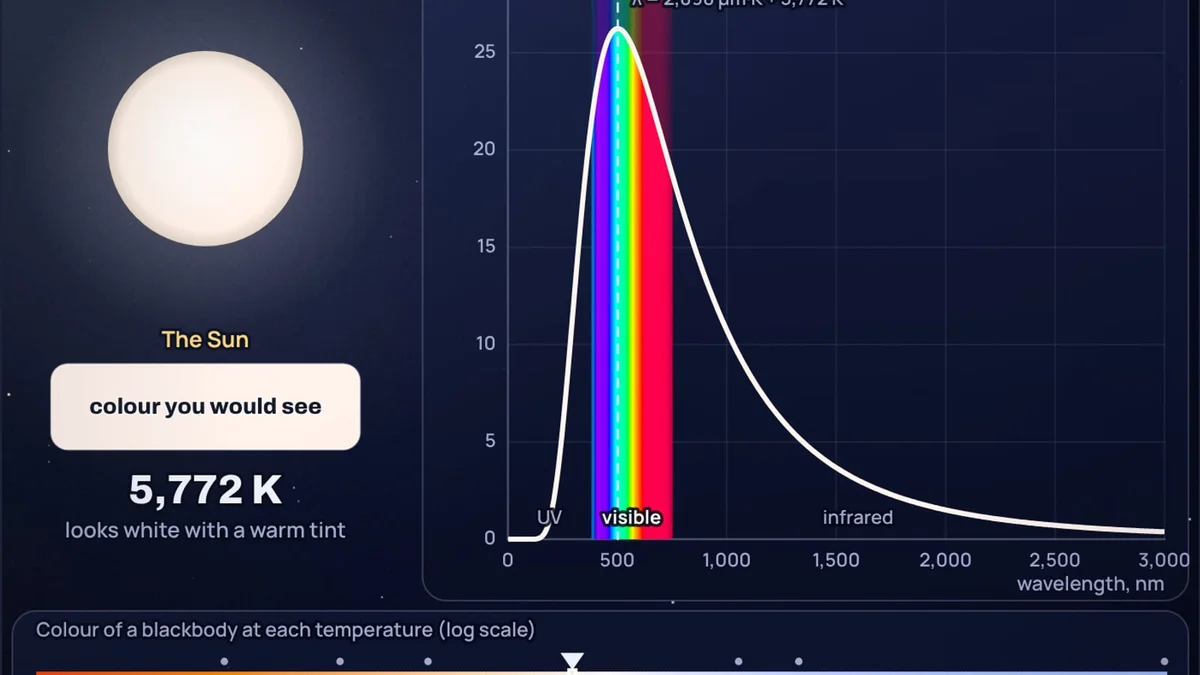
So the colour is not set by where the peak sits. It is set by the slope of the curve across the narrow visible window, 380 to 750 nm. Compare the radiance at 450 nm (blue) with 650 nm (red) using Planck's law:
Betelgeuse, 3,600 K: . Red outshines blue by a factor of 2.4, so the star looks orange.
The Sun, 5,772 K: . Nearly balanced, so it looks white.
Rigel, 12,100 K: . Blue outshines red 2.5 times, so it looks blue white.

How the simulator turns a spectrum into a colour
Most star colour charts on the web use a curve fitted to photographs. The simulator does the calculation the way a colour scientist would. It multiplies the Planck spectrum by the three CIE 1931 colour matching functions, which describe how the average human eye's three cone types respond, sums the result every nanometre from 360 to 830 nm, and converts those three numbers to an sRGB screen colour with the standard D65 white point. Brightness is normalised, so you see the hue a star would have if it were bright enough for full colour vision.
A good check is CIE Illuminant A, which is defined as a 2,856 K blackbody: the published chromaticity is x = 0.4476, y = 0.4074, and the simulator's calculation lands within 0.002 of both.
What temperature is each colour of star?
Astronomers sort stars into the spectral classes O, B, A, F, G, K and M, from hottest to coolest. The temperature ranges below are approximate for main sequence stars, and the colours are what the simulator computes for a blackbody at a representative temperature.
| Class | Temperature | Example | Computed colour | Peak | Looks |
|---|---|---|---|---|---|
| O | above 30,000 K | Zeta Puppis, 40,000 K | #9EB8FF | 72 nm | blue |
| B | 10,000 to 30,000 K | Rigel, 12,100 K | #C0D0FF | 239 nm | blue white |
| A | 7,500 to 10,000 K | Sirius A, 9,940 K | #CDDAFF | 292 nm | blue white |
| F | 6,000 to 7,500 K | 6,500 K blackbody | #FFF9FE | 446 nm | white |
| G | 5,200 to 6,000 K | The Sun, 5,772 K | #FFF1EA | 502 nm | white, warm tint |
| K | 3,700 to 5,200 K | 4,500 K blackbody | #FFDEBC | 644 nm | pale orange |
| M | 2,400 to 3,700 K | Betelgeuse 3,600 K, Proxima 2,980 K | #FFCB91, #FFB86C | 805 nm, 972 nm | orange |
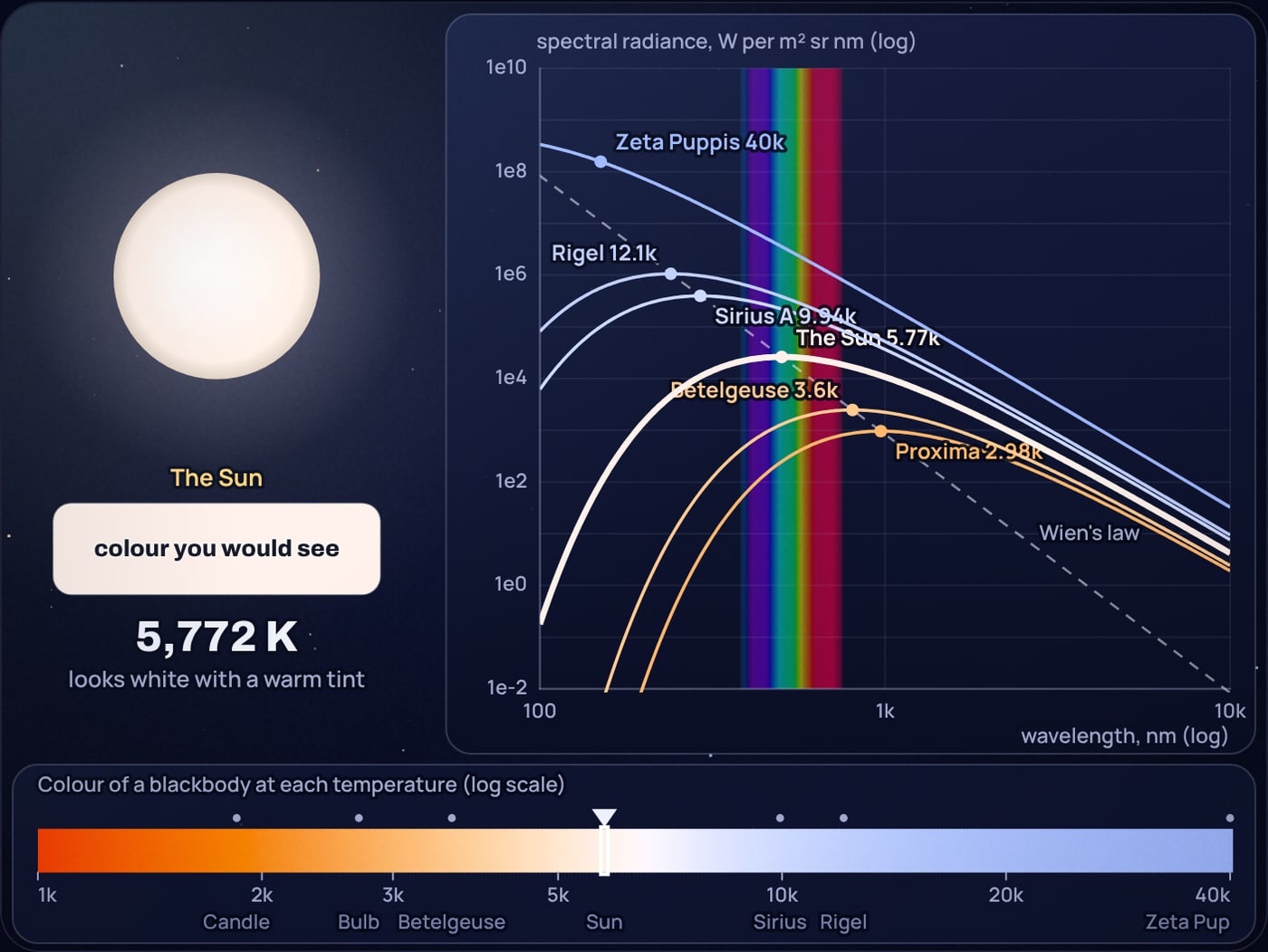
Notice how compressed the hot end is. Going from 12,100 K to 40,000 K, more than three times hotter, only shifts the colour from #C0D0FF to #9EB8FF. Once the peak is far into the ultraviolet, the visible band only sees the long, smooth tail of the curve, and that tail has the same shape at any high temperature. That is why there are no deep blue or violet stars: the bluest any blackbody can look is a pale sky blue.
Why are there no green stars?
The Sun peaks at 502 nm, which is blue green, so by the "colour of the peak" logic the Sun should be green. It is not, because a blackbody curve is far wider than the visible band. At 5,772 K the radiance at 450 nm and at 650 nm differ by only 12 percent, so all three cone types are stimulated about equally and the brain reads white. Every blackbody colour lies on a single curve in colour space, the Planckian locus, which runs from deep red through orange and white to pale blue. It never enters the green region. Our post on what colour the Sun really is goes further into the Sun's own case.
Why do hot stars give off so much more light?
The other half of the story is brightness. Integrate Planck's law over every wavelength and you get the Stefan-Boltzmann law: each square metre of a star's surface radiates
Sun: .
Rigel: , so 1,220 MW per m², 19 times the Sun's surface.
Betelgeuse: , so only 9.5 MW per m². But its radius is about 764 times the Sun's (Joyce and colleagues, 2020), so its total output is times the Sun's.
That last line is why a cool star can still be one of the brightest in the sky. Colour tells you temperature. Brightness tells you temperature and size together. The star life cycle simulator shows how a star's mass decides which temperature and size it ends up with, and how a star like Betelgeuse swells and cools late in its life.
What do light bulb kelvin ratings have to do with stars?
Exactly the same physics. The "2,700 K" on a warm white lamp is a correlated colour temperature: the temperature of the blackbody whose colour the lamp matches. An old tungsten bulb really is a small blackbody at about that temperature, and the simulator shows why it was such a poor lamp.
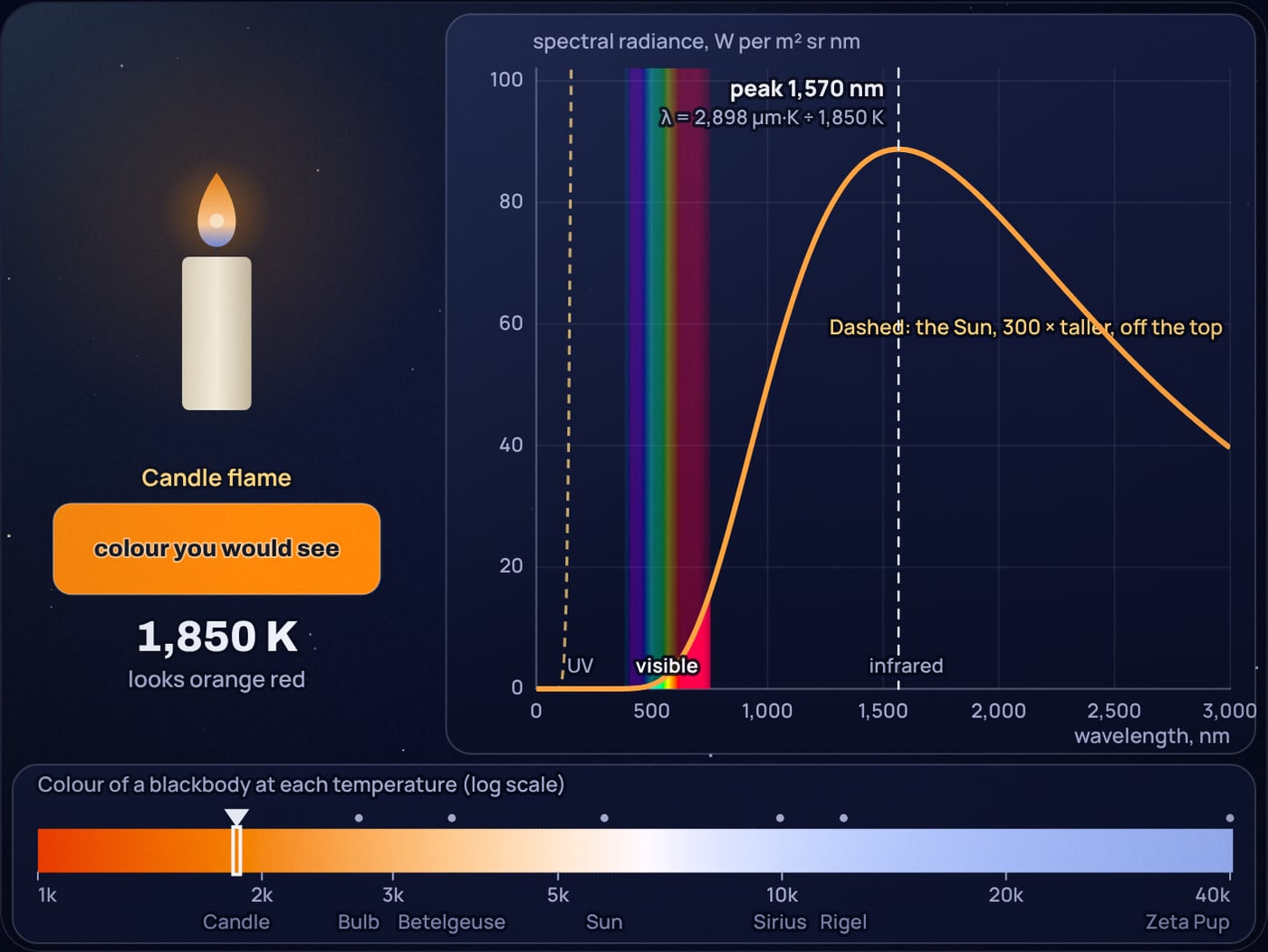
2,700 K bulb: peak at 2898/2700 = 1.07 µm. Only 7.0% of the radiated power lies between 380 and 750 nm; 92.9% is infrared heat.
6,500 K "daylight": peak at 446 nm, and 46.3% of the power is visible.
Candle flame, 1,850 K: peak at 1.57 µm, and just 0.7% is visible.
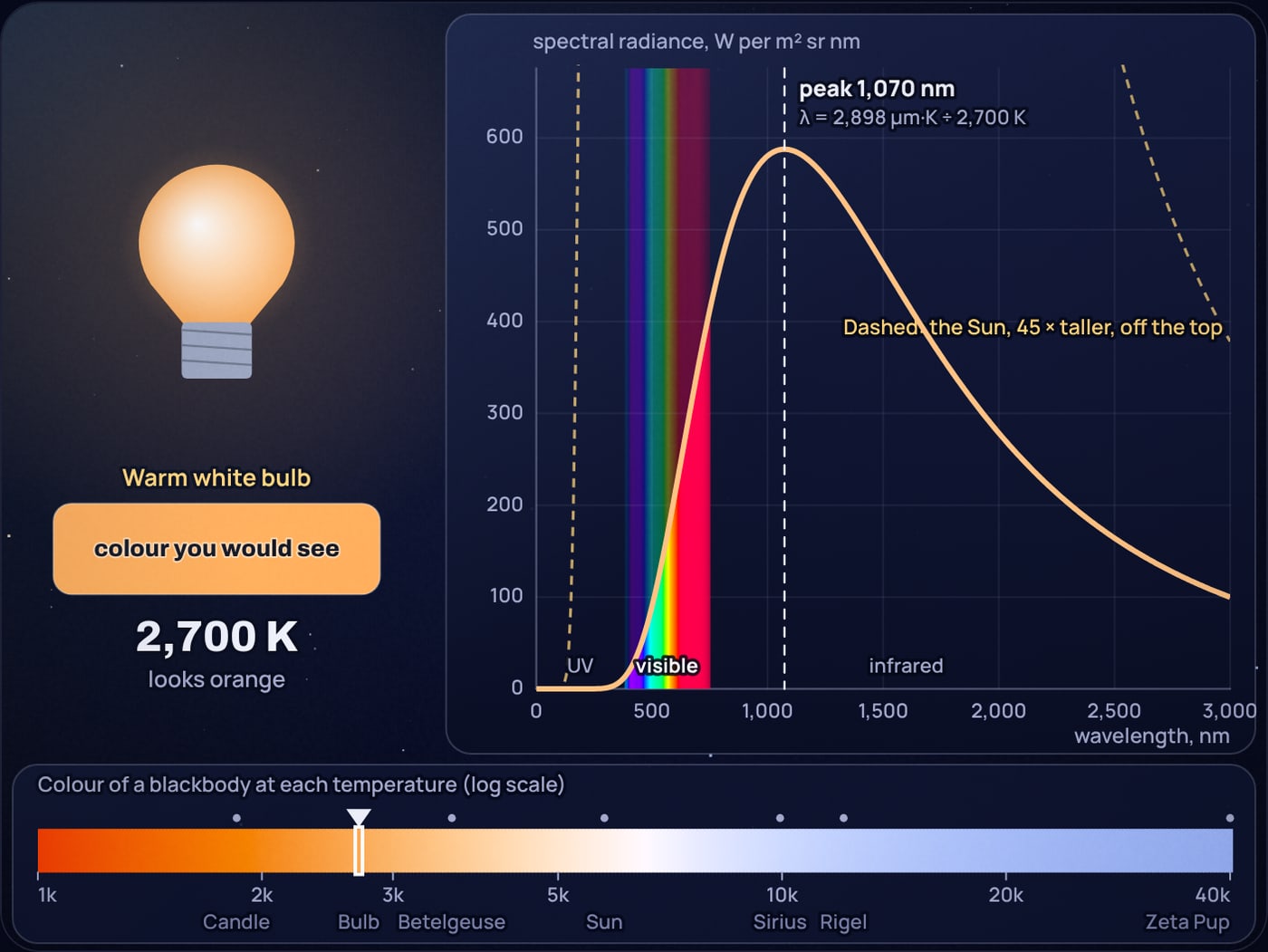
A red dwarf like Proxima Centauri, at 2,980 K, computes to #FFB86C, almost the same as that bulb. Astronomers call it a red dwarf, but if you stood near one your eyes would adapt and call it a warm white, a little like a room lit by old incandescent lamps. A modern LED lamp rated 2,700 K matches the colour but not the spectrum, since it uses a blue chip and a phosphor rather than a hot filament.
The misconception: red hot, blue cold
Taps, weather maps and thermostats all use red for hot and blue for cold, and that habit makes star colours feel backwards. For anything that glows, the scale runs the other way. A stove element at 1,000 K glows dull red, a filament at 2,700 K glows orange white, the Sun at 5,772 K is white, and only the hottest stars are blue. Blacksmiths knew this long before Planck: "white hot" is hotter than "red hot". The red on a tap is a convention about how water feels on skin, not about how matter glows.
A second, smaller misconception is that the colour of a star is the colour of its peak wavelength. The tables above show why that fails: Betelgeuse peaks in the infrared and Rigel in the ultraviolet, yet both are clearly visible and coloured. The eye sees the slope across 380 to 750 nm, not the peak.
Why do most stars look white to the naked eye?
Because most stars are faint. In dim light the eye relies on rod cells, which do not distinguish colour at all, so only the brightest stars trigger enough cone response to show a hue. That is why Betelgeuse, Antares, Rigel and Vega show colour while fainter stars look like white points. Binoculars help, since they gather more light. Near the horizon, extra air reddens and scatters starlight and makes bright stars like Sirius flash colours as they twinkle; that is the atmosphere, not the star.
Try it yourself
Open the simulator on the Sun and drag the slider slowly down to 3,000 K, watching where the curve crosses the shaded visible band. Then try the Compare view to see every preset star on one chart, and type 7,000 K into the box to find the temperature that looks most neutral on your screen.
Sources
- Levesque and Massey (2020), Betelgeuse Just Isn’t That Cool, ApJ Letters (arXiv:2002.10463)
- IAU 2015 Resolution B3 on nominal solar values (5,772 K)
- Ribas et al. (2017), The full spectral radiative properties of Proxima Centauri (arXiv:1704.08449)
- Rigel, effective temperature 12,100 K from Przybilla (2010)
- Sirius, effective temperature 9,940 K from Adelman (2004)
- Bouret et al. (2012), Properties of Galactic early type O supergiants, Zeta Puppis at 40,000 K (arXiv:1205.3075)
- Joyce et al. (2020), Betelgeuse radius of 764 solar radii (arXiv:2006.09837)
- Wyman, Sloan and Shirley (2013), Simple Analytic Approximations to the CIE XYZ Color Matching Functions, JCGT
- Colour temperature of everyday light sources
Frequently asked questions
Why are some stars red and some blue?
Because they have different surface temperatures. A hot surface glows with a spectrum that peaks at shorter wavelengths. A 3,600 K star like Betelgeuse peaks at 805 nm in the infrared and sends more red than blue into the visible band, so it looks orange. A 12,100 K star like Rigel peaks at 239 nm in the ultraviolet and sends 2.5 times more blue than red, so it looks blue white.
Which color star is the hottest?
Blue stars. The hottest O type stars reach 30,000 to 50,000 K. Zeta Puppis, at about 40,000 K, peaks at 72 nm in the far ultraviolet. Red stars are the coolest, from about 2,400 K to 3,700 K.
Why are there no green stars?
A star’s spectrum is too broad. When the peak falls in the green, as it does for the Sun at 502 nm, the star also emits strongly in red and blue, and the eye sees the mixture as white. No temperature produces a green blackbody.
What color is the Sun as a star?
White. Its effective temperature of 5,772 K gives a computed colour of #FFF1EA, white with a faint warm tint. It looks yellow from the ground because the air scatters some of its blue light out of the direct beam.
Is a 2,700 K light bulb the same colour as a red dwarf star?
Very nearly. A 2,700 K blackbody computes to #FFAE59 and Proxima Centauri at 2,980 K to #FFB86C, both orange whites. A red dwarf is called red in astronomy, but to the eye it would look like a warm white bulb.
 Why the 2027 Solar Eclipse Lasts 6 Minutes 23 Seconds
 How We Know 3I/ATLAS Is Interstellar: Orbit Math