Why moons break apart: the Roche limit and planetary rings
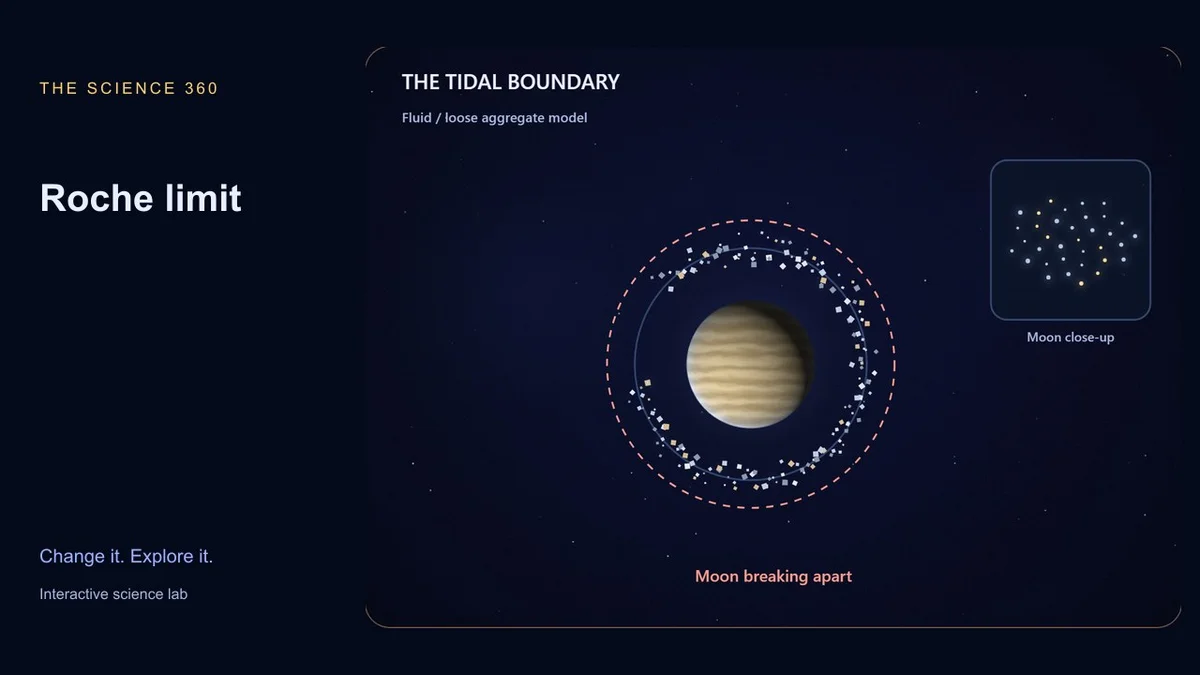
A moon can be pulled apart even while the planet’s gravity keeps its pieces in orbit. The key is the difference in gravity across the moon. Its near side falls toward the planet more strongly than its far side. If the moon cannot hold itself together against that tidal stretching, a single object can become a stream of fragments.
Open the Roche limit simulator to compare the moon’s distance with a calculated disruption estimate. The dashed circle is a physical-model result; the visible breakup is an illustration.
A worked example: an icy moon near a Saturn-density planet
For an ideal fluid satellite, the classical estimate is:
d = 2.44 R × (ρplanet / ρmoon)^(1/3)
Here R is the planet’s radius, d is the distance from its centre, and ρ denotes average density. The ratio inside the brackets has no units.
Set the planet density to 687 kg/m³ and the moon density to 900 kg/m³. Substituting those values gives d/R ≈ 2.23. A circular orbit at 2.8 radii lies outside that boundary; at 1.8 radii it lies inside it. The corresponding heights above the planet’s surface are 1.8 and 0.8 radii, because centre distance and surface altitude differ by one radius.
Change composition before changing the orbit
Keep the orbit at 1.8 radii and increase the moon density to 3300 kg/m³. The estimate falls to about 1.45 radii. The denser body’s self-gravity is harder for the same tidal gradient to overcome.
| Moon density | Fluid Roche estimate |
|---|---|
| 900 kg/m³ | 2.23 planet radii |
| 1800 kg/m³ | 1.77 planet radii |
| 3300 kg/m³ | 1.45 planet radii |
Notice the cube root: doubling density does not halve the limit. It multiplies it by about 0.794. Predict the result of another density change before moving the slider, then check the measurement.
Why a spacecraft can survive inside the limit
The formula describes a self-gravitating body under specific assumptions. A spacecraft or small rock is held together largely by material strength. Its fate cannot be read from a fluid-moon boundary alone. The simulation’s rigid-body option is another idealized estimate, not a structural-strength calculator.
The same caution applies to the debris. Crossing a classical boundary does not instantly produce Saturn’s finished rings. Collisions, orbital evolution, fragmentation and the supply of material affect what develops. A ring’s existence does not by itself settle its origin or age.
An investigation to keep
Find the smallest density that puts a moon at two planet radii outside the fluid estimate. Record your inputs and use Copy link to save the setup. Then switch body models and explain why the answer changes.
Continue with the ocean tides simulation to explore differential gravity in a less destructive setting.
Sources and further reading
 5 amazing physics experiment for your kids
 50 Hilarious Physics Jokes That Will Make You Laugh