How close can a moon get before tides pull it apart?
A loosely bound moon can be disrupted when the difference in gravity across it overwhelms its own gravity. The classical Roche limit estimates this distance using the densities of the planet and moon.
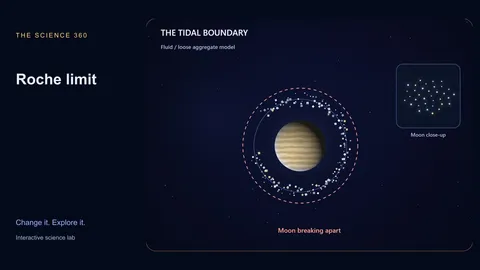
Press “Watch the moon break apart” to follow an intact moon across the limit: it stretches, develops cracks, separates into fragments, then spreads into a ring. Use the scrubber to inspect each stage. The boundary is calculated; the destruction timing is a schematic illustration. Small rocks held together by material strength can survive where a fluid body cannot.
Read the companion article for a worked investigation, or continue with ocean tides.
What to look for
- A Saturn-density planet and a 900 kg/m³ moon give a fluid limit of about 2.23 planet radii.
- A denser moon has a smaller Roche limit: doubling its density multiplies the distance by 2⁻⅓, about 0.794.
- A Roche limit below one planet radius is inside the planet; surface contact happens first.
Experiments to try
Load a complete preset, predict what will change, then adjust one control and compare the live measurements.
Icy moon outside
Guided experimentStart with a Saturn-density planet and an icy aggregate. At 2.8 planet radii it is outside the classical fluid estimate of about 2.23 radii. The distance is measured from the centre, not the cloud tops.
Cross the limit
Guided experimentMove the same moon to 1.8 radii. The debris illustration appears because the distance is inside the fluid Roche limit. It marks a disruption regime; it does not calculate individual collisions or the time needed to form a ring.
Dense rocky moon
Guided experimentKeep the orbit but increase the moon density. Its self-gravity is stronger relative to the tidal gradient, so the fluid boundary moves inward to about 1.45 planet radii. Composition changes the answer even when the planet stays the same.
Compare the cases
| Moon density | Fluid limit, Saturn-density primary |
|---|---|
| 900 kg/m³ | 2.23 R |
| 1800 kg/m³ | 1.77 R |
| 3300 kg/m³ | 1.45 R |
Rounded values and classifications refer to the model and assumptions on this page.
How the model works
The model computes d/R from the density ratio. The fluid coefficient includes deformation of a self-gravitating fluid; the rigid estimate is a simpler balance of differential gravity and self-gravity.
The orbit is circular and the planet is spherical. The green or coral boundary reports whether the selected orbit lies outside or inside the selected estimate. Rings need additional physics: disruption does not instantly make a mature ring system.
What the model leaves out
- No material strength, spin evolution, eccentric-orbit history or particle collision solver.
- The moon and debris sizes are exaggerated. The rendered breakup is schematic.
- The rigid coefficient is an idealized estimate, not an engineering failure criterion.
Common misconceptions
A Roche limit is not an invisible solid wall. It depends on the body model; a strong small object and a fluid moon need not fail at the same distance.
Frequently asked questions
Does the Roche limit prove how Saturn’s rings formed?
No. It explains why self-gravity alone may not assemble a moon in some close orbits. The origin and age of actual rings require additional evidence.
Why is the distance measured from the centre?
The gravitational field and the classical formula use separation from the planet’s centre. Subtract one planet radius to obtain height above its surface.
Keep learning
Why moons break apart: the Roche limit and planetary rings
Follow a density-based worked example of the Roche limit, then test when an icy or rocky moon crosses a tidal-disruption boundary.