What patterns appear when orbital periods share a ratio?
Simple orbital-period ratios produce repeating alignments. In real systems, repeated gravitational interactions can create a dynamical resonance, but a numerical period ratio alone does not prove one.
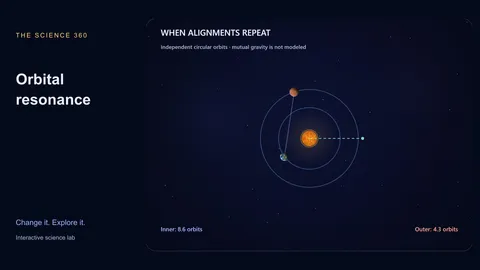
This is a kinematic pattern explorer: two bodies travel on independent circular Kepler orbits. Their radii follow the selected period ratio. Conjunction markers show how the alignment direction repeats or drifts.
Read the companion article for a worked investigation, or continue with kepler orbits.
What to look for
- At a 2:1 period ratio, the outer orbit is about 1.587 times the inner radius.
- At 3:2, the outer radius is about 1.310 times the inner radius.
- Near a simple ratio, alignment directions drift slowly rather than repeating exactly.
Experiments to try
Load a complete preset, predict what will change, then adjust one control and compare the live measurements.
2:1 rhythm
Guided experimentThe inner body completes two orbits per outer orbit. Successive conjunctions return to the same direction in this circular model. Watch the connection line repeat as the orbit counters advance.
3:2 rhythm
Guided experimentThree inner orbits take the same time as two outer orbits. Successive conjunctions revisit a repeated direction. The full two-body geometry repeats every three inner periods.
Slightly off 2:1
Guided experimentA small detuning makes conjunction directions drift. Compare a few cycles with the exact 2:1 preset. A pattern that looks nearly stationary over one orbit can move substantially over longer times.
Compare the cases
| Outer / inner period | Outer / inner radius | Conjunction interval, inner periods |
|---|---|---|
| 2:1 | 1.587 | 2 |
| 3:2 | 1.310 | 3 |
| 4:1 | 2.520 | 1.333 |
Rounded values and classifications refer to the model and assumptions on this page.
How the model works
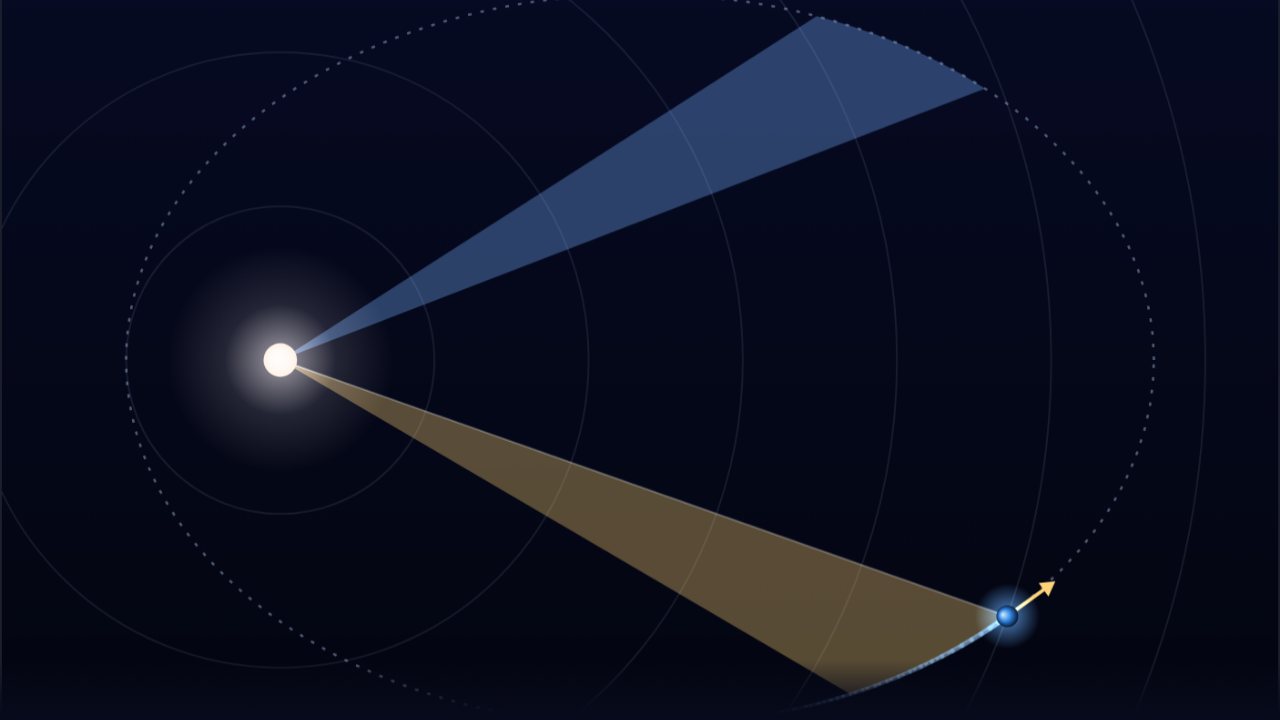
The inner period is one model unit and the outer period is q. Kepler’s third law gives the radius ratio q^(2/3). Both angular positions are computed analytically, without an accumulating numerical orbit error.
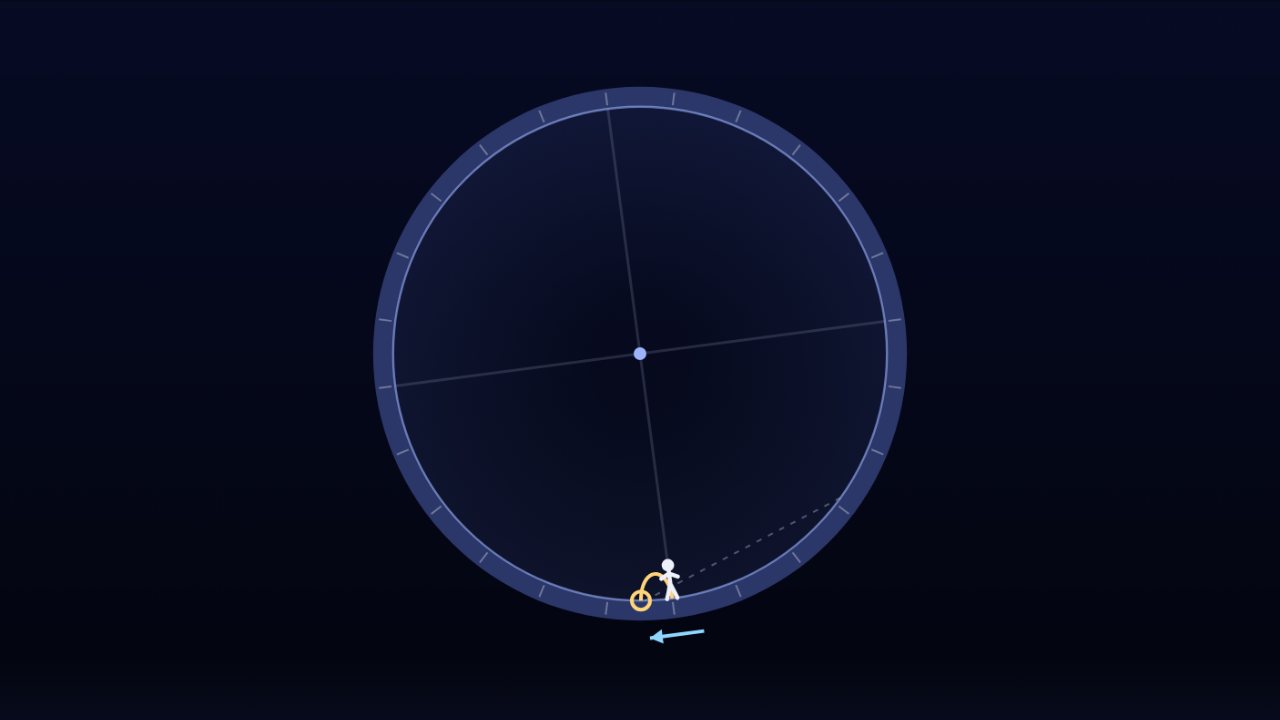
Conjunctions occur every q/(q − 1) inner periods. Marking their directions reveals the repeated pattern. Playback spans 20 inner periods; the displayed finite set of markers is a sampling window, not a stability test.
What the model leaves out
- No mutual gravity, migration, eccentricity, resonant-angle libration or resonance capture.
- The positions illustrate period commensurabilities, not a simulated Galilean-moon or Pluto–Neptune system.
- A simple-ratio match is reported with a tolerance and does not certify dynamical resonance.
Common misconceptions
Two planets having a near-integer period ratio is not enough to establish true resonance. A dynamical assessment examines the relevant resonant angles and how gravitational perturbations evolve.
Frequently asked questions
Does this simulate Io, Europa and Ganymede?
No. It illustrates two circular periods. The real three-moon Laplace resonance needs mutual gravity and a three-body resonant-angle description.
Why do conjunction markers drift near 2:1?
The period ratio is slightly detuned, so each new alignment occurs at a different longitude. The difference accumulates over repeated cycles.
Keep learning
Orbital resonance and repeating alignments: what a period ratio tells you
Explore 2:1 and 3:2 orbital rhythms, calculate radius ratios with Kepler’s law, and learn why a simple period match does not prove dynamical resonance.