Orbital resonance and repeating alignments: what a period ratio tells you
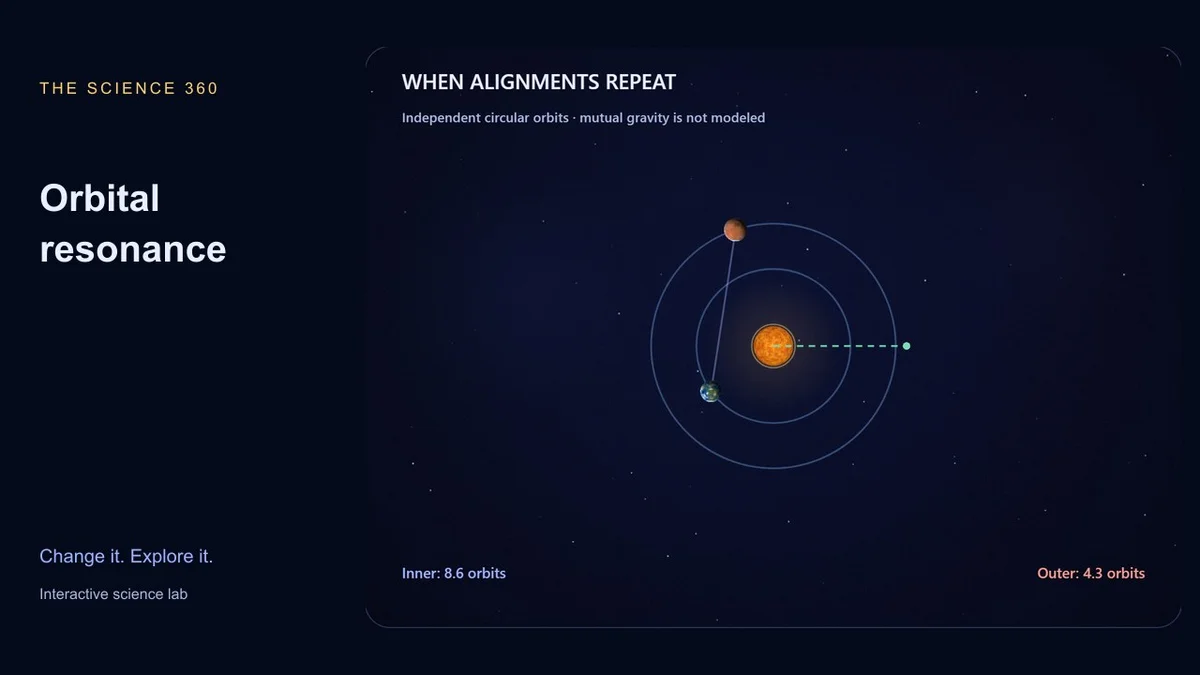
Two orbiting bodies can repeatedly align in a striking pattern when their periods have a simple ratio. That geometry is the starting point for understanding orbital resonances, but it is not the whole dynamical story.
The orbital resonance pattern explorer lets you vary the outer-to-inner period ratio and watch conjunction directions. It deliberately uses independent circular orbits, so the repeating pattern is easy to inspect without pretending to simulate resonance capture.
Define which period is on top
In this lab, q is the outer period divided by the inner period. At q = 2, the inner body completes two revolutions while the outer body completes one. At q = 1.5, three inner revolutions take the same time as two outer revolutions.
Always state the convention. “3:2” can be confusing when one description compares periods and another compares orbital frequencies, which are their reciprocals.
Turn a period ratio into a radius ratio
For circular orbits around the same dominant central mass, Kepler’s third law gives:
outer radius / inner radius = q^(2/3)
A 2:1 period ratio therefore needs a radius ratio of about 1.587. It does not put the outer body twice as far away. For 3:2 the radius ratio is about 1.310, and for 4:1 it is about 2.520.
Load each preset and check the displayed orbital sizes against those numbers. The planets are enlarged markers, but the orbital-radius ratio comes from the equation.
Mark each conjunction
The alignment interval, measured in inner periods, is:
Tsyn = q/(q − 1)
At 2:1, conjunctions occur every two inner periods. At 3:2 they occur every three. In both cases the alignment can return to the same direction after a complete common cycle.
At 4:1, the interval is four thirds of an inner period. Successive conjunctions sample three directions before the pattern repeats. Watch the green markers rather than only the instantaneous connecting line.
Now choose 2.03 instead of 2. The near-match can look similar over a short interval, but the alignment direction slowly drifts. Small differences accumulate when you watch enough cycles.
Geometry is not yet dynamical resonance
In a real resonant system, mutual gravity and the evolution of appropriate resonant angles matter. A characteristic angle may librate around a value rather than circulate through every direction. Migration, eccentricity and dissipation can affect whether a system enters or leaves resonance.
This explorer does not integrate those interactions. It demonstrates commensurabilities and conjunction patterns, not libration, capture or long-term stability. Its “ratio match” reading is an arithmetic label rather than a dynamical diagnosis.
Save an exact 2:1 setup and a slightly detuned setup at the same playback position. Describe the difference without calling either a proven gravitational lock. Then use the Kepler orbit simulation to investigate the central-force law behind the period scaling.
Sources and further reading
 5 amazing physics experiment for your kids
 50 Hilarious Physics Jokes That Will Make You Laugh