How to Find the Spring Constant (With a Home Experiment)
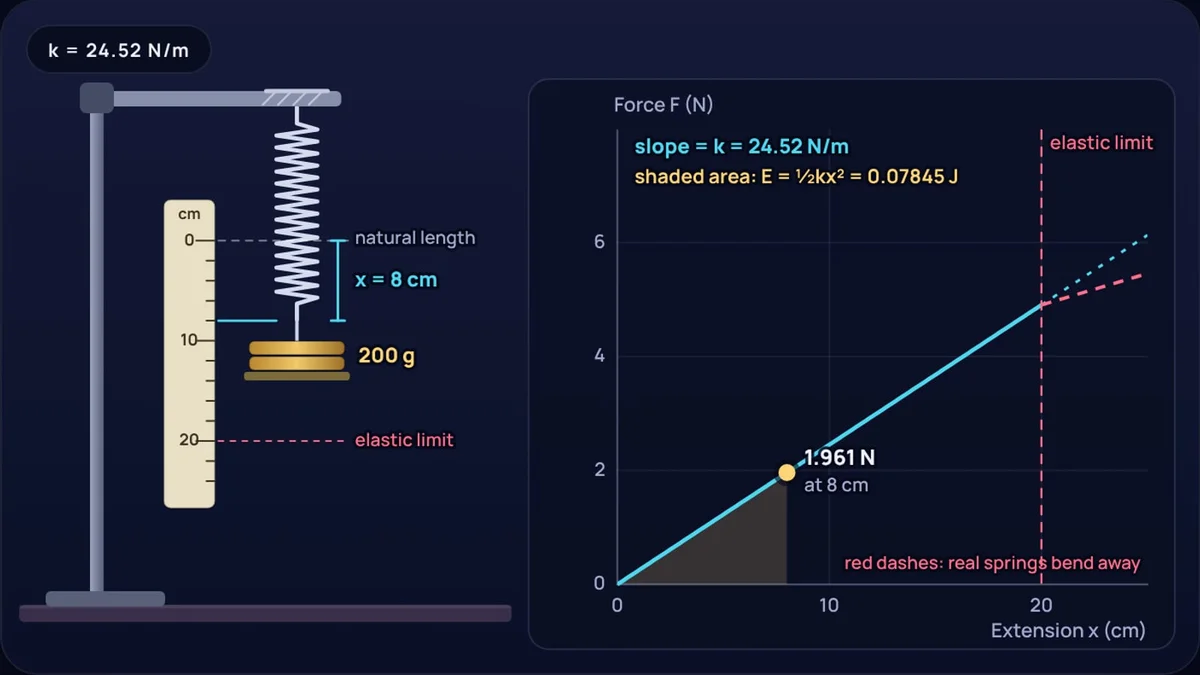
Pull on a spring and it pushes back. Pull twice as hard and it stretches twice as far. That simple pattern, first published by Robert Hooke in the 1670s, is what lets a spring balance weigh a parcel and a car's suspension soak up a pothole. The number that describes any particular spring is its spring constant, k, and you can measure it at home with a ruler, a cup and some water.
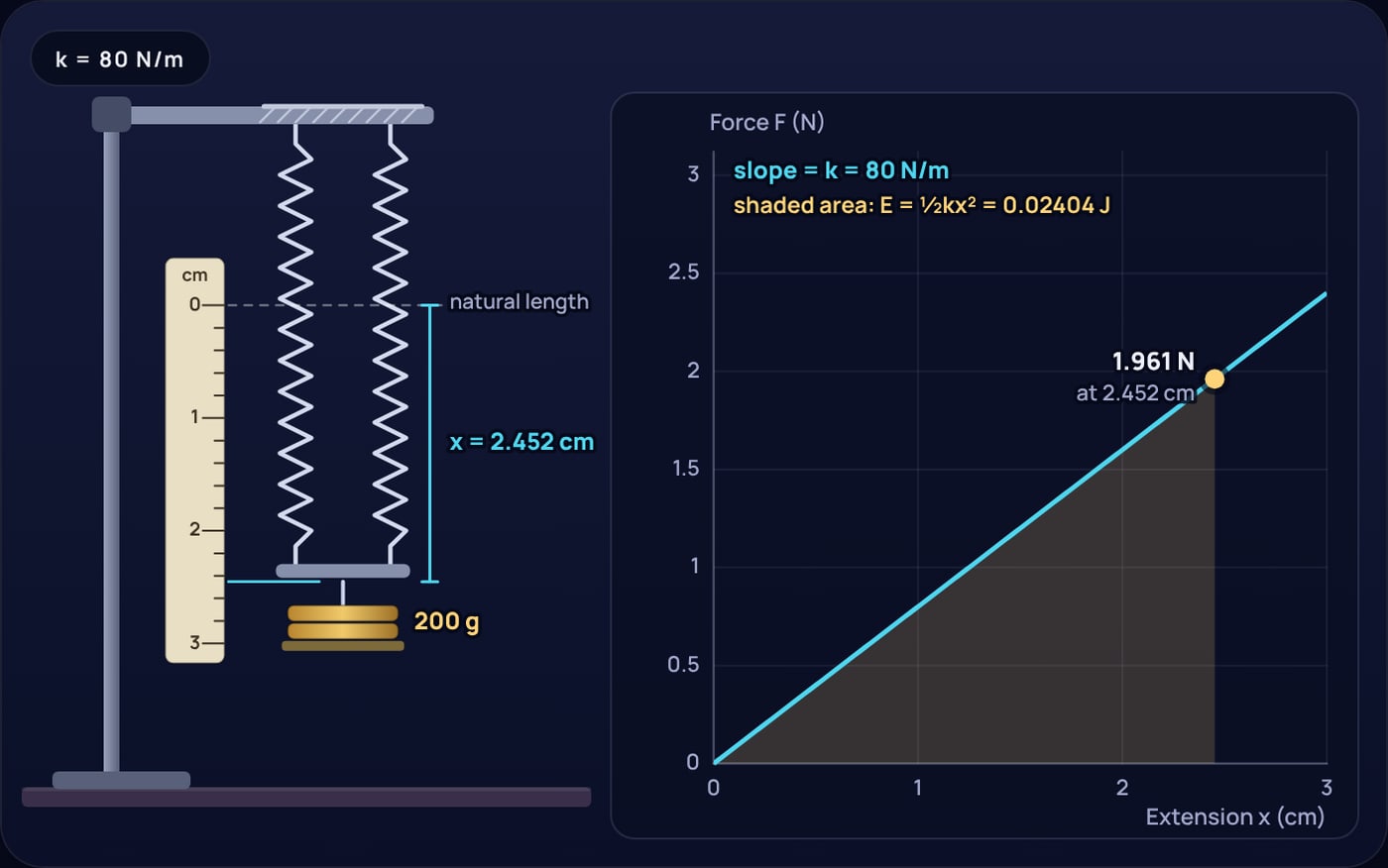
This guide explains what the spring constant means, how to work it out from one reading, and how to run a better experiment with several loads and a graph. The Hooke's law calculator does each step for you, including a best fit line through your own readings, and shows the spring stretching on a stand beside a ruler.
What is the spring constant?
Hooke's law says the force on a spring is proportional to how far it is stretched or squashed:
Here F is the force in newtons, x is the extension in metres, and k is the spring constant in newtons per metre (N/m). The extension is the change in length from the unloaded spring, not the total length. A stiff spring has a large k: it takes a lot of force to stretch it a little. A soft spring has a small k.
Hooke put it in his own words in 1678, after first hiding the idea in a Latin anagram: "if one power stretch or bend it one space, two will bend it two, and three will bend it three, and so forward." The Latin was ut tensio, sic vis: as the extension, so the force.
You will often see the law written as F = −kx. The minus sign only says that the spring pulls back in the opposite direction to the stretch. When you are finding k from a hanging load, you can work with the sizes and ignore it.
How do you find the spring constant from one reading?
You need two numbers: the force on the spring and the extension it causes. If you hang a mass on the spring, the force is the mass's weight, F = mg. NIST lists the standard acceleration of gravity as exactly 9.80665 m/s². Real gravity varies a little with place, from 9.780 m/s² at the equator to 9.832 m/s² at the poles according to NASA's Earth fact sheet, but that is within 0.3% of the standard value.
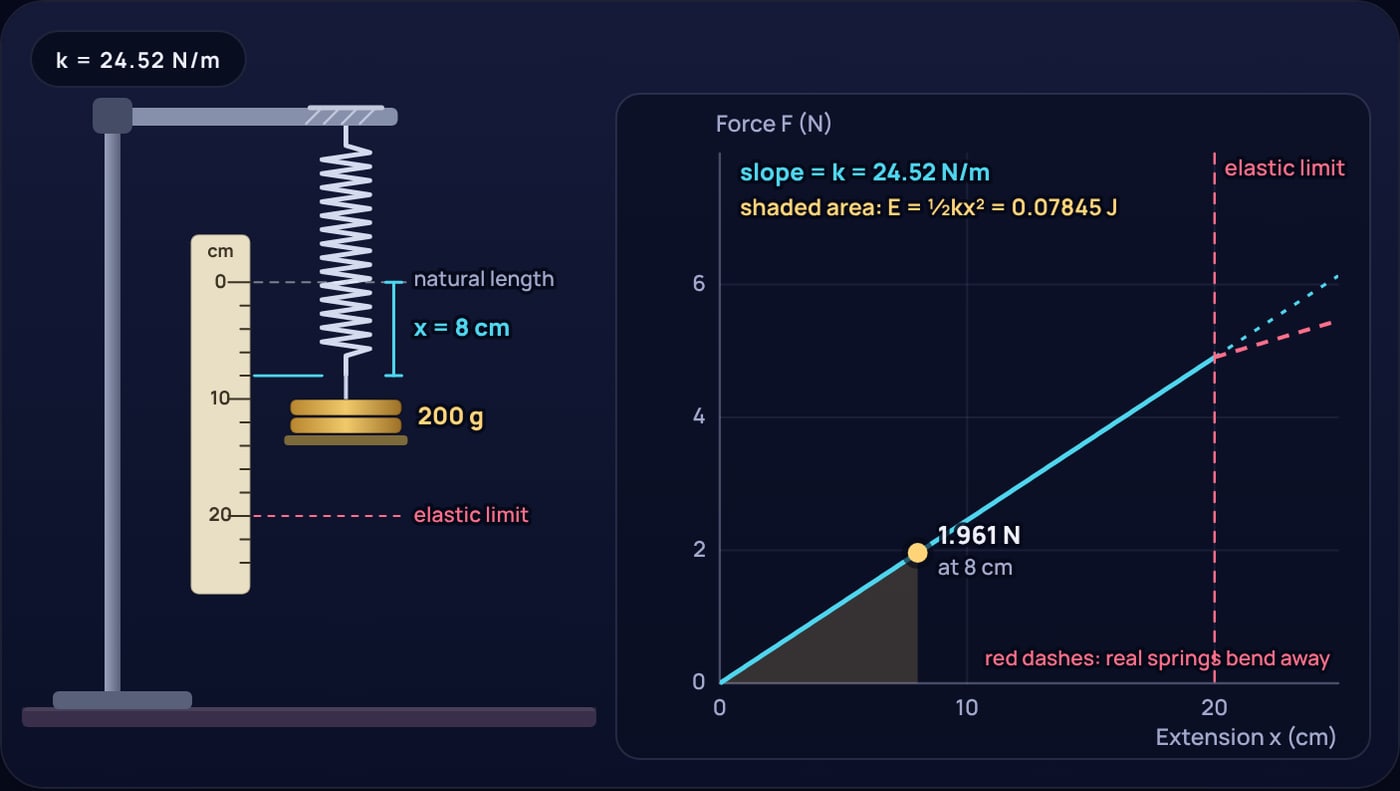
Example 1: a 200 g mass stretches a spring 8 cm
Every newton of pull stretches this spring by about 4.1 cm.
The two common slips are units and lengths. Convert grams to kilograms and centimetres to metres before dividing, or the answer will be out by a factor of 10 or 1,000. And measure the change in length, not the full length of the spring.
What do you need for a home experiment?
A school lab uses a clamp stand and slotted 100 g masses. At home you can replace the masses with water, because water has a known density. The NIST Chemistry WebBook gives water at 20 °C a density of 998.21 kg/m³, so every 100 mL of water has a mass of 99.8 g. A measuring jug turns into a set of weights.
- A spring that stretches noticeably under half a kilogram. A spare extension spring from a hardware shop or an old toy works well.
- Somewhere to hang it, such as a hook, a door handle or a broom handle across two chairs.
- A light container with a handle: a small plastic bag, a paper cup with a string loop or a small bucket.
- A measuring jug and water at room temperature.
- A ruler fixed upright beside the spring with tape, so it does not move between readings.
Weigh the empty container if you have a kitchen scale and add its mass to every load. If you do not, measure the extensions from the length with the empty container on. The container's weight then acts like a starting offset, which the graph method handles anyway.
How do you run the experiment step by step?
- Hang the spring with the empty container and let it settle. Read the position of the bottom of the spring on the ruler. This is your zero.
- Pour in 100 mL of water. Wait for the spring to stop bouncing and read the ruler again. The difference from the zero is the extension.
- Add another 100 mL and read again. Repeat up to 500 mL, or until the spring has stretched a good deal.
- Take the water out 100 mL at a time and check that the readings come back to the same values. If they do not, the spring has been stretched past its elastic limit.
- Read the ruler at eye level, level with the bottom of the spring, to avoid a parallax error.
How do you work out k from your readings?
Turn each load into a force with F = mg, then either work out k for each reading or plot all the readings on a graph. Here is a set of example readings from 100 to 500 mL of water.
Example 2: five loads of water
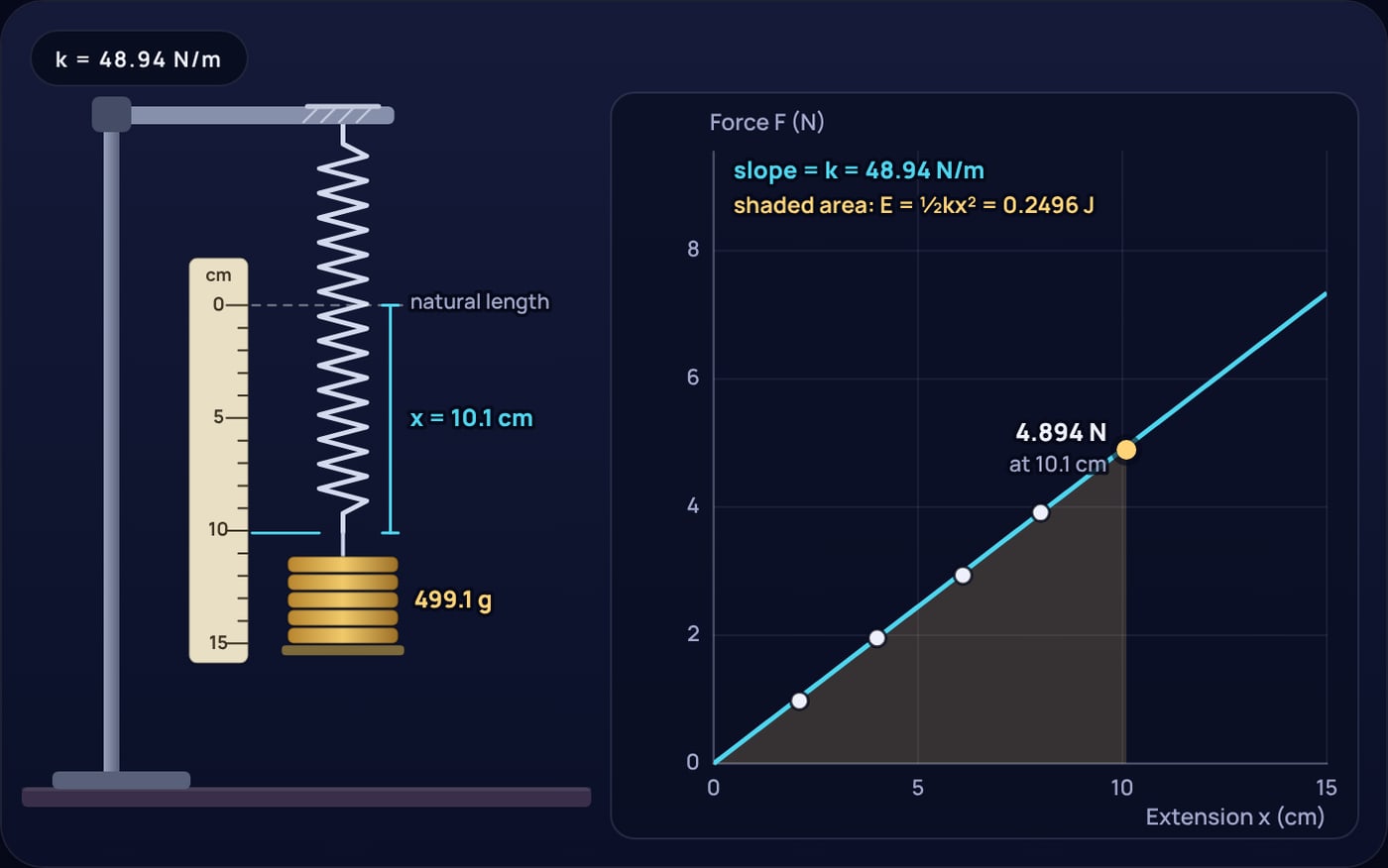
Loads of 99.8, 199.6, 299.5, 399.3 and 499.1 g gave extensions of 2.1, 4.0, 6.1, 8.0 and 10.1 cm.
Repeating for the others gives 48.9, 48.2, 48.9 and 48.5 N/m. The first reading is the odd one out: a 1 mm error in a 2 cm stretch is a 5% error, while in a 10 cm stretch it is only 1%.
A graph handles this better than an average of the five values. Plot force on the vertical axis and extension on the horizontal axis. If the spring obeys Hooke's law, the points lie on a straight line, and the slope of that line is k. A least squares fit through these five points gives:
Example 3: the slope of the best fit line
The line crosses the force axis at −0.03 N, very close to zero, and R² is 0.9997, so the points sit almost exactly on a straight line. Forcing the line through zero instead gives 48.5 N/m.
Why is a graph better than one reading?
There are two reasons. The first is that a straight line through several points averages out the small error in each reading, and it shows at a glance if one reading is wrong.
The second is that many springs do not start at zero. Tightly wound extension springs are often wound with the coils pressed together, so they need a small force before they start to open up at all. Their line is straight but does not pass through the origin. If you divided a single force by a single extension, that offset would give the wrong k. The slope ignores it. If your line crosses the force axis well away from zero, that is the sign of pre-tension, or of a zero reading taken before the spring had settled.
What is the elastic limit and how do you spot it?
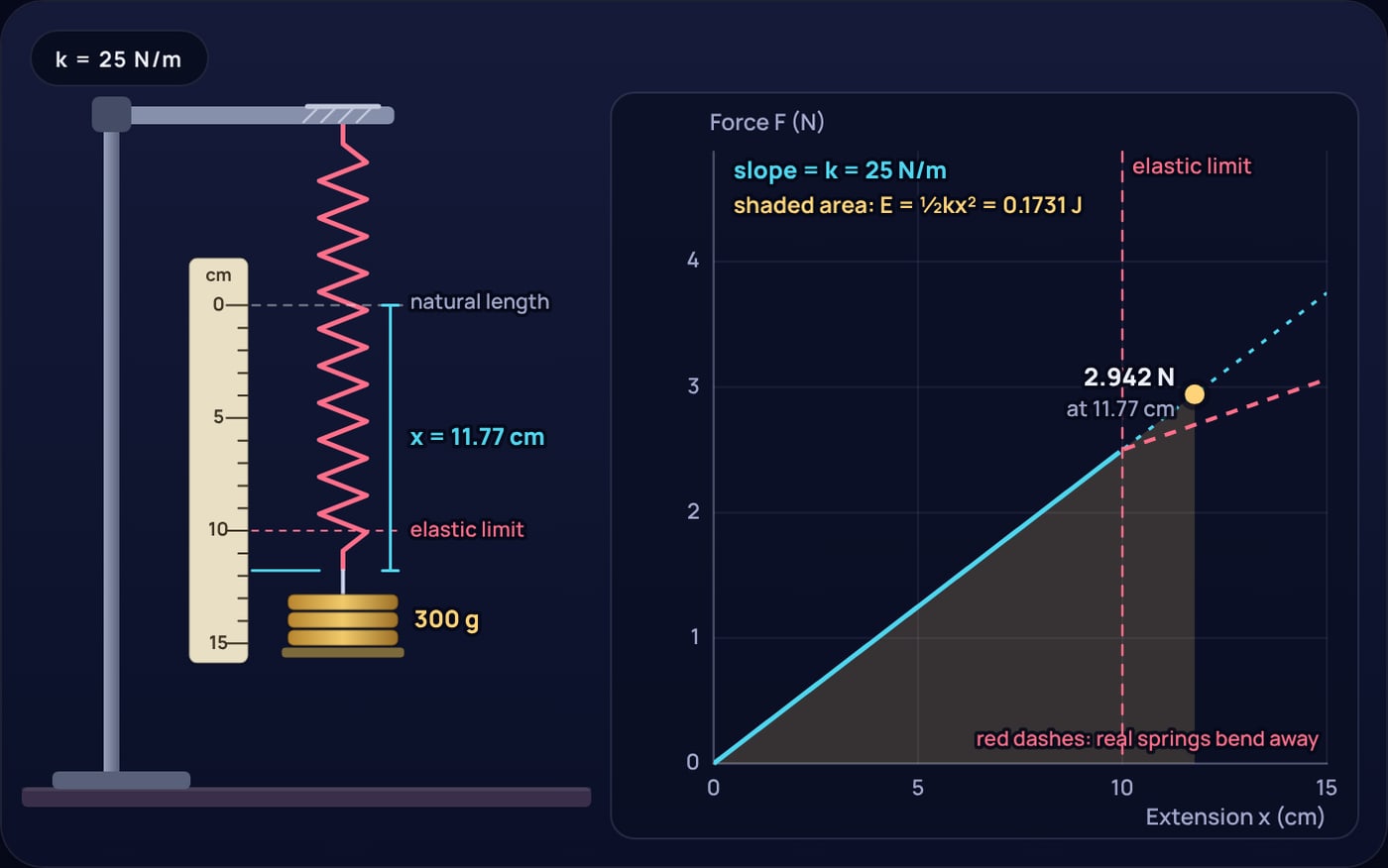
Hooke's law only holds up to a point. Stretch a spring too far and the metal of the coils starts to bend for good. Past this elastic limit, the graph curves away from a straight line and the spring no longer goes back to its original length when you take the load off. A spring from a ballpoint pen that has been pulled out into a long wire is a spring well past its elastic limit.
The unloading step in the experiment is the test. If every reading comes back as you remove the water, you are still in the elastic region. If the zero has moved, you are not, and your earlier readings no longer describe the spring as it is now.
How much energy does a stretched spring store?
The work you do stretching a spring is stored in it as elastic potential energy. On the force against extension graph, it is the area of the triangle under the line, with base x and height kx:
Example 4: a 200 N/m spring stretched 5 cm
Because x is squared, stretching the spring twice as far stores four times the energy.
The water experiment's spring at its largest stretch, 10.1 cm with k = 48.9 N/m, holds about 0.25 J. That is roughly the energy needed to lift its 499 g load by 5 cm, which makes sense: as the load stretched the spring by 10.1 cm, half of the energy it released went into the spring and the rest was lost as the spring bounced and settled.
What happens when you join two springs?
Hang two springs one below the other (in series) and each carries the whole load, so the stretches add and the pair is softer. Hang them side by side (in parallel) and they share the load, so the pair is stiffer.
Example 5: two 40 N/m springs
With a 200 g load, the series pair stretches 9.81 cm and the parallel pair only 2.45 cm, a factor of four.
Cutting a spring in half works like the series rule in reverse: each half is twice as stiff as the whole spring, because the same force now stretches half as many coils.
Which units are used for spring constants?
In physics, N/m is standard. Spring makers often quote N/mm, which is 1,000 times bigger, and in the United States pounds force per inch. NIST Special Publication 811 gives 1 lbf/in = 175.1268 N/m. A spring sold as 2 N/mm is 2,000 N/m, which is 11.4 lbf/in.
Once you know k, the same law gives you the stretch for any force or the force for any stretch. That is how a spring balance works: the scale markings are just F = kx turned into grams. For a related way of measuring forces in motion, see how long it takes to fall from a height, which rounds g to 9.81 m/s², or why astronauts float, where a spring balance would read zero. The water density used for the loads is explained in why ice floats.
Try it yourself
Open the Hooke's law calculator with the home experiment readings and replace them with your own: load in grams on the left, extension in centimetres on the right. It fits the best line, gives k, the intercept and R², and draws your points on the graph. The other buttons solve for force or extension, combine two springs, and warn you when a load passes the elastic limit you set.
Sources
- NIST, CODATA value of the standard acceleration of gravity: 9.806 65 m/s², exact.
- NASA NSSDCA, Earth fact sheet: surface acceleration 9.780 m/s² at the equator and 9.832 m/s² at the poles.
- NIST Chemistry WebBook, thermophysical properties of water: 998.21 kg/m³ at 20 °C and 1 atm.
- NIST, Special Publication 811, Appendix B.9: 1 lbf = 4.448 222 N, 1 lbf/in = 175.1268 N/m.
- The Physics Hypertextbook, springs: Hooke’s 1678 statement of the law and the anagram.
Frequently asked questions
How do you find the spring constant?
Hang a known load on the spring, work out its weight in newtons with F = mg, measure how far the spring stretches in metres, and divide: k = F ÷ x. For a better answer, use several loads and take the slope of the force against extension graph.
What are the units of the spring constant?
Newtons per metre, N/m. Spring catalogues also use N/mm, where 1 N/mm is 1,000 N/m, and pounds force per inch, where 1 lbf/in is about 175.1 N/m.
Why is a graph better than one reading?
Each reading has a small error, and some springs need a little force before they start to stretch. The slope of a best fit line through several readings averages out the errors and ignores any offset at the start.
How do I know if I have passed the elastic limit?
Remove the load and measure the spring again. If it does not return to its starting length, or if the graph starts to curve, you have gone past the elastic limit and the spring has been permanently stretched.
What is the spring constant of two springs together?
End to end (series), 1/k = 1/k₁ + 1/k₂, so two equal springs give half the stiffness. Side by side (parallel), k = k₁ + k₂, so two equal springs give double.