How Much Does an LED Bulb Save in a Year?
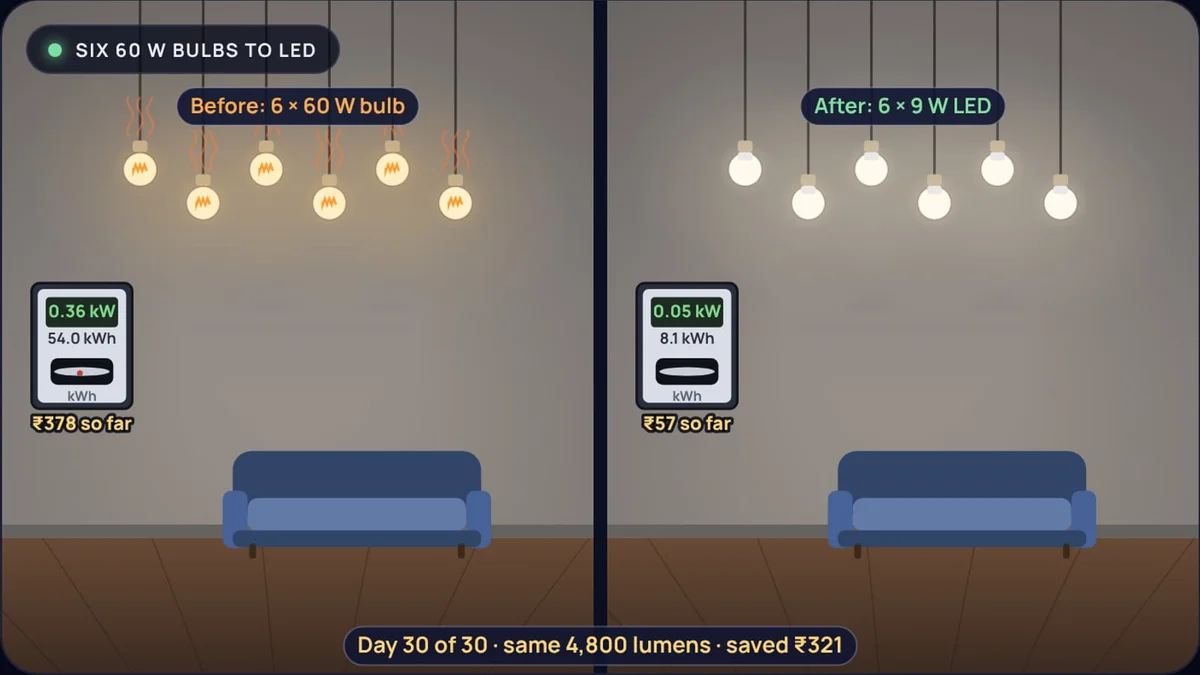
Most Indian homes have swapped some bulbs for LEDs, but a few rooms still have a yellow incandescent bulb, a CFL, or a tube light that hums on its old choke, and it is fair to ask whether replacing a working lamp is worth the money. The answer depends on what you are replacing, how long it stays on, and what you pay for a unit.
This post works out the saving for each kind of old lamp, compared at the same amount of light. Every example opens in the LED bulb savings calculator, where you can type your own number of lamps, hours, LED price and tariff.
Why compare lumens and not watts?
Watts measure how much power a lamp draws. They say nothing directly about how much light it gives. The light is measured in lumens, and the number that matters for running cost is how many lumens a lamp gives for each watt, called its efficacy.
The US Federal Trade Commission puts it simply: a traditional 60 W incandescent bulb gives about 800 lumens, and an LED bulb gives the same 800 lumens on about 9 W. That makes the incandescent bulb about 13.3 lumens per watt and the LED about 88.9. India's UJALA programme makes the same comparison with a CFL in the middle: according to the Press Information Bureau, a 7 W LED gives the same light as a 14 W CFL and a 60 W incandescent lamp. A 14 W CFL giving 800 lumens works out at about 57.1 lumens per watt.
So the fair question is never "60 W against 9 W" in the abstract. It is "how much power does each lamp need to give the light I already have?" The calculator holds the lumens fixed so both rooms get the same light.
How much does one LED bulb save?
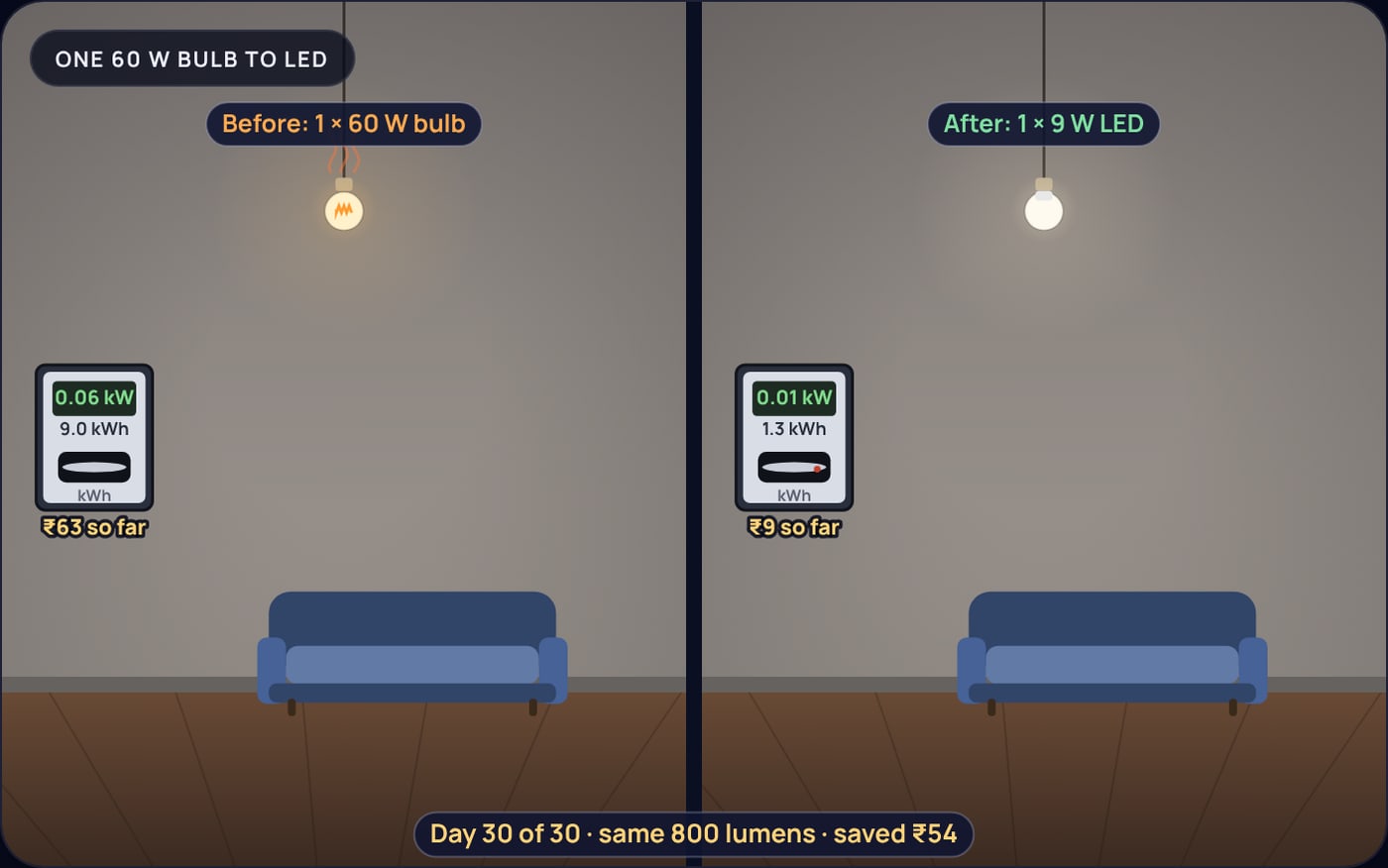
Worked example: one 60 W bulb to a 9 W LED
The bulb is on 5 hours a day and electricity costs ₹7 a unit. Both lamps give 800 lumens.
Power saved per lamp:
Energy saved in a year, in units (kWh):
Money saved at ₹7 a unit is 93.1 × 7 = ₹652 a year, or about ₹54.3 a month. An LED bulb at ₹70, the UJALA price, pays for itself in
That is about 39 days. The power drawn falls by 51 ÷ 60, or 85 percent, for the same light.
The UJALA documents give the same comparison another way: an LED bulb uses 1 unit of electricity in 140 hours, against 2 units for a CFL and 9 units for an incandescent lamp. Their LED is a 7 W bulb, and 7 W for 140 hours is 0.98 units, so the figures agree.
Where does the power in an old bulb go?
An incandescent bulb makes light by heating a thin tungsten filament until it glows. Most of the power it draws comes out as heat and infrared rather than visible light, which is why the glass gets too hot to touch.
An LED makes light directly from a semiconductor and wastes far less as heat. On the calculator's stage, the incandescent bulbs have heat rising from them; the LEDs do not.
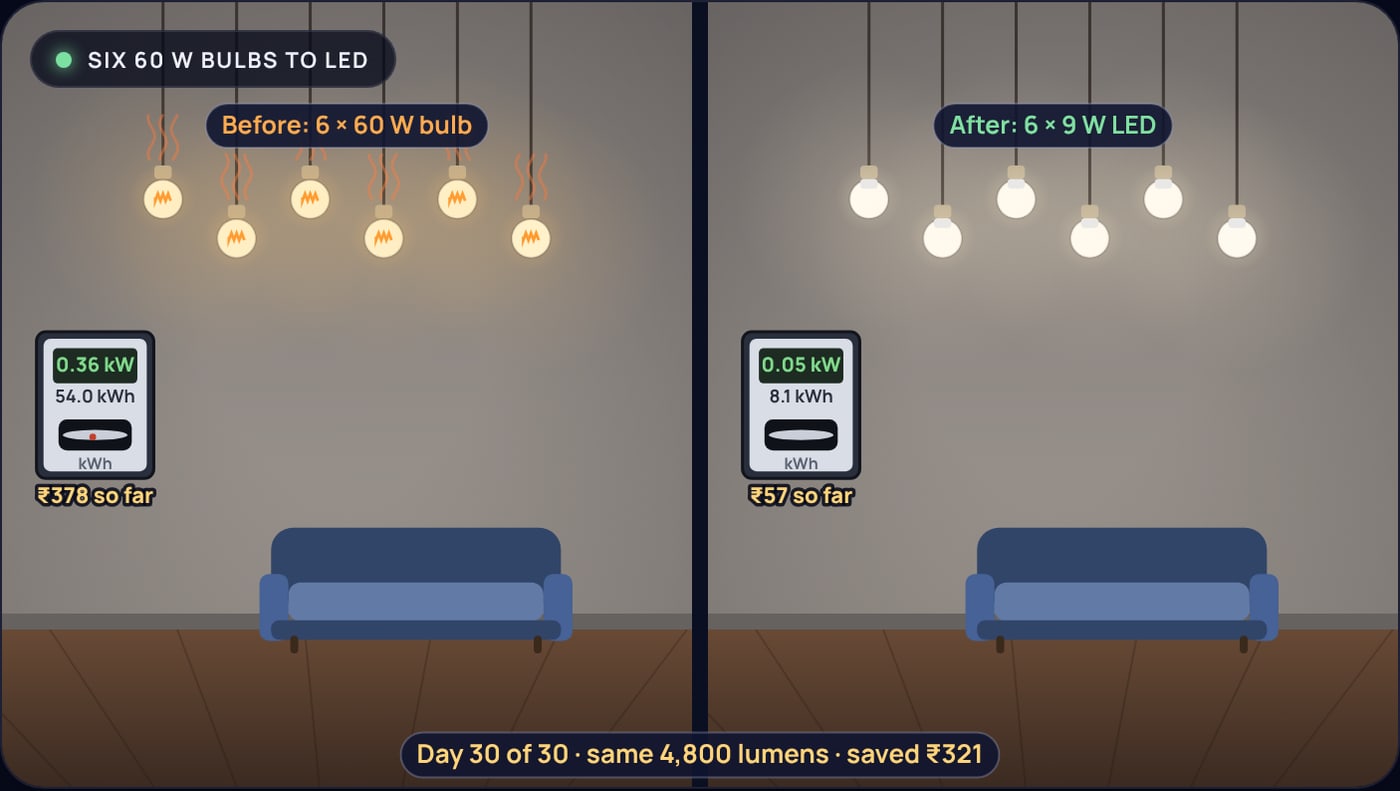
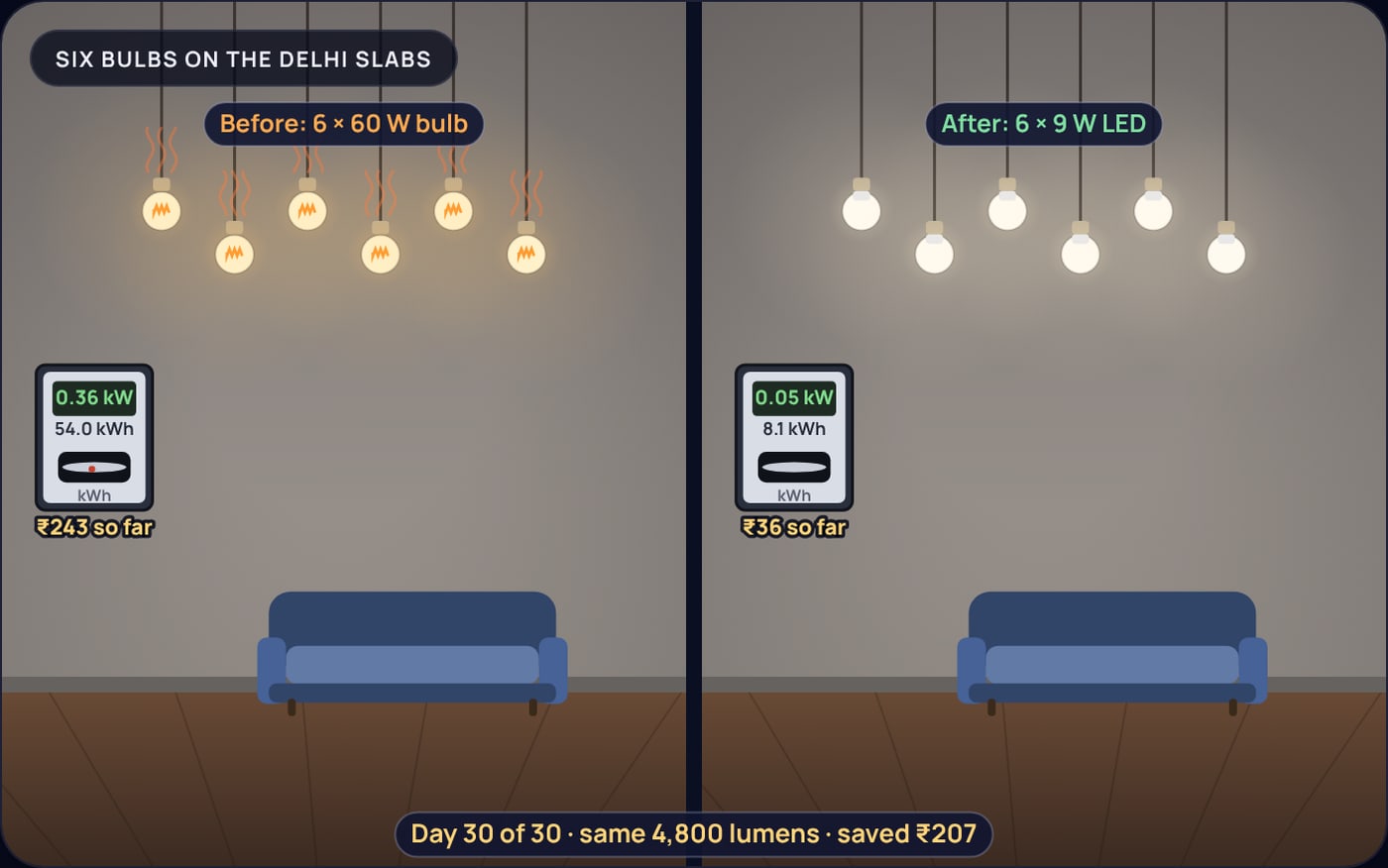
For a whole room it adds up: six 60 W bulbs draw 360 W, six 9 W LEDs 54 W.
Worked example: six bulbs in a living room
Six 60 W bulbs, 5 hours a day, ₹7 a unit, ₹70 per LED.
At ₹7 that is ₹3,909 a year, or ₹325.8 a month. The six LEDs cost 6 × ₹70 = ₹420, so payback is again 420 ÷ 325.8 = 1.29 months. Payback does not depend on the number of bulbs, only on the hours, the tariff and the price of one LED.
Is it worth replacing a CFL with an LED?
Much less so. A CFL is already about four times as efficient as an incandescent bulb, so there is less left to save. Using the UJALA comparison, a 14 W CFL gives the same light as the 9 W LED in our examples, a gap of only 5 W.
At ₹7 that is ₹383 a year for six lamps, or about ₹64 per lamp. The six LEDs still cost ₹420, so payback takes about 13.2 months instead of 39 days. The power cut is 5 ÷ 14, or 36 percent.
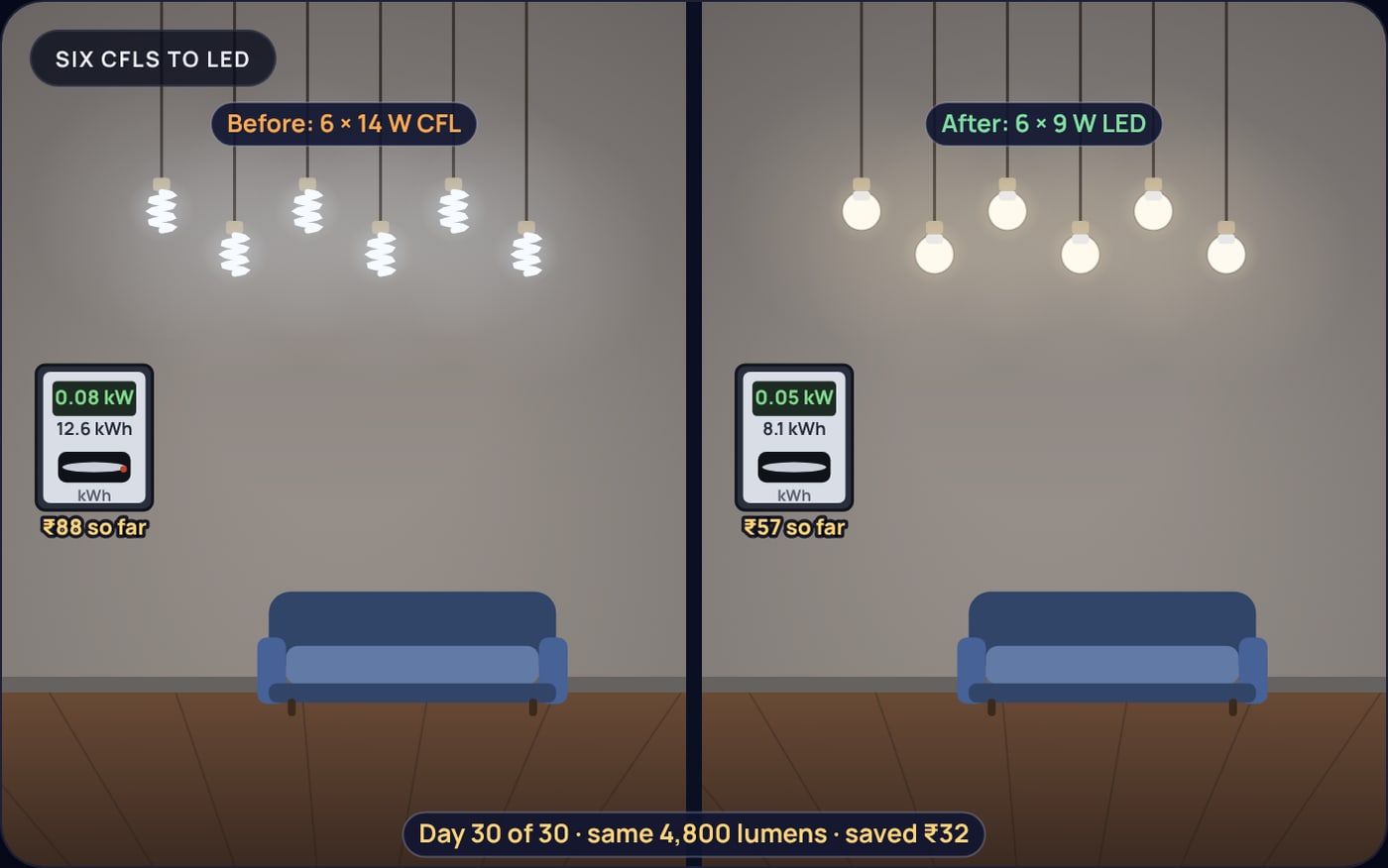
That is still a return of about 90 percent a year on the money spent, which is better than most savings accounts. But a working CFL keeps giving light, so many people swap CFLs as they fail.
How much does an LED tube light save?
Tube lights are a different case. A good fluorescent tube is already efficient. Philips's datasheet for its TL-D 36W/840 tube gives an efficacy of about 90 lumens per watt, which is about the same as the 88.9 we use for an LED bulb.
The waste is in the fitting. A conventional tube light needs a choke (a magnetic ballast) to start the tube and limit its current, and the choke heats up and wastes power of its own. Hong Kong's Electrical and Mechanical Services Department lists the typical system power of a 36 W, 4 ft tube as 48 W with a conventional ballast, and 36 W with an electronic one. So the fitting on your wall draws a third more than the tube's rating.
Worked example: four tube lights, 8 hours a day
A 36 W tube at 90 lumens per watt gives 3,240 lumens. On a choke it draws 48 W. An LED tube giving the same 3,240 lumens at 88.9 lumens per watt draws
The saving per tube is 48 − 36.45 = 11.55 W. For four tubes on 8 hours a day:
At ₹7 that is ₹944 a year, ₹78.7 a month. Four LED tubes at the UJALA price of ₹220 each cost ₹880, so payback is 880 ÷ 78.7 = 11.2 months.
Notice that the whole of this saving is the choke. The LED tube in this example draws slightly more than the bare fluorescent tube did. If you only fitted an electronic ballast, you would save about the same.
LED tubes on the market vary, though, and some are more efficient than 88.9 lumens per watt. Check the box. If yours says 110 lumens per watt, the same 3,240 lumens take 3,240 ÷ 110 = 29.5 W, the saving rises to 18.5 W a tube, and four tubes save about 217 units a year, about ₹1,516 at ₹7, with payback in about 7 months. Type the figure from your box into the calculator's LED lumens per watt field.
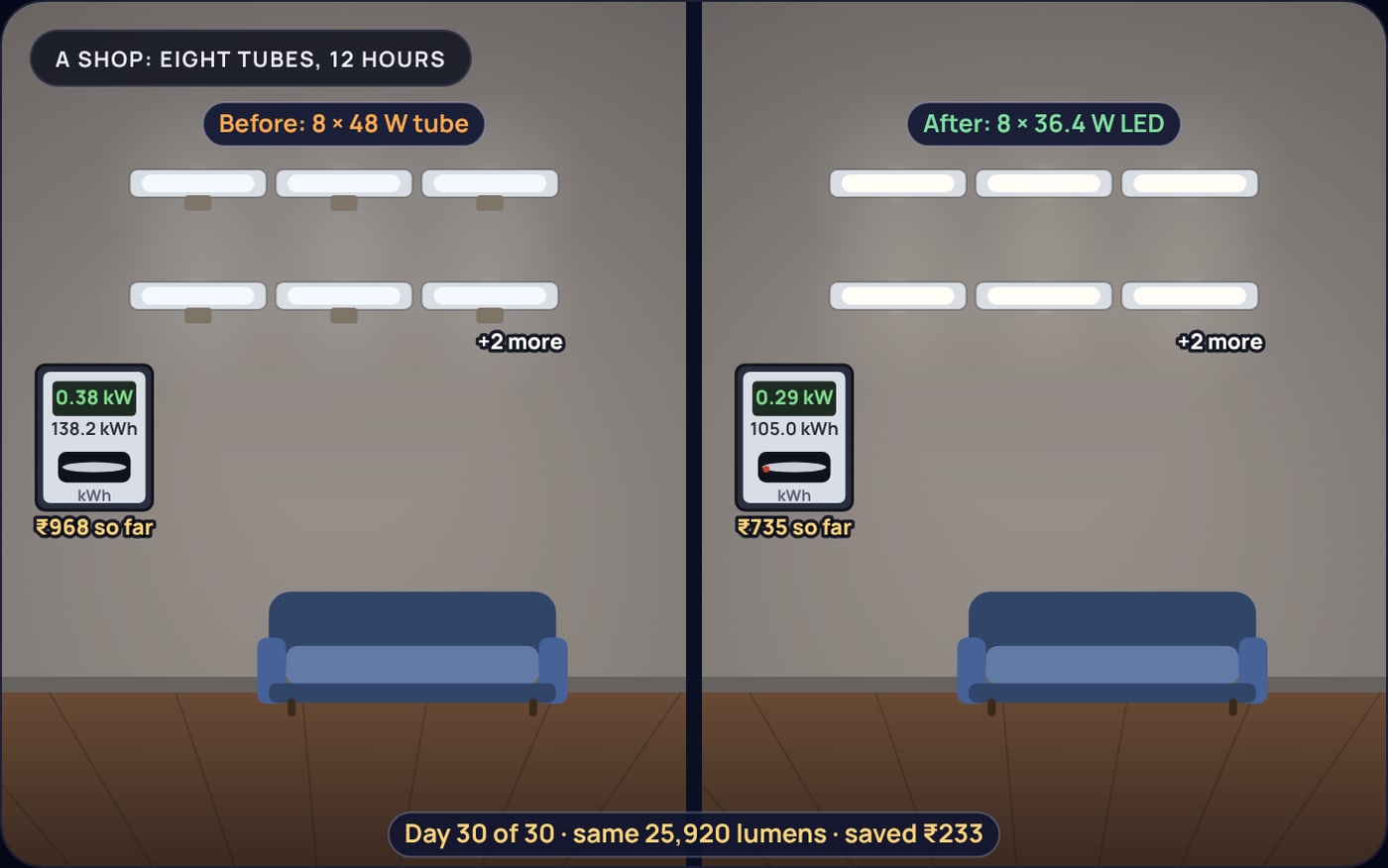
Long hours make the swap pay faster. A shop with eight tube lights on for 12 hours a day saves 404.7 units a year at the default efficacy, ₹2,833 at ₹7, and the eight LED tubes pay back in about 7.5 months.
What about slab tariffs?
Most Indian electricity boards charge by slab: the first block of units each month is cheap and later blocks cost more. The units an LED saves come off the top of your bill, so they are priced at the rate of your highest slab, not at an average.
Take a Delhi home that uses 300 units a month. Under the Delhi Electricity Regulatory Commission's domestic schedule, units 201 to 400 cost ₹4.50 each (before fixed charges, duty and taxes). Swapping six 60 W bulbs saves 558.5 ÷ 12 = 46.5 units a month, all of them in the ₹4.50 block.
That is less than the ₹3,909 at a flat ₹7, and payback stretches from 1.29 to about 2 months. A home on a higher slab saves more per unit. Choose the slab tariff in the calculator and type your own slabs and monthly use.
How does the calculator work it out?
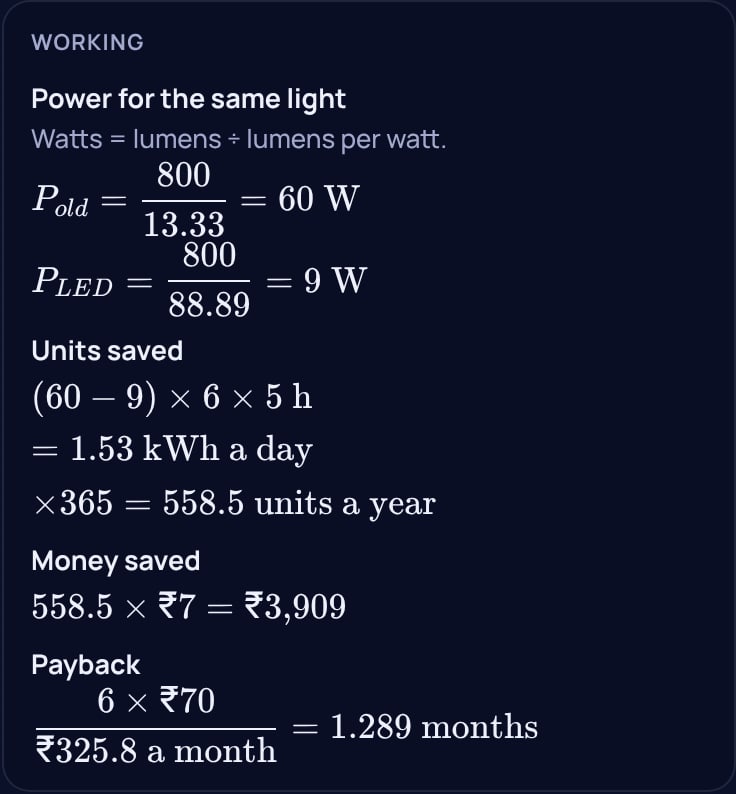
The calculator follows the same steps as the examples above, and shows them in its working panel:
- Watts for the old lamp: lumens divided by its efficacy, times 48 ÷ 36 for a tube light on a choke.
- Watts for the LED: lumens divided by the LED's lumens per watt.
- Units saved a year: the watts saved, times the number of lamps, times the hours a day, times 365, divided by 1,000.
- Money saved: units times your price, or the drop in your slab bill when those units come off the top.
- Payback: the price of all the LEDs divided by the money saved each month.
If you want to see how the price of a unit turns into a bill in code, the post on writing a program to calculate an electricity bill in Python builds a slab calculator step by step. For what a unit actually is, see joules, calories and kWh explained.
What does the calculator leave out?
- Lamp life. LEDs usually last much longer than incandescent bulbs, and the Philips datasheet gives its TL-D tube a rated life of 15,000 hours. Fewer replacements save money that is not counted here, so the real payback for an incandescent swap is even faster.
- Your LED. Efficacy varies by brand and model. The lumens and watts are printed on the box; divide one by the other and type it in.
- Heat. Incandescent bulbs warm the room. That is a small help in winter and a small extra load on an AC in summer, and neither is modelled. For the scale of an AC's consumption, see how many units a 1.5 ton AC uses per hour.
- Fixed charges and taxes. Only the energy charge per unit is counted.
How much has India saved with LEDs?
The scale is large. According to the Press Information Bureau, the UJALA scheme had distributed 36.87 crore LED bulbs by 6 January 2025, and it estimates the energy saved at 47,883 million kWh a year, worth ₹19,153 crore. In 2014, an LED bulb cost about ₹450 to ₹500 in shops; under UJALA it costs ₹70, and an LED tube light ₹220. The calculator uses these prices as defaults, as examples as of November 2026.
At ₹70 a bulb, the payback on an incandescent swap is so short that it hardly matters what tariff you are on. The CFL and tube light swaps are the ones worth checking with your own numbers. Open the LED bulb savings calculator, pick the old lamp, and type your hours, prices and tariff.
Sources
- US Federal Trade Commission, shopping for light bulbs: a traditional 60 W incandescent bulb gives about 800 lumens, and an LED gives the same 800 lumens on about 9 W.
- Press Information Bureau, UJALA: 10 years of energy-efficient lighting (January 2025): a 7 W LED gives the same light as a 14 W CFL and a 60 W incandescent lamp; 1 unit in 140 hours; ₹70 per LED bulb and ₹220 per LED tube light; 36.87 crore bulbs and 47,883 million kWh a year saved.
- Press Information Bureau, UJALA scheme note: LED, CFL and incandescent prices in 2014 and the units used per 140 hours.
- Philips, TL-D 36W/840 datasheet: efficacy of about 90 lumens per watt and rated life.
- Electrical and Mechanical Services Department, Hong Kong, ballast technology: a 36 W, 4 ft fluorescent tube has a typical system power of 48 W with a conventional ballast and 36 W with an electronic ballast.
- Delhi Electricity Regulatory Commission, tariff order press note and schedule: domestic energy charges of ₹3.00 to ₹8.00 per unit by slab, exclusive of duty and taxes.
Frequently asked questions
How much does an LED bulb save in a year?
Replacing a 60 W incandescent bulb with a 9 W LED that is on 5 hours a day saves about 93 units a year, ₹652 at ₹7 a unit. Replacing a 14 W CFL saves about 9.1 units, about ₹64.
What LED wattage replaces a 60 W bulb?
About 9 W. A 60 W incandescent bulb gives about 800 lumens, and an LED gives the same 800 lumens on about 9 W according to the US Federal Trade Commission. Check the lumens on the box rather than the watts.
Is it worth replacing CFL with LED?
The saving is small: about 5 W a lamp for the same light, 9.1 units a year at 5 hours a day. At ₹70 an LED, it pays back in about 13.2 months, so many people replace CFLs as they fail.
How much does an LED tube light save?
A 36 W tube on a conventional choke draws about 48 W. An LED tube giving the same light at 88.9 lumens per watt draws about 36 W, saving about 34 units a year at 8 hours a day. A more efficient LED tube saves more.
How many units does a 9 W LED bulb use?
A 9 W LED uses 1 unit (kWh) every 111 hours. On for 5 hours a day that is about 16 units a year, about ₹115 at ₹7 a unit.