Why Does a Steel Ship Float but a Steel Ball Sinks?
Drop a steel ball bearing into a bucket and it goes straight to the bottom. Steel is about 7,850 kg per cubic metre, nearly eight times the density of water, so that is no surprise. Yet a cargo ship built from thousands of tonnes of the same steel sits on top of the sea, loaded with containers, and stays there. The ship is not made of a lighter steel, and nothing is holding it up except the water.
The answer is Archimedes' principle plus one word: average. You can try both cases, along with an ice cube, an egg and a person floating in the Dead Sea, in our buoyancy simulator, which drops each object into a fluid and shows the forces and the spilled water.
What is Archimedes’ principle?
Water pushes on everything in it, and the push grows with depth. On a submerged object the push on the bottom is stronger than the push on the top, because the bottom is deeper. The difference is an upward force, the buoyant force. Archimedes' insight was that you do not need to add up all those pressures. The buoyant force always equals the weight of the fluid the object has pushed out of the way:
Here is the fluid's density, and is the volume of the object below the surface. The reasoning is short. Imagine the object replaced by a blob of water of the same shape. That blob would sit still, so the surrounding water must push it up with exactly its own weight. The surrounding water cannot tell the difference when you swap the blob for a steel ball or a hull, so it pushes up on them just as hard.
Two cases follow. If the object is denser than the fluid, even when it is completely under it displaces less weight of fluid than it weighs, so it sinks. If it is less dense, it settles at the depth where the displaced fluid weighs exactly as much as it does. Setting equal to the weight gives the most useful result in this post:
The share of a floating object below the surface is the ratio of the two densities. Nothing else matters: not its size, not its shape, not the depth of the water.
Why does a steel ball sink?
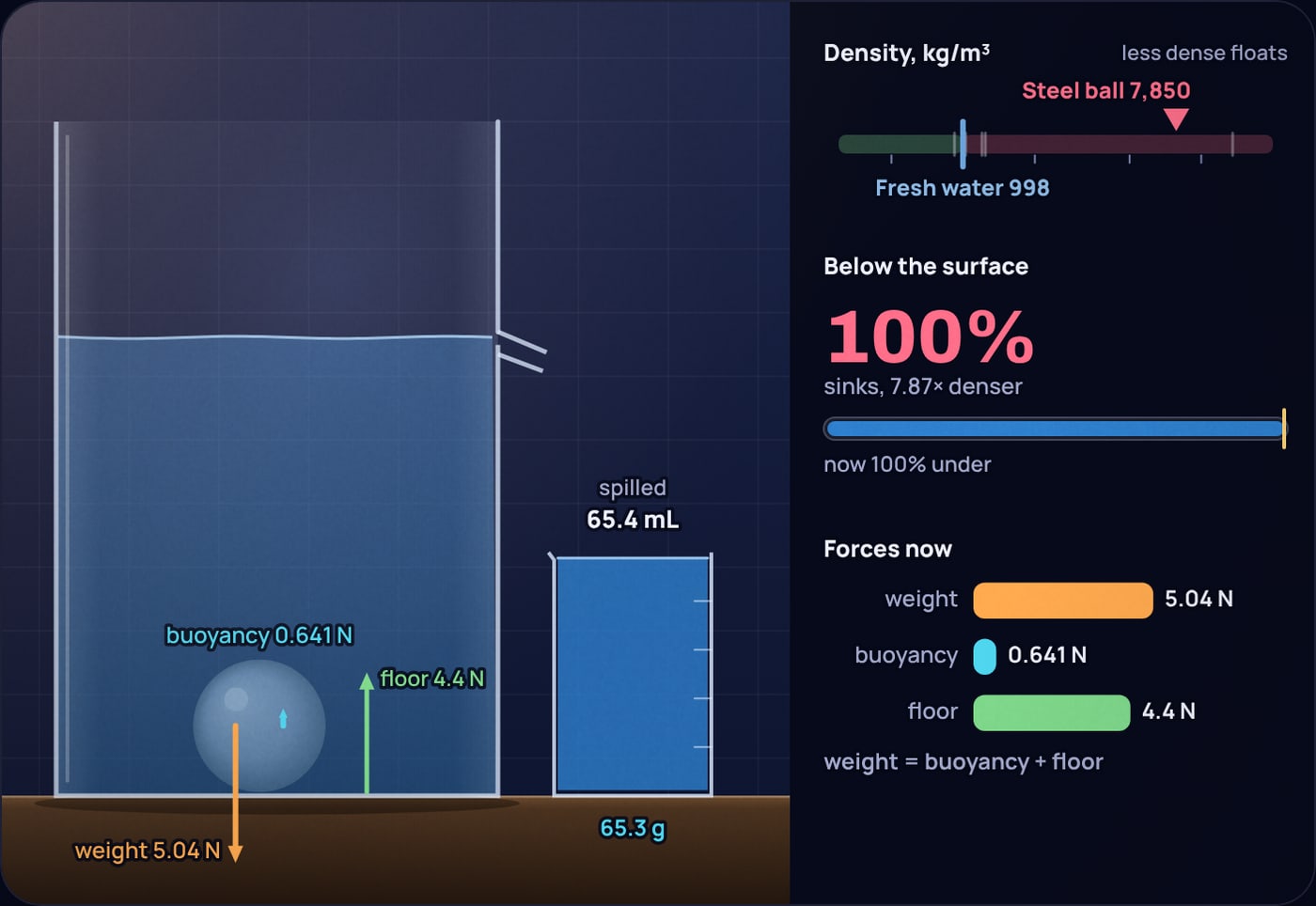
Take a 5 cm steel ball. Its volume is and its mass is 514 g, so it weighs 5.04 N. Fully under water, it pushes aside 65.4 mL of water, which has a mass of 65.3 g.
The water still helps. Under water the ball feels about 13 percent lighter, which is why a heavy stone is easier to lift off a river bed than off the bank. But 0.641 N cannot hold up 5.04 N, so the ball sinks and the floor of the tank carries the other 4.40 N.
So why does a steel ship float?
Because the ship is not solid steel. The simulator's ship is a simple box hull 100 m long, 20 m wide and 10 m deep, built from 20 mm steel plate on the bottom, sides, ends and deck, with half as much again added for frames and stiffeners. Real hulls are curved and far more complicated, but the box keeps the arithmetic honest.
The steel takes up less than 1 percent of the hull's volume. Averaged over everything inside the hull, the empty ship is lighter than cork. In sea water it would float only 0.74 m deep.
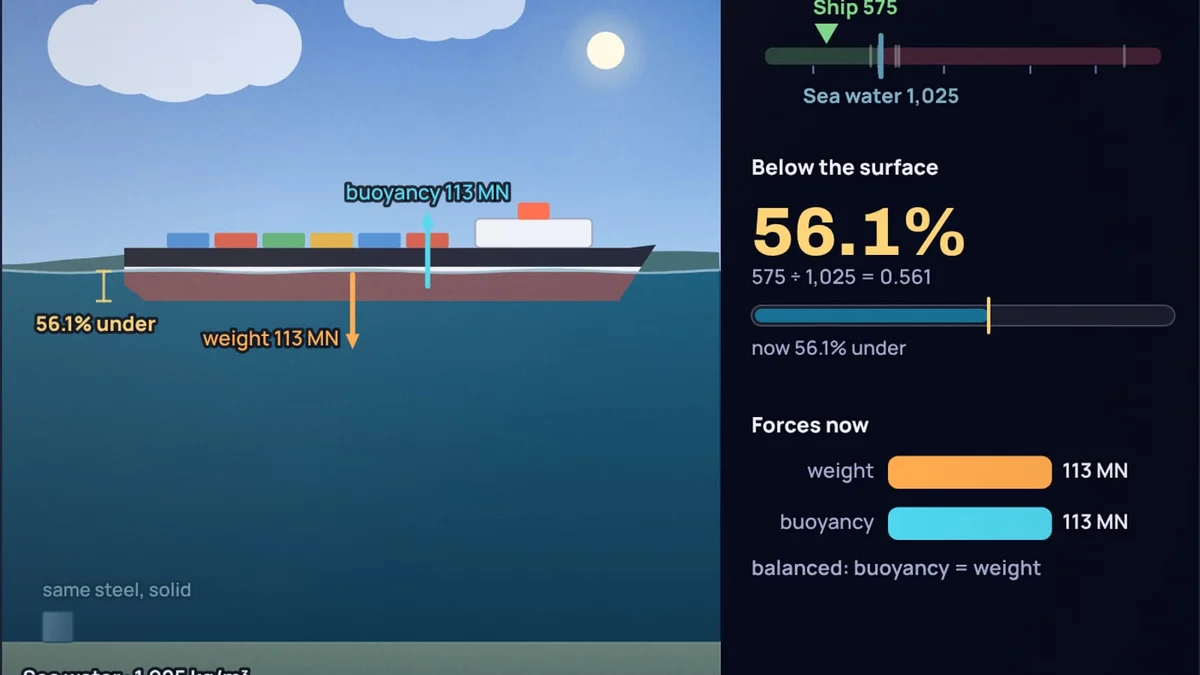
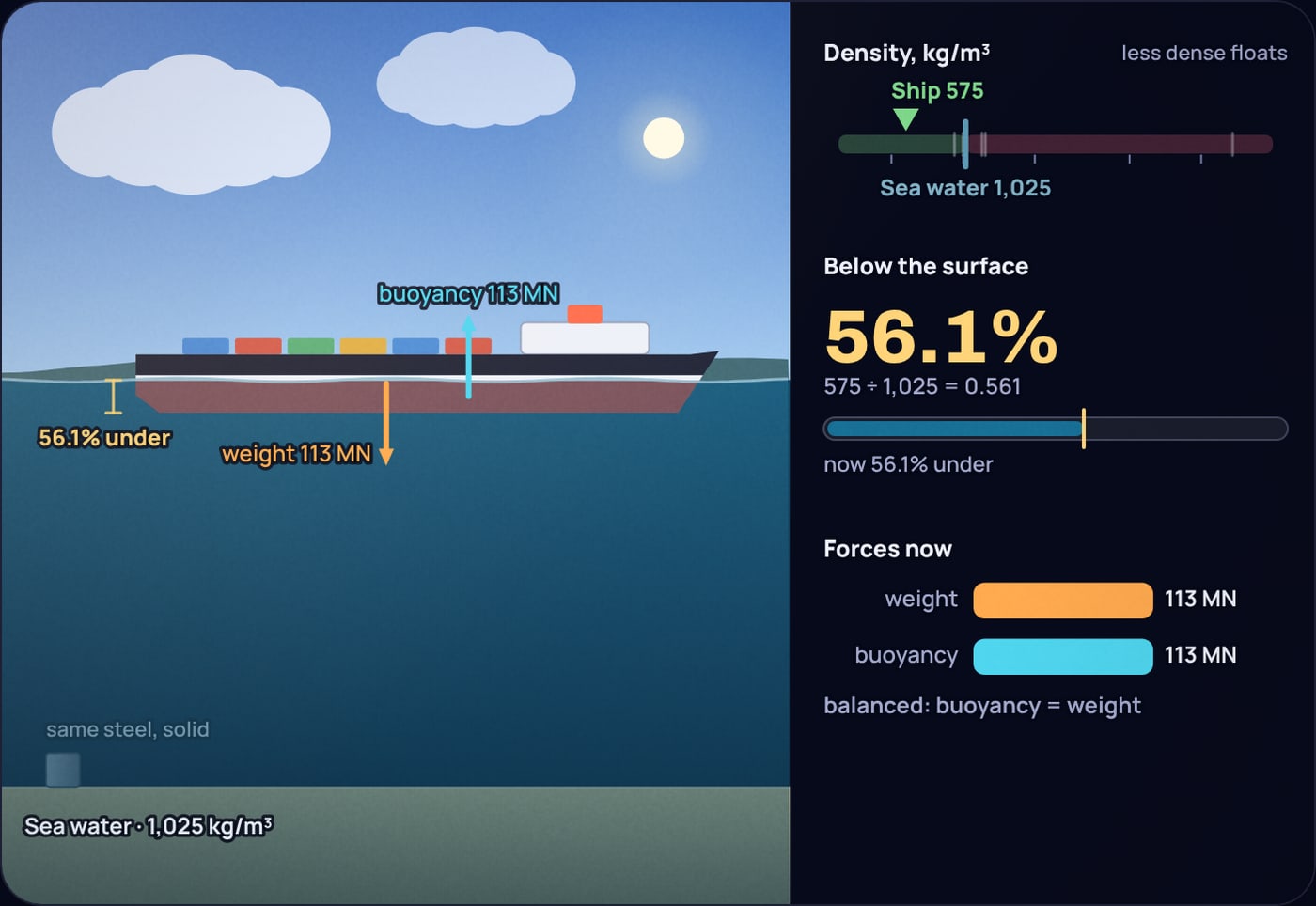
Now load 10,000 t of cargo. The total mass is 11,507 t and the average density is 575 kg/m³. Divide by sea water's 1,025 kg/m³ and you get 0.561: the hull floats with 56.1 percent of its depth below the surface, a draught of 5.6 m, leaving 4.4 m of side above the water. To float, the ship has pushed aside 11,227 m³ of sea water, and that water has a mass of 11,507 t, exactly the mass of the ship. The buoyant force is 113 MN, the weight of a ship.
Now crush the same 1,507 t of steel into a solid cube. It is 192 m³, a block 5.77 m on a side. It can displace only 192 m³ of sea water, about 197 t, against its own 1,507 t. It sinks. It has the same steel and the same mass as the hull, but under 1 percent of the volume it encloses. In Figure 1 you can see that cube on the sea floor, beside the ship that floats.
That is the whole trick of a ship. Shape changes how much water the steel can push aside. A sheet of aluminium foil sinks when you crumple it into a tight ball, and floats when you fold it into a little boat, for the same reason.
How much cargo before the ship sinks?
A hull can push aside at most its own enclosed volume. Once the deck is at the waterline, any extra load has nothing left to displace. For our hull in sea water, the limit is:
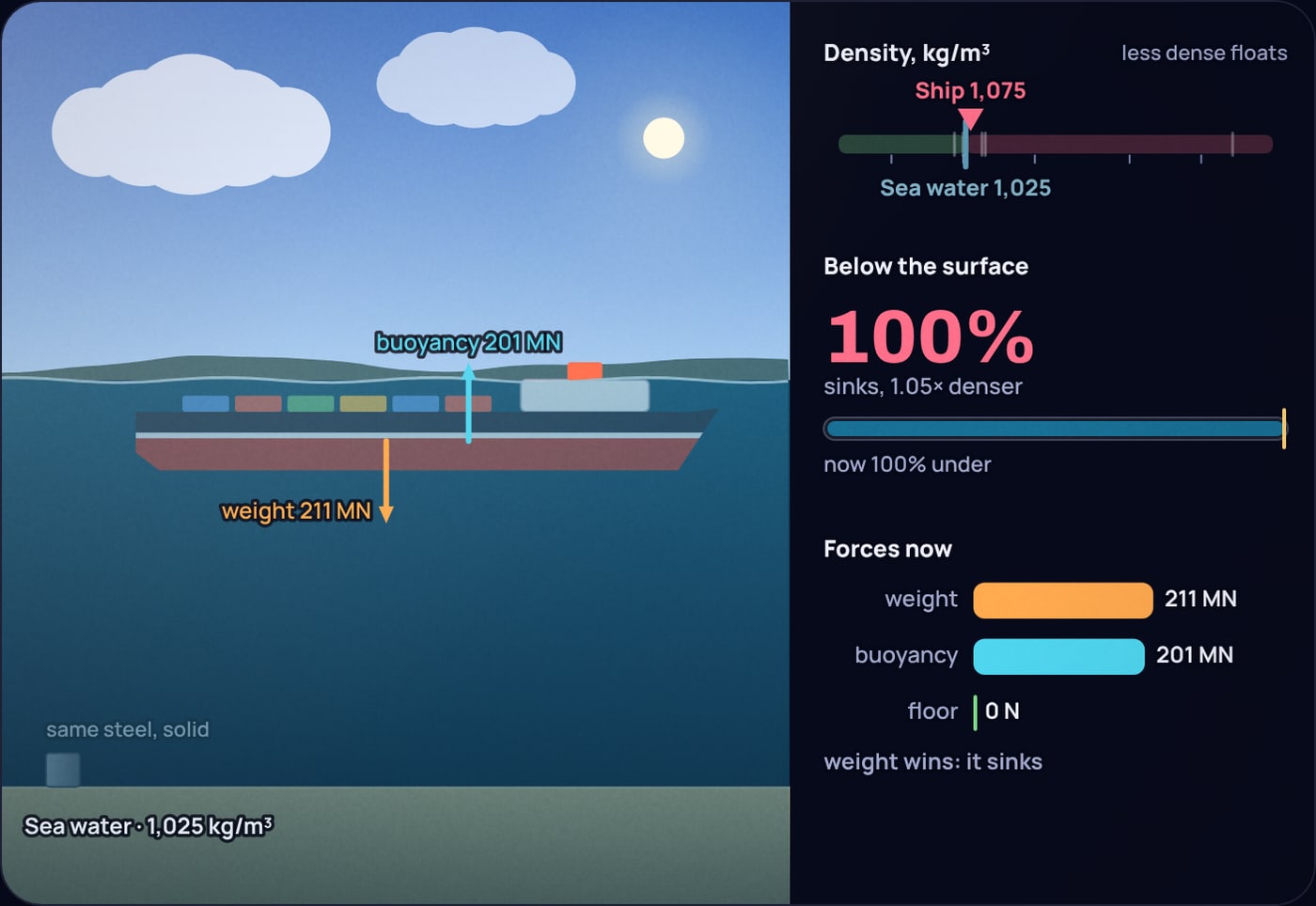
About 18,990 t. Load 20,000 t and the total of 21,507 t is more than the 20,500 t of sea water the whole hull can displace. The average density, 1,075 kg/m³, is now higher than sea water's, and the ship goes down.
Real ships never get close to that edge. They must keep a margin of hull above water, the freeboard, so waves do not flood the deck. The legal limit is painted on the side as a load line, often called the Plimsoll mark, and there is a separate, higher mark for fresh water. In fresh water at 998 kg/m³ the same ship sinks deeper: our 10,000 t load sits at 5.77 m instead of 5.61 m, and the hull's absolute limit drops from about 18,990 t to 18,450 t. A ship loaded to its fresh water mark in a river port rises to its sea water mark when it reaches the ocean.
Why is only the tip of an iceberg visible?
The density ratio rule explains the most famous floating object of all. Ice is about 917 kg/m³, because water expands when it freezes, and sea water is about 1,025 kg/m³.
So 89.5 percent of floating ice sits below the surface in the sea, and 91.9 percent in fresh water. In the simulator the cube drops into an overflow can, a container filled right up to its spout, so whatever goes below the surface spills into a beaker. The spilled sea water weighs 24.8 g, the same as the cube. That is Archimedes' principle in a form you can put on a kitchen scale.
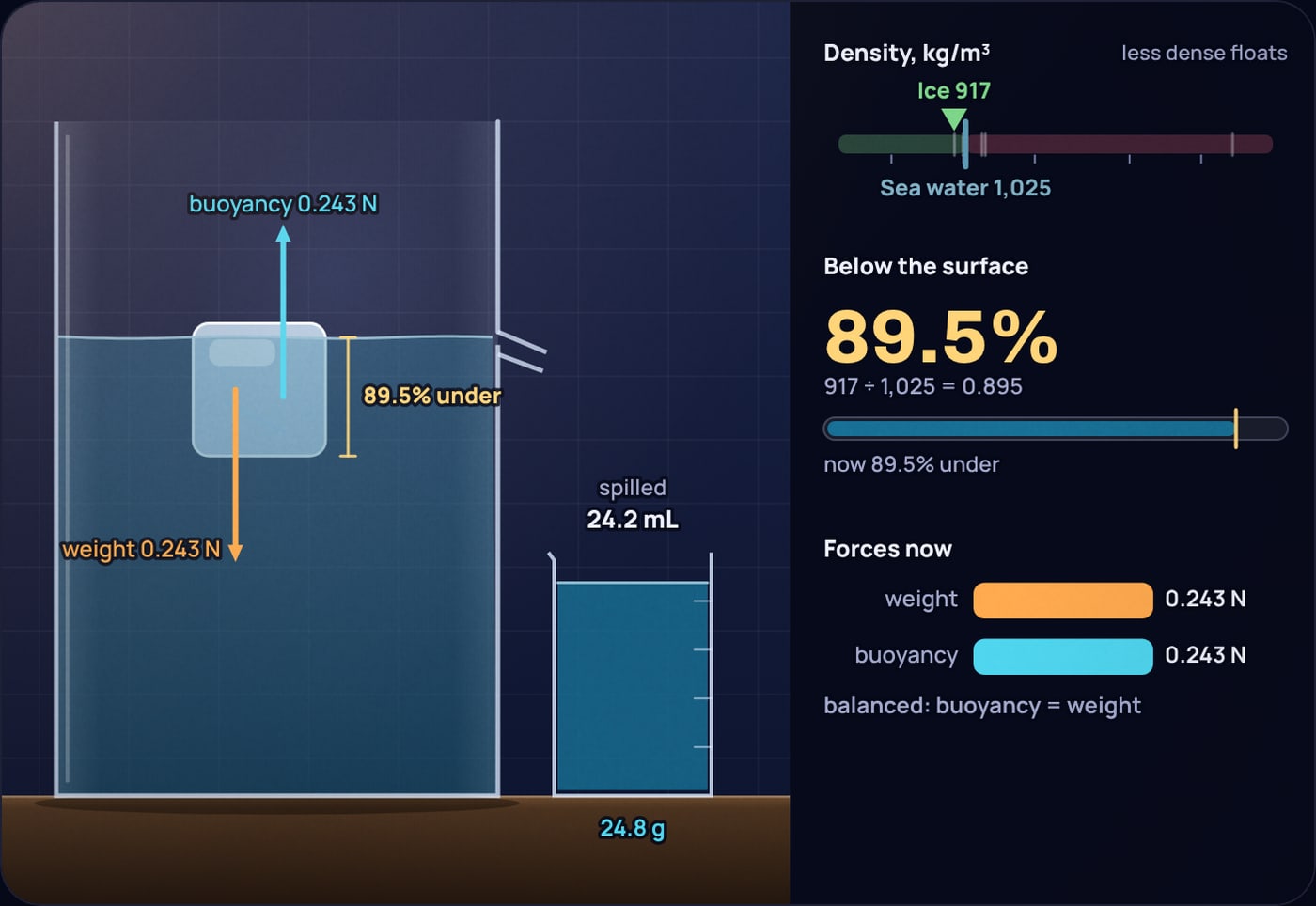
Real icebergs are a little more varied, because glacier ice holds air bubbles and sea water ranges from about 1,020 to 1,030 kg/m³. The usual rule of thumb, that about 90 percent is hidden, is the density ratio.
Why does an egg float in salt water?
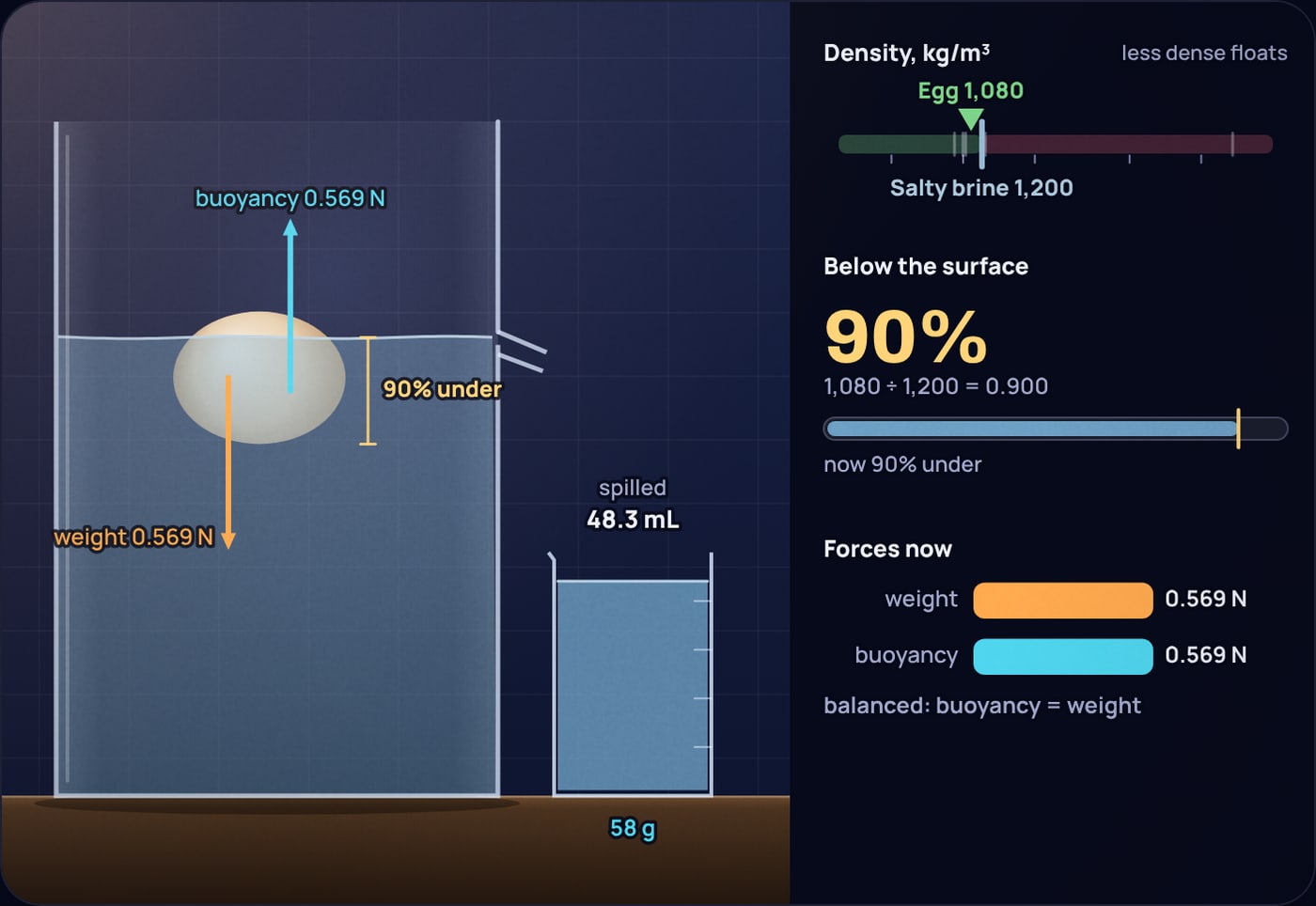
The rule also works the other way round: change the fluid instead of the object. A fresh hen's egg is a little denser than water. Egg producers test shell quality by floating eggs in a series of salt baths with densities from 1.060 to 1.090 or 1.100 times water's. The bath an egg first floats in gives its specific gravity, and eggs between 1.070 and 1.085 are judged to have good shells. The simulator uses 1,080 kg/m³.
In tap water the egg sinks, but only just. The buoyant force is 0.526 N against a weight of 0.569 N, so the bottom of the glass carries a mere 0.043 N. Stir in salt and the water's density rises. Once it passes 1,080 kg/m³ the egg lifts off. In saturated brine, about 1,200 kg/m³, it floats with exactly 90 percent of its volume under, since 1,080 ÷ 1,200 = 0.900. Sea water, at 1,025 kg/m³, is not salty enough.
Why do you float so high in the Dead Sea?
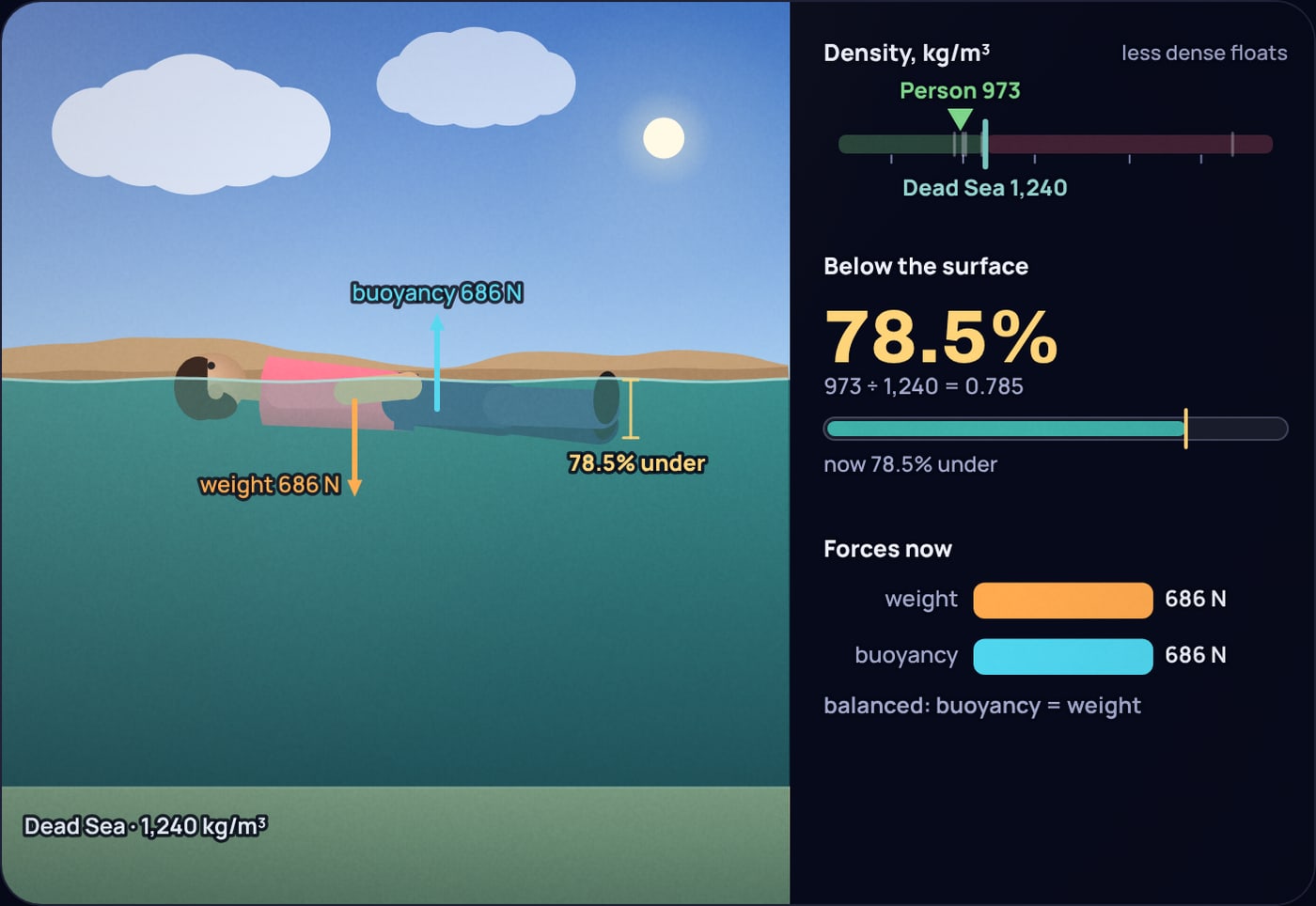
Your body is a mix of materials. Fat is less dense than water, while muscle and bone are denser, and your lungs hold several litres of air. The simulator models a 70 kg adult at 1,040 kg/m³ with the lungs emptied, and adds 4.6 L of volume for a full breath. That gives:
In a freshwater pool the same person floats with only 2.5 percent above the surface, which is why floating on your back takes a little care: the face is barely clear. In sea water it is 5.0 percent. The Dead Sea, with a density of about 1.24 kg/L, lifts 21.5 percent of the body above the surface, so visitors can sit up in the water as if in an armchair. Breathe all the way out in fresh water and the body's average density climbs back to 1,040 kg/m³, and the model sinks slowly. Real people vary a lot with body fat and lung size, so treat these as one example, not a rule.
Can steel ever float on its own?
Yes, in a fluid denser than steel. Mercury is 13,546 kg/m³, so a steel ball floats on it with 7,850 ÷ 13,546 = 58 percent of its volume submerged. Because a sphere is widest in the middle, that 58 percent of the volume corresponds to a depth of a little over half the diameter, and the simulator solves the spherical cap equation to find it. Mercury vapour is toxic, so this is one experiment best done on screen. The steel on mercury setup shows it.
Common mistakes about floating and sinking
"Heavy things sink." Mass alone decides nothing. An 11,507 t ship floats and a 514 g steel ball sinks. What decides it is mass per volume, averaged over everything the object encloses.
"A floating object weighs nothing in the water." It has all of its weight. The buoyant force is simply equal and opposite. That is why a boat's load line moves when you add cargo.
"Things float higher in deep water." Depth does not appear in the floating rule. A ship floats at the same draught in 10 m of water as over a 4 km deep ocean, as long as the water's density is the same. That pressure difference with depth matters for what happens to sealed objects deep down, which our post on submarine implosions covers.
Try it yourself
Open the steel ship and drag the cargo slider from 0 to 25,000 t. Watch the hull settle deeper, then cross the 18,990 t limit and go under. Switch the fluid to fresh water and see the draught grow by about 15 cm. Then try the ice cube in cooking oil, where it is 99.7 percent under and only just floats. If ice itself interests you, read why ice is slippery.
Sources
- Physics Factbook, Density of Seawater: hypertextbook.com (1,020 to 1,030 kg/m³, about 1,025 at the surface)
- USGS Water Science School, Water Density: usgs.gov (0.998 g/cm³ near room temperature)
- Wikipedia, Ice: en.wikipedia.org/wiki/Ice (0.9167 g/cm³ at 0 °C)
- Wikipedia, Dead Sea: en.wikipedia.org/wiki/Dead_Sea (density 1.24 kg/L)
- Chemicool, Mercury: chemicool.com (13.546 g/cm³ at 20 °C)
- Petersime, Evaluating the exterior quality of hatching eggs: petersime.com (salt baths 1.060 to 1.090, good shells 1.070 to 1.085)
- Wikipedia, Load line (watercraft): en.wikipedia.org (fresh water mark above the summer sea water mark)
Frequently asked questions
Why does a steel ship float?
Because its hull encloses a large volume of air. What decides floating is the ship’s total mass divided by the volume of its hull below the deck, not the density of steel. A 100 m box hull of 1,507 t of steel carrying 10,000 t of cargo averages 575 kg/m³, well below sea water at 1,025 kg/m³.
Why does a steel ball sink?
A solid steel ball has no air inside, so its average density is the density of steel, about 7,850 kg/m³. Fully under water it can only push aside its own volume of water, which weighs about one eighth as much as the ball.
What is Archimedes’ principle?
Anything in a fluid is pushed up by a force equal to the weight of the fluid it displaces. A floating object sinks until the displaced fluid weighs as much as the object.
How much of an iceberg is under water?
About 90 percent. Ice is about 917 kg/m³ and sea water about 1,025 kg/m³, and 917 divided by 1,025 is 0.895, so 89.5 percent of the volume sits below the surface.
Can a ship carry more cargo in sea water than in fresh water?
Yes. Sea water is denser, so each cubic metre the hull pushes aside holds up more weight. Our 100 m box hull can carry about 18,990 t in sea water but only about 18,450 t in fresh water, and ships carry a separate fresh water load line for this reason.
 50 Hilarious Physics Jokes That Will Make You Laugh
 Could Ant-Man Really Shrink? The Physics Says No