Why do some things float and others sink?
An object floats when its average density is lower than the fluid's, and sinks when it is higher. A floating object settles until the fluid it pushes aside weighs exactly as much as it does, so the share below the surface is the density ratio: ice at 917 kg/m³ in sea water at 1,025 kg/m³ floats 89.5% under. That is Archimedes' principle: the upward push, the buoyant force, equals the weight of the fluid displaced.
The word that matters is average. A solid steel ball is 7.9 times denser than water and sinks. A steel ship carrying 10,000 tonnes of cargo averages 575 kg/m³ because its hull encloses so much air, so it floats with 5.6 m of its 10 m sides under water. The simulation lets you try both, plus an egg that sinks in tap water and floats in brine, and a person in a pool and in the Dead Sea. For the long version, read why a steel ship floats but a steel ball sinks.
Key results from the simulation
- Tip of the iceberg: ice floats 89.5% under in sea water and 91.9% under in fresh water, so only about a tenth shows.
- Egg test: a fresh egg at 1,080 kg/m³ sinks in tap water (998) and floats 90.0% under in saturated brine (1,200).
- Steel ship: 1,507 t of steel shaped into a 100 m hull floats in sea water until the cargo passes about 18,993 t. The same steel as a solid 5.8 m cube sinks.
- Dead Sea: a person with a full breath averages 973 kg/m³. In the Dead Sea (1,240) 21.5% of the body rides above the surface, against 2.5% in a freshwater pool.
- Mercury: at 13,546 kg/m³ mercury floats a steel ball 58.0% under.
Six experiments to try
Each section gives the numbers the simulation shows and has a button that loads the experiment. Densities are at about 20 °C and the sources are listed in the "how it works" section.
Only the tip of the iceberg: ice in sea water
3 cm ice cube, 917 kg/m³Ice is one of the few solids less dense than its own liquid: water expands about 9 percent when it freezes. Dropped into sea water, the cube plunges, bobs back up and settles with 89.5% of its volume below the surface, because 917 ÷ 1,025 = 0.895. Real icebergs carry air bubbles and sit in water that varies from about 1,020 to 1,030 kg/m³, so the usual rule of thumb is that about 90 percent is hidden.
Watch the beaker. The overflow can spills exactly the volume now under the surface, 24.2 mL, and that much sea water weighs 24.8 g, the same as the 24.8 g cube. In cooking oil the same cube is 99.7% under and only just floats.
Related reading: Why is ice slippery?
An egg that sinks in tap water and floats in salt water
58 g hen egg, 1,080 kg/m³A fresh egg is a little denser than water, about 1,080 kg/m³, so in tap water it sinks. The buoyant force, 0.526 N, carries 92 percent of its 0.569 N weight and the bottom of the glass carries the remaining 0.043 N. Stir in salt until the brine is denser than the egg and it rises: in saturated brine at 1,200 kg/m³ it floats with 90.0% under.
Egg graders use the same idea in reverse. As an egg ages, water escapes through the shell and the air cell grows, so its density drops. Old eggs float in salt solutions that fresh eggs sink in. Sea water at 1,025 kg/m³ is not salty enough to float a fresh egg.
A steel ship with 10,000 tonnes of cargo
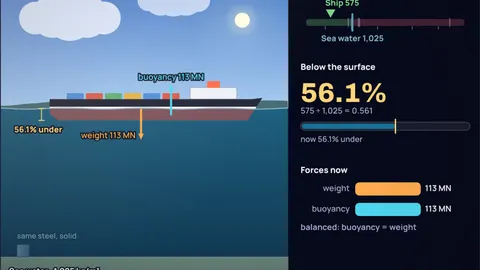
100 m × 20 m × 10 m box hull, 1,507 t of steelThe model ship is a box hull 100 m long, 20 m wide and 10 m deep, built from 20 mm plate with half as much again for the frames. That is 192 m³ of steel, 1,507 t, wrapped around 20,000 m³ of space. Load 10,000 t of cargo and the total mass is 11,507 t, so the mean density is 575 kg/m³ and the hull sits 5.6 m deep.
To float, the ship has to push aside 11,227 m³ of sea water, which weighs 11,507 t, the ship's own mass. On the sea floor next to it the simulation draws the same 1,507 t of steel as a solid cube 5.8 m on a side. That cube can only push aside 192 m³ of water, about 197 t, far less than its weight.
Related reading: Why does a steel ship float but a steel ball sink?
Overloading the ship until it sinks
20,000 t of cargoA hull can displace at most its own enclosed volume, 20,000 m³. In sea water that is 20,500 t, so the most cargo the box hull can carry before the deck goes under is about 18,993 t. With 20,000 t aboard the total is 21,507 t, the mean density 1,075 kg/m³ is above sea water's, and the ship goes down.
Fluid density matters too. In fresh water the same hull carries only about 18,453 t, 540 t less, which is why real ships carry load-line marks with a separate, higher line for fresh water. Real ships are also never loaded near the deck: they keep a safety margin of freeboard for waves.
Floating in the Dead Sea
70 kg person, full breathBody tissues differ: fat is about 900 to 950 kg/m³, muscle about 1,050 and bone well over 1,500. A lean 70 kg adult with empty lungs comes out at about 1,040 kg/m³ in the model. A full breath adds about 4.6 L of volume, which brings the average down to 973 kg/m³.
In a freshwater pool that leaves only 2.5% of the body above the surface, enough for the face if you lie back and keep still. The Dead Sea, at about 1,240 kg/m³, holds 21.5% above the surface, so bathers float high enough to sit up and read. Breathe out in fresh water and the average rises to 1,040 kg/m³: the person slowly sinks.
A steel ball floating on mercury
5 cm steel ball, 7,850 kg/m³In water a 5 cm steel ball weighs 5.04 N and the water holds up only 0.641 N of it, so it sinks, and under water it feels 0.641 N lighter than in air: an apparent weight of 4.4 N. Mercury, at 13,546 kg/m³, is denser than steel, and the ball floats with 58.0% of its volume under, sitting 55 percent of its diameter deep.
For a sphere the depth is not the same as the volume share, because the widest slice is in the middle. The simulation solves the spherical cap equation for the depth. Mercury is toxic and its vapour is the hazard, so this is one to try on screen.
Will it float? Share below the surface for each object and fluid
| Object | Density | Fresh water | Sea water | Dead Sea | Cooking oil | Mercury |
|---|---|---|---|---|---|---|
| Ice cube | 917 | 91.9% | 89.5% | 74.0% | 99.7% | 6.8% |
| Pine block | 500 | 50.1% | 48.8% | 40.3% | 54.3% | 3.7% |
| Fresh egg | 1,080 | sinks | sinks | 87.1% | sinks | 8.0% |
| Steel ball | 7,850 | sinks | sinks | sinks | sinks | 58.0% |
| Ship, 10,000 t cargo | 575 | 57.7% | 56.1% | 46.4% | 62.5% | 4.2% |
| Person, full breath | 973 | 97.5% | 95.0% | 78.5% | sinks | 7.2% |
| Person, breathed out | 1,040 | sinks | sinks | 83.9% | sinks | 7.7% |
Densities in kg/m³. Each cell is the share of the volume below the surface, the density ratio, or "sinks" when the object is denser than the fluid. Fluids: fresh water 998, sea water 1,025, Dead Sea 1,240, cooking oil 920, mercury 13,546.
How the simulation works
Two forces act on the object: its weight mg down, and the buoyant force ρgV up, where ρ is the fluid's density and V is the part of the object's volume below the surface. The simulation finds the depth at which they balance. For a block that depth is simply the density ratio times its height. For the steel ball and the egg (treated as a sphere) it solves the spherical cap volume, (cap volume ÷ ball volume) = h²(3 − h) ÷ 4 for a depth h measured in radii.
If the object is denser than the fluid it cannot balance, so it sinks to the floor, where the floor pushes up with the difference between weight and buoyancy. That difference is the apparent weight you would feel lifting it under water. The drop and the bobbing are a damped spring animation in scaled units, chosen to look natural, not a fluid-dynamics calculation. The final resting depth is exact.
The glass tank is an overflow can (a Eureka can): it is filled to the spout, so whatever volume goes below the surface spills into the beaker. For a floating object the spilled fluid weighs the same as the object, which is Archimedes' principle you can see.
Densities at about 20 °C: fresh water 998 kg/m³ (USGS lists 0.998 g/cm³ near room temperature), sea water 1,025 (Physics Factbook: 1,020 to 1,030), saturated brine 1,200, Dead Sea 1,240 (about 1.24 kg/L), vegetable oil 920, mercury 13,546 (13.546 g/cm³), ice 917, dry pine 500 (pine ranges about 350 to 600), fresh egg 1,080 (egg-grading salt baths run from 1.060 to 1.100 times the density of water), carbon steel 7,850.
What the model leaves out
- Stability: a floating object can capsize if its centre of gravity is too high above its centre of buoyancy. The simulation keeps every object upright; real ships are designed so that tipping shifts the buoyancy to push them back.
- Surface tension: a dry steel needle or a paper clip can rest on water, held by surface tension, not buoyancy. That only works for very small, light objects and is not modelled.
- Water soaking in: wood slowly absorbs water and gets denser, and ice melts. The objects here never change.
- Compressibility: water and steel barely compress, but air does. A person or a submarine with air inside gets denser with depth, so the model is a shallow-water picture.
- Temperature and salinity changes: real sea water varies from about 1,020 to 1,030 kg/m³ with salt and temperature. The model uses one value per fluid.
- Real ship shapes: the hull is a box, not a curved hull, so the draught is exact for a box but only a guide for a real ship.
Common misconceptions
“Heavy things sink, light things float.” A 10,000 tonne ship floats and a 5 g steel ball bearing sinks. What decides it is density, mass per volume, averaged over the whole object including any air it encloses.
“A floating object has no weight in the water.” It still has all its weight. The buoyant force simply balances it. For a sinking object the buoyant force is the weight of the displaced fluid, so a steel ball in water feels only about 13 percent lighter.
“The deeper an object goes, the bigger the buoyant force.” Once it is fully under, the buoyant force stays the same at any depth for an incompressible object, because the displaced volume no longer changes. Pressure rises with depth on top and bottom alike.
Frequently asked questions
Why does a steel ship float but a steel ball sinks?
Because the ship's hull encloses a lot of air. A ship floats if its total mass divided by the volume of its hull is less than the density of water. Our 100 m box hull holds 1,507 t of steel around 20,000 m³ of space, so with 10,000 t of cargo it averages 575 kg/m³. A solid ball of steel averages 7,850 kg/m³ and sinks.
How much of an iceberg is under water?
About 90 percent. Ice is 917 kg/m³ and sea water about 1,025, so 89.5% of the volume sits below the surface. Air bubbles in glacier ice and changes in sea water density move that by a few percent.
Why do you float more easily in the Dead Sea?
The Dead Sea is about 1,240 kg/m³, a quarter denser than fresh water, because roughly a third of it is dissolved salt. A person who just floats in a pool, with 2.5% above the surface, has 21.5% above it in the Dead Sea.
Why does an egg float in salt water?
A fresh egg is about 1,080 kg/m³, slightly denser than fresh water at 998. Dissolving salt raises the water's density. Once the brine is denser than the egg it floats; in saturated brine it sits 90.0% under.
What is the formula for buoyant force?
F = ρgV, the density of the fluid times gravity times the volume of fluid displaced. A 3 cm ice cube floating in sea water displaces 24.2 mL, so the buoyant force is 1,025 × 9.81 × 0 m³ = 0.243 N, which equals the cube's weight.
Do humans float or sink?
Most people float with a full breath and sink slowly when they breathe out. In the model a 70 kg body is 973 kg/m³ with full lungs and 1,040 kg/m³ with empty ones, either side of fresh water at 998. People with more body fat float more easily.
Keep learning
Why Does a Steel Ship Float but a Steel Ball Sinks?
Steel is 7.9 times denser than water, yet a ship with 10,000 t of cargo floats 5.6 m deep. Archimedes' principle, worked out for ships, icebergs, eggs and the Dead Sea.
What exactly is Implosion of Submarines
What exactly is Implosion we keep hearing about? Recently The Titan, Titanic watching Submarine imploded near Titatnic...

Why Is Ice Slippery? Not Pressure Melting, Here's the Math
Skate pressure lowers ice's melting point by about 1 °C, and no pressure melts ice below −22 °C. What really makes ice slippery, with numbers and plots.

Gravity is still strong at the space station. Why do astronauts float?
The station, crew and loose objects fall together. Weightlessness is about the missing support force, not gravity switching off above the atmosphere.