Lagrange points explained: the geometry behind JWST and Aditya-L1
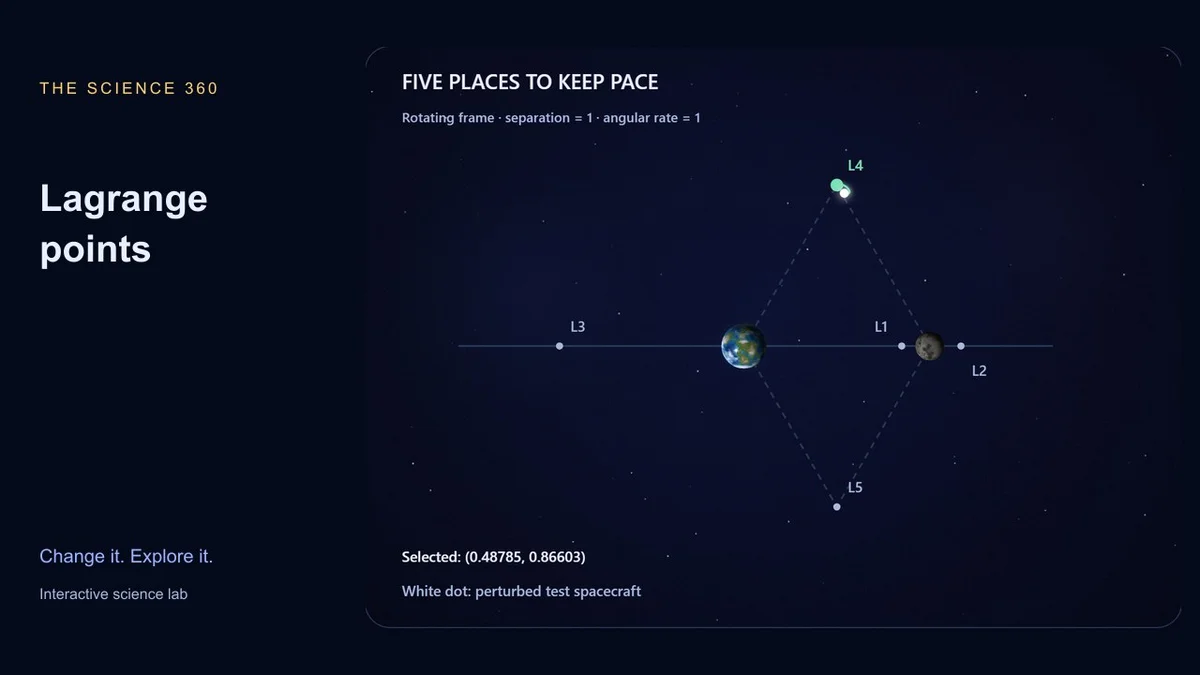
A spacecraft can stay near the same Sun–Earth alignment without sharing Earth’s exact orbit. The five Lagrange points explain where this is possible in an ideal circular system. They are equilibria in a rotating reference frame, not places where gravity vanishes.
Use the Lagrange points simulator to compare systems and give a test spacecraft a small nudge. Start with Earth–Moon mode, where the geometry is easier to see than the tightly spaced Sun–Earth L1 and L2 points.
First choose a moving camera
Imagine a camera rotating once per revolution with Earth and the Moon. Both bodies now appear fixed. A spacecraft moving correctly with the system may also stay near a fixed position in that view.
The equations for this camera include centrifugal and Coriolis terms. Dropping those terms would describe a different problem. The simulation places the primary bodies one unit apart and sets their angular rate to one; this makes the same mathematics usable for different mass ratios.
L1 lies between the bodies. L2 lies beyond the smaller body. L3 lies on the other side of the larger one. L4 and L5 complete equilateral triangles with the two bodies.
Staying balanced is different from staying stable
An exactly balanced pencil can be motionless in an ideal equation, but a small disturbance can grow. L1, L2 and L3 are similarly unstable in the circular restricted three-body problem.
Select Earth–Moon L4 and a small nudge. Then compare it with L2. You are changing the starting equilibrium while keeping the underlying equations. A short trail is only an illustration over the displayed interval; it is not a guarantee about every possible spacecraft path.
For the triangular points, the small-perturbation criterion is:
μ(1 − μ) < 1/27
μ is the smaller body’s fraction of the total mass. Earth–Moon satisfies the criterion. Equal masses do not. Try the equal-mass L4 preset: the point still exists geometrically, but its stability changes.
What this means for real missions
JWST operates around the Sun–Earth L2 region, while Aditya-L1 uses the L1 region. Their actual trajectories involve three-dimensional orbits and mission-specific corrections. The planar lab does not recreate either mission’s halo orbit.
For Sun–Earth mode, the equilibrium markers close to Earth may look crowded. That is a scale issue: drawing every point equally far apart would misrepresent the system. Read the selected normalized coordinates as well as the picture.
A useful comparison
Set the nudge to zero, then increase it gradually. Explain why an equilibrium can remain still in the ideal case while being unstable under perturbations. Save two setups and compare their trails.
Next explore Kepler’s laws, where the rotating two-primary framework is replaced by a simpler central-force orbit.
Sources and further reading
 5 amazing physics experiment for your kids
 50 Hilarious Physics Jokes That Will Make You Laugh