How Much Electricity Does a Geyser Use? Units and Cost
In winter the geyser is one of the biggest loads in many Indian homes. It draws 2 or 3 kW while it heats, and people notice the bill. But wattage alone does not tell you how many units it uses. That depends on how much water you heat, how far you heat it, and how long the tank sits hot between baths.
This post works out each part with a 25 litre, 2 kW storage geyser and a family of four, then compares an instant geyser, a heat pump and a solar water heater. Every example opens in the water heater cost calculator, where you can type your own litres, temperatures, geyser size and tariff.
How much electricity does one bath take?
Warming water takes a fixed amount of heat per kilogram per degree, its specific heat capacity. The US Department of Energy's thermodynamics handbook takes it as 1 Btu per pound per °F for water, which is about 4.18 kJ per kg per °C; the calculator uses 4.184. A litre of water is close to 1 kg, and one unit of electricity (1 kWh) is 3,600 kJ.
Worked example: one 20 litre bucket bath
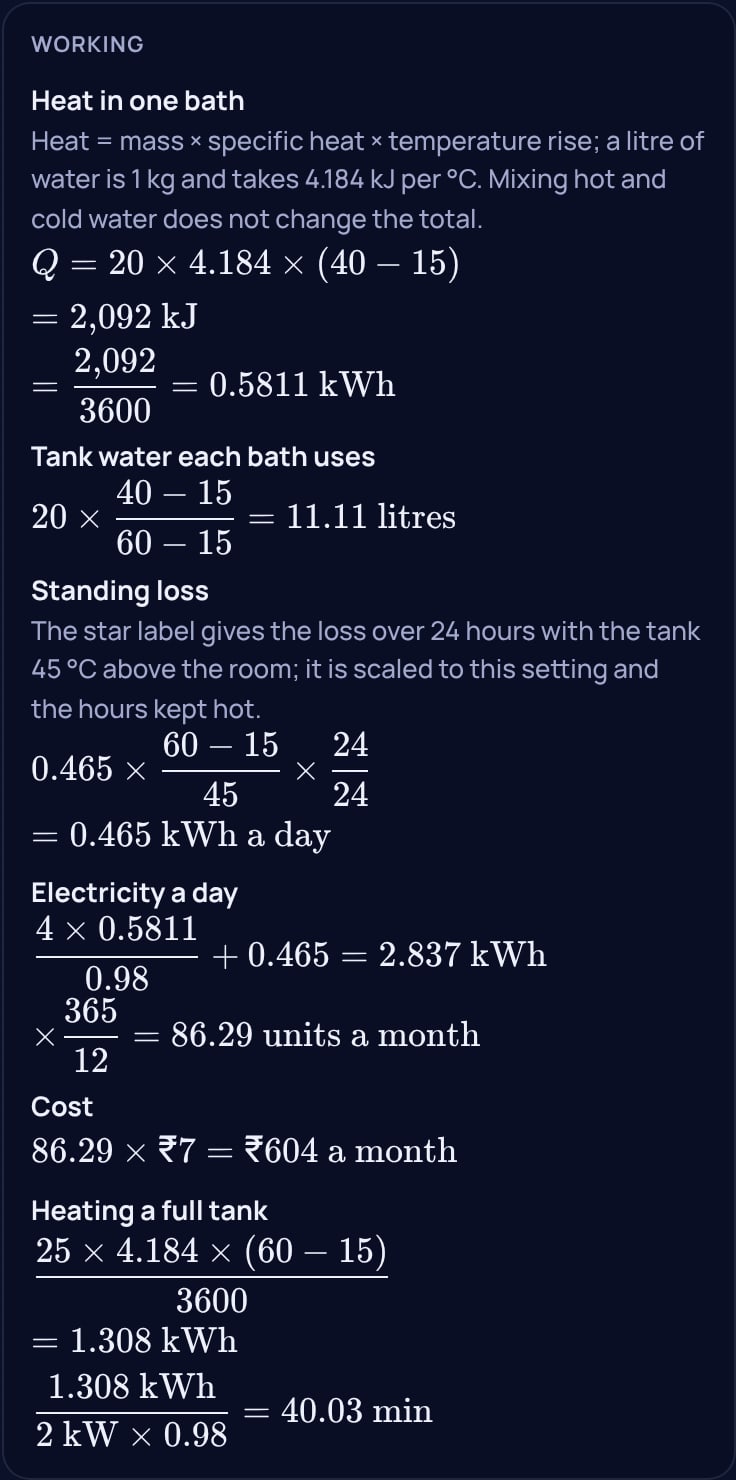
Cold water comes in at 15 °C, an example winter figure (type your own), and the bath is at 40 °C.
So each bucket bath holds about 0.58 units of heat. Four baths a day hold 2.32 units, and a geyser that passes 98 percent of its electricity into the water draws 2.32 ÷ 0.98 = 2.37 units for them.
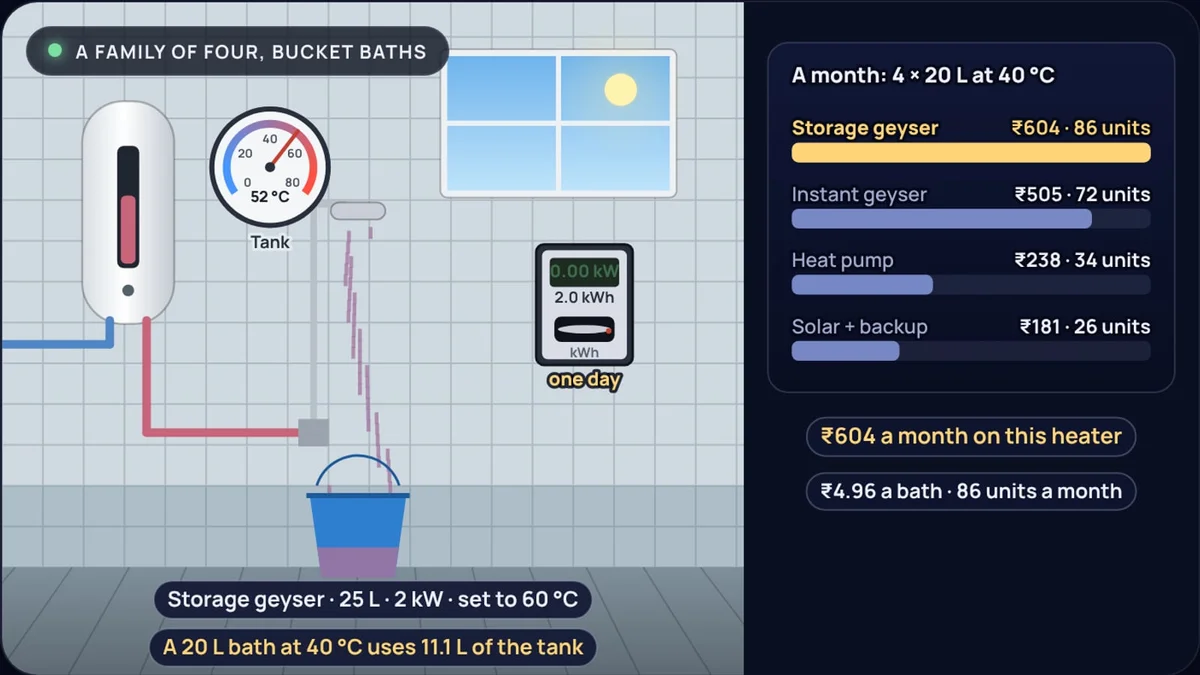
Notice what is missing from that sum: the geyser's setting. Whether the tank is at 50 °C or 70 °C, you mix its water with cold water until the bucket is at 40 °C. The total heat in the bucket is fixed by its litres and its temperature. A hotter tank only means you use fewer litres of tank water and more cold water.

How much does a geyser use in a month?
A storage geyser adds one more term: standing loss, the heat that leaks through the insulation while the tank waits hot. This is what the BEE star label measures. The current table, notified by the Ministry of Power in December 2025 and valid from 1 July 2026 to 31 December 2027, gives limits in kWh per 24 hours with the tank 45 °C above the room. For a 25 litre geyser, 4 stars means a loss above 0.423 and up to 0.465 kWh a day; 5 stars means 0.423 or less.
Worked example: a month of bucket baths
A 4-star 25 litre geyser with the highest loss its band allows, 0.465 kWh a day. Set to 60 °C with 15 °C water, the difference is exactly the label's 45 °C, so the loss is 0.465 kWh if the geyser is left on all day.
At ₹7 a unit that is ₹604 a month, or about ₹4.96 a bath. The standing loss is 0.465 of the 2.84 units, about 16 percent.
That 16 percent answers a common worry. Leaving a well insulated geyser on all day does not double the bill. A whole day of standing loss is less heat than one bucket bath.
How long does a geyser take to heat?
This is where the wattage matters. The heater puts heat in at its rated power, so the time is the heat the tank needs divided by the kilowatts.
Worked example: heating a full 25 litre tank
A 3 kW heater would do it in about 27 minutes. It would not use more units: it puts the same 1.31 kWh in faster.
So the wattage on the box is a speed, not a cost. Two geysers of different wattage heating the same water to the same temperature use the same units. The kettle post makes the same point at a smaller scale: in a bigger kettle is not the problem, heating extra water is, it is the litres that set the energy.
Does turning the thermostat down save money?
A little. Lowering the setting from 60 °C to 50 °C does not change the heat in the bath, for the reason above. Each bath now uses 20 × 25 ÷ 35 = 14.3 litres of tank water instead of 11.1. What falls is the standing loss, which scales with how much hotter the tank is than its surroundings: 0.465 × 35 ÷ 45 = 0.36 kWh a day instead of 0.465.
That saves about 0.1 units a day, roughly 3 units or ₹22 a month. A lower setting does mean fewer baths per tankful, so with several baths back to back you may run short of hot water.
Should you switch off the geyser?
Switching on the geyser only before baths cuts the hours the tank is kept hot. If it is hot for 2 hours a day instead of 24, the calculator scales the standing loss to 2 ÷ 24 of the day's figure.
That brings the month from 86.3 to 73.3 units, about ₹91 a month less at ₹7. The real saving is a little smaller, because a tank that is switched off still loses some heat as it cools, which the next heat-up replaces. The calculator does not count that.
What changes the bill the most?
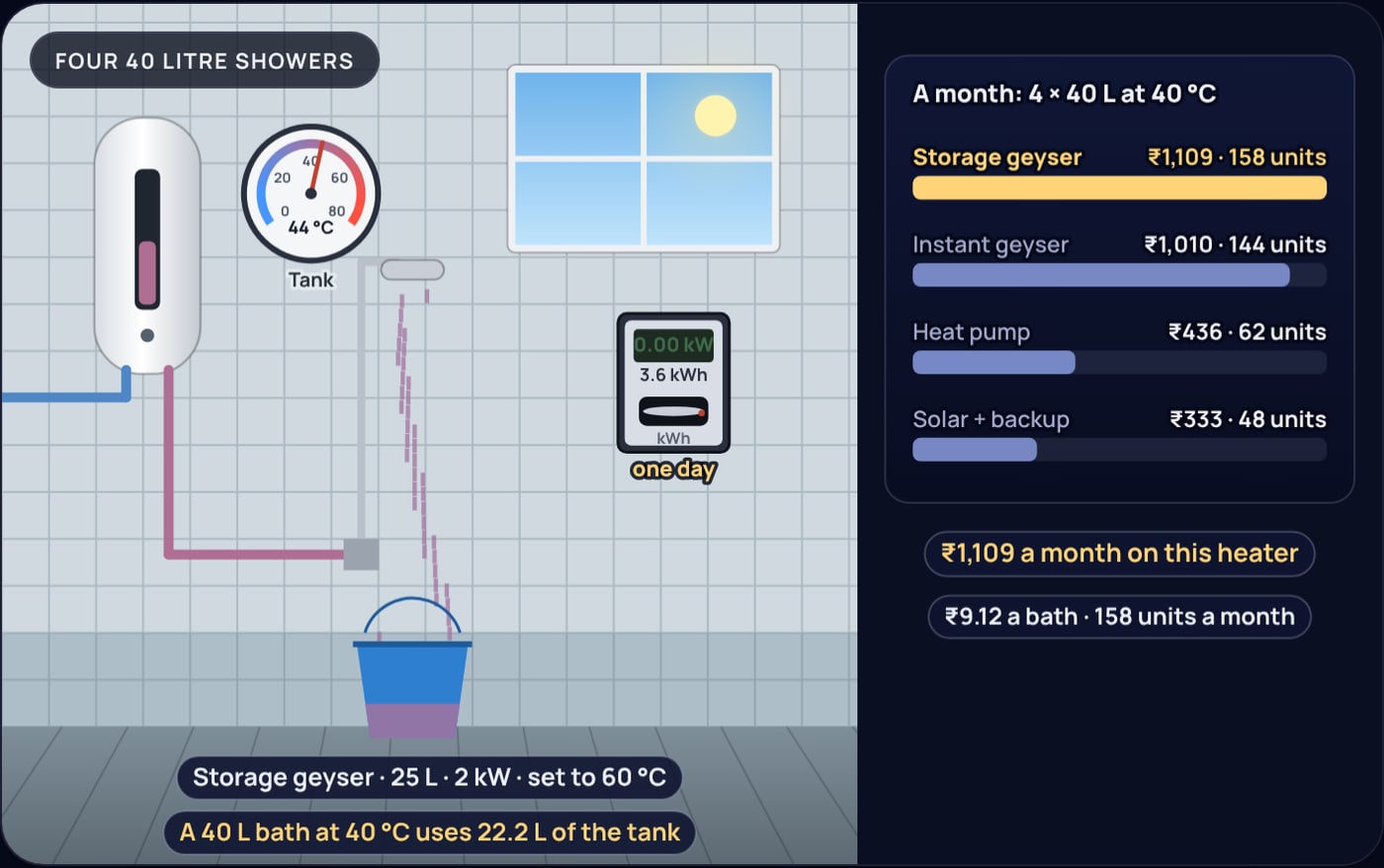
The litres. A shower uses much more water than a bucket. If each of the four baths is a 40 litre shower, twice the bucket, the heat in the water doubles and the month rises to about 158 units, ₹1,109. Each shower uses 22.2 litres of tank water, so a 25 litre tank barely covers one before it must reheat.
The season matters next. With cold water at 25 °C instead of 15 °C, each 40 °C bath needs a 15 °C rise instead of 25 °C, and the same four buckets cost about ₹380 a month instead of ₹604. That is why geyser bills fall so much in spring even when habits do not change.
Is an instant geyser cheaper?
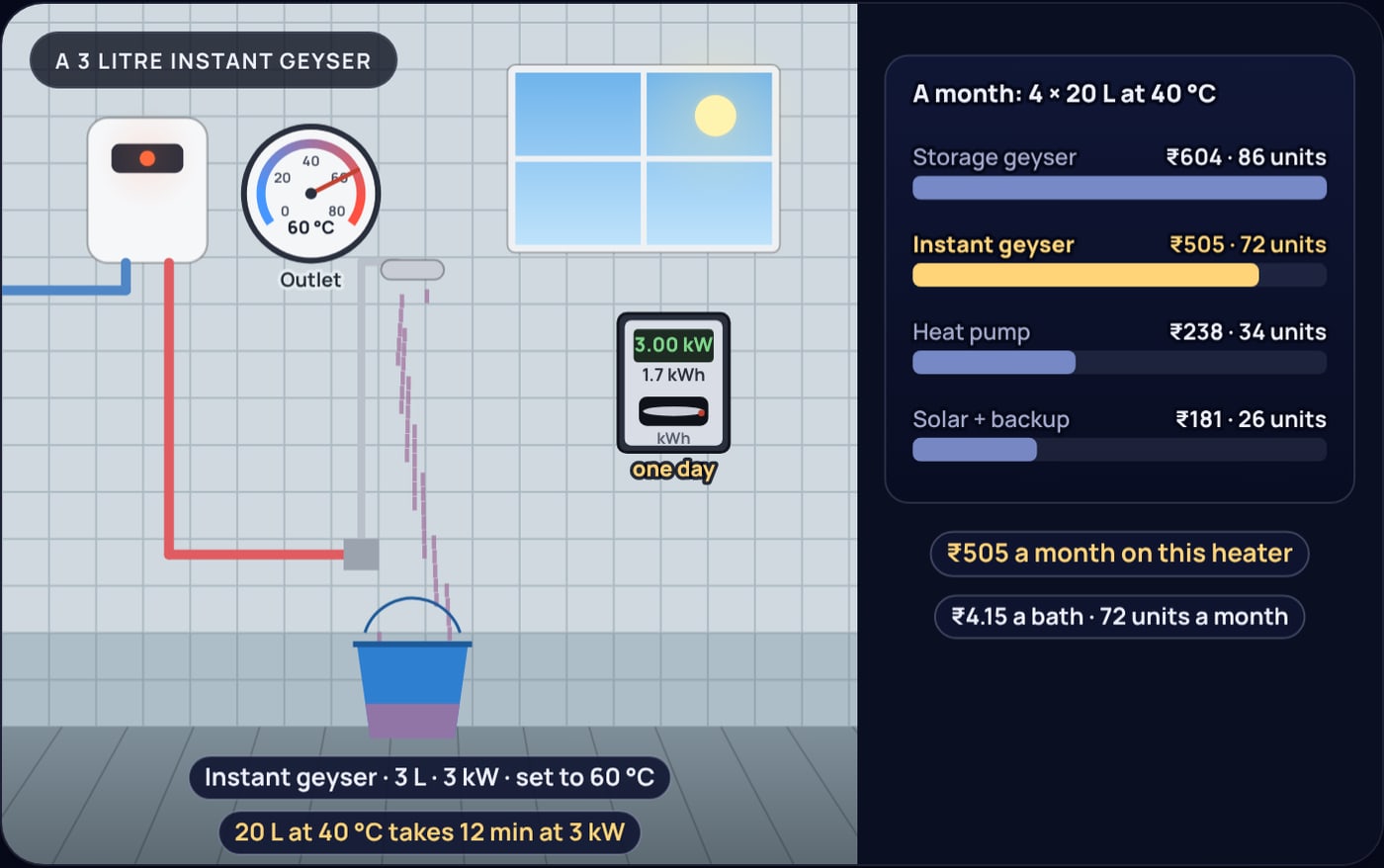
An instant geyser has a tiny tank, often 3 litres, and a bigger heater, often 3 kW (V-Guard's 3 litre instant models are 3,000 W). It heats while you draw water, so there is almost no standing loss. For the same four buckets it uses about 72 units a month, ₹505, about ₹99 less than the storage geyser.
The catch is flow. 3 kW can warm only so much water per minute:
That is about 1.7 litres a minute at 40 °C. Fine for filling a bucket, slow for a shower.
What about heat pump and solar water heaters?
Both cut the electricity much more, because most of their heat does not come from the wire.
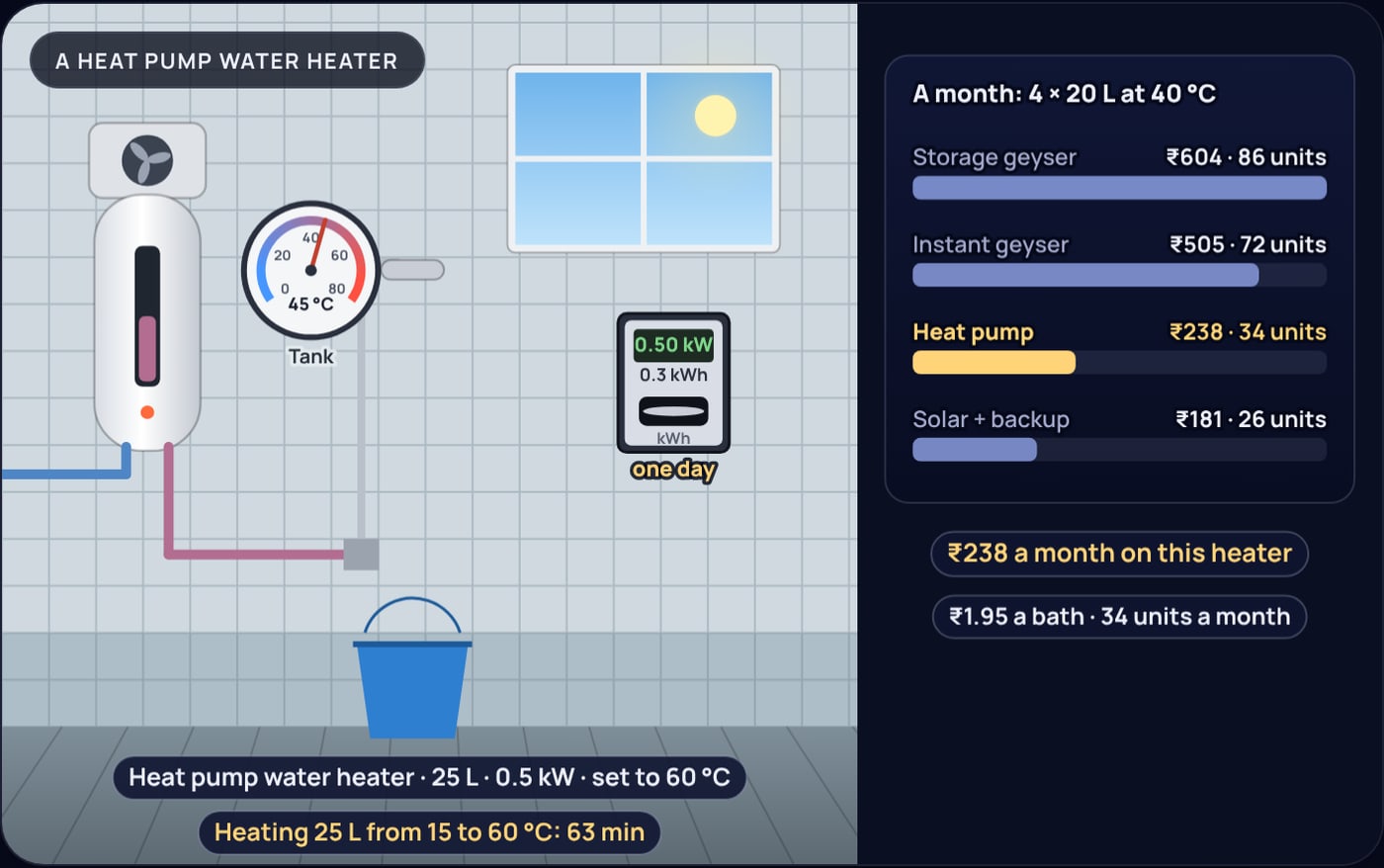
A heat pump water heater works like an AC in reverse: it moves heat from the surrounding air into the water. The US Department of Energy says these heaters can be two to three times as efficient as conventional electric resistance water heaters. The calculator uses a coefficient of performance (COP) of 2.5, the middle of that range, meaning 2.5 units of heat in the water for each unit of electricity. The same four baths and standing loss then take about 34 units, ₹238 a month.
A solar water heater gets its heat from a collector on the roof, with an electric element as backup for cloudy days. How much of the year's heat the sun supplies depends on where you live and when you bathe. The calculator takes this as an input, with 70 percent as an example; at that share, the backup uses about 26 units, ₹181 a month.
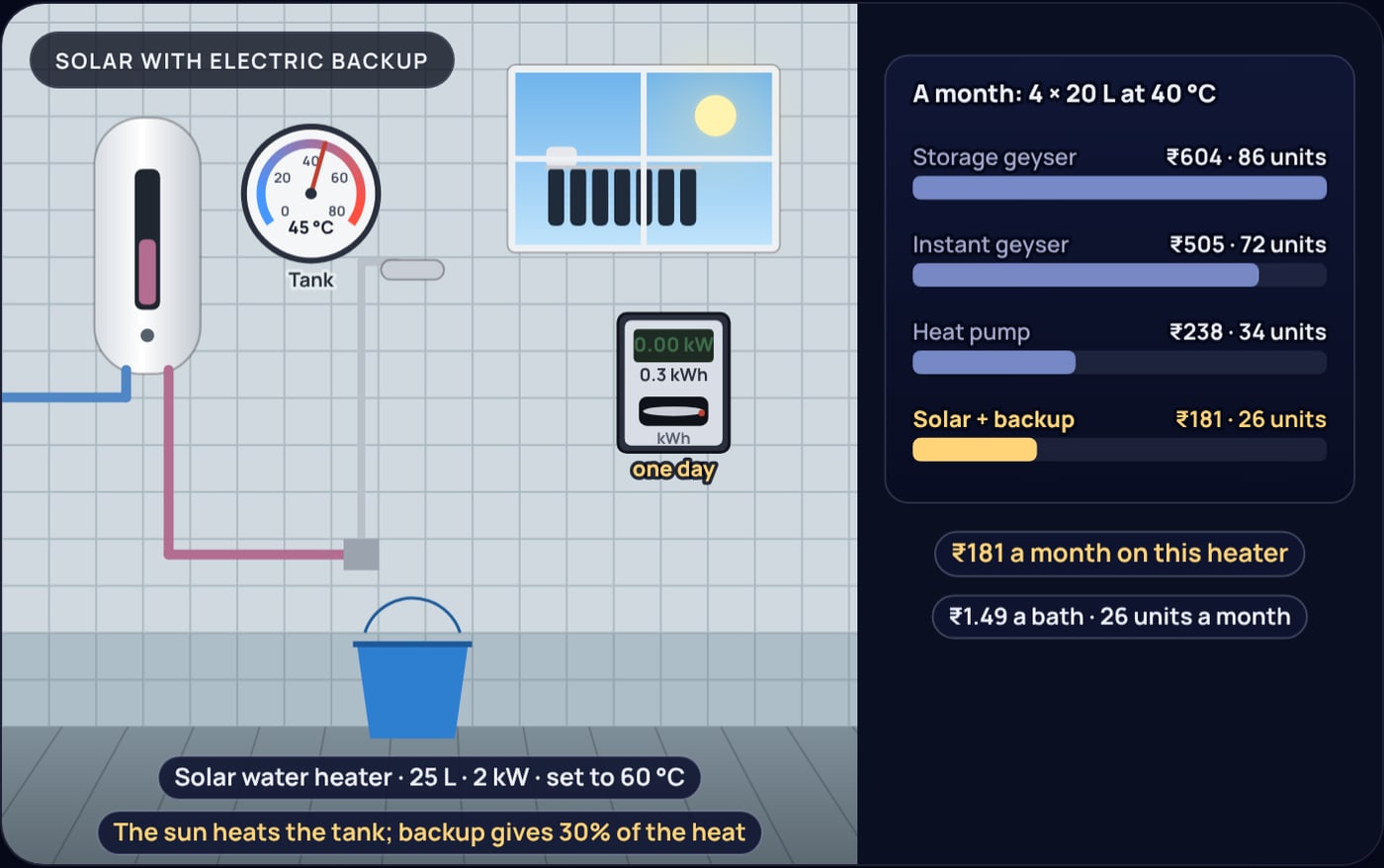
The Ministry of New and Renewable Energy's figure gives a useful check. It says a 100 litre a day solar water heater can replace an electric geyser and may save about 1,500 units a year. Heating 100 litres by 35 °C every day takes 100 × 4.184 × 35 ÷ 3,600 = 4.07 kWh, or about 1,485 units a year. So MNRE's figure assumes that much hot water every day, almost all of it from the sun. A family using less, or a north Indian winter with foggy weeks, will save less. Neither the heat pump nor the solar figure includes the purchase price.
How does the calculator work it out?
- Heat in each bath: litres × 4.184 × (bath temperature − cold water temperature) ÷ 3,600 kWh.
- Standing loss: the star label figure × (setting − cold water temperature) ÷ 45 × hours kept hot ÷ 24. It takes the room as the same temperature as the cold water.
- Electricity a day: storage = baths' heat ÷ efficiency + standing loss; instant = baths' heat ÷ efficiency; heat pump = (baths' heat + standing loss) ÷ COP; solar = (1 − solar share) × the storage figure.
- A month is a day × 365 ÷ 12, priced at a flat rate or on top of the rest of your house on a slab tariff.
- Heating time: the heat a full tank needs ÷ (kW × efficiency), or ÷ (kW × COP) for a heat pump.
It leaves out heat lost in long pipes, the cooling of a tank while it is switched off, purchase prices, fixed charges and taxes. For how kWh, joules and calories relate, see joules, calories and kWh explained, and for the other big seasonal load, how many units a 1.5 ton AC uses per hour.
To see your own numbers, open the water heater cost calculator, set the litres and temperatures your family uses, and compare the four kinds of heater on your tariff.
Sources
- US Department of Energy, Thermodynamics, Heat Transfer and Fluid Flow handbook, volume 1: heat added = mass × specific heat × temperature rise, with the specific heat of water taken as 1.0 Btu per lbm per °F (about 4.19 kJ per kg per °C).
- Ministry of Power, notification S.O. 5970(E), 23 December 2025, Gazette of India (copy of the gazette PDF): Table 3.5, star bands for electric storage water heaters by standing loss in kWh per 24 hours at a 45 °C difference, valid 1 July 2026 to 31 December 2027.
- V-Guard, Victo 25 litre storage water heater (2,000 W) and Zio 3 litre instant water heater (3,000 W): typical heater ratings.
- US Department of Energy, heat pump water heaters: two to three times as efficient as conventional electric resistance water heaters.
- Ministry of New and Renewable Energy and REEEP, Solar water heating systems: a review of global experiences: a 100 litre capacity solar water heater may save about 1,500 units of electricity a year under Indian conditions.
- IEEFA and JMK Research, Advancing residential rooftop solar adoption in India (October 2025): ₹7 a unit as a typical household tariff assumption.
- Delhi Electricity Regulatory Commission, tariff order press note and schedule: domestic slab rates used for the calculator's slab option.
Frequently asked questions
How much electricity does a geyser use per day?
For four 20 litre bucket baths at 40 °C from 15 °C water, a 25 litre, 2 kW geyser left on all day uses about 2.8 units a day: 2.4 for the water and 0.47 of standing loss. That is about 86 units, ₹604 a month at ₹7.
How long does a 25 litre geyser take to heat?
About 40 minutes for a 2 kW geyser heating 25 litres from 15 °C to 60 °C. The water needs 25 × 4.184 × 45 = 4,707 kJ, 1.31 units, and 2 kW delivers that in about two thirds of an hour.
Should I switch off the geyser after use?
It helps a little. A 4-star 25 litre geyser kept at 60 °C all day loses about 0.47 units a day; switching it on only 2 hours a day saves about ₹91 a month at ₹7. Using fewer litres saves more.
Is an instant geyser cheaper than a storage geyser?
It saves the standing loss, about ₹99 a month in our example, because it has no tank to keep hot. But a 3 kW instant geyser warms only about 1.7 litres a minute to 40 °C, so it suits bucket baths more than showers.
How much does a solar water heater save?
MNRE says a 100 litre a day solar water heater may save about 1,500 units of electricity a year. The real saving depends on how much hot water you use and how sunny your winters are.