How much electricity does a geyser use?
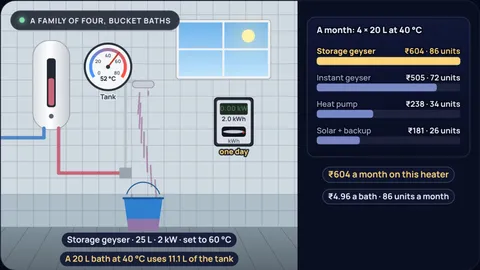
Most of it goes into the bath water itself. Warming a 20 litre bucket from 15 °C to 40 °C takes 0.58 units of heat. For a family of four taking one such bath each a day, a 25 litre, 2 kW geyser left on all day uses about 86 units a month, ₹604 at ₹7 a unit, and heats its tank from cold in about 40 minutes. About 16% of that is standing loss, the heat the tank leaks while it waits.
Choose the kind of heater, the baths a day, the litres and temperature of each, the cold water temperature, the geyser setting, and your tariff. The stage heats the tank and fills a bucket; the card compares a month on a storage geyser, an instant geyser, a heat pump and a solar heater. Defaults are examples as of November 2026 with sources below. For the longer explanation, read how much electricity a geyser uses.
Key results from the calculator
- Four 20 litre bucket baths a day in winter (15 °C water in, 40 °C baths): 86 units and ₹604 a month on a 25 litre storage geyser, about ₹4.96 a bath.
- Four 40 litre showers instead: 158 units and ₹1,109 a month. The litres matter more than anything else.
- Switching the geyser on for 2 hours a day instead of leaving it on: 73 units, ₹91 a month less.
- Same baths on a heat pump (COP 2.5) or a solar heater giving 70% of the heat: ₹238 and ₹181 a month.
Six examples, worked
Each example uses a 25 litre, 2 kW storage geyser set to 60 °C, cold water at 15 °C, baths at 40 °C, a standing loss of 0.465 kWh a day and ₹7 a unit unless it says otherwise. The button loads it.
A family of four, one bucket bath each
4 × 20 litres at 40 °C, geyser left onEach bucket takes 20 × 4.184 × (40 − 15) = 2,092 kJ, or 0.581 units. Four a day, divided by 98% efficiency, is 2.37 units.
Keeping the tank at 60 °C all day loses 0.465 units more, so the day comes to 2.84 units: 86.3 a month and ₹604 at ₹7.
Four showers of 40 litres each
twice the water of a bucketA 40 litre shower holds twice the heat of a 20 litre bucket, 1.16 units. The standing loss stays the same.
The month rises to 158 units and ₹1,109. Each shower uses 22.2 litres of 60 °C water, so the 25 litre tank manages 1.1 showers before it must reheat.
Switching the geyser on only before baths
kept hot 2 hours a dayThe heat in the baths does not change. The standing loss falls from 0.465 to 0.039 units a day.
That saves 13 units, ₹91 a month: worth doing, but smaller than cutting the litres.
A 3 litre, 3 kW instant geyser
no tank to keep hotWith no standing loss, the same four buckets take 72.1 units, ₹505 a month.
But 3 kW warms only about 1.7 litres a minute by 25 °C, so each 20 litre bucket takes 11.9 minutes. That suits a bucket bath better than a shower.
A heat pump water heater
COP 2.5, 0.5 kW inputA heat pump moves heat from the room air into the water. At a COP of 2.5, each unit of electricity puts 2.5 units of heat in the tank.
The same baths and standing loss take 33.9 units, ₹238 a month. The purchase price is not counted.
A solar water heater with electric backup
the sun gives 70% of the heat (example)If the sun supplies 70% of the heat over the month, the backup element supplies the rest: 25.9 units, ₹181.
The share is an example. It is higher in a sunny south Indian winter and lower in foggy north Indian weeks; type your own.
Heat in one bath, and a month of four a day on a 25 litre storage geyser
| Water per bath | Heat at 40 °C from 15 °C | Cost a bath at ₹7 | A month, 4 a day | Same in summer (25 °C in) |
|---|---|---|---|---|
| 10 litres | 0.29 kWh | ₹2.08 | 50 units, ₹352 | 33 units, ₹229 |
| 15 litres | 0.44 kWh | ₹3.11 | 68 units, ₹478 | 43 units, ₹304 |
| 20 litres | 0.58 kWh | ₹4.15 | 86 units, ₹604 | 54 units, ₹380 |
| 30 litres | 0.87 kWh | ₹6.23 | 122 units, ₹857 | 76 units, ₹532 |
| 40 litres | 1.16 kWh | ₹8.30 | 158 units, ₹1,109 | 98 units, ₹683 |
| 60 litres | 1.74 kWh | ₹12.45 | 231 units, ₹1,614 | 141 units, ₹986 |
Includes a standing loss of 0.465 kWh a day at a 45 °C difference, scaled to the difference between the 60 °C setting and the cold water, with the geyser left on. Multiply units by your price per unit.
How the calculator works
The heat in each bath is litres × 4.184 kJ per kg per °C × (bath temperature − cold water temperature), divided by 3,600 to give units (kWh). A litre of water is taken as 1 kg. Mixing hot and cold water does not change the total, so the geyser setting does not change this part.
The geyser setting decides how many litres of tank water each bath uses: bath litres × (bath − cold) ÷ (setting − cold). It also sets the standing loss, the heat lost through the insulation. BEE’s star label gives this loss over 24 hours with the tank 45 °C above the room; the calculator scales it to your setting (taking the room as the cold water temperature) and the hours the geyser is kept hot.
Electricity a day: storage geyser = bath heat ÷ efficiency + standing loss; instant = bath heat ÷ efficiency; heat pump = (bath heat + standing loss) ÷ COP; solar = (1 − solar share) × the storage figure. A month is a day × 365 ÷ 12. Heating time is the heat for a full tank divided by the heater kW (times efficiency, or times COP for a heat pump).
What the model leaves out
- Pipe losses: hot water left in the pipe after a bath cools there; long pipe runs add to the bill.
- Cooling while switched off: a tank switched off still loses some heat as it cools, which the reheat then replaces; the calculator counts loss only while it is kept hot.
- Purchase and fitting: prices of heat pumps and solar heaters, and their life, are not included.
- Fixed charges and taxes: only the energy charge per unit is counted.
Common misconceptions
"A higher wattage geyser uses more electricity." It heats faster, but the heat the water needs is the same. A 3 kW heater does the job in two thirds of the time a 2 kW one takes.
"Setting the geyser hotter costs much more." Hotter tank water is mixed with more cold water for the same bath. Only the standing loss rises, a small part of the bill.
"Leaving the geyser on all day doubles the bill." For a well insulated 4-star 25 litre tank, a whole day of standing loss is under half a unit, less than one bucket bath.
Frequently asked questions
How much electricity does a geyser use per day?
For four 20 litre bucket baths at 40 °C from 15 °C water, a 25 litre, 2 kW geyser left on all day uses about 2.8 units a day: 2.4 for the water and 0.47 of standing loss. That is about 86 units, ₹604 a month at ₹7.
How long does a 25 litre geyser take to heat?
About 40 minutes for a 2 kW geyser heating 25 litres from 15 °C to 60 °C. The water needs 25 × 4.184 × 45 = 4,707 kJ, 1.31 units, and 2 kW delivers that in about two thirds of an hour.
Should I switch off the geyser after use?
It helps a little. A 4-star 25 litre geyser kept at 60 °C all day loses about 0.47 units a day; switching it on only 2 hours a day saves about ₹91 a month at ₹7. Using fewer litres saves more.
Is an instant geyser cheaper than a storage geyser?
It saves the standing loss, about ₹99 a month in our example, because it has no tank to keep hot. But a 3 kW instant geyser warms only about 1.7 litres a minute to 40 °C, so it suits bucket baths more than showers.
How much does a solar water heater save?
MNRE says a 100 litre a day solar water heater may save about 1,500 units of electricity a year. The real saving depends on how much hot water you use and how sunny your winters are.
Keep learning
How Much Electricity Does a Geyser Use? Units and Cost
A 25 litre geyser heating four 20 litre baths a day uses about 86 units a month, ₹604 at ₹7. Heating time, standing loss, instant, heat pump and solar.

A bigger kettle is not the problem. Heating extra water is
A reproducible Python model separates water volume, kettle power and assumed efficiency to show what changes the energy used for a cup of hot water.
How Many Units Does a 1.5 Ton AC Use per Hour?
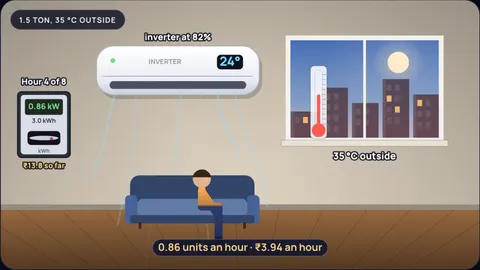
A 1.5 ton 5 star inverter AC uses about 0.86 units an hour at 35 °C outside and 24 °C inside. Worked examples for star ratings, thermostat and tariffs.
Joules, Calories and kWh: Energy Units Explained
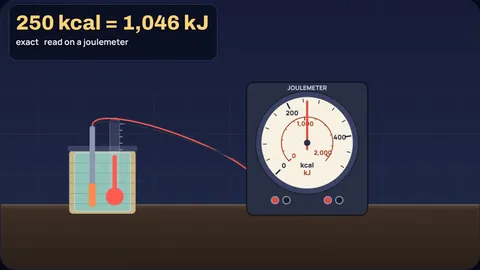
What a joule, a calorie, a food Calorie, a kilowatt hour, an electronvolt and a Btu are, the exact factors between them, and worked conversions.