Ohm's Law Triangle and Power Formula, Explained Simply
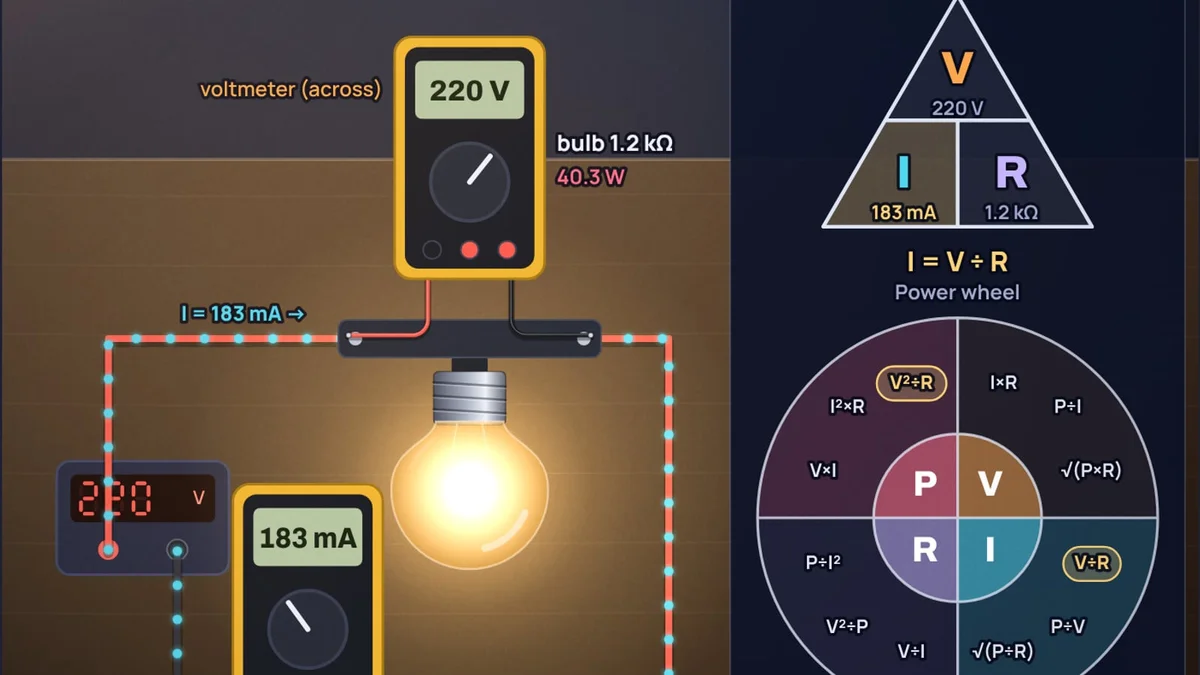
A 1200 Ω bulb and a 100 Ω heater coil, both plugged into 220 V. Which one gets hotter? Most people pick the bulb, because "more resistance means more heat". The heater wins by a factor of twelve: 484 W against about 40 W. Ohm's law and the power formula explain why in two lines, and the triangle and wheel diagrams are simply ways of remembering those two lines.
This post walks through both diagrams, solves the classic NCERT Class 10 examples step by step and lists all twelve formulas. To check any example as you read, open the Ohm's law calculator and circuit simulator: type any two of voltage, current, resistance and power, and the meters on the bench read out the rest.
What does Ohm’s law actually say?
Georg Ohm found in 1827 that the current through a metal wire is proportional to the voltage across it, as long as the temperature stays the same. The constant of proportionality is the resistance:
V is the potential difference in volts, I the current in amperes and R the resistance in ohms. One ohm is the resistance that lets 1 volt push 1 ampere, so 1 Ω = 1 V/A. Double the voltage and the current doubles; double the resistance and the current halves. A graph of V against I is a straight line through the origin, and its slope is R.
How do you use the Ohm’s law triangle?
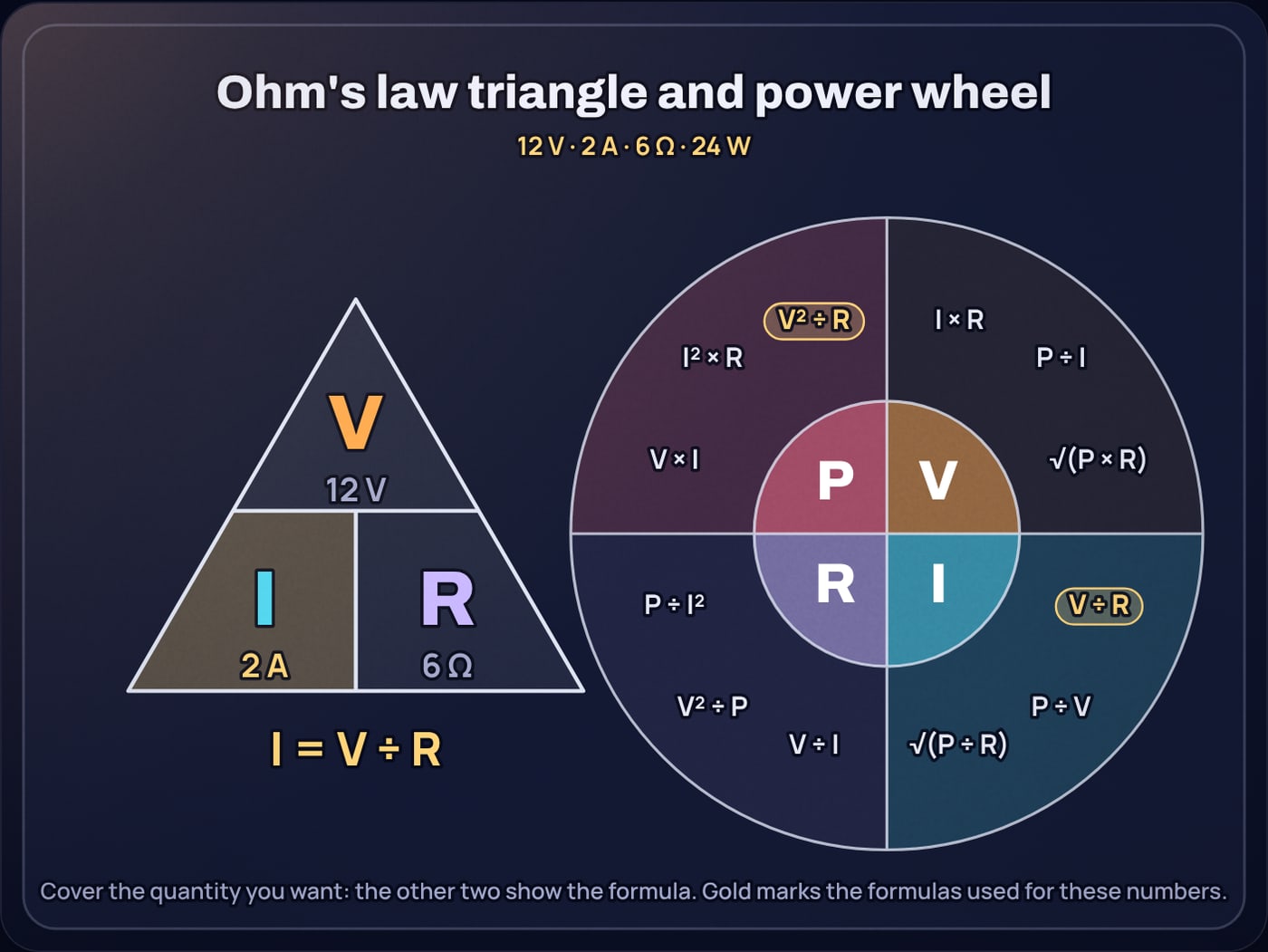
Draw a triangle with V at the top and I and R side by side at the bottom. Cover the quantity you want with a finger:
- Cover V: I and R are side by side, so multiply.
- Cover I: V is above R, so divide.
- Cover R: V is above I, so divide.
The triangle works because V is the product of the other two. The same trick works for any formula of the form a = b × c, including P = V × I: put P on top, V and I underneath. What the triangle cannot do is mix all four quantities. For that you need the power wheel.
NCERT example: how much current does a bulb draw?
This is a worked example in the NCERT Class 10 Science chapter on electricity, and versions of it turn up in board exams every year.
Example 1: bulb and heater on 220 V
(a) How much current will a bulb draw from a 220 V source if its filament resistance is 1200 Ω? (b) What about a heater coil of 100 Ω?
Now the part the textbook does not ask. The power is :
The lower resistance draws twelve times the current and makes twelve times the heat.
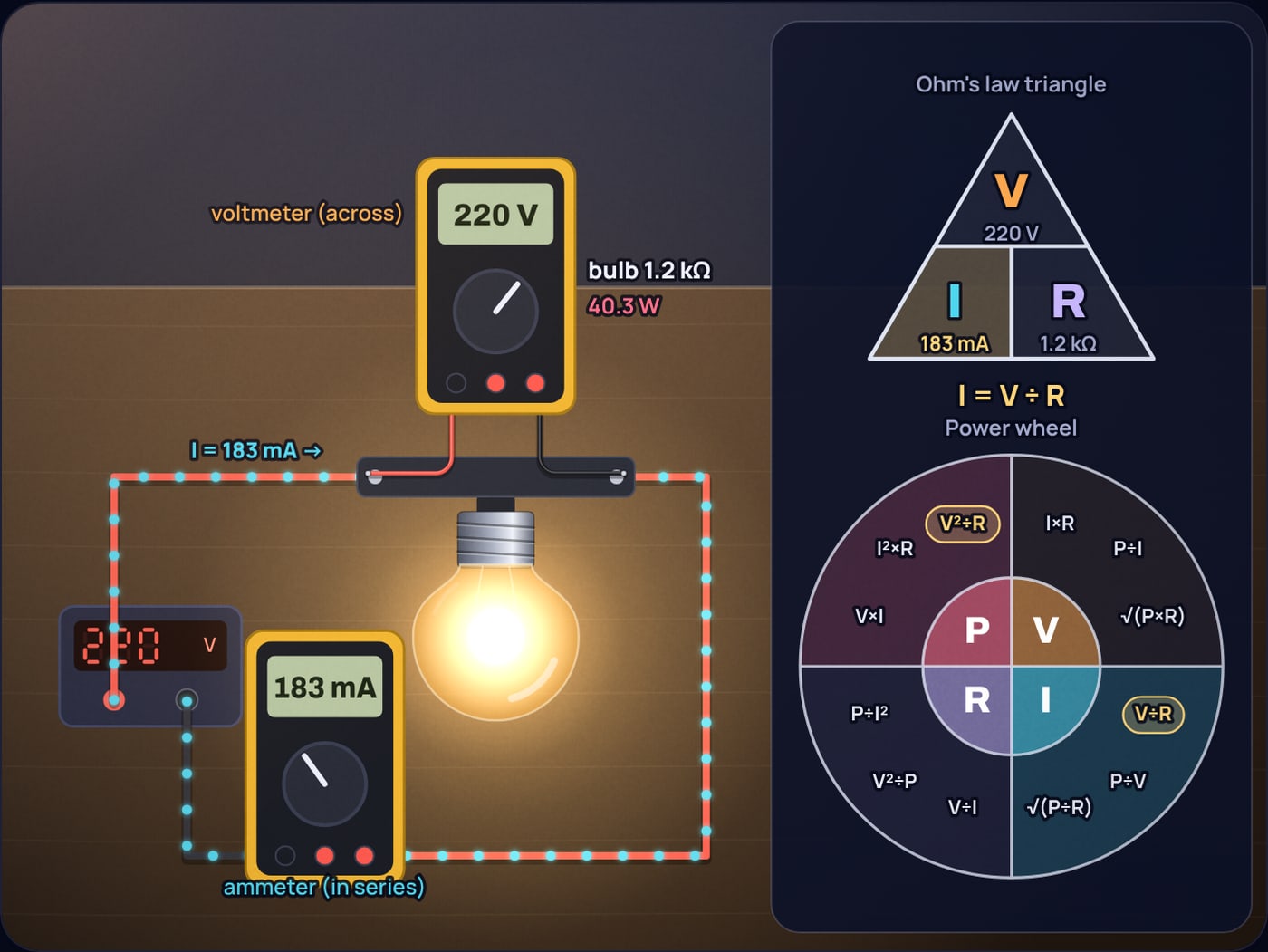
For full marks, write the formula first, substitute with units, and round to the precision of the data: 0.18 A, not 0.1833333 A. Examiners also look for the correct circuit diagram, with the ammeter in series and the voltmeter in parallel. A voltmeter in series would block the current (it has a very high resistance); an ammeter in parallel would short the load (it has almost none).
What is the power wheel?
Power is the rate at which a component turns electrical energy into heat, light or motion:
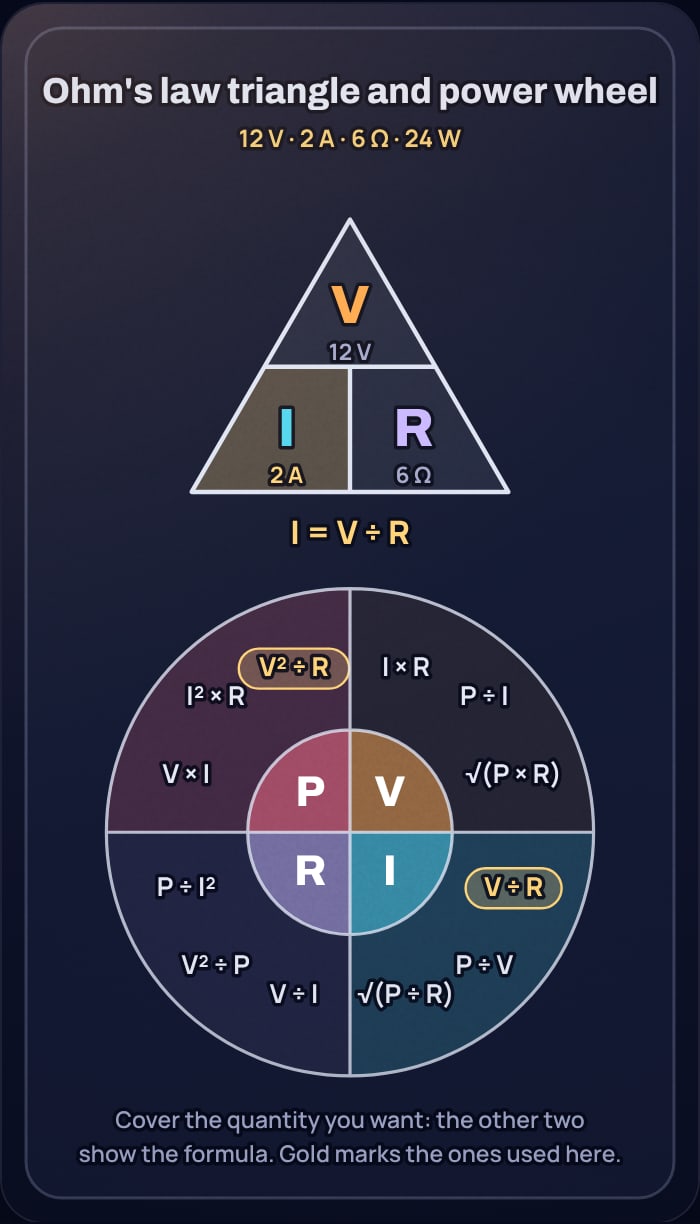
Substitute V = IR and you get . Substitute I = V/R and you get . Rearrange each of those for the other quantities and you end up with twelve formulas, three for each of V, I, R and P. The power wheel arranges them in four quadrants around the four letters, so you find the quantity you want in the middle and pick the formula in its quadrant that uses the two things you know.
| You know | Voltage V | Current I | Resistance R | Power P |
|---|---|---|---|---|
| V and R | known | V ÷ R | known | V² ÷ R |
| V and I | known | known | V ÷ I | V × I |
| I and R | I × R | known | known | I² × R |
| P and V | known | P ÷ V | V² ÷ P | known |
| P and I | P ÷ I | known | P ÷ I² | known |
| P and R | √(P × R) | √(P ÷ R) | known | known |
You do not need to memorise the table. Remember V = IR and P = VI, and derive the rest in one substitution. The wheel is a shortcut for when you are tired.
How much current does a kettle draw?
Appliance labels give power and voltage, not resistance. That is the "P and V" row.
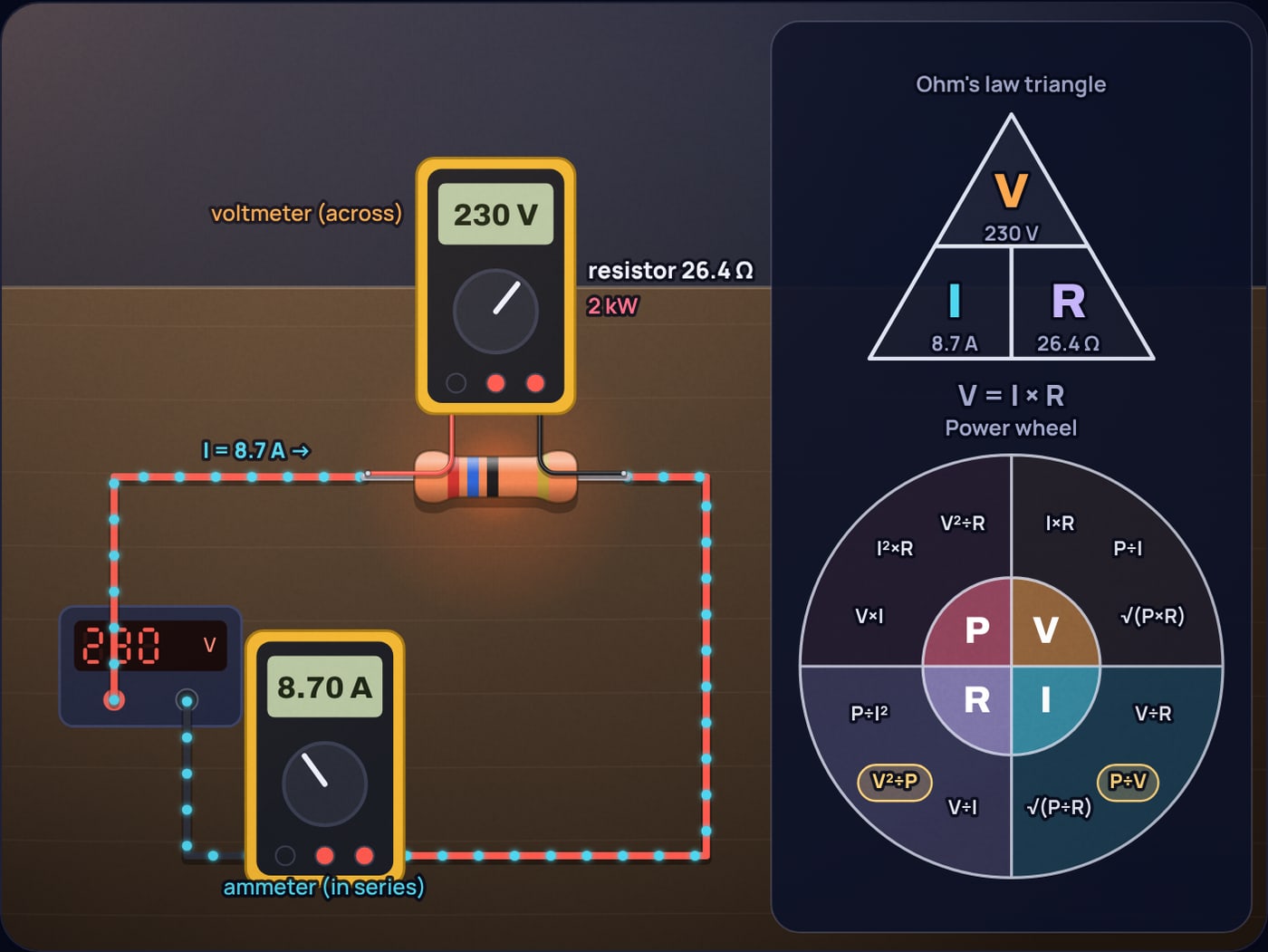
Example 2: a 2000 W kettle on 230 V
8.7 A is more than the 6 A rating of a small Indian plug socket, which is why a kettle this size belongs on a 16 A socket. Running it for three minutes uses 2000 W × 0.05 h = 0.1 kWh, a tenth of a unit on the electricity bill.
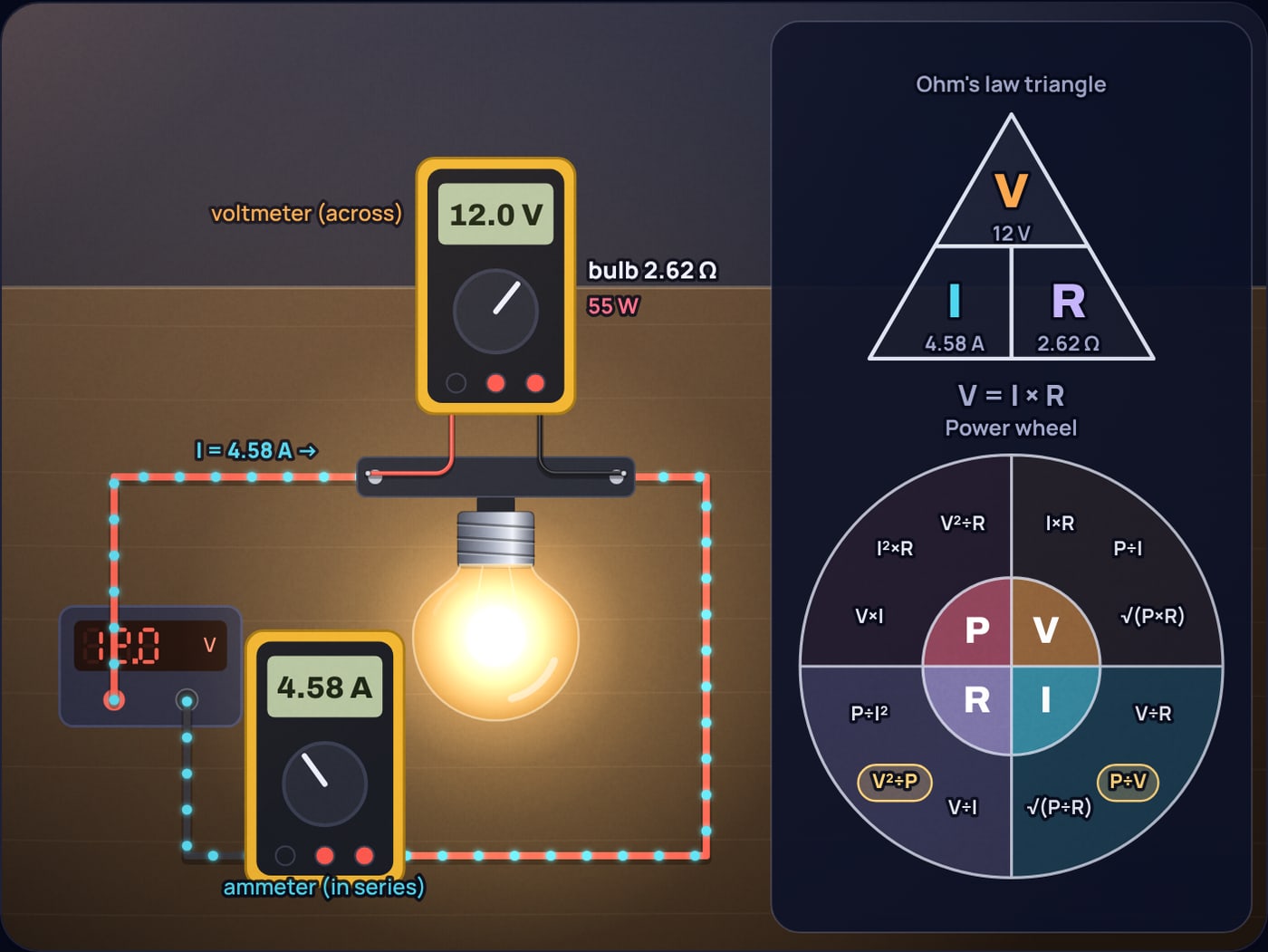
Low voltage changes the picture. A 55 W car headlight on 12 V draws 55 ÷ 12 = 4.58 A, about half the kettle's current for under a thirtieth of its power. That is why 12 V systems need thick wire, and why the grid moves power at very high voltage: for the same power, current falls as voltage rises, and the heat lost in the wires goes as . Our post on why power lines use high voltage puts numbers on that.
Does more resistance mean more heat?
It depends on what is held fixed, and this is the misconception behind the opening question.
- Fixed voltage (a wall socket, a battery): . Lower resistance means more power. Heaters, kettles and irons use low resistance on purpose.
- Fixed current (components in series, a wire carrying a load's current): . Higher resistance means more power. This is why a thin extension cable or a loose, high-resistance joint gets hot while the appliance works normally.
Both formulas are right. They answer different questions.
Is current used up in a circuit?
No. The same current flows into a bulb and out of it; the ammeter reads the same anywhere in a series loop. What the bulb uses is energy. Each coulomb of charge loses V joules as it passes through, and P = V × I is the rate. One ampere is about electrons per second, yet each electron drifts along a 1 mm² copper wire at only about 0.07 mm per second. The signal that switches the light on travels close to the speed of light; the electrons themselves barely move. And because current needs a voltage difference across a path, a bird sitting on one line feels almost nothing, as explained in why birds don't get electrocuted.
Where does Ohm’s law fail?
Ohm's law is a property of some materials at constant temperature, not a law of nature like conservation of energy. A tungsten filament's resistance rises roughly tenfold from cold to white hot, so a bulb's V-I graph bends. Diodes and LEDs are worse: their current rises exponentially with voltage, which is why LEDs need a resistor in series. For those parts you still use R = V ÷ I at one operating point, but you cannot extrapolate it to another voltage.
Try it yourself
Load the NCERT heater coil in the simulator, then type 1200 into the R box. Watch the current fall from 2.2 A to 0.18 A and the power drop from 484 W to 40 W while the supply stays at 220 V. Then switch "You know" to P and V and enter your own appliance's label to find its current.
Sources
- NCERT Class 10 Science, chapter "Electricity", Example 12.3 (bulb filament 1200 Ω and heater coil 100 Ω on 220 V), as reproduced by Teachoo: teachoo.com, NCERT Example 12.3
- NIST CODATA, elementary charge e = 1.602 176 634 × 10-19 C (exact): physics.nist.gov/cgi-bin/cuu/Value?e
Frequently asked questions
How do you use the Ohm’s law triangle?
Write V on top and I and R side by side underneath. Cover the quantity you want. If the other two are side by side, multiply them; if one is above the other, divide the top by the bottom. Covering V gives V = I x R, covering I gives I = V / R and covering R gives R = V / I.
What is the formula for electric power?
P = V x I, power in watts equals voltage in volts times current in amperes. Combined with Ohm’s law it also gives P = I squared x R and P = V squared / R. Use whichever matches the two quantities you know.
Why does a heater have low resistance if resistance makes heat?
Because a wall socket fixes the voltage, not the current. At a fixed voltage the power is V squared / R, so a smaller resistance draws more current and makes more heat. A 100 ohm coil on 220 V gives 484 W, while a 1200 ohm bulb filament on the same supply gives only about 40 W.
Is Ohm’s law valid for a bulb?
Only at one operating point. A filament’s resistance rises steeply as it heats, so its current does not grow in proportion to voltage and the V-I graph curves. Ohm’s law applies exactly to metallic conductors at constant temperature.
What is the SI unit of resistance and how is it defined?
The ohm. A conductor has a resistance of 1 ohm if a potential difference of 1 volt across it drives a current of 1 ampere, so 1 ohm equals 1 volt per ampere.
 555 Timer Astable Circuit Explained with Waveforms
 555 Timer Frequency Formula: Where 1.44 Comes From