What is Ohm's law?
Ohm's law says the current through a conductor is proportional to the voltage across it: V = I × R, so I = V ÷ R and R = V ÷ I. A 9 V battery across a 1 kΩ resistor drives 9 V ÷ 1000 Ω = 9 mA, and the resistor turns 81 mW into heat (P = V × I). Any two of voltage, current, resistance and power fix the other two.
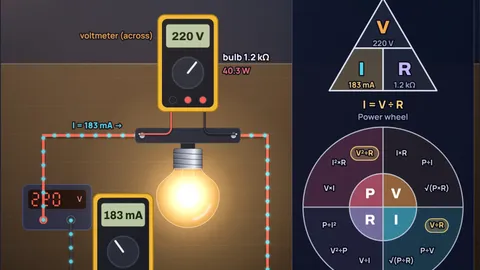
The calculator above solves whichever pair you know, with the meters on the bench showing the result and the current dots moving faster as the current grows. The triangle and the power wheel light up the formula used. It covers the NCERT Class 10 numericals on electricity, the LED resistor calculation and every appliance on your bill. The Ohm's law triangle and power formula post explains the memory aids in detail.
Key results
- V = I × R: 9 V across 1 kΩ gives 9 mA; 220 V across a 1200 Ω bulb filament gives 183 mA.
- P = V × I = I² × R = V² ÷ R: the same 1200 Ω bulb on 220 V uses 40.3 W, roughly a 40 W bulb.
- From power and voltage: a 2000 W kettle on 230 V draws 8.7 A and its element is 26.4 Ω when hot.
- Electrons are slow: 1 A in a 1 mm² copper wire means 6.24 × 10^18 electrons per second, but each drifts at only about 0.073 mm/s.
Six Ohm's law examples, solved
Each example gives the two known values, the formulas the calculator uses and the results it shows, with a button that loads it. Three are classic school numericals; three are real appliances.
A 9 V battery and a 1 kΩ resistor
Known: V and RWith voltage and resistance known, current is I = V ÷ R = 9 ÷ 1000 = 9 mA, and power is P = V² ÷ R = 81 ÷ 1000 = 81 mW. A standard 1/4 W resistor runs at about a third of its rating, so it barely warms.
Notice where the meters sit. The ammeter is in the loop, so all the current goes through it. The voltmeter is across the resistor, touching both ends. Swap them and the ammeter would short the resistor while the voltmeter, with its very high resistance, would stop the current.
NCERT: how much current does a 1200 Ω bulb draw on 220 V?
Class 10 numerical · Known: V and RThis is a worked example in the NCERT Class 10 Science chapter on electricity. I = V ÷ R = 220 ÷ 1200 = 183 mA, about 0.18 A. The calculator adds what the book does not ask: P = V² ÷ R = 40.3 W, which tells you it is a 40 W bulb.
For the board exam, write the formula, substitute with units and give the answer to two significant figures: I = 220 V ÷ 1200 Ω = 0.18 A. The 1200 Ω is the hot filament. Cold, a tungsten filament has roughly a tenth of that resistance, which is why bulbs often fail at switch-on.
NCERT: a 100 Ω heater coil on 220 V
Class 10 numerical · Known: V and RThe companion question: I = 220 ÷ 100 = 2.2 A. The power is P = V² ÷ R = 48,400 ÷ 100 = 484 W, a small room heater or an iron.
Compare it with the bulb: lower resistance means more current and more power on the same supply. That surprises people who think "more resistance, more heat". On a fixed voltage, P = V² ÷ R, so the smaller resistance wins. Heaters use low resistance on purpose.
A 2000 W kettle on 230 V
Known: P and VThe label gives power and voltage, so the calculator uses I = P ÷ V = 2000 ÷ 230 = 8.7 A and R = V² ÷ P = 52,900 ÷ 2000 = 26.4 Ω. That is more than the 6 A rating of a small Indian plug socket, so a kettle this size belongs on a 16 A socket.
Three minutes of boiling uses 0.10 kWh, one tenth of a unit on your electricity bill. The electricity bill calculation in Python shows how units turn into rupees.
A 55 W car headlight on 12 V
Known: P and VA halogen H4 low beam is rated 55 W at 12 V. I = P ÷ V = 4.58 A, and R = V² ÷ P = 2.62 Ω when hot. Two headlights take over 9 A, which is why they run through a relay and a fuse rather than straight through the dashboard switch.
Low voltage means high current for the same power. That is the reason power lines use high voltage, explained in why power lines use high voltage, and why a 12 V system needs much thicker wire than a 230 V one, see the 12 V wire gauge guide.
A torch bulb on two AA cells
Known: V and RTwo fresh AA cells give 3 V. A small torch bulb with 10 Ω of hot filament draws I = 3 ÷ 10 = 300 mA and uses 900 mW. Switch the load to a resistor and nothing in the numbers changes: Ohm's law does not care what the resistance is made of.
It does care whether the resistance stays constant. A filament's resistance climbs as it heats, so a bulb's current-voltage graph curves over instead of being a straight line. A resistor at constant temperature gives the straight line that defines an ohmic conductor.
All twelve Ohm's law and power formulas
| You know | Voltage V | Current I | Resistance R | Power P |
|---|---|---|---|---|
| V and R | known | V ÷ R | known | V² ÷ R |
| V and I | known | known | V ÷ I | V × I |
| I and R | I × R | known | known | I² × R |
| P and V | known | P ÷ V | V² ÷ P | known |
| P and I | P ÷ I | known | P ÷ I² | known |
| P and R | √(P × R) | √(P ÷ R) | known | known |
These are the twelve formulas of the power wheel. Example: a 220 Ω resistor at its 1/4 W limit has V = √(P × R) = 7.42 V and I = √(P ÷ R) = 33.7 mA.
How the calculator works
Type into any two of the four boxes, or pick the pair with the "You know" buttons. The calculator keeps the two most recently typed quantities as known and solves the other two: one with Ohm's law, V = I × R, and one with the power law, P = V × I, rearranged as needed. Those twelve rearrangements are the power wheel.
The circuit is drawn as you would build it on a bench: a supply, wires, the load (a resistor or a bulb), an ammeter in series and a voltmeter in parallel. The meters show the computed current and voltage. The dots move in the direction of conventional current, from + to −, at a speed that grows with the logarithm of the current, so 1 mA and 10 A both stay visible. The bulb's glow and the resistor's heat colour follow the power.
The V-I-R triangle highlights the quantity it solves when the pair is two of V, I and R. When power is involved, the wheel shows which formula was used. The Figures view draws both large with your numbers filled in.
For the electron numbers: the current in amperes is coulombs per second, and one electron carries 1.602 × 10^-19 C, so 1 A is 6.24 × 10^18 electrons per second. Their drift speed is v = I ÷ (n × A × e), with n = 8.5 × 10^28 free electrons per cubic metre in copper.
What the model leaves out
- Non-ohmic loads: a bulb filament, a diode or an LED does not keep a fixed resistance. The calculator treats R as the resistance at the operating point, which is right for that moment but not across the whole range.
- Temperature: a resistor or heater element changes resistance as it warms. Tungsten roughly ten times between cold and white hot; copper about 0.4% per °C.
- Internal resistance: real batteries and supplies sag under load. The calculator treats the supply as an ideal voltage source.
- Meter effects: a real ammeter adds a little resistance and a real voltmeter draws a tiny current. Both are ignored here, which is fine for ordinary multimeters.
- AC: for mains, V and I are RMS values and the formulas hold for resistive loads such as heaters and kettles. Motors and electronics add reactance and power factor, which this model leaves out.
Common misconceptions
"Current gets used up in the bulb." The same current flows in and out. What the bulb uses is energy: the voltage drops across it, and P = V × I is the rate at which energy leaves the circuit as light and heat.
"Electricity moves at the speed of light, so electrons do too." The signal travels at a large fraction of light speed through the field around the wires. The electrons themselves drift at fractions of a millimetre per second.
"More resistance means more heat." Only at a fixed current (P = I² × R). At a fixed voltage, which is what a wall socket gives, P = V² ÷ R, so lower resistance means more heat. That is how heaters work.
Frequently asked questions
What is the formula for Ohm's law?
V = I × R: voltage in volts equals current in amperes times resistance in ohms. Rearranged, I = V ÷ R and R = V ÷ I. Cover the quantity you want on the V-I-R triangle and the other two show the formula.
How do you calculate power from voltage and current?
Multiply them: P = V × I. With Ohm's law you also get P = I² × R and P = V² ÷ R. A 2000 W kettle on 230 V draws I = P ÷ V = 8.7 A.
How much current does a 220 V bulb with 1200 ohm resistance draw?
I = V ÷ R = 220 ÷ 1200 = 0.18 A (more exactly 183 mA). Its power is V² ÷ R = 40.3 W, so it is about a 40 W bulb. This is a worked example in the NCERT Class 10 electricity chapter.
Does Ohm's law apply to all materials?
No. It holds for metals and resistors at constant temperature, which are called ohmic. Bulbs, diodes, LEDs and transistors are non-ohmic: their current does not rise in proportion to voltage, so the V-I graph is curved.
Why does a USB charger supply 5 V and 2 A?
That pair sets the power: P = V × I = 5 × 2 = 10 W. Ohm's law then says the load looks like 2.5 Ω to the charger. Fast chargers raise the voltage instead of the current to deliver more power through the same thin cable.
Keep learning
Ohm's Law Triangle and Power Formula, Explained Simply
How the V = IR triangle and the power wheel work, with NCERT-style worked examples, a table of all twelve formulas and the mistakes that cost exam marks.

Why Is Electricity Transmitted at High Voltage? The Math
Why is electricity transmitted at high voltage? We work the I²R loss for a real 345 kV line, show why 1,100 kV is about the ceiling, and when HVDC wins.

Why Do LEDs Need a Resistor? The I-V Curve Explained
An LED's current rises exponentially with voltage: 0.1 V extra takes a red LED from 20 mA to 56 mA. Here is the physics, the resistor math and the fixes.

Why Don't Birds Get Electrocuted on Power Lines?
A bird on a live wire feels about 4 millivolts and 4 microamps. We work the numbers, bust the 'not grounded' myth, and show when birds really do die.