Is Warp Drive Possible? The Alcubierre Energy Bill
In May 1994 a graduate student at Cardiff, Miguel Alcubierre, published a five-page letter in Classical and Quantum Gravity with a title Star Trek fans still quote: "The warp drive: hyper-fast travel within general relativity." It contains a perfectly legal solution of Einstein's field equations in which a ship crosses space faster than light without ever moving faster than light. It also contains, on its second-to-last page, a single line of algebra that kills the idea: the energy density it needs is negative everywhere it is not zero.
Search "is warp drive possible" and the first page is mostly news stories about new papers that "make warp drives possible," plus a figure you will see everywhere: the drive needs more energy than the mass of the universe. Both are muddled. The famous universe-scale number is not in Alcubierre's paper at all, it depends on one parameter you can turn by 34 orders of magnitude, and the "possible" headlines mostly describe either slower-than-light bubbles or a positive-energy claim that later analysis says is wrong. Here is what the equations actually say, with the energy bill worked out.
How does the Alcubierre warp drive work?
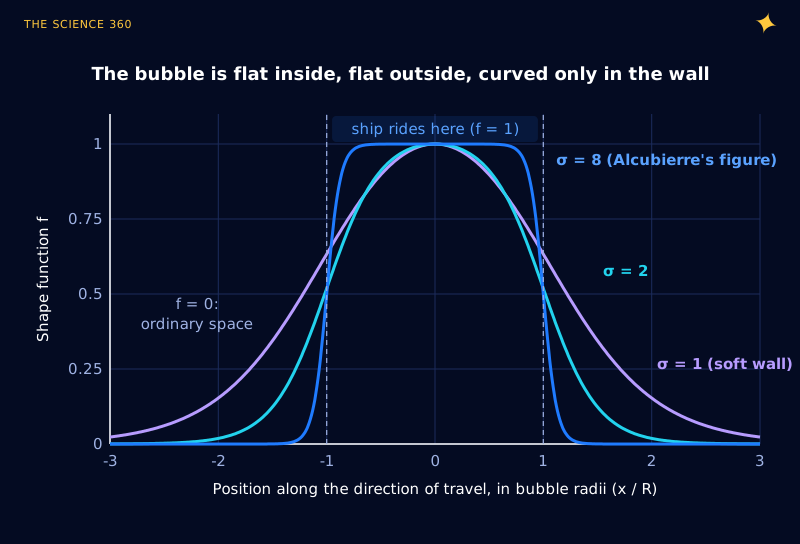
Alcubierre wrote spacetime in the way numerical relativists do: slices of space at each moment, with a "shift" that says how each slice is slid relative to the next. His slices are perfectly flat. All the curvature sits in the shift, which drags a region of space along at speed . The metric is short enough to write in one line (units where ):
Here is distance from the centre of the bubble, is the bubble radius and sets how sharp the wall is. Where the space is carried along with the ship. Where it is ordinary empty space. The ship floats at rest inside its pocket, in free fall, feeling no acceleration at all, while the pocket moves.
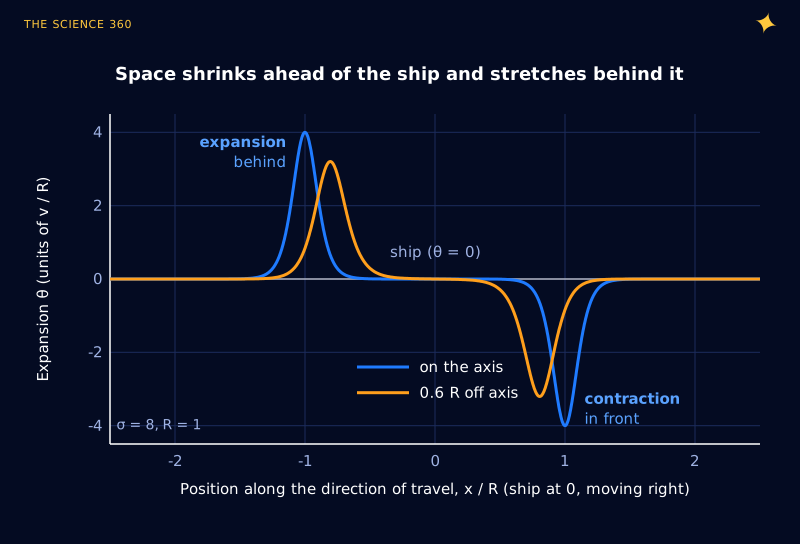
What does the dragging look like? Alcubierre computed the expansion of little volumes of space as seen by observers who stay put in each slice, and got , where is distance ahead of the bubble centre. Ahead of the ship is negative and space contracts. Behind, it is positive and space expands. That is the picture on every warp drive explainer, and it falls straight out of the formula.
Does a warp drive break the speed of light?
Not in the sense relativity forbids. Light emitted inside the bubble still outruns the ship. The ship's path through spacetime is always timelike, inside its own light cone. What moves faster than light is the bubble, measured by distant observers in flat space. Relativity places no speed limit on how fast the geometry of space can change; the expansion of the universe already carries galaxies away from us faster than light, which is why the observable universe is 93 billion light years across rather than 27.6.
There is also no time dilation for the crew. Alcubierre showed that proper time on board equals coordinate time outside, because the ship is in free fall at the centre of flat space. Compare that with ordinary near-light travel, where clocks on board fall behind (see our twin paradox explainer). The crew of a warp ship and the people they left behind would agree on how long the trip took.
Why does warp drive need negative energy?
Einstein's equations run both ways. Usually you give them matter and they tell you the curvature. Alcubierre did the opposite: he chose the curvature he wanted and asked what matter would produce it. For observers at rest in each slice, the answer is his equation 19:
Units ; is the distance from the line of travel.
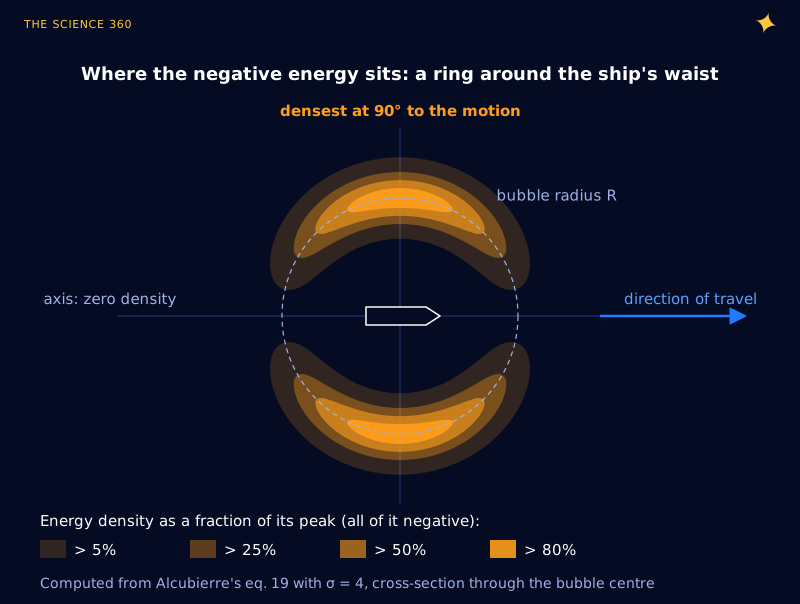
Every factor in that expression is a square, so it is never positive. Wherever there is curvature, the energy density is negative. That violates the weak energy condition, the assumption that every observer sees non-negative energy density, which ordinary matter and light both obey. The factor also says where the exotic stuff lives: none on the line of travel, the most around the bubble's waist. Figure 3 shows the shape.
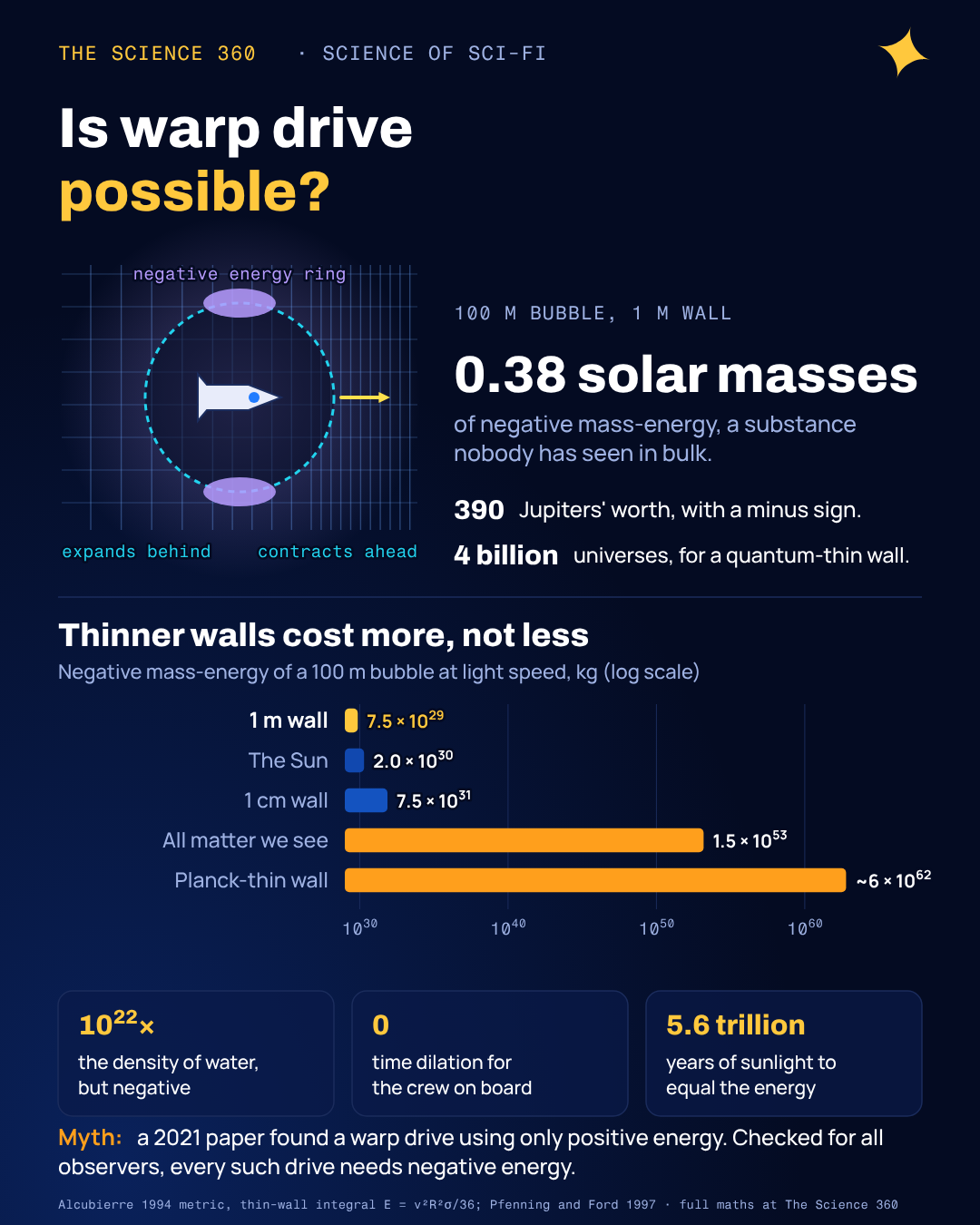
How negative? Put the formula into SI units by multiplying by c⁴/G, and pick a ship-sized bubble.
Peak energy density for R = 100 m, a 1 m wall (σ = 2 m⁻¹), v = c
At the wall, , and at the waist .
As a mass density, , about 1022 times the density of water, with a minus sign.
That is the density you would need through a wall a metre thick wrapped around a 100 m ship. Note that it does not depend on R: a bigger bubble needs the same density over more volume.
Where does “more energy than the universe” come from?
Not from Alcubierre. His paper gives no total at all. The famous number comes from Michael Pfenning and Larry Ford in 1997. The only known source of negative energy is quantum field theory (the Casimir effect between metal plates is the textbook example), and quantum fields obey "quantum inequalities" that limit how much negative energy you can pile up and for how long. Pfenning and Ford applied those limits and found the bubble wall could be only a few hundred Planck lengths thick, around 10⁻³³ m. Then they integrated.
The integral is worth doing yourself, because it shows the trick. Integrating Alcubierre's over all of space, Pfenning and Ford get . For a thin wall, is only large near , where it is .
Total energy, tanh wall, thin-wall limit
That is a length, in units.
R = 100 m, σ = 2 m⁻¹ (wall about 1 m), v = c
Convert with :
That is 0.38 solar masses (Sun: 1.988 × 1030 kg), about 390 Jupiters. As energy, , which is what the Sun radiates in 5.6 trillion years.
Pfenning and Ford, using a simpler box-shaped wall, quote "on the order of a quarter of a solar mass" for the same 1 m case, which agrees with this within the factor that wall shape makes. The key feature is E ∝ R²/Δ: the energy scales inversely with wall thickness Δ. Squeeze the wall down to their quantum-inequality limit and you get their headline, about 6 × 10⁶² kg, which is roughly four billion times the 1.5 × 10⁵³ kg of ordinary matter in the observable universe. Pfenning and Ford wrote "roughly ten orders of magnitude," comparing to a count of galaxies; either way the point stands.
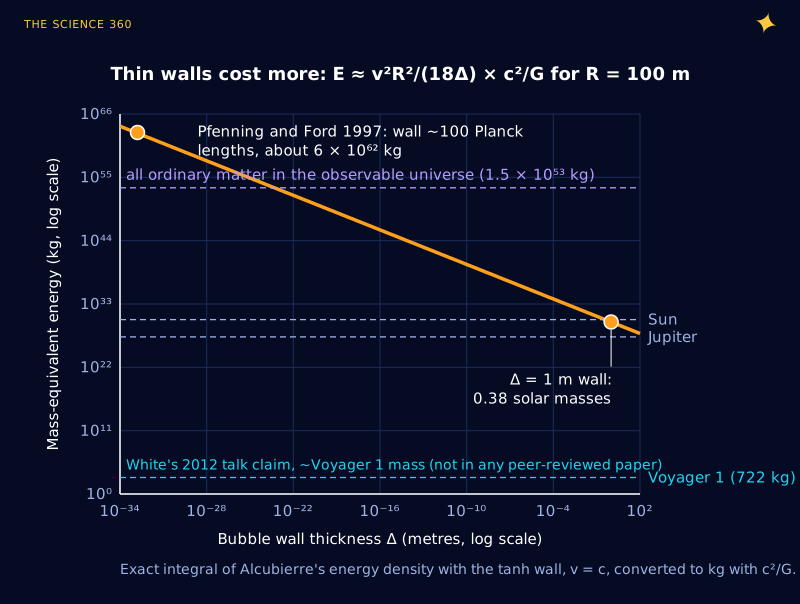
So the honest version of the famous claim is: if negative energy comes from quantum fields obeying the known inequalities, a ship-sized bubble needs billions of universes' worth of it. If you are allowed to break those inequalities and use a metre-thick wall, it needs a third of a Sun. Either way it is negative mass-energy, a substance nobody has ever seen in bulk. A third of a solar mass of anything is not an engineering target; compare the energy in one gram of ordinary matter, about 9 × 10¹³ J.
Did NASA really cut the energy to the mass of Voyager?
This is the claim that made "NASA is working on warp drive" a headline in 2012. Harold "Sonny" White at NASA Johnson presented work at the 100 Year Starship Symposium arguing that a thicker, doughnut-shaped bubble, plus oscillating the warp intensity, would lower the requirement from around the mass of Jupiter to around the mass of the Voyager 1 probe.
The written paper behind the talk, "Warp Field Mechanics 101" (NASA NTRS, 2011), shows that thicker walls lower the peak density and says the total energy falls too, but it gives no figure in kilograms for a working bubble. It describes Voyager 1 as "a small 0.722 mT spacecraft" only in its introduction, as the benchmark for how slow conventional travel is. White himself called the oscillation saving "an interesting conjecture." The thicker-wall part matches Figure 4: making bigger does help. But at you would need around 10²⁷ m to reach 700 kg on the tanh curve, a wall larger than the observable universe, so the claimed saving has to come from a geometry nobody has published in detail.
Whatever the exact figure, the negative-energy requirement does not go away in any version of White's work. It only gets smaller.
Is there a warp drive without negative energy?
In 2021 Erik Lentz, then at Göttingen, published "Breaking the warp barrier" in Classical and Quantum Gravity. He claimed a new family of soliton solutions that move faster than light and are sourced only by positive energy, possibly a conducting plasma with electromagnetic fields. That is where most of the "warp drive possible after all" headlines come from. Even on its own terms the bill was enormous: Lentz estimated a 100 m bubble with a 1 m shell needs a few tenths of a solar mass, the same ballpark as the Alcubierre calculation above.
The claim has not survived scrutiny. The cleanest result is Santiago, Schuster and Visser, Physical Review D 105, 064038 (2022), "Generic warp drives violate the null energy condition." Their argument: earlier positive-energy claims only checked the energy density seen by one family of observers. Check all observers, and any physically reasonable warp drive of this broad class violates the null energy condition, which implies the weak, strong and dominant conditions fail too. Then in November 2025 Bill Celmaster and Steve Rubin posted a preprint that computes the stress-energy of Lentz's own geometry and finds regions of negative energy density, plus errors in the original derivation. That preprint had not been through peer review when this was written, but it points the same way as the published theorem.
What does exist is a positive-energy warp drive that is slower than light. Fuchs and colleagues, Classical and Quantum Gravity 41, 095013 (2024), built a constant-velocity solution from a shell of ordinary matter with an Alcubierre-like shift inside, satisfying all the energy conditions. It is real progress in the mathematics, and it is also, physically, a massive moving shell with a comfortable interior. It does not go faster than light, and nobody has shown how to accelerate it.
The problems that remain even if negative energy existed
Suppose you had a tank of negative energy. The literature still finds further problems, and none of them is small.
You cannot steer it from inside. Once the bubble is faster than light, the front wall is outside the future light cone of anyone inside the ship. No signal from the bridge can reach it, so the crew cannot create, shape or switch off the part of the bubble ahead of them. Sergei Krasnikov showed in 1998 that, under reasonable assumptions, a traveller cannot speed up their own arrival at a destination in this way; the exotic matter along the route would have to be laid down in advance, by something moving no faster than light.
The horizon makes it unstable. A faster-than-light bubble has horizons at its front and back, rather like a black hole's (for the original, see what happens at a black hole horizon). Finazzi, Liberati and Barceló, Physical Review D 79, 124017 (2009), computed how quantum fields behave in a bubble that starts from flat space and goes superluminal. The renormalised stress-energy grows exponentially at the front wall, and the crew would see a thermal flux of Hawking-like particles. Their conclusion: warp geometries are unstable to semiclassical back-reaction.
It collects everything in its path. McMonigal, Lewis and O'Byrne, Physical Review D 85, 064024 (2012), traced particles that meet a moving bubble. Particles heading forward get "time locked" in the wall with enormous energies, and accelerating or decelerating the bubble kicks particles inside it.
So, is warp drive possible?
My answer: not as anything you could build, and probably not even in principle. The honest framing is that general relativity allows warp geometries the way it allows wormholes and time machines: as solutions that need a kind of matter with negative energy that has never been seen outside tiny quantum effects. Every attempt to find a faster-than-light version that avoids negative energy has, so far, been shown to sneak it back in. The work is still worth doing: if faster-than-light travel is impossible, warp metrics are the cleanest way to find out exactly why. Meanwhile Voyager 1, our fastest interstellar traveller, is still short of one light day from Earth after 49 years.
FAQ
Is warp drive possible?
Not with any known physics. Miguel Alcubierre's 1994 warp metric is a valid solution of Einstein's equations, but it needs regions of negative energy density, which no known material provides in bulk. Later proofs show that every warp bubble of this general type needs some negative energy, and a faster-than-light bubble also runs into horizon and instability problems.
How much energy does the Alcubierre drive need?
It depends strongly on how thin the bubble wall is. For a 100 metre bubble at light speed with a 1 metre wall, integrating Alcubierre's formula gives about 7.5 × 10²⁹ kg of negative mass-energy, roughly 0.38 solar masses. If the wall must be only about 100 Planck lengths thick, as Pfenning and Ford argued in 1997, the figure rises to about 6 × 10⁶² kg.
Did NASA reduce the warp drive energy to the mass of Voyager?
Harold White of NASA Johnson said in a 2012 conference talk that changing the bubble shape and oscillating it could cut the requirement to roughly the mass of Voyager 1, about 700 kg. His written 2011 paper gives no such number in kilograms, the idea was never published in a peer-reviewed journal, and it does not remove the need for negative energy.
Did Erik Lentz find a warp drive without negative energy?
Lentz claimed in 2021 that his soliton solutions needed only positive energy. A 2022 Physical Review D paper by Santiago, Schuster and Visser showed that generic warp drives must violate the null energy condition for some observers, and a 2025 preprint by Celmaster and Rubin reports negative energy density inside Lentz's geometry itself. The claim is not accepted.
Does a warp drive break the speed of light?
Locally, no. The ship sits in flat space inside the bubble and never outruns a light beam next to it. Space itself is reshaped so that the bubble as a whole covers distance faster than light would outside it, much as distant galaxies recede faster than light because of cosmic expansion.
Related on The Science 360
Sources
- M. Alcubierre, "The warp drive: hyper-fast travel within general relativity", Classical and Quantum Gravity 11, L73 (1994), shape function (eq. 6), expansion (eq. 12), energy density (eq. 19): arXiv:gr-qc/0009013
- M. J. Pfenning and L. H. Ford, "The unphysical nature of 'warp drive'", Classical and Quantum Gravity 14, 1743 (1997), total energy integral, wall of a few hundred Planck lengths, 6.2 × 10⁶⁵ g estimate, quarter solar mass for a 1 m wall: arXiv:gr-qc/9702026
- H. White, "Warp Field Mechanics 101", NASA Technical Reports Server JSC-CN-24651 (2011): ntrs.nasa.gov/citations/20110015936
- CBS News / Space.com, "Scientists say 'warp drive' spaceships could be feasible" (2012), White's Voyager comparison and "interesting conjecture" quote: cbsnews.com
- E. W. Lentz, "Breaking the warp barrier: hyper-fast solitons in Einstein-Maxwell-plasma theory", Classical and Quantum Gravity 38, 075015 (2021), energy estimate of a few tenths of a solar mass: arXiv:2006.07125
- J. Santiago, S. Schuster and M. Visser, "Generic warp drives violate the null energy condition", Physical Review D 105, 064038 (2022): arXiv:2105.03079
- B. Celmaster and S. Rubin, "Violations of the weak energy condition for Lentz warp drives" (preprint, November 2025): arXiv:2511.18251
- J. Fuchs et al., "Constant velocity physical warp drive solution", Classical and Quantum Gravity 41, 095013 (2024): arXiv:2405.02709
- S. Finazzi, S. Liberati and C. Barceló, "Semiclassical instability of dynamical warp drives", Physical Review D 79, 124017 (2009): arXiv:0904.0141
- B. McMonigal, G. F. Lewis and P. O'Byrne, "The Alcubierre warp drive: on the matter of matter", Physical Review D 85, 064024 (2012): arXiv:1202.5708
- S. V. Krasnikov, "Hyperfast interstellar travel in general relativity", Physical Review D 57, 4760 (1998): arXiv:gr-qc/9511068
- NASA NSSDCA planetary fact sheets, Sun (mass 1,988,400 × 10²⁴ kg, luminosity 382.8 × 10²⁴ W) and Jupiter (1,898.13 × 10²⁴ kg): nssdc.gsfc.nasa.gov
- Wikipedia, "Observable universe" (ordinary matter about 1.5 × 10⁵³ kg): en.wikipedia.org
Method note: Figures 1 to 4 are computed directly from Alcubierre's equations 6, 12 and 19. Total energies use Pfenning and Ford's integral with the exact tanh wall and ; for a thin wall the result is in geometric units. The "1 m wall" corresponds to .
Header image: NASA & ESA (image GSFC_20171208_Archive_e000791), regraded for this article.