What was the Moon phase on a given date?
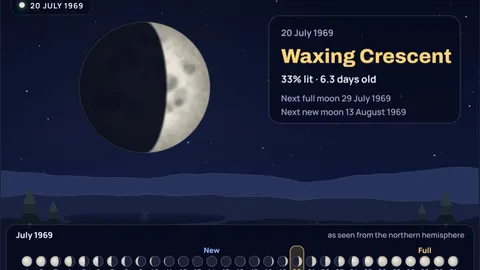
Enter the date and the calculator gives the phase, how much of the Moon was lit and how many days it was past new moon. For example, on 20 July 1969, when Apollo 11 landed, the Moon was a waxing crescent, 33% lit and 6.3 days old. On 1 January 2000 it was a waning crescent, 27% lit. The previous and next new and full moons are listed with their times in your time zone.
Phase times come from Jean Meeus's Astronomical Algorithms, the standard reference for this kind of calculation, and agree with the US Naval Observatory's published times to within about a minute. The drawing shows the Moon as it looked from the northern hemisphere; switch to southern and the lit side flips. If you were born at night and want the exact picture, add the time. The companion post on birthday moons explains how to read the result, and the Moon phases simulation shows why the shape changes at all.
Key results from the calculator
- A lunar month is 29.53 days on average (new moon to new moon), but single months run from about 29.3 to 29.8 days, because the Moon's orbit is elliptical.
- A phase name covers a whole calendar day. "Full Moon" means the exact full moon happens on that date in your time zone, so the same instant can fall on different dates in London and in India.
- The Moon looks full for about three nights. A day either side of full it is still about 98% lit, and two days either side about 94%.
- Moon on famous dates: Apollo 11 landing 33%, India's independence at midnight 4%, Chandrayaan-3's landing 41%, the 2023 super blue moon 100%.
Six dates to try
Each section gives the numbers the calculator shows for that date. Times are in the zone shown in brackets.
The Moon when Apollo 11 landed (20 July 1969)
20:17 UTCAt the moment of landing the Moon was a waxing crescent, 33% lit and 6.3 days past the new moon of 14 July 1969. That was planned: NASA wanted the Sun low over the landing site so long shadows would show boulders and craters, and that happens a few days after the Moon's sunrise at the site.
From Earth the landing site in the Sea of Tranquillity was just inside the lit part, close to the terminator. The next full moon was 29 July 1969, after the crew were home.
The Moon at India's independence (midnight, 15 August 1947)
00:00 ISTAt the stroke of midnight the Moon was a thin waning crescent, 4% lit and 27.6 days old. It was below the horizon at midnight; it rose in the east a little before dawn. The new moon followed on 16 August 1947 at 16:42 IST.
So the night of the "tryst with destiny" speech was a dark, moonless one. For any other family date, set the zone to India and type the date.
The first Moon of the year 2000
00:00 UTCAt midnight on 1 January 2000 the Moon was a waning crescent, 27% lit, 24.1 days into its cycle. The new moon came on 6 January 2000 at 18:13 UTC, and the first full moon of the millennium on 21 January 2000, which was also a total lunar eclipse.
Astronomers count lunations from the new moon of 6 January 2000 in Meeus's system, which is why it makes a handy reference point. The lunar eclipse post explains why that full moon turned red.
The Moon when Chandrayaan-3 landed (23 August 2023)
18:04 ISTWhen Vikram touched down near the lunar south pole, the Moon seen from India was a waxing crescent, 41% lit and 7.1 days old. First quarter followed the next morning.
The timing was chosen for the same reason as Apollo's: the lander needed the start of a lunar day at its site, giving about two weeks of sunlight for its solar panels before the long lunar night.
The super blue moon of 31 August 2023
Full moon, UTCThe second full moon of August 2023 came at 01:35 UTC on 31 August, which made it a "blue moon" in the popular sense: the second full moon in one calendar month. The first was on 1 August 2023 at 18:31 UTC.
It was also close to perigee, the nearest point of the Moon's orbit, so it looked slightly larger and brighter than an average full moon. Whether a full moon counts as "blue" depends on your time zone, since the dates of the two full moons can shift across midnight.
The new moon of the 2 August 2027 solar eclipse
New moon, UTCA solar eclipse can only happen at new moon, when the Moon passes between Earth and the Sun. The calculator gives the new moon of 2 August 2027 at 10:04 UTC, minutes from the eclipse's greatest point over North Africa.
Most new moons miss the Sun because the Moon's orbit is tilted about 5° to Earth's, so it passes above or below. This one lines up, and gives one of the longest totalities of the century. The 2027 eclipse post explains why it lasts so long.
New and full moons in 2027 (UTC and India time)
| New moon (UTC) | New moon (IST) | Full moon (UTC) | Full moon (IST) |
|---|---|---|---|
| 7 January 2027, 20:24 | 8 January 2027, 01:54 | 22 January 2027, 12:17 | 22 January 2027, 17:47 |
| 6 February 2027, 15:56 | 6 February 2027, 21:26 | 20 February 2027, 23:23 | 21 February 2027, 04:53 |
| 8 March 2027, 09:29 | 8 March 2027, 14:59 | 22 March 2027, 10:43 | 22 March 2027, 16:13 |
| 6 April 2027, 23:51 | 7 April 2027, 05:21 | 20 April 2027, 22:27 | 21 April 2027, 03:57 |
| 6 May 2027, 10:58 | 6 May 2027, 16:28 | 20 May 2027, 10:58 | 20 May 2027, 16:28 |
| 4 June 2027, 19:40 | 5 June 2027, 01:10 | 19 June 2027, 00:44 | 19 June 2027, 06:14 |
| 4 July 2027, 03:01 | 4 July 2027, 08:31 | 18 July 2027, 15:44 | 18 July 2027, 21:14 |
| 2 August 2027, 10:04 | 2 August 2027, 15:34 | 17 August 2027, 07:28 | 17 August 2027, 12:58 |
| 31 August 2027, 17:40 | 31 August 2027, 23:10 | 15 September 2027, 23:03 | 16 September 2027, 04:33 |
| 30 September 2027, 02:36 | 30 September 2027, 08:06 | 15 October 2027, 13:46 | 15 October 2027, 19:16 |
| 29 October 2027, 13:36 | 29 October 2027, 19:06 | 14 November 2027, 03:25 | 14 November 2027, 08:55 |
| 28 November 2027, 03:24 | 28 November 2027, 08:54 | 13 December 2027, 16:08 | 13 December 2027, 21:38 |
| 27 December 2027, 20:12 | 28 December 2027, 01:42 |
Computed with Meeus, Astronomical Algorithms, chapter 49, converted to Universal Time with NASA's Delta T formula. IST is UTC + 5:30, which is why some phases fall on the next date in India.
How the calculator works
The Moon goes from new to full and back in 29.530589 days on average. Jean Meeus's method starts from that average to find the "mean" new moon nearest your date, then adds about 40 small corrections for the pull of the Sun, the shape of the Moon's orbit and the planets. Without them a predicted full moon can be wrong by up to about 14 hours; with them the times match the US Naval Observatory to within a minute or two between 1900 and 2100.
The result is in dynamical time, the smooth clock of planetary motion, so the calculator subtracts Delta T, the slowly growing gap between that clock and the time on your watch (about 64 seconds in 2000), using NASA's published polynomial.
How much of the disc is lit depends on the phase angle i, the Sun to Moon to Earth angle. The calculator computes the Moon's elongation from the Sun with the main terms of the lunar theory (Meeus, chapter 48) and the lit fraction is (1 + cos i) ÷ 2.
The phase name follows the US Naval Observatory convention: if an exact new moon, first quarter, full moon or last quarter falls on your calendar date in your time zone, that is the name; otherwise it is a waxing or waning crescent or gibbous. The month strip shows each day at local noon.
What the model leaves out
- The tilt of the crescent: the drawing always puts the lit side to the right (waxing) or left (waning). In the real sky the crescent tilts with your latitude and the time of night; near the equator a crescent can look like a smile.
- Whether the Moon was up: the calculator gives the phase, not the moonrise. A full moon is up all night, but a crescent may have set before you looked.
- Libration and the Moon's distance: the face drawn is a fixed map. In reality the Moon rocks slightly and its apparent size changes by about 14% between perigee and apogee.
- Before 1900 and after 2100: the formulas still work, but Delta T is uncertain further back, so the date picker is limited to 1900 to 2100.
Common misconceptions
"The phases are caused by Earth's shadow." Earth's shadow only falls on the Moon during a lunar eclipse. The phases are just how much of the Moon's sunlit half faces us. The simulation shows it from above.
"A half moon is a quarter moon by mistake." Both names are right: at first and last quarter the Moon is a quarter of the way through its orbit and we see half its disc lit.
"There is a full moon on the same date everywhere." The exact full moon is one instant. In time zones on either side of midnight it falls on different dates.
Frequently asked questions
What was the moon phase on my birthday?
Enter your date of birth and your time zone at the top of this page. The calculator shows the phase name, how much of the Moon was lit and its age in days. Add your birth time if you know it for the exact illumination at that moment.
How accurate is this moon phase calculator?
Phase times use Jean Meeus's Astronomical Algorithms and agree with the US Naval Observatory's published times to within about a minute for 1900 to 2100. The lit percentage agrees with the Observatory's daily figures to within 1%.
How long does a full moon last?
The exact full moon is a single instant, but the Moon looks full for about three nights. A day either side of full it is still about 98% lit, which the eye cannot tell from 100%.
Why is the moon phase different in another country on the same date?
The Moon is in the same phase for everyone at the same instant, but the calendar date differs between time zones. A full moon at 20:00 UTC happens at 01:30 the next day in India, so India lists it a day later.
How many days is the moon cycle?
29.53 days on average from one new moon to the next, called the synodic month. Individual months vary from about 29.3 to 29.8 days because the Moon's orbit is elliptical.
Keep learning
What Was the Moon Phase on the Day You Were Born?
Find the Moon phase on your birthday, how much of it was lit and how old it was, and learn to check the answer yourself with two short calculations.
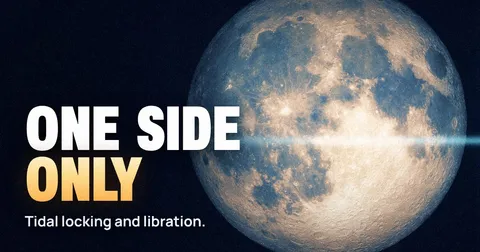
Why We Only See One Side of the Moon (and It's 59%)
The Moon is tidally locked, spinning once per 27.3-day orbit. The torque that locked it, why we see 59% of it, and why it drifts 3.8 cm a year.
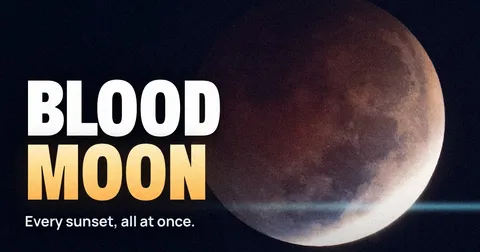
Why Is the Moon Red During a Lunar Eclipse? The Real Physics
Earth's air bends sunlight 1.1° into its shadow and strips the blue on the way. A worked model of the red Moon, the blue rim and why volcanoes darken it.
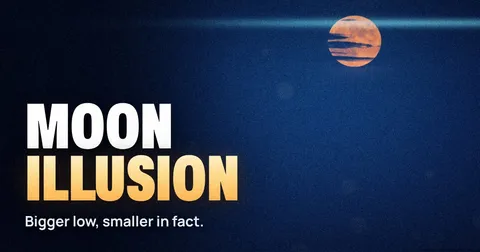
Moon Illusion Explained: Why the Horizon Moon Looks Big
The horizon Moon looks huge, yet it's 1.7% narrower and 16% shorter than overhead. We measure it, then weigh the theories for why your brain inflates it.