How do you calculate centripetal force?
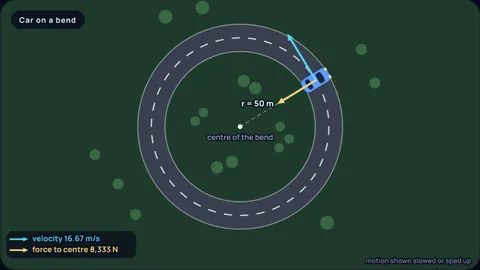
Multiply the mass by the speed squared and divide by the radius: F = mv² ÷ r. A 1,500 kg car taking a 50 m bend at 60 km/h (16.67 m/s) needs 8,333 N pointing to the centre of the bend, an acceleration of 5.556 m/s² or 0.567 g. The calculator takes the speed as m/s, km/h, mph, rpm, rad/s or seconds per turn, and shows the arrows on the case you pick.
Centripetal means "centre seeking". It is not a new kind of force: it is whatever real force pulls the object inward, such as tyre grip, a drum wall, a string or gravity. Why you feel thrown outward on a bend is explained in Why do you feel pushed outward on a bend?.
Key results
- Formula: F = mv² ÷ r = mω²r, and the acceleration is a = v² ÷ r = ω²r. Double the speed and the force goes up four times.
- Converting speed: ω = v ÷ r; rpm × 2π ÷ 60 gives ω in rad/s; one turn takes T = 2πr ÷ v.
- In g: divide the acceleration by 9.80665 m/s², the standard acceleration of gravity.
- Vertical circles: at the top the slowest speed is √(gr). For a 1 m swing that is 3.132 m/s.
Six worked examples
Each button loads the example into the calculator.
A car on a 50 m bend at 60 km/h: 0.567 g
speed in km/h60 km/h is 16.67 m/s. a = 16.67² ÷ 50 = 5.556 m/s², which is 0.567 g. For a 1,500 kg car the force is 8,333 N, all of it supplied by the grip of the tyres on a flat road.
At 90 km/h on the same bend the force would be (90 ÷ 60)² = 2.25 times as large, which is why speed limits drop before sharp bends.
Related reading: Why do you feel pushed outward on a bend?
A washing machine drum at 1200 rpm: 422.7 g
speed in rpmA 525 mm drum (radius 26.25 cm, from a Haier 1200 rpm machine's specification) turning at 1200 rpm has ω = 1200 × 2π ÷ 60 = 125.7 rad/s. The wall moves at 32.99 m/s and the acceleration is ω²r = 4,145 m/s², 422.7 g.
A 100 g wet sock is pressed against the wall with 414.5 N, the weight of about 42.3 kg. The water in it has nothing holding it on a circle once it reaches a hole, so it leaves in a straight line.
The ISS: 0.88 g towards Earth
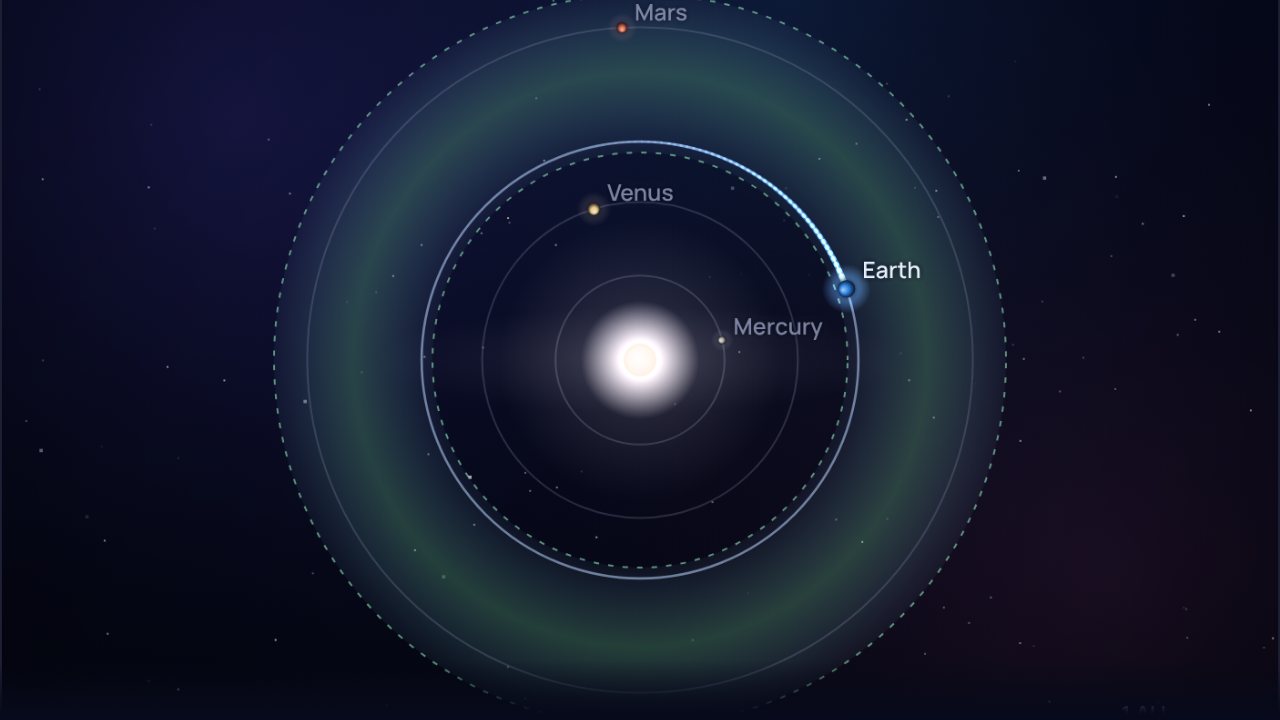
orbitOn 13 November 2026 JPL Horizons puts the ISS about 6,797 km from Earth's centre, 418 km above the equator, moving at 7.658 km/s. a = v² ÷ r = 8.629 m/s², 0.88 g, and one orbit takes 1.55 h.
Gravity at that distance, GM ÷ r², is 8.629 m/s², the same number: gravity alone supplies the centripetal force. For the station's 419,725 kg (NASA) that is 3.622 MN.
Related reading: Why astronauts float
A bucket swung overhead: at least 3.132 m/s
vertical circle, minimum speedAt the top of the swing the water stays in only if the bucket needs at least g of centripetal acceleration, so that gravity alone cannot pull the water out of the circle. v²/r ≥ g gives v ≥ √(gr). On a 1 m swing that is 3.132 m/s, or one turn every 2.01 s.
At that speed the bucket pushes on the water with almost nothing at the top, and with 98.08 N at the bottom for 5 kg: twice its weight.
A loop of 10 m radius at 14 m/s: 2 g
vertical circlea = 14² ÷ 10 = 19.6 m/s², 2 g. At the top, gravity provides 1 g of that and the seat pushes down on the rider with the other 0.999 g, so a rider feels about their normal weight, upside down. The slowest speed that would keep them in the seat at the top is √(9.80665 × 10) = 9.903 m/s.
A 200 g ball on a 50 cm string, once a second: 3.948 N
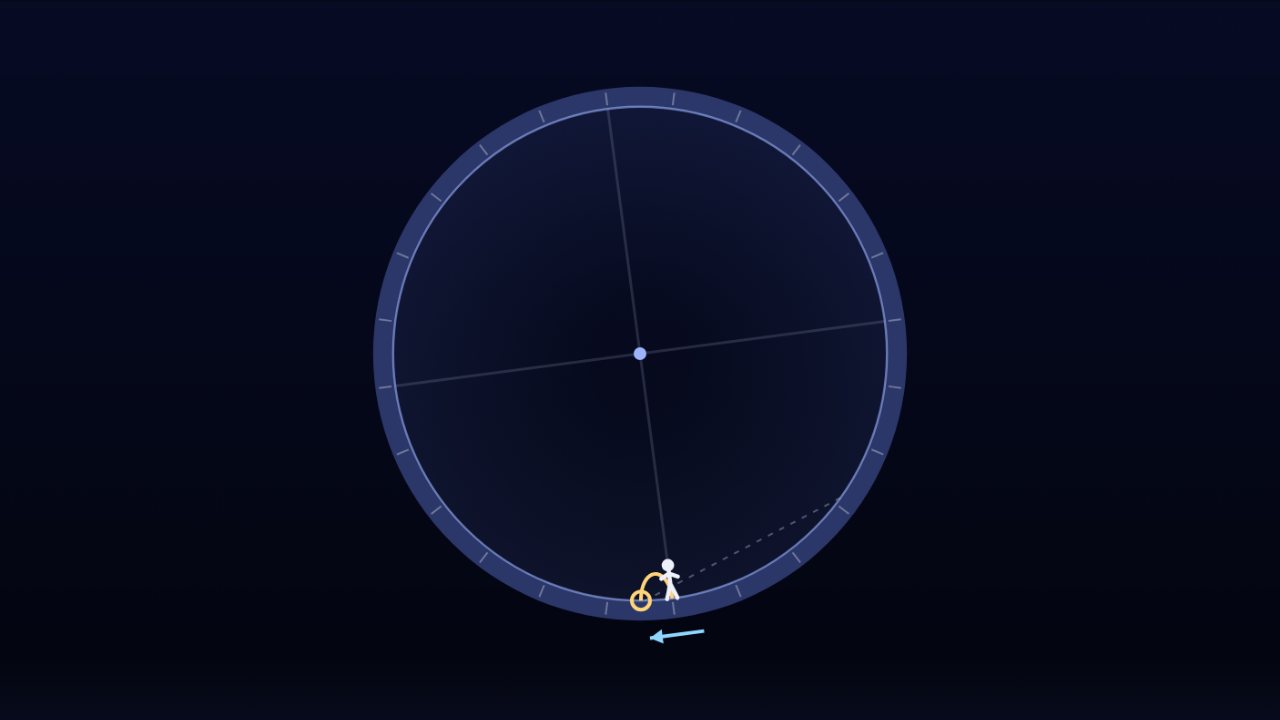
speed as rpm60 rpm is one turn a second, ω = 2π rad/s, so the ball moves at 3.142 m/s. The string must pull with m ω² r = 0.2 × (2π)² × 0.5 = 3.948 N. Let go and the ball flies off along the tangent, not straight outward.
Centripetal acceleration at a glance
| Case | Radius | Speed | Acceleration | In g |
|---|---|---|---|---|
| Car, 60 km/h bend | 50 m | 16.67 m/s | 5.556 m/s² | 0.567 g |
| Washing machine, 1200 rpm | 26.25 cm | 32.99 m/s | 4,145 m/s² | 422.7 g |
| ISS orbit | 6,797 km | 7.658 km/s | 8.629 m/s² | 0.88 g |
| Bucket at minimum speed | 1 m | 3.132 m/s | 9.809 m/s² | 1 g |
| Coaster loop | 10 m | 14 m/s | 19.6 m/s² | 2 g |
| Ball on a string, 60 rpm | 50 cm | 3.142 m/s | 19.74 m/s² | 2.01 g |
The drum size is from a Haier HW120-BP12357S8 specification (525 mm drum, 1200 rpm). The ISS distance and speed are hourly JPL Horizons values for 13 November 2026, averaged; its orbit is slightly oval, so both vary a little round each orbit. The car, bucket, loop and ball are example inputs.
How the calculator works
Mass, radius and speed are converted to kilograms, metres and metres per second. Speed given as ω uses v = ωr, rpm uses ω = rpm × 2π ÷ 60, and a period uses v = 2πr ÷ T.
Then a = v² ÷ r, F = ma, and the acceleration in g is a ÷ 9.80665 m/s² (the standard value, NIST).
For a vertical circle the support pushes with m(a − g) at the top and m(a + g) at the bottom, and the slowest speed at the top is √(gr). For a flat bend, friction must supply all of F, which needs a grip of at least a ÷ g times the weight.
What the model leaves out
- Banked bends: on a tilted road part of the inward force comes from the road surface itself, so less friction is needed.
- Changing speed: a loop car slows down as it climbs, so the speed at the top is lower than at the bottom. Enter the speed at the point you care about.
- Oval orbits: the ISS orbit is close to a circle; for strongly elliptical orbits v²/r does not apply with a single r.
Common misconceptions
"Centrifugal force throws you outward." From the ground, nothing pushes you outward: you carry on in a straight line while the car turns under you.
"Centripetal force is a separate force." It is the name for the inward part of real forces, such as friction, tension, a normal force or gravity.
"Things fly straight out when released." They leave along the tangent, at right angles to the radius.
Frequently asked questions
What is the formula for centripetal force?
F = mv² ÷ r, or F = mω²r with ω in radians per second. m is the mass in kg, v the speed in m/s and r the radius in m.
How do I convert rpm to centripetal acceleration?
Turn rpm into ω with ω = rpm × 2π ÷ 60, then a = ω²r. A 1200 rpm drum of 26.25 cm radius gives 125.7 rad/s and about 4,145 m/s², or 423 g.
How do I get the g-force?
Divide the centripetal acceleration by 9.80665 m/s². A car on a 50 m bend at 60 km/h pulls 0.567 g.
What is the minimum speed at the top of a vertical circle?
v = √(gr). For a bucket on a 1 m swing it is about 3.13 m/s, about one turn every two seconds.
Is centrifugal force real?
Only as an apparent force in a turning frame of reference. Seen from outside, the only real forces point inward; the outward feeling is your body trying to keep going straight.
Keep learning
Why Do You Feel Pushed Outward on a Bend?
Nothing pushes you outward on a bend: the car turns and you go straight. Centrifugal vs centripetal force, with numbers for cars, spin cycles and orbits.

Gravity is still strong at the space station. Why do astronauts float?
The station, crew and loose objects fall together. Weightlessness is about the missing support force, not gravity switching off above the atmosphere.
How Fast Must a Space Station Spin for 1 g?
A station needs about 30/√r rpm for 1 g. Why small stations feel wrong: head-to-foot gradient, Coriolis, and the radius you really need. Worked numbers.

Is There Gravity on the ISS? Yes: 89% of Earth's
Gravity at the ISS is 89% of Earth's surface value. Astronauts float because they fall 4.35 m every second and keep missing. Here are the numbers.