How do you calculate work and power?
Work is force times distance, W = F d cos θ, in joules. Power is work divided by time, P = W ÷ t, in watts. Climbing stairs, the work is your weight times the height, m g h: a 70 kg person going up 1.05 m does 721 J of work, and doing it in half a second is 1,442 W, about 1.93 hp.
One horsepower is 745.7 W, and a person can only beat it for a few seconds. How many watts people can really produce, and how the stair test measures it, is in How many watts can a human produce? The stair test.
Key results
- Work: W = F d cos θ. Only the part of the force along the motion counts; at 90° no work is done.
- Climbing: W = m g h with g = 9.80665 m/s². 70 kg up 10.5 m of stairs is 7,208 J whether you walk or run.
- Power: P = W ÷ t. That climb is 160 W in 45 s and 481 W in 15 s.
- Horsepower: 1 hp = 745.7 W; 1 metric horsepower (PS) = 735.5 W, the power to lift 75 kg by 1 m each second.
Six worked examples
Each button loads the example into the calculator. The masses and times are made-up examples, not measurements.
Stair sprint test: 1,442 W
short burstIn the Margaria-Kalamen test you sprint up stairs three at a time and are timed from step 3 to step 9, six steps of about 17.5 cm: 1.05 m up. For 70 kg in 0.5 s, W = 70 × 9.80665 × 1.05 = 721 J and P = 721 J ÷ 0.5 s = 1,442 W, or 1.93 hp.
Walking up three floors: 160 W
steady climb60 steps of 17.5 cm is 10.5 m. Lifting 70 kg that high takes 7,208 J. Spread over 45 seconds that is 160 W, about the output a fit person can keep up for a while.
Running up the same stairs: 481 W
same work, more powerThe work is the same 7,208 J, because the height and the mass have not changed. Doing it in 15 s instead of 45 s triples the power to 481 W. That is the difference between work and power.
One metric horsepower: 75 kg up 1 m in 1 s
the unitMetric horsepower is defined as lifting 75 kg by 1 metre each second: 75 × 9.80665 × 1 ÷ 1 = 735 W. The mechanical horsepower, 550 foot-pounds per second, is a little bigger at 745.7 W.
Pushing a crate 10 m: 2,000 J
W = F dA steady 200 N push along the floor for 10 m does 200 × 10 = 2,000 J of work. Taking 20 s, the power is 100 W. Against friction, that energy ends up as heat.
Pulling at 30°: 6,495 J
W = F d cos θPull a sled with 150 N on a rope at 30° to the ground for 50 m. Only 150 × cos 30° = 130 N acts along the ground, so the work is 130 × 50 = 6,495 J, and over a minute that is 108 W.
Watts and horsepower
| Power | Watts | Horsepower (hp) | Metric hp (PS) |
|---|---|---|---|
| 100 W | 100 W | 0.134 | 0.136 |
| 250 W | 250 W | 0.335 | 0.34 |
| 500 W | 500 W | 0.671 | 0.68 |
| 746 W | 746 W | 1 | 1.01 |
| 1 kW | 1,000 W | 1.34 | 1.36 |
| 1.5 kW | 1,500 W | 2.01 | 2.04 |
| 2 kW | 2,000 W | 2.68 | 2.72 |
| 10 kW | 10,000 W | 13.4 | 13.6 |
| 100 kW | 100,000 W | 134 | 136 |
Mechanical horsepower is 550 ft·lbf/s = 745.7 W. Metric horsepower (PS) is 75 kgf·m/s = 735.5 W. Electric horsepower is exactly 746 W.
How the calculator works
Push or pull: the work is the force times the distance times the cosine of the angle between the force and the motion. A force at an angle does work only through its part along the motion.
Stair test: the height is the number of steps times the height of each. The work against gravity is m × g × h with standard gravity g = 9.80665 m/s². Pounds are turned into kilograms with 1 lb = 0.45359237 kg.
Power is the work divided by the time, shown in watts, kilowatts, horsepower and metric horsepower. The gauge uses a log scale from 10 W to 5,000 W.
What the model leaves out
- Body efficiency: the tool counts only the useful work. Muscles turn roughly a quarter of food energy into work over minutes, so the food energy burned is several times larger.
- Getting going: in a stair sprint some effort goes into speeding up and swinging the arms and legs, which the m g h formula does not count. Starting the timing after a run-up, as the test does, keeps that small.
- Changing forces: the push mode assumes a steady force in a fixed direction.
Common misconceptions
"Running up the stairs is more work than walking." The work against gravity is the same; running only raises the power.
"Holding a heavy bag still is work." In physics, no: nothing moves, so no work is done on the bag, even though your muscles tire.
"Horsepower is what one horse can do." It is a defined unit. James Watt adopted it in the late 18th century to compare steam engines with working draft horses, and the figure was fixed by agreement, not measured on one horse.
Frequently asked questions
What is the formula for work done?
W = F × d × cos θ, where F is the force in newtons, d the distance in metres and θ the angle between the force and the motion. The answer is in joules.
How do you calculate power climbing stairs?
Multiply your mass by 9.81 and by the height climbed to get the work in joules, then divide by the time in seconds. 70 kg up 1.05 m in 0.5 s is 1,442 W.
How many watts is one horsepower?
One mechanical horsepower is about 745.7 W. One metric horsepower (PS) is 735.5 W, and one electric horsepower is exactly 746 W.
What is the difference between work and power?
Work is the energy transferred, in joules. Power is how fast it is transferred, in watts, which are joules per second. Walking or running up the same stairs is the same work but different power.
How much power can a human produce?
A healthy person can produce about 1.2 hp (around 900 W) for a few seconds, and about 0.1 hp, around 75 W, indefinitely. Trained athletes reach about 2.5 hp briefly.
Keep learning
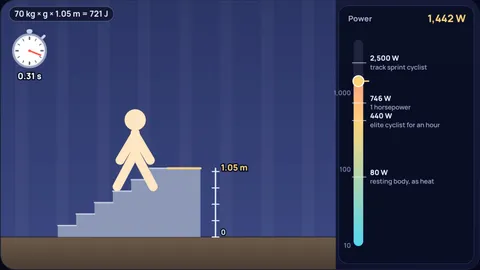
How Many Watts Can a Human Produce? The Stair Test
A sprint up six steps can top one horsepower. How the stair test turns mass, height and time into watts, and how much power people can keep up.
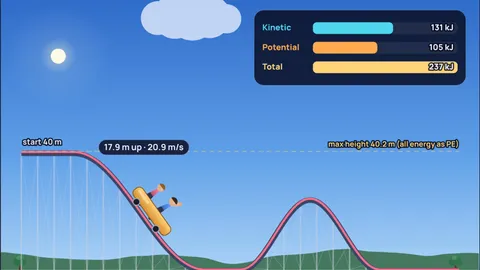
Kinetic Energy vs Potential Energy: Examples With Numbers
Kinetic and potential energy worked through with real numbers: a skater, a roller coaster, a car at 50 and 100 km/h, a runner and the Moon.
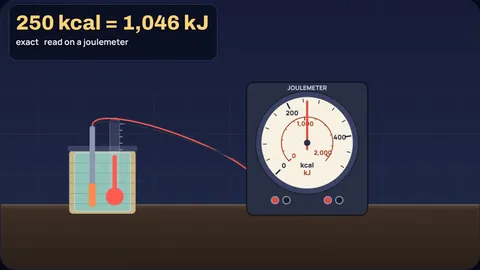
Joules, Calories and kWh: Energy Units Explained
What a joule, a calorie, a food Calorie, a kilowatt hour, an electronvolt and a Btu are, the exact factors between them, and worked conversions.