How long does light take to get from space to Earth?
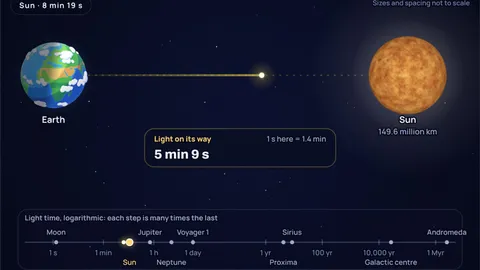
Light covers 299,792.458 km every second, so sunlight takes 8 min 19 s to reach Earth on average (from 8 min 11 s in January to 8 min 27 s in July), moonlight 1.28 seconds, and light from Mars between 3 min 2 s and 22 min 19 s. From Voyager 1, the most distant spacecraft, it now takes a whole day, and from the Andromeda Galaxy 2.48 million years. The calculator divides each distance by the speed of light and shows the working.
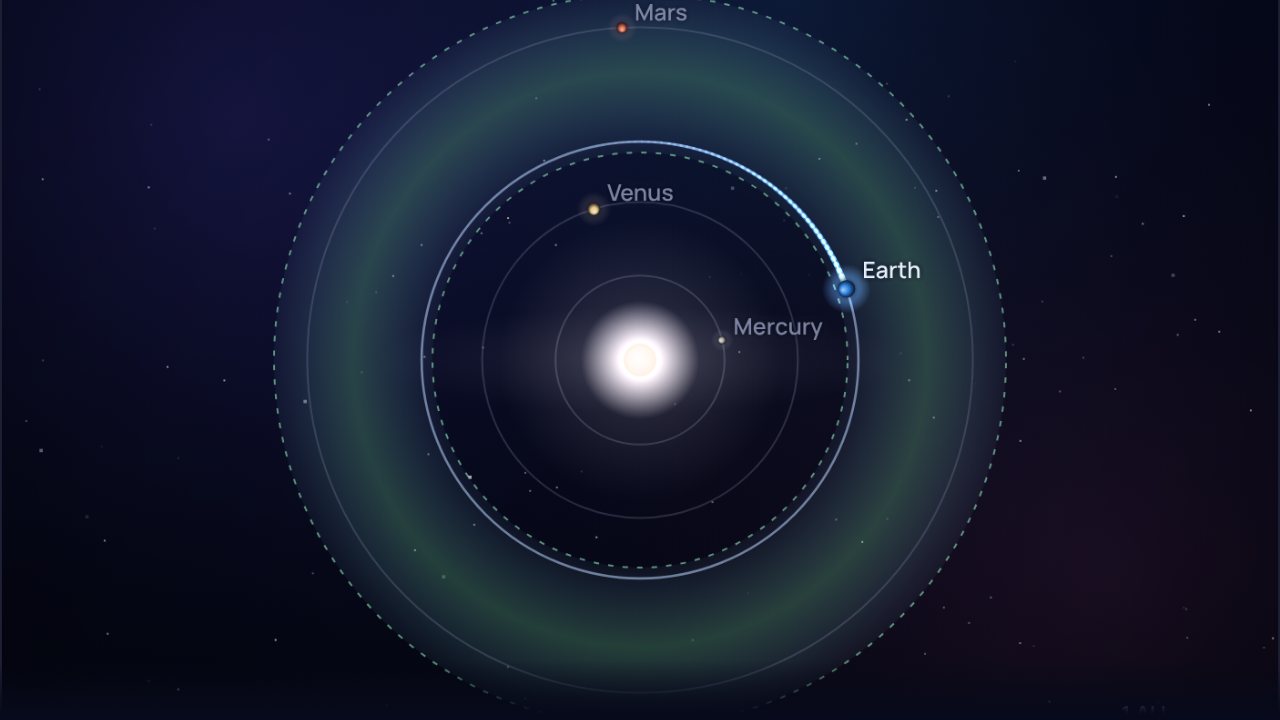
Planet distances change as Earth and the planet move round the Sun, so the calculator gives the closest, average and farthest values, plus the distance on any date from 2020 to 2040 worked out from NASA JPL orbital elements. Voyager 1's distance comes from JPL's Horizons ephemeris. For the Sun in more depth read How long does sunlight take to reach Earth?.
Key results
- Sun: 8 min 19 s at 1 au (149.6 million km). The Sun you see is always at least 8 min 11 s old.
- Moon: 1.28 seconds on average, so a radio call to the Moon and back takes about 2.56 seconds.
- Mars: 3 min 2 s at its closest and 22 min 19 s at its farthest, so nobody can steer a Mars rover in real time.
- Voyager 1: 23 h 59 min on 13 November 2026, 173.1 au away. It passes one light day from Earth on 19 November 2026, the first spacecraft to do so.
- Beyond: 4.25 years from Proxima Centauri, 8.60 years from Sirius, 26,673 years from the centre of the Milky Way and 2.48 million years from Andromeda.
Six trips at the speed of light
Each button loads the example into the calculator. Dated values are for 13 November 2026.
The Sun: 8 min 19 s
average distance, 1 auOne astronomical unit is defined as exactly 149,597,870.7 km. Divided by 299,792.458 km/s that is 499.0 seconds, or 8 min 19 s. Earth's orbit is slightly oval, so the time runs from 8 min 11 s at perihelion in early January (147.095 million km) to 8 min 27 s at aphelion in early July (152.100 million km).
The light itself is much older. The energy it carries was made in the Sun's core and took a long time to work its way out to the surface; the 8 min 19 s is only the last leg.
Related reading: How long does sunlight take to reach Earth?
The Moon: 1.28 seconds
384,400 km on averageThe Moon's average distance, centre to centre, is 384,400 km, so its light takes 1.28 seconds. The orbit is oval too: 1.21 seconds at a typical perigee and 1.35 seconds at a typical apogee.
A radio message to the Moon and its reply take about 2.56 seconds, plus the time people need to think. That is the gap you hear between Houston's questions and the Apollo astronauts' answers.
Mars: 3 min 2 s to 22 min 19 s
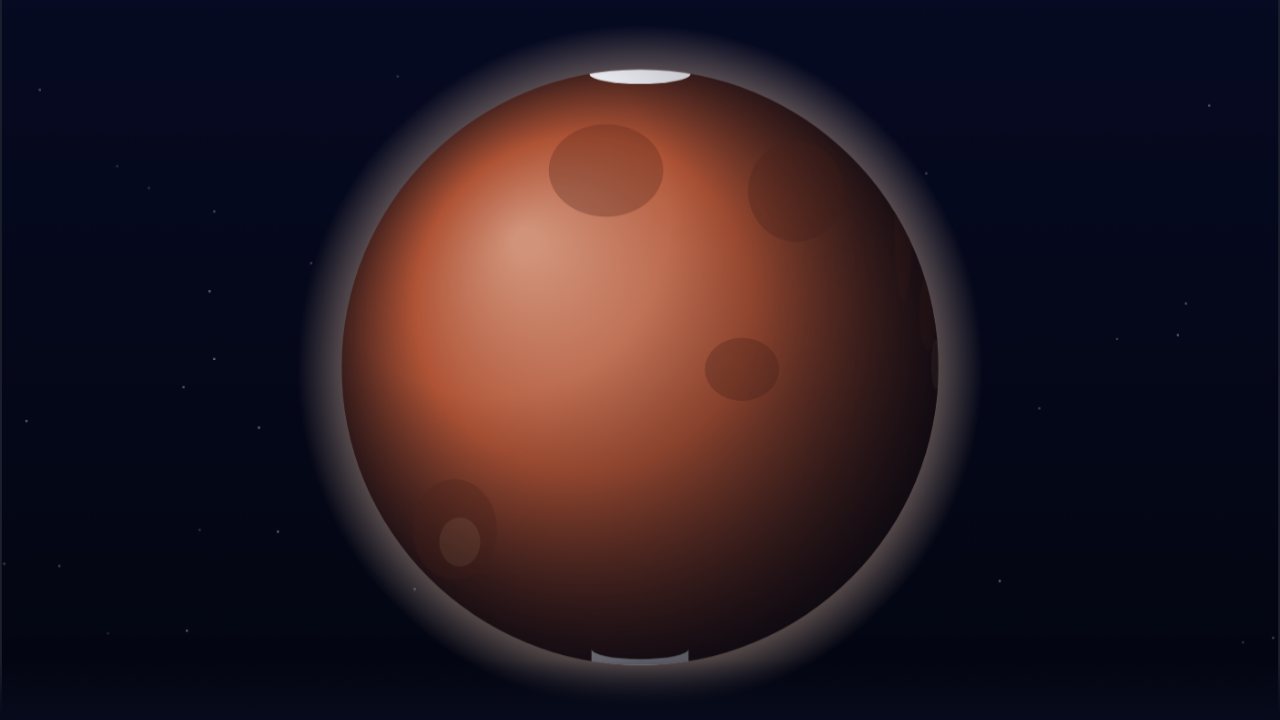
one wayNASA's Mars fact sheet gives the closest and farthest distances as 54.6 and 401.4 million km, which makes the one-way light time 3 min 2 s to 22 min 19 s. Averaged over 250 years of orbits the distance is 254.7 million km, or 14 min 10 s.
So a rover driver who sees a rock in a picture is seeing the past, and any command arrives minutes later. That is why rovers are sent a plan of moves to carry out rather than steered live.
Related reading: How long does it take to get to Mars?
Voyager 1: one light day
173.1 au from EarthOn 13 November 2026 JPL's Horizons ephemeris puts Voyager 1 173.1 au from Earth, 25.89 billion km, so its radio signals take 23 h 59 min. One light day is 25.90 billion km, and Voyager 1 crosses it on 19 November 2026.
The distance does not grow smoothly. Voyager 1 moves away from the Sun at about 16.9 km/s, but Earth's own orbit, at nearly 30 km/s, carries it towards the spacecraft for part of each year, so for a few months the light time actually shrinks.
Proxima Centauri: 4.25 years
the nearest star after the SunGaia measured Proxima Centauri's parallax as 768.0665 ± 0.0499 milliarcseconds. That puts it 4.2465 light years away, 40.17 trillion km, so its light takes 4.25 years to arrive, give or take a couple of hours.
The light you would see from it tonight left in August 2022. Proxima is too faint to see without a telescope; its bright neighbours Alpha Centauri A and B, a little farther away, are the stars you can see.
Related reading: How do we know how far away stars are?
The Andromeda Galaxy: 2.48 million years
761 ± 11 kiloparsecsHubble observations of 55 Cepheid variable stars put Andromeda 761 ± 11 thousand parsecs away (Li and colleagues, 2021). That is 2.48 million light years, so the light you see from it left 2.48 million years ago, give or take about 35,877 years.
The centre of our own galaxy, 8,178 parsecs away by the GRAVITY team's measurement of the star S2 orbiting its black hole, is much closer: 26,673 years.
Light travel time from Earth
| Destination | Closest | Average | Farthest |
|---|---|---|---|
| Moon | 1.21 seconds | 1.28 seconds | 1.35 seconds |
| Sun | 8 min 11 s | 8 min 19 s | 8 min 27 s |
| Mercury | 4 min 18 s | 8 min 38 s | 12 min 20 s |
| Venus | 2 min 7 s | 9 min 27 s | 14 min 31 s |
| Mars | 3 min 2 s | 14 min 10 s | 22 min 19 s |
| Jupiter | 32 min 43 s | 43 min 43 s | 53 min 51 s |
| Saturn | 1 h 7 min | 1 h 20 min | 1 h 32 min |
| Uranus | 2 h 23 min | 2 h 40 min | 2 h 55 min |
| Neptune | 4 h 0 min | 4 h 10 min | 4 h 22 min |
| Pluto | 3 h 58 min | 5 h 39 min | 6 h 59 min |
| Voyager 1 (13 Nov 2026) | 23 h 59 min | ||
| Proxima Centauri | 4.25 years ± 2 h 25 min | ||
| Sirius | 8.60 years ± 13.1 days | ||
| Galactic centre | 26,673 years ± 83.35 years | ||
| Andromeda Galaxy | 2.48 million years ± 35,877 years |
Light time is distance ÷ 299,792.458 km/s. Closest and farthest come from the NASA fact sheets. Planet averages are time averages over 1800 to 2050 from the JPL orbital elements; for the Moon it is the semimajor axis and for the Sun 1 au.
How the calculator works
The speed of light in vacuum is exactly 299,792.458 km/s, because the metre is defined from it. Every result is the distance in km divided by that number. Custom distances are converted to km first: a mile is 1.609344 km, an astronomical unit 149,597,870.7 km, a light year 9.4607 trillion km (light speed times 365.25 days) and a parsec 648,000 ÷ π au, about 3.2616 light years.
For the planets the calculator solves Kepler's equation for Earth and the planet with NASA JPL's approximate orbital elements, valid from 1800 to 2050, and takes the distance between them. Against JPL's full ephemeris for 13 November 2026 these positions are within about 3 light seconds for every planet. Pluto uses the mean elements from NASA's Pluto fact sheet.
Voyager 1's distance is read from a table of JPL Horizons ranges every 10 days from 2020 to 2040, with a smooth curve between the points. The star and galaxy distances come from parallax (Proxima, Sirius), the orbit of the star S2 round the Milky Way's central black hole, and Cepheid variable stars in Andromeda.
What the model leaves out
- Air: light is about 0.03% slower in air, which over the thickness of the atmosphere adds only a few nanoseconds. The calculator uses the speed in vacuum.
- Gravity: passing close to the Sun delays a radio signal by up to a few hundred microseconds (the Shapiro delay). Ignored here.
- Your position: distances are from the centre of the Earth to the centre of the target. Being on the surface changes the Moon time by up to about 0.02 seconds.
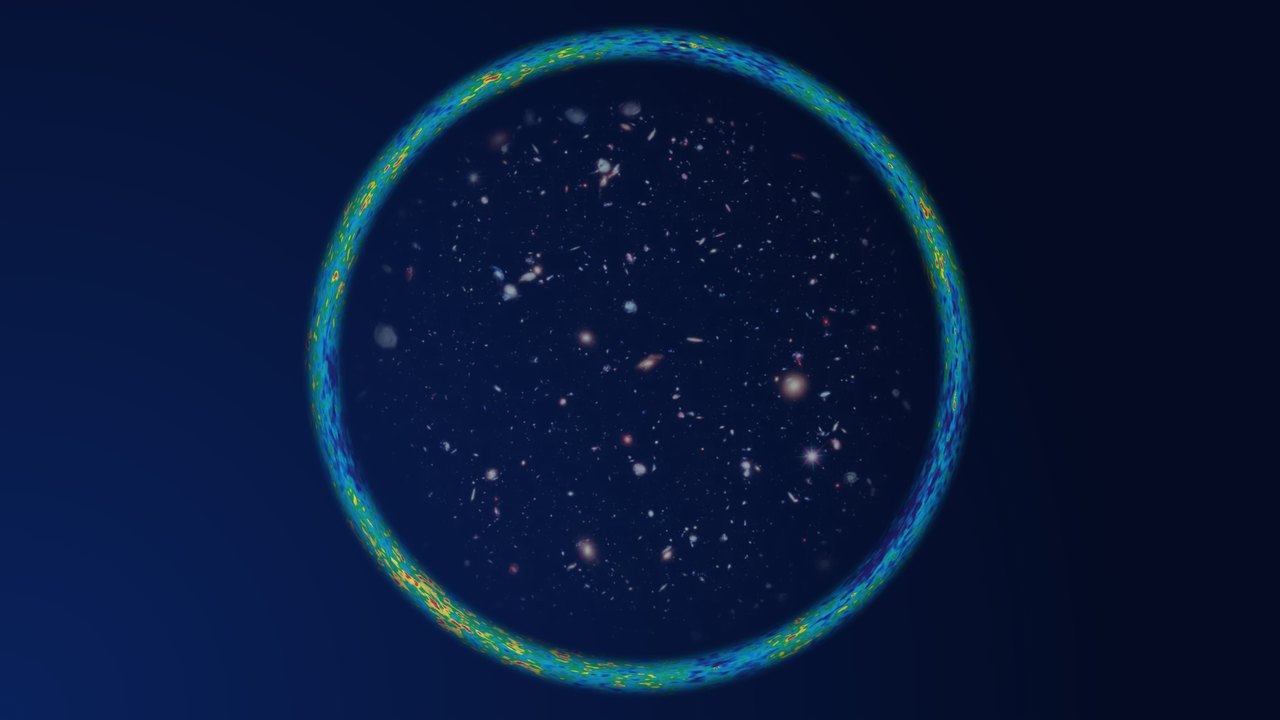
- Expansion of the universe: irrelevant out to Andromeda, which is moving towards us. For distant galaxies, light time and distance stop being the same thing.
Common misconceptions
"Sunlight is 8 minutes old." The 8 min 19 s is only the trip from the surface. The energy was made in the core long before that.
"If the Sun vanished we would know at once." We would keep seeing it, and Earth would keep orbiting, for 8 min 19 s. Changes in gravity travel at the speed of light too.
"The nearest planet is always Venus." Venus comes closest, at 2 min 7 s, but averaged over time Mercury is nearer: 8 min 38 s against 9 min 27 s for Venus.
Frequently asked questions
How long does it take light from the Sun to reach Earth?
8 min 19 s on average, from 8 min 11 s in early January, when Earth is closest to the Sun, to 8 min 27 s in early July.
How long does light take from the Moon?
1.28 seconds on average, between 1.21 seconds and 1.35 seconds as the Moon's distance changes through its orbit.
How long does a signal take to reach Mars?
Between 3 min 2 s and 22 min 19 s one way, depending on where Earth and Mars are in their orbits. The average is 14 min 10 s.
How far is a light year in km?
9,460,730,472,580.8 km, about 9.46 trillion km: the distance light covers in a Julian year of 365.25 days.
How long does light take to reach Pluto?
3 h 58 min at the closest and 6 h 59 min at the farthest, because Pluto's orbit is very stretched. When New Horizons flew past on 14 July 2015, Pluto was 4 h 25 min of light time from Earth, so every picture took that long to come home.
Keep learning
How Long Does Sunlight Take to Reach Earth?
Sunlight takes 8 minutes 19 seconds to reach Earth on average: 8 min 11 s in January, 8 min 27 s in July. The sums, plus light times to planets and stars.

Top 6 things that can travel faster than light
The speed of light is the ultimate sped barrier of the Universe or is it? Here are 6 ways that you can break the speed of light and can FTL
How Long Does It Take to Get to Mars? The Orbital Math
About 7 months, but why? We derive the 259-day Hohmann transfer, the 26-month launch window and why most real probes arrive in 200 to 230 days.

How Do We Know How Far Away Stars Are? Parallax Math
Proxima Centauri shifts 0.768 arcsec a year, which puts it 4.2465 light-years away. Here is the parallax math, what Gaia changed and the distance ladder.