How do you find the spring constant?
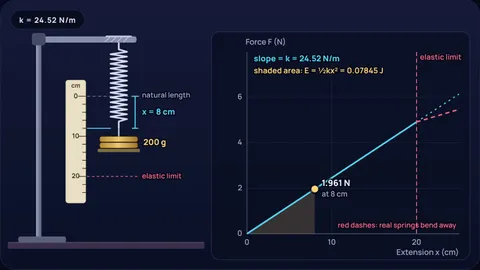
Divide the force on the spring by how far it stretches: k = F ÷ x. A 200 g mass pulls down with 0.2 × 9.80665 = 1.961 N; if it stretches the spring 8 cm, then k = 1.961 ÷ 0.08 = 24.52 N/m. The calculator does the same sum for any force, mass or extension, and turns it round to give the force for a stretch or the stretch for a force.
For a better answer, hang several loads and measure each extension. "From readings" fits the best straight line through them and gives k as its slope. The stage shows the spring on a stand next to a ruler, and the force against extension graph with the stored energy shaded. For a full home experiment with a water bottle, read How to find the spring constant.
Key results
- Hooke's law: F = kx, so k = F ÷ x and x = F ÷ k. x is the change in length, not the total length.
- Hanging masses: the force is the weight, F = mg, with standard gravity g = 9.80665 m/s². 100 g gives 0.9807 N.
- Energy stored: E = ½kx², the area under the force against extension line.
- Two springs: in series 1/k = 1/k₁ + 1/k₂ (softer); in parallel k = k₁ + k₂ (stiffer).
- Units: 1 N/cm = 100 N/m, 1 N/mm = 1,000 N/m, 1 lbf/in = 175.1 N/m.
Six worked examples
Each button loads the example into the calculator.
200 g stretches a spring 8 cm: k = 24.52 N/m
spring constant from one readingThe load is a weight, so first turn the mass into a force: F = mg = 0.200 kg × 9.80665 m/s² = 1.961 N. Then k = F ÷ x = 1.961 N ÷ 0.08 m = 24.52 N/m.
That means each newton of pull stretches this spring by 4.079 cm, and it stores 0.07845 J at this stretch.
Five loads of water: k = 48.94 N/m
best fit through readingsA bag hangs from a spring and gets 100 mL of water at a time. Water at 20 °C is 998.21 kg/m³ (NIST), so each 100 mL is 99.8 g. The example readings are 2.1, 4.0, 6.1, 8.0 and 10.1 cm.
The best straight line has a slope of 48.94 N/m and meets the axis at −0.029 N, close to zero, with R² = 0.9997. Forcing the line through zero gives 48.55 N/m. Several readings average out the small errors in any one.
Related reading: How to find the spring constant
Two 40 N/m springs end to end: k = 20 N/m
springs in seriesHung one below the other, each spring carries the whole load of 1.961 N, so each stretches 4.903 cm and the pair stretches 9.807 cm. Twice the stretch for the same force means half the stiffness: 1/k = 1/40 + 1/40, so k = 20 N/m.
The same springs side by side: k = 80 N/m
springs in parallelSide by side, the springs share the load, 0.9807 N each, and both stretch the same 2.452 cm. The stiffnesses add: k = 40 + 40 = 80 N/m, four times the series pair.
Past the elastic limit: 11.77 cm on a spring rated to 10 cm
elastic limit warningWith k = 25 N/m, 300 g would stretch the spring 11.77 cm if it kept obeying Hooke's law. The elastic limit here is set at 10 cm, so the calculator warns: past that point the coils start to deform for good, the graph stops being a straight line, and the spring may not return to its old length.
The elastic limit is a property of each spring. Find it by loading in small steps and checking that the spring returns to its starting length each time you unload it.
A 200 N/m spring stretched 5 cm stores 0.25 J
force and energy from extensionThe force is F = kx = 200 × 0.05 = 10 N. The energy is the area of the triangle under the line, E = ½kx² = ½ × 200 × 0.05² = 0.25 J. Double the stretch and the energy goes up four times, because x is squared.
Loads and forces for hanging masses
| Mass hung | Force (N) | Stretch at 25 N/m | Stretch at 100 N/m |
|---|---|---|---|
| 50 g | 0.4903 | 1.961 cm | 4.903 mm |
| 100 g | 0.9807 | 3.923 cm | 9.807 mm |
| 200 g | 1.961 | 7.845 cm | 1.961 cm |
| 300 g | 2.942 | 11.77 cm | 2.942 cm |
| 500 g | 4.903 | 19.61 cm | 4.903 cm |
| 1 kg | 9.807 | 39.23 cm | 9.807 cm |
Force from F = mg with the standard acceleration of gravity, 9.80665 m/s² (NIST CODATA). Real surface gravity runs from 9.780 m/s² at the equator to 9.832 m/s² at the poles (NASA Earth fact sheet), within 0.3% of the standard value, which is smaller than a typical error reading a ruler.
How the calculator works
Every input is converted to newtons, metres and newtons per metre, then F = kx is rearranged for the unknown. A mass hung on the spring becomes a force with F = mg and g = 9.80665 m/s². 1 lbf = 4.448222 N and 1 inch = 0.0254 m, both exact, from NIST Special Publication 811.
"From readings" fits a least squares straight line through your (extension, force) points. The slope is k. It also reports the intercept, R² and the slope of the best line forced through zero, so you can spot a bad first reading.
Series springs combine as 1/k = 1/k₁ + 1/k₂ and parallel springs as k = k₁ + k₂. The energy stored is E = ½kx².
What the model leaves out
- The spring's own mass: a heavy spring stretches a little under its own weight. Measure extensions from the length it hangs at with nothing on it.
- Pre-tension: many close-wound extension springs need a small force before the coils even start to separate. Their line does not pass through zero; use the best fit slope, not one reading.
- Beyond the elastic limit: the calculator only warns you; it does not model how the spring yields.
- Motion: a mass bouncing on a spring is a separate problem. The period is 2π√(m/k), which this tool does not show.
Common misconceptions
"x is the length of the spring." It is the change in length from the unloaded spring.
"Two springs are always stiffer." Only side by side. End to end, two equal springs are half as stiff as one.
"The minus sign means the force is negative." F = −kx describes the spring's pull, which points against the stretch. The size of the force is still kx.
Frequently asked questions
What is the formula for the spring constant?
k = F ÷ x: the force on the spring in newtons divided by its extension in metres. The answer is in N/m.
How do I find k with masses?
Hang a known mass, multiply by 9.81 m/s² to get the force in newtons, measure how far the spring stretches in metres, and divide. Repeat with several masses and take the slope of the force against extension graph.
What are the units of the spring constant?
Newtons per metre (N/m). Spring makers also use N/mm (1 N/mm = 1,000 N/m) and pounds force per inch (1 lbf/in = 175.1 N/m).
How much energy does a stretched spring store?
E = ½kx². A 200 N/m spring stretched 5 cm stores ½ × 200 × 0.05² = 0.25 J.
What happens past the elastic limit?
The spring stops obeying F = kx and is permanently stretched, so it does not return to its original length when the load is removed.
Keep learning
How to Find the Spring Constant (With a Home Experiment)
Find a spring constant with k = F ÷ x: hang known loads, measure the stretch, and take the slope of the graph. A worked home experiment using cups of water.
How Long Does It Take to Fall From a Height?
Fall time and landing speed for drops from 1 m to 1 km, the one formula behind them, worked examples, and when air resistance starts to matter.

Gravity is still strong at the space station. Why do astronauts float?
The station, crew and loose objects fall together. Weightlessness is about the missing support force, not gravity switching off above the atmosphere.