How do you calculate the dew point?
Air at 20 °C and 50% relative humidity has a dew point of 9.3 °C: cool it to that temperature and it is saturated, and any surface colder than that collects condensation. At 30 °C and 70% the dew point is 23.9 °C, which feels oppressive. The calculator uses the Magnus formula with the coefficients Alduchov and Eskridge recommend for −40 to 50 °C.
Dew point says more about how humid it feels than relative humidity does, because it measures how much water is actually in the air. Why a glass of iced water sweats on a summer day is explained in Why does a cold glass sweat?.
Key results
- Dew point: γ = ln(RH ÷ 100) + 17.625T ÷ (243.04 + T), then dew point = 243.04γ ÷ (17.625 − γ), in °C.
- Humidity from dew point: RH = 100 × e_s(dew point) ÷ e_s(T). The NWS example of 80 °F with a 60 °F dew point gives 50.5%.
- Condensation: water condenses on any surface at or below the dew point. An iced glass at 5 °C sweats in 25 °C air at 60% humidity (dew point 16.7 °C) but stays dry at 25% (dew point 3.6 °C).
- Comfort: the NWS calls a dew point of 55 °F (12.8 °C) or less dry and comfortable, 55 to 65 °F sticky, and 65 °F (18.3 °C) or more oppressive.
Six worked examples
Each button loads the example into the calculator.
A room at 20 °C and 50%: dew point 9.3 °C
dew pointSaturated air at 20 °C has a vapour pressure of 23.33 hPa, so at 50% it holds 11.67 hPa, about 8.6 g of water in each cubic metre. Cooling it to 9.3 °C fills it to 100%. A window pane at 12 °C is warmer than that, so it stays clear.
30 °C and 70%: dew point 23.9 °C
oppressiveA dew point of 23.9 °C (75 °F) is well past the NWS's 65 °F line for oppressive air. The air holds 21.2 g of water per cubic metre, two and a half times the room above.
An iced glass at 5 °C in 25 °C air: it sweats
condensationAt 25 °C and 60% humidity the dew point is 16.7 °C. The outside of a glass of iced water at about 5 °C is 11.7 °C colder than that, so the air touching it is cooled past saturation and leaves its water on the glass. The 5 °C glass temperature is an example input.
The same glass in dry air stays dry
no condensationAt 25 °C and only 25% humidity the dew point drops to 3.6 °C. The 5 °C glass is 1.4 °C above it, so the air touching it gets cool and damp but never reaches 100%. This is why cold drinks barely sweat in a desert or a heated room in winter.
A winter window at 8 °C mists up
window condensationA room at 20 °C and 55% humidity has a dew point of 10.7 °C. If the inside of the glass is at 8 °C, an example value for a cold single pane, it sits 2.7 °C below the dew point and runs with water. Drier indoor air, or warmer glass from double glazing, stops it.
80 °F with a 60 °F dew point: 50.5% humidity
humidity from dew pointThe National Weather Service uses this example to show that relative humidity can mislead: 30 °F air with a 30 °F dew point is at 100%, yet the 80 °F day at only 50.5% feels far more humid, because it holds much more water.
Dew point at common temperatures and humidities
| Air | 30% RH | 50% RH | 70% RH | 90% RH |
|---|---|---|---|---|
| 0 °C | −15.5 °C | −9.2 °C | −4.8 °C | −1.4 °C |
| 10 °C | −6.8 °C | 0.0 °C | 4.8 °C | 8.4 °C |
| 15 °C | −2.4 °C | 4.7 °C | 9.6 °C | 13.4 °C |
| 20 °C | 1.9 °C | 9.3 °C | 14.4 °C | 18.3 °C |
| 25 °C | 6.2 °C | 13.9 °C | 19.1 °C | 23.2 °C |
| 30 °C | 10.5 °C | 18.4 °C | 23.9 °C | 28.2 °C |
| 35 °C | 14.8 °C | 23.0 °C | 28.7 °C | 33.1 °C |
Dew points in °C from the Magnus formula with the Alduchov and Eskridge (1996) coefficients. Below 0 °C the dew point is over water; frost forms on surfaces a little above it.
How the calculator works
The saturation vapour pressure of water is e_s(T) = 6.1094 exp(17.625T ÷ (T + 243.04)) hPa, with T in °C. Alduchov and Eskridge (1996) recommend these coefficients for −40 to 50 °C, with a maximum error under 0.4%.
From temperature and relative humidity the tool finds the actual vapour pressure, then the temperature at which that would be saturation: the dew point. From temperature and dew point it does the reverse to get relative humidity.
The condensation check compares the surface temperature with the dew point. At or below it, the air touching the surface is saturated and water condenses; below 0 °C it freezes as frost.
Water in the air (g/m³) is the vapour pressure divided by the gas constant for water vapour, 461.5 J/(kg·K), and the absolute temperature.
What the model leaves out
- Frost point: below 0 °C ice forms at a slightly higher temperature than the dew point over water; the tool does not calculate it separately.
- Surface temperature: you need to know or estimate it. A glass of iced water is a few degrees above 0 °C; a single window pane in winter can be close to the outside temperature.
- Air movement: in a draught, condensation forms more slowly because the cooled layer of air is constantly replaced.
Common misconceptions
"The glass is leaking." The water on a cold glass comes from the air around it. It forms on an empty cold can just the same.
"100% humidity means it is raining." It means the air is saturated at its current temperature. Fog and dew often form at 100% without rain.
"High relative humidity means muggy." Not in cold air. 100% at 0 °C holds far less water than 50% at 30 °C. Dew point is the better guide.
Frequently asked questions
What is the dew point?
The temperature to which air must be cooled, without changing its water content, for it to become saturated. Any surface colder than the dew point collects condensation.
How do I calculate dew point from temperature and humidity?
Use the Magnus formula: γ = ln(RH ÷ 100) + 17.625T ÷ (243.04 + T), then dew point = 243.04γ ÷ (17.625 − γ), with T in °C. At 20 °C and 50% it gives 9.3 °C.
What dew point is comfortable?
The US National Weather Service calls 55 °F (12.8 °C) or less dry and comfortable, 55 to 65 °F sticky with muggy evenings, and 65 °F (18.3 °C) or more oppressive.
Why do windows get condensation?
In cold weather the inside of the glass can be colder than the dew point of the room air. Air touching it is cooled to saturation and its water condenses on the pane.
Can the dew point be higher than the air temperature?
No. At 100% humidity the dew point equals the air temperature. Air cannot hold more vapour than saturation for long; the excess condenses.
Keep learning
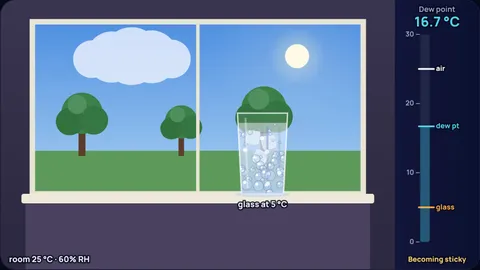
Why Does a Cold Glass Sweat? The Dew Point Explained
The water on a cold glass comes from the air, not the drink. It forms when the glass is colder than the dew point. Here is how to work that out.

Why Does Humid Heat Feel Hotter Than Dry Heat?
Sweat only cools you when it evaporates, and humid air slows that down. The heat index puts a number on it: 32 °C at 70% humidity feels like 40 °C.

Why is there a tiny hole in an airplane window?
The small hole in some airplane window panes connects a gap to the cabin—not the outside. Here is how that changes the pressure across the layers.
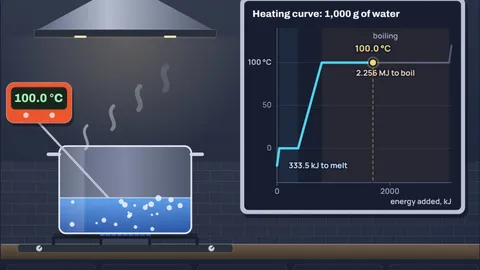
Why Does Water Have Such a High Specific Heat?
Water needs 4.184 J to warm one gram by 1 °C, over nine times as much as iron. Light molecules and hydrogen bonds explain why, with worked numbers.