Why Does Humid Heat Feel Hotter Than Dry Heat?
A 32 °C afternoon in a dry inland town and a 32 °C afternoon on a humid coast are not the same afternoon. In the dry heat you feel the sun on your skin but stay oddly comfortable in the shade. In the sticky heat your shirt is soaked within minutes and you cannot cool down, even standing still. The thermometer reads the same, but your body is losing a different fight.
The difference is evaporation. This post works through why humid air feels hotter, with the formulas weather services use and real numbers. The heat index and wind chill calculator turns any temperature and humidity into a feels-like temperature with the official danger bands, and does the same for wind in the cold.
How does sweating cool you down?
Turning liquid water into vapour takes a lot of energy. The molecules that escape are the fastest ones, and they take their energy with them, so the skin they leave behind cools. That energy is the heat of vaporisation, and for water near skin temperature it is large.
Example 1: the cooling power of sweat
One litre of sweat an hour, if every drop evaporates, removes heat at 672 W. Sweat that runs off and drips onto the floor removes almost nothing, because it never turned into vapour.
That last point is the whole story. In hot weather the body can still lose some heat by radiation and by warming the air, but only while the air is cooler than the skin, at roughly 34 to 35 °C. On a 32 °C day that route is nearly closed, and in a 40 °C desert it runs backwards: the air heats you. Evaporation is the one cooling route left, and humidity decides how well it works.
Why does humidity slow evaporation?
Evaporation is driven by a difference in water vapour pressure: high at the wet skin, lower in the air around it. The bigger the gap, the faster sweat leaves. Air that is already full of vapour leaves a small gap.
The vapour pressure of saturated air depends only on temperature. A widely used fit is the Magnus formula with the coefficients of Alduchov and Eskridge (1996), which they recommend for −40 to 50 °C:
The actual vapour pressure of the air is the relative humidity times that saturated value. So you can compare the push on sweat from wet skin at 34 °C into two very different afternoons.
Example 2: the push on your sweat
The gap is 53.1 − 33.2 = 19.9 hPa in the humid air and 53.1 − 11.1 = 42.0 hPa in the dry air. Sweat is pushed off the skin about twice as hard in the desert, even though the desert is 8 °C hotter.
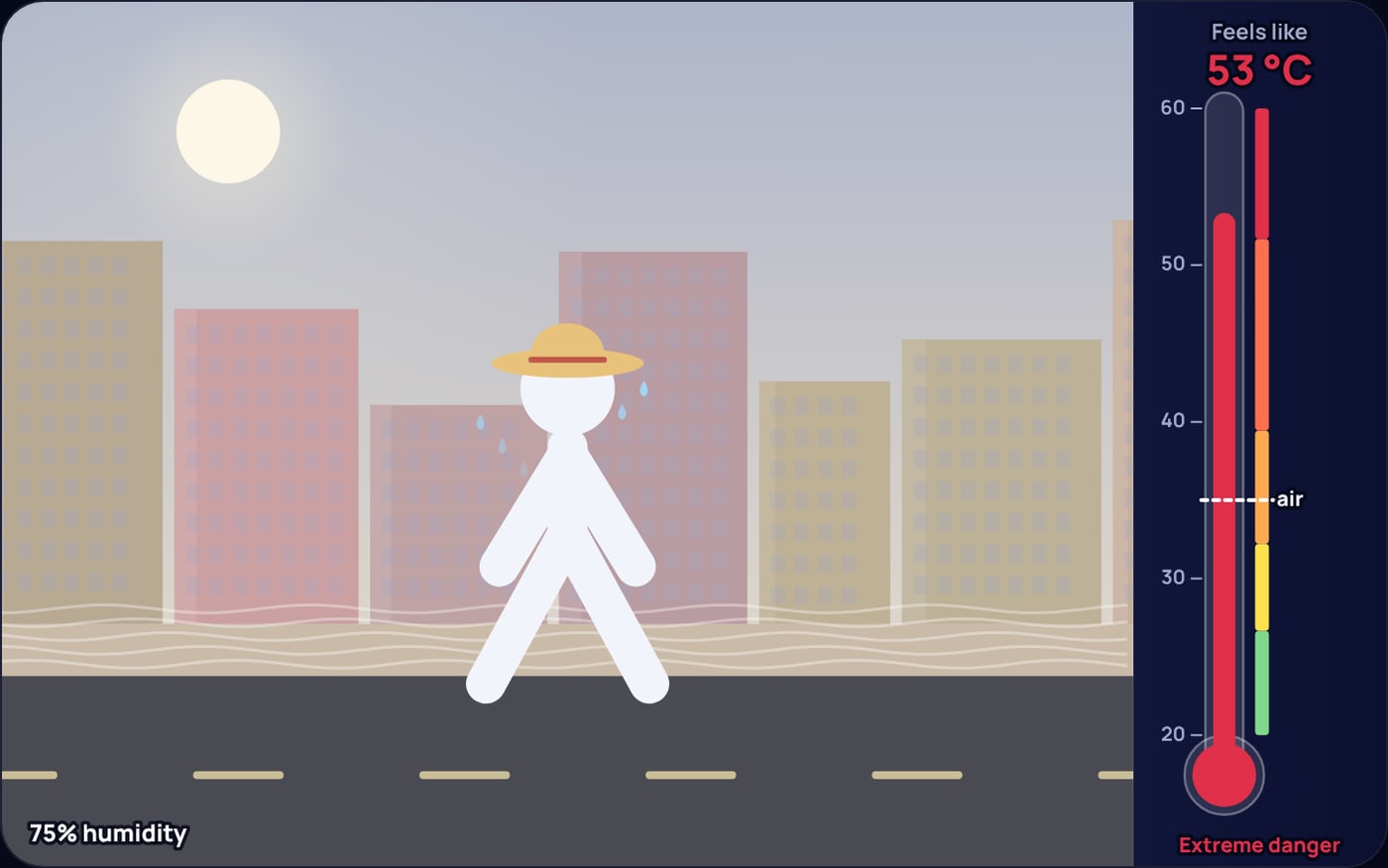
At 35 °C and 75% humidity the air holds 42.1 hPa of vapour, which leaves a gap of only 11 hPa. Sweat pours out and very little of it evaporates. That is why muggy heat feels oppressive in a way the thermometer does not capture.
What is the heat index?
The heat index rests on tables by the researcher Steadman of how hot people would feel at different temperatures and humidities. In 1990 Lans Rothfusz of the US National Weather Service fitted a formula to Steadman's tables, and the NWS still uses it, in °F and percent relative humidity:
It is a curve fit, not physics, so the NWS adds two small corrections: one for very dry air (under 13% humidity, 80 to 112 °F) and one for very humid air (over 85%, 80 to 87 °F). For mild weather, where the heat index would come out under about 80 °F, it uses Steadman's simpler formula instead.
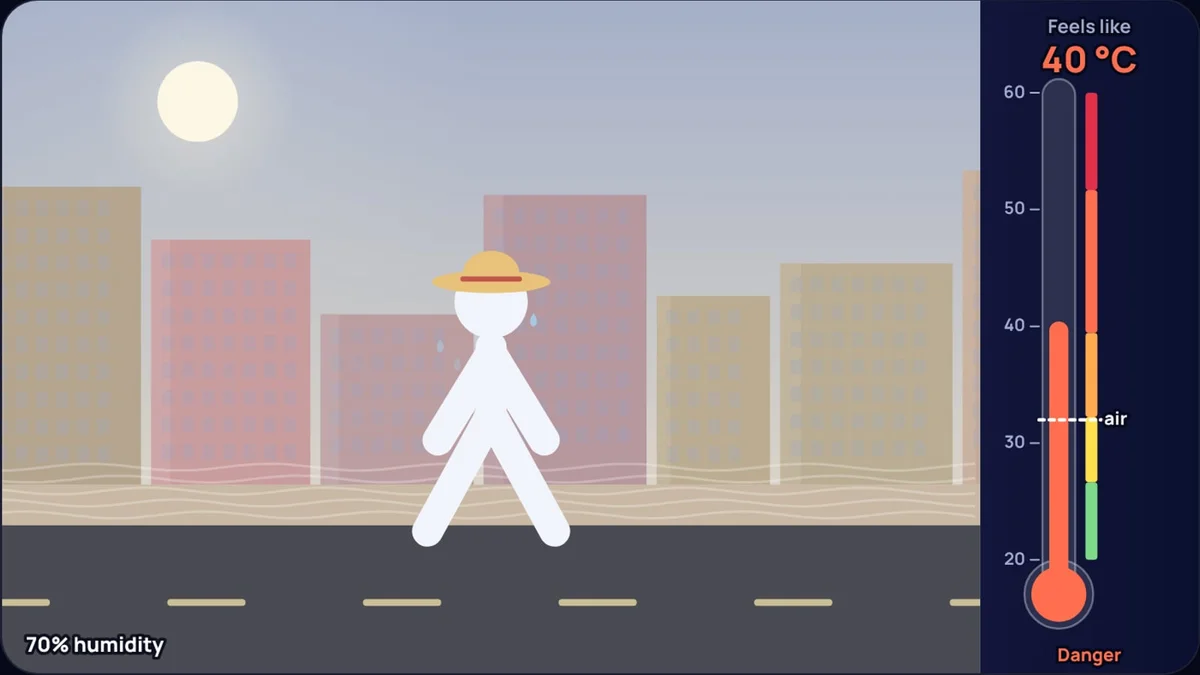
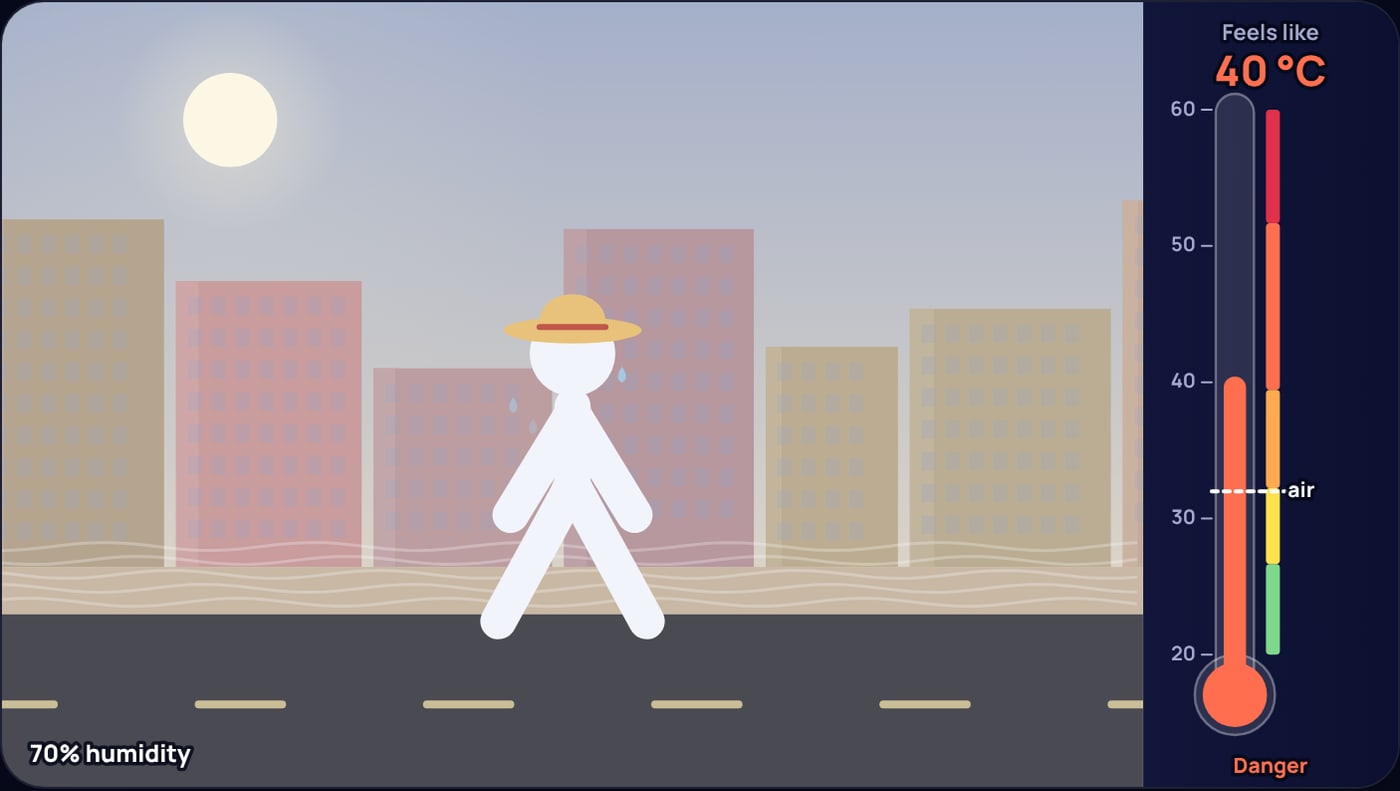
Example 3: 32 °C at 40% and at 70% humidity
Thirty points of humidity add 8 °C to how hot it feels. At 85% humidity the same 32 °C reaches 46.6 °C.
How dangerous is a high heat index?
The National Weather Service groups heat index values into four bands, each with a warning about what long exposure or physical activity can do:
- Caution, 80 to 90 °F (27 to 32 °C): fatigue is possible.
- Extreme caution, 90 to 103 °F (32 to 39 °C): heat cramps, heat exhaustion or heat stroke are possible.
- Danger, 103 to 124 °F (39 to 51 °C): heat cramps or heat exhaustion are likely, and heat stroke is possible.
- Extreme danger, 125 °F (52 °C) or more: heat stroke is highly likely.
These values are for shade. The NWS notes that direct sunshine can raise the heat index by up to 15 °F, about 8 °C, so a reading in the extreme caution band can be in the danger band for someone working in the sun.
Can dry heat feel cooler than the thermometer?
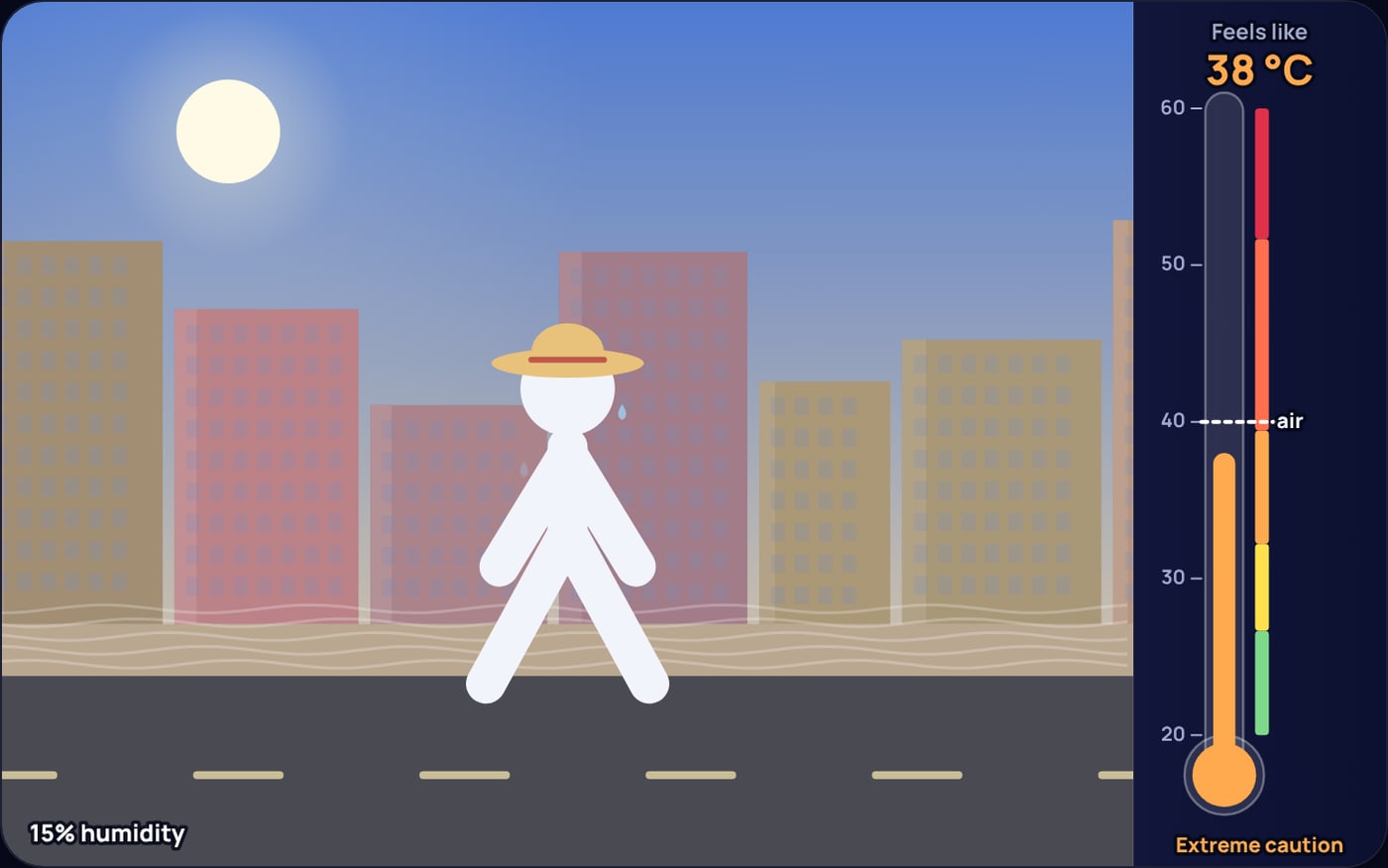
It can. At 40 °C and 15% humidity the heat index is 38 °C, two degrees below the air temperature, because sweat evaporates almost as fast as it appears. You may not even feel wet.
That is a trap rather than a comfort. A 2022 study at Penn State put young, healthy volunteers in hot rooms and raised the heat until their core temperature could no longer hold steady. In hot, dry rooms they reached that point earlier than a wet-bulb rule predicted, because the air itself was pouring heat into their skin faster than evaporation could take it away. Sweat rates were about the same in every room; what changed was how much heat came in from the air.
Is there a limit to the heat a person can survive?
The cleanest way to combine heat and humidity is the wet-bulb temperature: the temperature a thermometer wrapped in a wet cloth reaches as water evaporates from it. It is the lowest temperature evaporation alone can cool something to. If the wet-bulb temperature reaches skin temperature, sweat cannot remove any heat at all.
In 2010 Steven Sherwood and Matthew Huber argued that a wet-bulb temperature above 35 °C for long periods would cause hyperthermia in humans, because the body could no longer get rid of its own metabolic heat. They also found that the highest wet-bulb temperatures measured across very different climates never exceeded 31 °C.
The Penn State group tested that limit directly. In humid rooms between 36 and 40 °C, their volunteers lost control of their core temperature at a wet-bulb temperature of 30.55 ± 0.98 °C on average, and none reached 35 °C. For young, healthy people doing light everyday tasks, the real limit is several degrees below the theoretical one.
What about wind chill in the cold?
Wind chill is the cold-weather twin of the heat index. Still air next to your skin warms up and acts like a thin blanket. Wind blows it away, so you lose heat faster, as if the air were colder. The formula the NWS has used since 2001, in °F and mph, is:
Example 4: the NWS example
That is −28.6 °C. At that wind chill the NWS says exposed skin can freeze in about 30 minutes.
Wind chill is only defined at or below 50 °F (10 °C) with wind above 3 mph. The 2001 version replaced an older index based on 1945 research in Antarctica, and was checked in human trials with volunteers walking on a treadmill in a chilled wind tunnel.
Environment and Climate Change Canada uses wind chill bands with frostbite times. From −28 to −39 °C exposed skin can freeze in 10 to 30 minutes, from −40 to −47 °C in 5 to 10 minutes, and from −48 to −54 °C in 2 to 5 minutes. Wind cannot cool anything below the air temperature, though, so frostbite needs the air itself to be below freezing.
Try it yourself
Open the heat index calculator at 35 °C and 75% humidity and lower the humidity a step at a time to watch the feels-like temperature fall and the street's haze clear. Switch to wind chill and try the blizzard preset to see the frostbite time. For why some things feel cold to the touch at the same temperature, read why metal feels colder than wood, and for why water soaks up so much heat, why water has such a high specific heat.
Sources
- NWS Weather Prediction Center, The heat index equation: the Rothfusz regression, the simple formula and both adjustments.
- NWS Amarillo, Heat index: the four danger bands and the note that full sun can add up to 15 °F.
- NWS, Wind chill chart: the 2001 formula, its limits and the 0 °F, 15 mph example.
- NWS, Wind chill brochure: the 2001 index, the human trials and the frostbite shading.
- Environment and Climate Change Canada, Wind chill and the wind chill index: risk bands and frostbite times.
- Alduchov and Eskridge, Improved Magnus form approximation of saturation vapor pressure (1996): coefficients and the −40 to 50 °C range.
- Engineering ToolBox, Water properties: heat of vaporisation, 2,420.3 kJ/kg at 34 °C.
- Sherwood and Huber, An adaptability limit to climate change due to heat stress, PNAS 2010.
- Vecellio and colleagues, Evaluating the 35 °C wet-bulb temperature adaptability threshold for young, healthy subjects, Journal of Applied Physiology 2022.
Frequently asked questions
Why does humid heat feel hotter than dry heat?
Your body cools itself by evaporating sweat. Humid air already holds a lot of water vapour, so sweat evaporates slowly and carries away less heat. The same temperature therefore feels hotter, which is what the heat index measures.
What does 32 °C feel like at 70% humidity?
About 40 °C (105 °F) by the US National Weather Service heat index, in its danger band. At 40% humidity the same 32 °C feels like about 32 °C.
Can dry heat feel cooler than the actual temperature?
Yes. At 40 °C and 15% humidity the heat index is about 38 °C, because sweat evaporates very quickly. Dry heat still dehydrates you fast and can overheat you, especially in the sun.
What is the heat index?
It is the air temperature that would feel the same to a typical person in shade at a moderate humidity. The National Weather Service calculates it with the Rothfusz regression, from temperature and relative humidity.
What is the most humid heat a person can survive?
Theory puts the limit at a wet-bulb temperature of 35 °C, where sweat can no longer remove body heat. Experiments on young, healthy adults in humid heat found the real limit lower, around 31 °C wet-bulb on average.