Why Does a Cold Glass Sweat? The Dew Point Explained
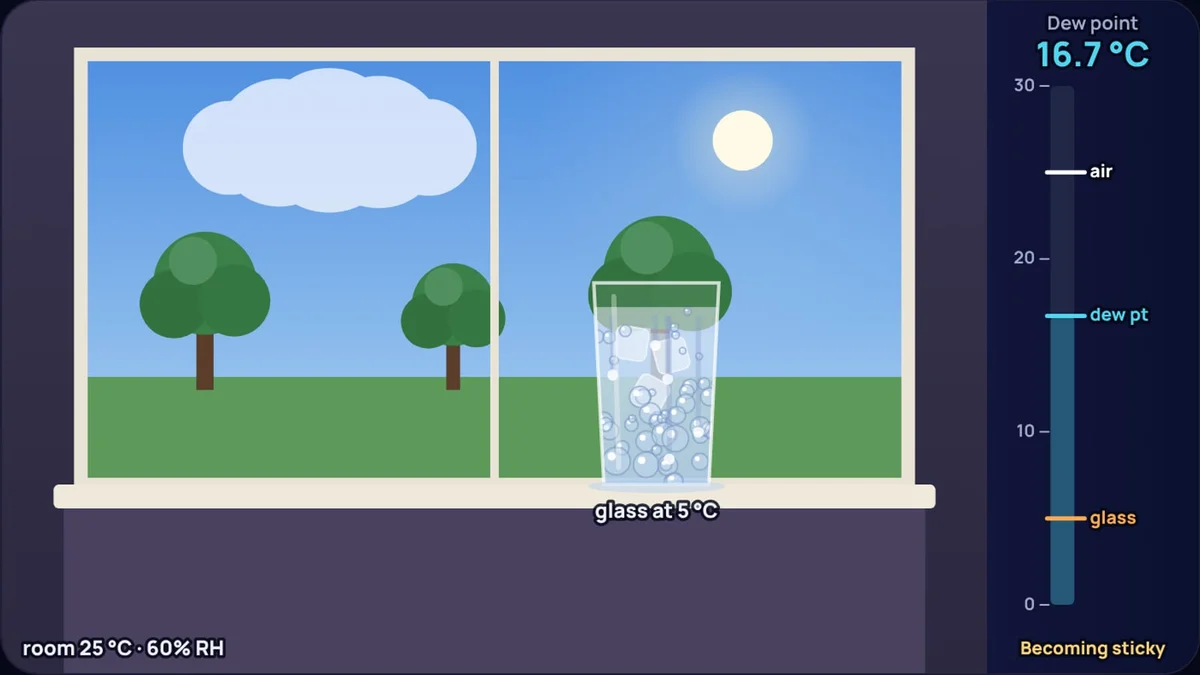
Pour iced water into a glass on a summer afternoon and within a minute the outside is beaded with drops. Leave it ten minutes and there is a ring of water on the table. Plenty of people have assumed, at least once, that the glass must be leaking. It is not. Every one of those drops was floating in the room as invisible water vapour a moment earlier.
This post explains where the water comes from and how to predict when it will appear, using the dew point. The dew point calculator works out the dew point from temperature and humidity and tells you whether a cold glass or a winter window will fog up.
Where does the water on a cold glass come from?
Air always carries some water as vapour: single molecules mixed in with the nitrogen and oxygen. You cannot see it. The amount air can hold before the vapour starts turning back into liquid depends strongly on temperature, and it rises fast as the air warms.
That maximum is described by the saturation vapour pressure. A widely used fit is the Magnus formula, with the coefficients that Alduchov and Eskridge recommended in 1996 for temperatures from −40 to 50 °C:
Relative humidity is how full the air is, as a share of that maximum. The actual vapour pressure is .
Example 1: the water in a summer room
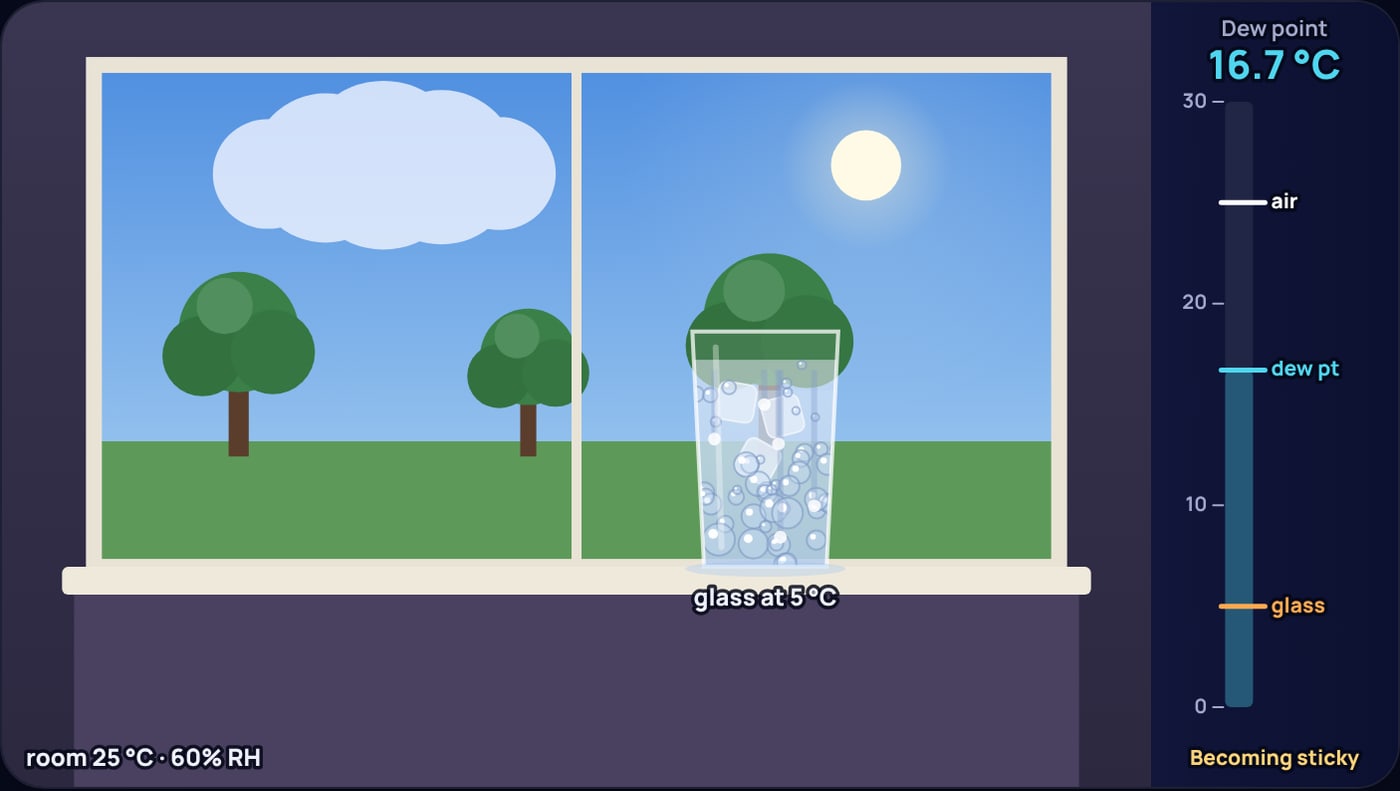
The room air has 18.97 hPa of vapour. Air at 5 °C can only hold 8.72 hPa. Chill the air next to the glass to 5 °C and more than half its vapour has nowhere to go but onto the glass.
What is the dew point?
Cool a parcel of air without adding or removing any water, and its relative humidity rises, because the maximum it can hold is falling. At some temperature it reaches 100%. That temperature is the dew point. Cool it any further and the extra vapour condenses as dew, fog or drops on a glass.
Turning the Magnus formula inside out gives the dew point from the temperature and the relative humidity:
Example 2: dew point of the summer room
Any surface colder than 16.7 °C will collect water in this room. A glass of iced water, a can from the fridge and a cold water pipe all qualify.
How much water can a cold glass pull out of the air?
Vapour pressure can be turned into grams of water per cubic metre with the ideal gas law for water vapour, using its gas constant of 461.5 J/(kg·K), which is the universal gas constant divided by the molar mass of water.
Example 3: grams of water per cubic metre
A cubic metre of room air carries 13.8 g of water. Chilled to 5 °C it shrinks to 0.933 m³, which can hold 6.3 g, so about 7.5 g has to condense.
A glass only chills a thin layer of air, but that layer is constantly replaced as the cooled air sinks and fresh room air takes its place. Over ten minutes the glass sees a lot of air, which is how a puddle forms under it.
Condensing water also gives back the heat it took to evaporate: about 2,477 joules for every gram at 10 °C. That heat goes into the glass. A sweating glass of iced water warms faster than the same glass in dry air, which is one more reason an insulated sleeve helps on a humid day.
Why does a cold drink not sweat on some days?
Because the dew point can be lower than the glass. The key number is not the air temperature or even the relative humidity on its own, but how the dew point compares with the cold surface.
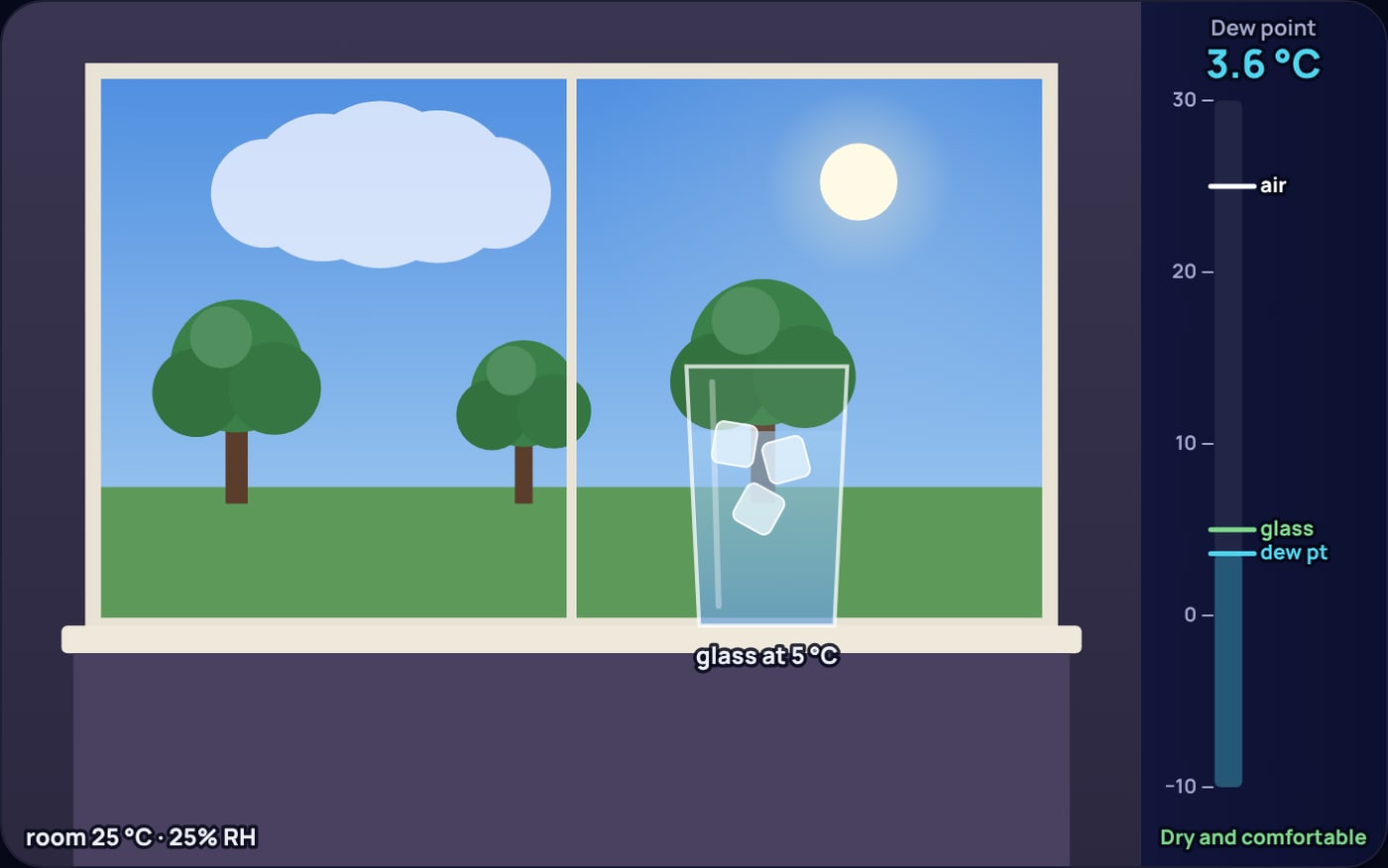
Example 4: the same glass in dry air
The air touching the glass is chilled to 5 °C and reaches about 91% relative humidity, but never 100%. The glass stays dry. Drop a few more ice cubes in and cool the glass below 3.6 °C, and it starts to fog.
Why is dew point a better guide than relative humidity?
Relative humidity depends on temperature, so it moves around during the day even when the amount of water in the air does not. The US National Weather Service gives a neat example: air at 30 °F with a 30 °F dew point is at 100% humidity, while air at 80 °F with a 60 °F dew point is at only about 50%. The second day feels far more humid, because it holds much more water.
The dew point tracks the water itself. The NWS uses it as a comfort guide in summer: a dew point of 55 °F (12.8 °C) or less is dry and comfortable, 55 to 65 °F is sticky with muggy evenings, and 65 °F (18.3 °C) or more is oppressive. On a day with a 24 °C dew point, a glass of iced water drips like a tap.
Here is the dew point for a few common conditions:
| Air | 30% RH | 50% RH | 70% RH | 90% RH |
|---|---|---|---|---|
| 10 °C | −6.8 °C | 0.0 °C | 4.8 °C | 8.4 °C |
| 20 °C | 1.9 °C | 9.3 °C | 14.4 °C | 18.3 °C |
| 25 °C | 6.2 °C | 13.9 °C | 19.1 °C | 23.2 °C |
| 30 °C | 10.5 °C | 18.4 °C | 23.9 °C | 28.2 °C |
Why do windows fog up in winter?
Exactly the same physics, turned around. In winter the cold surface is the window, cooled from outside, and the moist air is in your room. Cooking, showers, drying laundry and breathing all add water to indoor air.
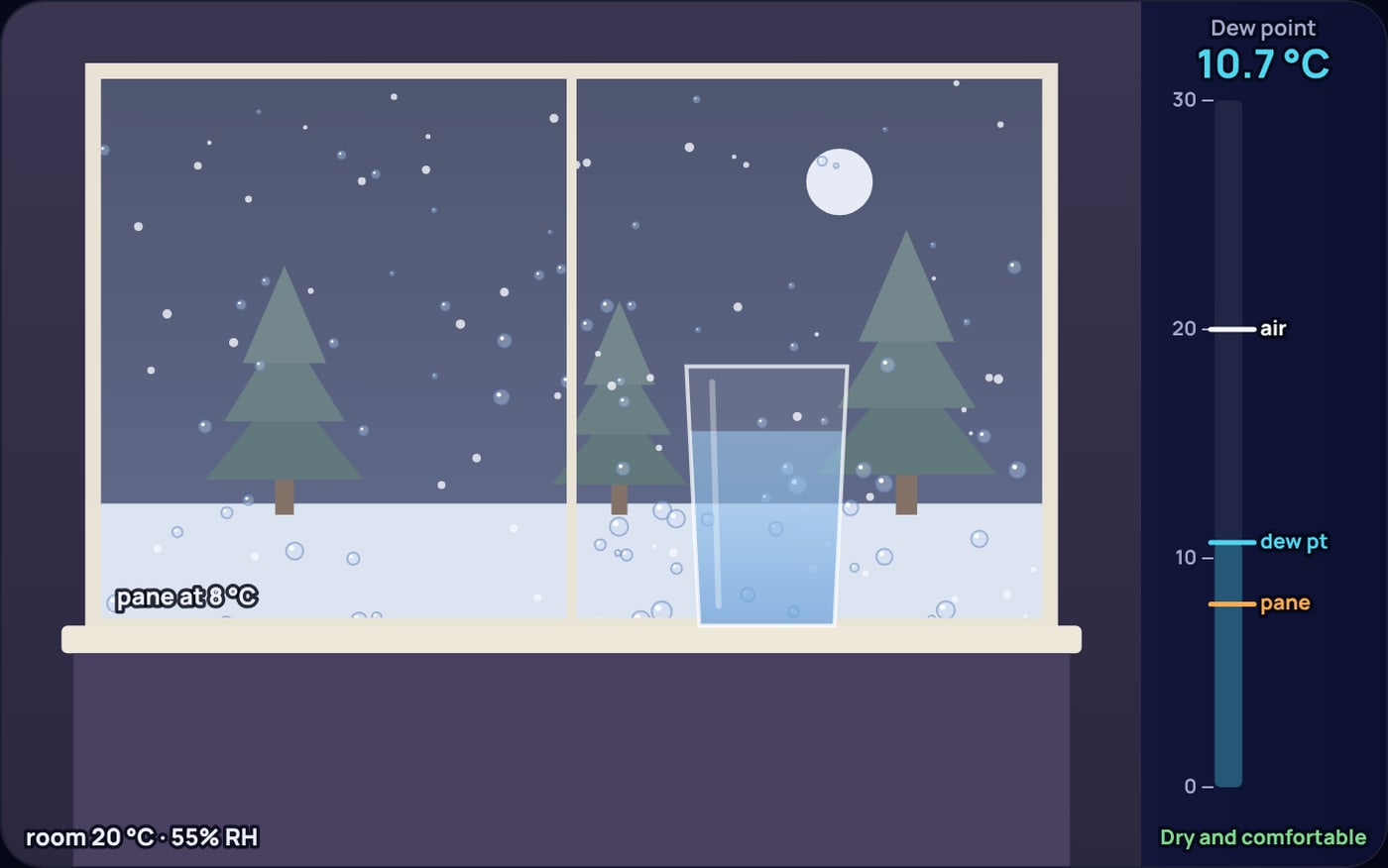
Example 5: a bedroom window
If the inside of the pane is at 8 °C, an example value for a single pane on a cold night, it is 2.7 °C below the dew point and mists up. Dry the room to 40% humidity and the dew point falls to 6.0 °C, below the pane, and the window stays clear.
There are two ways to stop it: lower the dew point by drying the air, with ventilation or a dehumidifier, or raise the surface temperature, which is what double glazing does by keeping the inner pane closer to room temperature. A fan pointed at a window helps for the same reason it dries washing: it keeps replacing the air layer before it can cool to saturation.
Where else does the dew point show up?
Dew on a lawn at dawn forms when grass, cooled by radiating heat to a clear night sky, drops below the dew point. Fog forms when a whole layer of air cools to its dew point. Your breath turns into a cloud on a cold morning because the warm, saturated air from your lungs mixes with cold air and is chilled below its dew point in an instant. And a bathroom mirror steams up because a hot shower raises the dew point of the room far above the temperature of the glass.
Below freezing the vapour can skip the liquid stage and grow straight into ice crystals, which is frost on a car windscreen or the inside of a freezer.
Try it yourself
Open the dew point calculator on a muggy 30 °C day and lower the humidity until the glass stops sweating. Switch the surface to a window and find the pane temperature where your room starts to fog. If muggy air makes you feel worse as well as wetter, why humid heat feels hotter shows how dew point and humidity slow the evaporation of sweat. For condensation at 10 km, read about the tiny hole in an aeroplane window, and for why water stores so much heat, why water has such a high specific heat.
Sources
- Alduchov and Eskridge, Improved Magnus form approximation of saturation vapor pressure (1996): the AEKR coefficients 6.1094, 17.625 and 243.04, recommended for −40 to 50 °C with a maximum error under 0.384%.
- Wikipedia, Clausius-Clapeyron relation: the August-Roche-Magnus formula with these coefficients.
- NWS La Crosse, Heat index and dew point: dew point comfort levels and the 80 °F, 60 °F dew point example.
- Engineering ToolBox, Water properties: heat of vaporisation, 2,477.2 kJ/kg at 10 °C.
Frequently asked questions
Why does a cold glass sweat?
The glass chills the air touching it. If the glass is colder than the dew point of the room air, that thin layer of air becomes saturated and water vapour condenses on the outside of the glass. The water comes from the air, not from the drink.
What is the dew point?
The temperature to which air has to be cooled, keeping its water content the same, for it to become saturated. Any surface colder than the dew point collects condensation.
Why does a cold drink not sweat on some days?
In dry air the dew point is low. At 25 °C and 25% humidity it is about 3.6 °C, so a glass of iced water at about 5 °C stays above it and no water condenses.
Is the water on the outside of a glass leaking through?
No. Glass is watertight. The same drops form on a sealed can or an empty chilled glass, and they form faster when the room is more humid.
Why do windows get condensation in winter?
The inside of the glass is cooled by the cold outdoors. When it is below the dew point of the room air, typically around 10 °C for a room at 20 °C and 55% humidity, water condenses on it.