How old are you on other planets?
Divide the days you have lived by the length of a year on that planet. A 30-year-old has lived 10,957 days, which makes them 15.9 on Mars (a year of 686.98 days), 125 on Mercury (87.969 days), 2.53 on Jupiter and only 0.18 on Neptune, whose year lasts 60,189.018 days. The calculator above does this for any birth date and also gives the calendar date of your next birthday on each world.
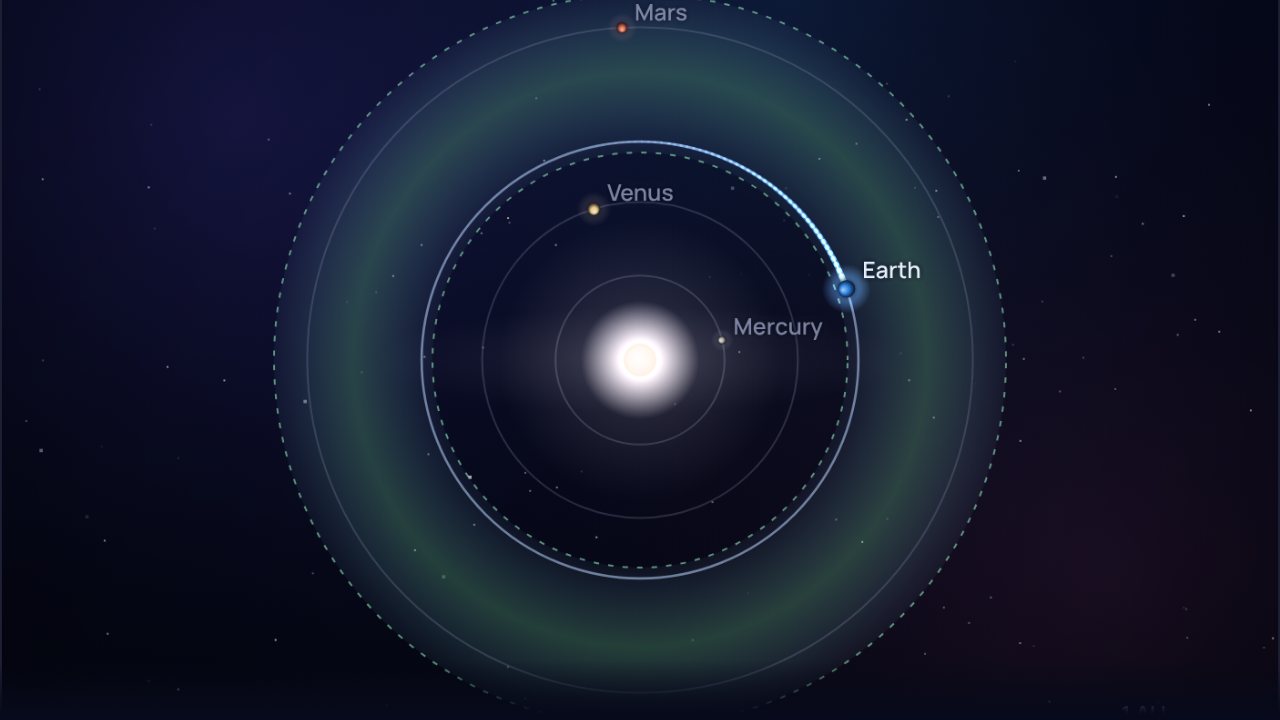
The year lengths are the sidereal orbit periods from NASA's planetary fact sheets: the time each planet takes to go once round the Sun relative to the stars. On the stage every planet is drawn in its real direction from the Sun on the chosen date, and the lit arc behind it shows how far it has travelled since your last birthday there. If you prefer to think in weight rather than time, the weight on other planets simulation works the same way for gravity.
Key results
- The rule: age on a planet = days lived ÷ days in that planet's year. Mercury's year is 87.969 days, Mars's 686.98, Jupiter's 4,332.589 and Pluto's 90,560.
- Someone born on 1 January 2000 is, on 13 November 2026, 112 on Mercury, 14.3 on Mars, 2.26 on Jupiter and has not yet had a first birthday on Saturn (0.91).
- Mars birthdays come every 1.881 Earth years, so a Mars age is always a little more than half your Earth age. A Mercury age is about 4.15 times your Earth age.
- Nobody alive has had a birthday on Neptune or Pluto. Neptune's year is 164.79 Earth years and Pluto's 247.94. A first Uranus birthday comes at age 84.01, which plenty of people reach.
Six birth dates worked through
Each example uses the calculator with 13 November 2026 as the "as of" date. The button loads it, and the numbers change to your own today.
Born on 1 January 2000
9,813 days livedA millennium baby has lived 9,813 days by 13 November 2026, which is 26.9 Earth years. Divide by 686.98 and you get 14.3 Mars years: 14 Mars birthdays so far, with the next on 18 March 2028.
On Mercury the same person is 112 and their next Mercury birthday is on 22 December 2026. On Saturn they are 0.91, so their first Saturn birthday is still to come, on 12 June 2029.
A 30-year-old
10,957 days livedThirty calendar years contain seven or eight leap days, so a 30-year-old has lived about 10,957 days. That is 48.8 on Venus, 15.9 on Mars and 2.53 on Jupiter.
Thirty is also roughly when you have your first Saturn birthday: a Saturn year is 29.45 Earth years, so a person born on 13 November 1996 reached it on 25 April 2026 and is 1.02 Saturn years old on the 13 November example date. Astrologers call this the "Saturn return", which is simply Saturn coming back to the same place against the stars.
The Apollo 11 landing, 20 July 1969
57.3 Earth years agoTreat the first Moon landing as a birthday and on 13 November 2026 it is 30.5 Mars years old and 4.83 Jupiter years old. Its first Saturn birthday was in 1999, and it is 1.95 Saturn years old, so the second comes on 11 June 2028.
On Uranus it is still only 0.68 years old. The first Uranus birthday of the landing falls on 24 July 2053.
Neptune has done one lap since it was found
Discovered 23 September 1846Neptune was first identified on 23 September 1846. With a year of 60,189.018 days, its first "birthday" since discovery came in July 2011 (this calculator gives 9 July 2011; ESA and NASA marked it on 11 July 2011, and the two days of difference come from using one mean year length). On 13 November 2026 it is 1.09 Neptune years since that night.
The same span is 2.14 Uranus years and 748 Mercury years. Load the example and the selected arc on Neptune's orbit shows the short distance it has gone since 2011.
A 10-year-old on Mercury
Four birthdays a yearMercury goes round the Sun in 87.969 days, a little under three months, so a child gets about four Mercury birthdays every Earth year. A 10-year-old has lived about 3,652 days and is about 41.5 in Mercury years.
Mercury's year is shorter than its solar day. The Sun takes about 176 Earth days to go from noon to noon there, so a Mercury birthday party would see only half a Mercury day.
Eighty years old, and almost one on Uranus
A Uranus year is 84.01 Earth yearsAn 80-year-old has lived about 29,219 days, which is 0.95 Uranus years. A first Uranus birthday needs 30,685 days of life, a little over 84 Earth years, so an 80-year-old has about four years to wait. Neptune would take another 80 years beyond that.
Pluto is out of reach altogether. It was discovered on 18 February 1930 and, at 90,560 days per orbit, will not have gone once round the Sun since then until early 2178 (28 January 2178 with the fact sheet's period; other published estimates using a slightly longer period give March 2178). On 13 November 2026 its discovery is 0.39 Pluto years old.
How long is a year on each planet?
| World | Year (Earth days) | Year (Earth years) | Age of a 30-year-old | Born 1 Jan 2000, age on 13 Nov 2026 |
|---|---|---|---|---|
| Mercury | 87.969 | 0.241 | 125 | 112 |
| Venus | 224.701 | 0.615 | 48.8 | 43.7 |
| Earth | 365.256 | 1.000 | 30.0 | 26.9 |
| Mars | 686.98 | 1.881 | 15.9 | 14.3 |
| Jupiter | 4,332.589 | 11.86 | 2.53 | 2.26 |
| Saturn | 10,755.699 | 29.45 | 1.02 | 0.91 |
| Uranus | 30,685.4 | 84.01 | 0.36 | 0.32 |
| Neptune | 60,189.018 | 164.79 | 0.18 | 0.16 |
| Pluto (dwarf planet) | 90,560 | 247.94 | 0.12 | 0.11 |
Year lengths are sidereal orbit periods from the NASA planetary fact sheets, in days of 24 hours. "Earth years" divides by 365.25 days. Earth's own row uses calendar birthdays. A 30-year-old here has lived 10,957 days.
How the calculator works
The calculator counts whole days from your birth date to the "as of" date (today unless you set one), then divides by the length of each planet's year in days. For Mars that is days ÷ 686.98. The whole-number part is the number of birthdays you have had there, and the next birthday is your birth date plus one more full planet year of days, rounded down to a calendar date.
The year lengths are sidereal periods: one lap of the Sun measured against the distant stars. NASA also lists a tropical period (equinox to equinox), which differs by a few days for the outer planets. For Earth the calculator uses ordinary calendar birthdays, because that is what your age on Earth means.
Planet directions on the stage come from the Keplerian orbital elements in NASA JPL's "Approximate Positions of the Planets", with Kepler's equation solved for each date, and from NASA's mean elements for Pluto. They are good to a degree or so for dates between 1800 and 2050. The orbits are evenly spaced so all nine fit on the screen; the real Neptune orbit is about 78 times wider than Mercury's.
What the model leaves out
- Time of day and time zone: ages are counted in whole calendar days, so a birthday can shift by one day depending on the hour and the place you were born.
- Changing year lengths: a planet's period changes very slightly from orbit to orbit because the other planets tug on it. The calculator uses one mean value per planet.
- Local days: a year on Venus is 225 Earth days but its solar day is 117 Earth days, so "years" here are always counted in Earth days, never in local sunrises.
- The Moon: it orbits Earth, not the Sun, so it shares Earth's year and is left out. Pluto is included as a dwarf planet because people ask for it.
Common misconceptions
"You age more slowly on a planet with a long year." Your body ages at the same rate everywhere at these speeds. Only the number on the birthday cake changes, because the year you count with is longer.
"A year is how long a planet takes to spin." That is a day. A year is one trip round the Sun. Jupiter spins in under 10 hours but takes 11.86 Earth years to go round once.
"Divide your age by the planet's distance." Year length grows faster than distance: by Kepler's third law the square of the period goes as the cube of the orbit size, so Jupiter is 5.204 times as far as Earth but its year is 11.86 times as long.
Frequently asked questions
How old would I be on Mars?
Divide your age in days by 686.98, the length of a Mars year. A 30-year-old has lived about 10,957 days, so is 15.9 Mars years old. Roughly, your Mars age is your Earth age divided by 1.881.
Which planet would make me the oldest?
Mercury, because it has the shortest year at 87.969 days. A 30-year-old is 125 Mercury years old.
How old would I be on Jupiter?
Jupiter's year is 4,332.589 days, or 11.86 Earth years. Divide your Earth age by 11.86: a 30-year-old is 2.53 Jupiter years old.
Has anyone had a birthday on Neptune?
No. A Neptune year is 60,189.018 days, about 164.79 Earth years. Neptune itself completed its first orbit since its discovery in July 2011.
Why does the calculator use days instead of dividing ages?
Counting days handles leap years and the exact date, so the next birthday can be given as a calendar date. Dividing your Earth age by the planet's year in Earth years gives almost the same number.
Keep learning
How Old Would I Be on Mars? Mars Years Explained
How old you would be on Mars: divide the days you have lived by 686.98. Worked examples, a quick rule, sols, the next Mars birthday and every other planet.
Top 20 Interesting Facts About Our Solar System
Here, we'll delve into the top 10 interesting facts about our solar system that will leave you in awe of the cosmos
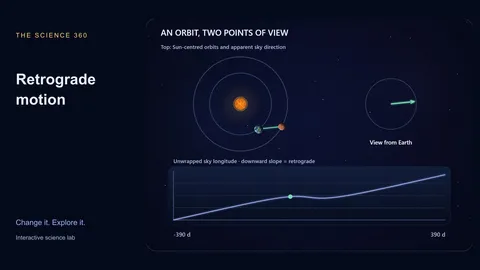
Why planets seem to move backward: retrograde motion explained
Use Earth’s moving viewpoint to explain Mars, Mercury and Venus retrograde motion, with a worked synodic-period example.
Why Are Planets Round but Asteroids Aren't? The Math
Gravity rounds a world once its central pressure beats the strength of rock or ice. We compute the threshold: about 200 km for ice, 300 km for rock.