Why stars twinkle—and why planets sometimes break the rule
A bright star seems to shake, flash and sometimes change colour. The surprising part is how close to home much of that drama begins: the air between you and space. Ordinary rapid twinkling is usually atmospheric scintillation, not the star repeatedly switching its light on and off.
The familiar shortcut—stars twinkle, planets do not—is useful, but incomplete. A planet low in a turbulent sky can twinkle too. The better question is why the same atmosphere affects a point-like star and a tiny planetary disk differently.
The star sends light. The atmosphere rearranges it.
NASA’s StarChild explanation locates the effect in our atmosphere: changing air bends arriving starlight, altering how much reaches the observer. The star need not change its output for its image here to fluctuate.
The relevant air is not simply “wind blowing the light sideways.” Temperature and density variations change how light propagates through it. As those variations evolve and move, the arriving light pattern changes. The Hong Kong Observatory’s discussion connects this to a more familiar sight: distant objects shimmering above a hot road.
Refraction is part of the explanation; a full optical treatment also involves wave propagation. The everyday consequence is a restless image and changing intensity at your eye. Our diagram is deliberately simpler than that full calculation.
Why a planet gets an averaging advantage
A star is physically enormous, but its great distance makes its angular size extremely small for ordinary viewing. For this problem it behaves approximately as a point source. A planet can be physically much smaller yet occupy a larger angle in our sky.
University of Wisconsin–Madison astronomer James Lattis explains that light from different parts of a planet’s apparent disk follows slightly different paths through the atmosphere. Distortions across those contributions partly average out. The combined light therefore tends to look steadier than a star’s.
This is about apparent extent, not whether an object makes its own light. A planet does not avoid scintillation merely because it reflects sunlight. Nor is a star’s distance a magical shield or amplifier on its own: distance matters here because of the angular size it produces.

Original schematic informed by the NASA and university explanations. Source sizes, ray paths and distances are illustrative, not to scale. This is not a measured light curve or a numerical atmospheric simulation.
The exception makes the explanation more useful
The Astronomical League’s observing note explicitly qualifies the rule: under especially turbulent conditions, particularly low in the sky, planets can twinkle to the unaided eye. Through a telescope, atmospheric distortion can also make their images shimmer or blur.
That does not overturn the averaging explanation. Averaging reduces the effect under ordinary conditions; it does not promise perfect cancellation in every view. A low object is also being observed through a longer path through the atmosphere than an object high overhead. NASA notes the stronger twinkling often seen near the horizon.
So “it twinkles” is evidence about the view, not a reliable identification by itself. Check a current sky chart, the object’s direction, and the time. A distant aircraft, a star and a planet should not be classified from one flicker alone.
Try a comparison that keeps the question fair
On a clear evening, use a current sky chart to identify a bright star and a visible planet. The NASA skywatching guide is a starting point; which planets you can actually see depends on your location, date, obstructions and weather.
- Observe from a safe stationary spot with a clear view. Avoid looking across a warm roof, exhaust plume or strongly heated road if you can.
- Note the time, object names and whether each is low, midway up or high in the sky. Compare objects at roughly similar heights where practical.
- Watch each for the same short interval and describe what you see: brightness changes, colour flashes, image movement, or no obvious change. Do not invent a numerical twinkling score from memory.
- Repeat later, or on another evening, and record the conditions. A changed appearance is a reason to investigate the viewing conditions, not instant proof that the source changed.
A phone recording can document the observation, but automatic exposure, focus hunting, digital processing and camera movement can create additional variation. Keep settings and support as consistent as possible. This is a comparison exercise, not calibrated photometry.
Some stars really do vary
Atmospheric twinkling is not the only reason a celestial object changes brightness. Variable stars and eclipsing systems can genuinely change their observed light. Sky & Telescope’s explanation separates these source changes from ordinary scintillation.
Do not try to distinguish every possible phenomenon from its timescale alone. Astronomers use repeated, controlled measurements and comparison stars to study variability. For casual observing, the important distinction is between a changing source and a changing path from that source to your detector.
Our Moon-illusion camera test asks a related experimental question: how can you separate what a source is doing from what perception, atmosphere or equipment adds? In both cases, the surprising sky becomes more understandable when you examine the whole route from object to observer.
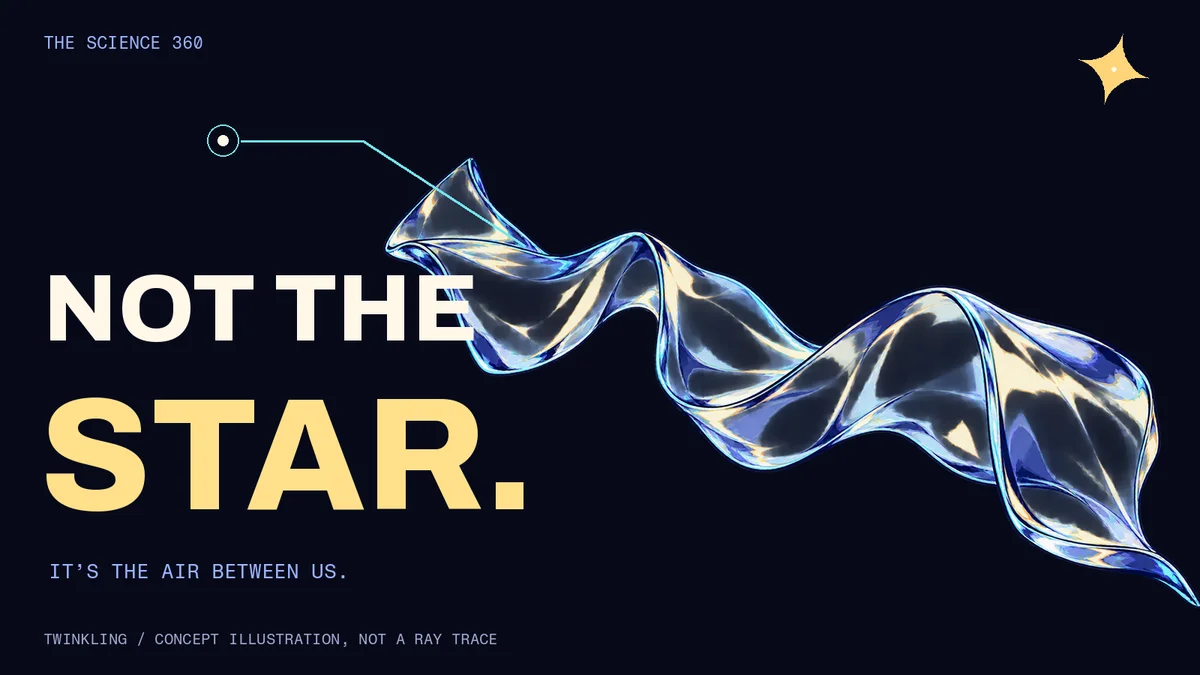
Cover: an AI-assisted glass-ribbon element, representing changing air, combined with original drawn points, lettering and the publication’s star. It is a conceptual collage, not a photograph or a scientific model of atmospheric layers.