How many times will my power bank charge my phone?
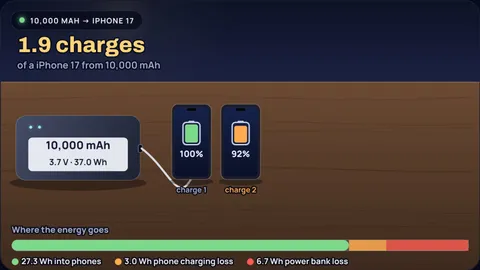
Fewer times than dividing the mAh suggests. A 10,000 mAh power bank charges an iPhone 17 (3,692 mAh) about 1.9 times, not the 2.7 that 10,000 ÷ 3,692 promises; a 20,000 mAh bank gives an iPhone 17 Pro Max about 2.8 charges. The power bank's mAh are counted at its 3.7 V cell voltage, and about a quarter of the energy is lost as heat on the way into the phone.
The calculator uses Anker's typical 82% output efficiency and an assumed 90% for the phone's own charging, both adjustable. The companion post explains each loss; why phone charging slows after 80 percent covers what happens inside the phone, and the mAh to Wh converter handles airline limits.
Key results from the calculator
- 10,000 mAh: about 1.9 charges of an iPhone 17, 1.4 of a Galaxy S25 Ultra (5,000 mAh).
- 20,000 mAh: about 2.8 charges of an iPhone 17 Pro Max (5,088 mAh).
- Only about 74% arrives: of a 10,000 mAh bank's 37.0 Wh, 30.3 Wh leaves the USB port and 27.3 Wh ends up in the phone battery.
- The output at 5 V of a 10,000 mAh bank is about 6,068 mAh, the same figure Anker gives in its own explanation.
Six power banks and phones
Each example loads the power bank, the phone and the efficiencies. Phone capacities are the makers' published typical values.
10,000 mAh and an iPhone 17
Most common pairing37 Wh in the cells, 30.3 Wh out of the port, 27.3 Wh into the phone. The iPhone 17's 3,692 mAh battery at 3.85 V holds 14.2 Wh, so that is 1.9 charges.
20,000 mAh and an iPhone 17 Pro Max
Big bank, big phoneThe 17 Pro Max has a 5,088 mAh battery, so even a 20,000 mAh bank gives only about 2.8 full charges.
10,000 mAh and a Galaxy S25 Ultra
Large Android phoneSamsung gives the S25 Ultra a typical 5,000 mAh (rated minimum 4,855 mAh). A 10,000 mAh bank charges it about 1.4 times: one full charge and a good part of a second.
5,000 mAh and a Pixel 10
Small bankA slim 5,000 mAh bank holds 18.5 Wh. The Pixel 10's typical 4,970 mAh battery needs about 19.1 Wh, so the bank gets it to only about 71%, despite the near-identical mAh numbers.
27,000 mAh, Galaxy S25, from 20%
Topping upMost people recharge before the phone is flat. Starting each charge at 20%, the largest airline-friendly bank tops up a 4,000 mAh Galaxy S25 about 6.0 times.
A poor power bank, 64% efficient
Cheap circuitryZendure's guide works through a pack that delivers only 63.75% of its rated energy. At 64%, a 10,000 mAh bank charges an iPhone 17 about 1.5 times instead of 1.9.
Phone charges by power bank size (82% and 90% efficiency, from 0%)
| Power bank | iPhone 17 | iPhone 17 Pro Max | Galaxy S25 | Galaxy S25 Ultra | Pixel 10 |
|---|---|---|---|---|---|
| 5,000 mAh | 1.0 | 0.7 | 0.9 | 0.7 | 0.7 |
| 10,000 mAh | 1.9 | 1.4 | 1.8 | 1.4 | 1.4 |
| 20,000 mAh | 3.8 | 2.8 | 3.5 | 2.8 | 2.9 |
| 27,000 mAh | 5.2 | 3.8 | 4.8 | 3.8 | 3.9 |
Phone capacities: Apple EU energy labels (reported by MacRumors), Samsung Newsroom typical values, Google Store typical value. Phone battery taken at 3.85 V. Real results vary with heat, cable, charging speed and whether the phone is in use.
How the calculator works
Power bank energy: the mAh on the label belongs to the lithium ion cells inside, at about 3.7 V. Anker's own example: 10,000 mAh × 3.7 V = 37 Wh.
Power bank losses: the circuit that raises 3.7 V to the USB voltage, and the cells' own resistance, turn some energy into heat. Anker gives 82% as a typical efficiency, so 37 Wh becomes about 30 Wh at the port, or 6,068 mAh counted at 5 V.
Phone losses: the phone's charging chip converts the USB voltage back down to its battery, and the battery warms as it charges. Phone makers do not publish this figure; the calculator assumes 90% and lets you change it.
Phone battery energy: the phone's mAh times its battery's nominal voltage, taken as 3.85 V for current phones (adjustable). Charges = energy into the phone ÷ the phone battery's energy for the part you recharge.
What the model leaves out
- Using the phone while it charges: the screen and radios use some of the energy, so you get fewer charges.
- Wireless charging: charging through a coil loses more than a cable. Use a lower phone efficiency for it.
- Battery ageing: an old phone battery holds less, so the bank charges it more times, each one shorter.
- Cold and heat: both reduce what a power bank delivers and can pause charging.
Common misconceptions
"10,000 mAh will charge my 5,000 mAh phone twice." The two mAh numbers are at different voltages and the conversion loses energy. Expect about 1.3 to 1.5 charges.
"The power bank is faulty because it gave less than its rating." A shortfall of a quarter to a third is normal. Anker and Zendure both explain it.
"Fast charging wastes more of the power bank." Higher power does run warmer, but the main losses are the voltage conversion in the bank and the phone.
Frequently asked questions
How many times can a 10,000 mAh power bank charge an iPhone?
About 1.9 times for an iPhone 17 (3,692 mAh), with typical losses. Larger iPhones get fewer: about 1.4 for a 17 Pro Max.
How many times can a 20,000 mAh power bank charge a phone?
Between about 2.8 and 3.8 times for current iPhones, and about 2.8 for a 5,000 mAh Galaxy S25 Ultra.
Why does my power bank not give its full mAh?
Its mAh is counted at the cells' 3.7 V, not the 5 V USB output, and the voltage conversion and the phone's own charging lose some energy as heat. Typically about three quarters of the energy reaches the phone battery.
How efficient is a power bank?
Anker gives about 82% as typical for the power bank itself. Cheap ones can be lower: Zendure works through an example that delivers 64% of its rated energy.
Is it better to compare power banks in Wh?
Yes. Wh is energy and does not depend on the voltage it is counted at. A 10,000 mAh bank at 3.7 V is 37 Wh.
Keep learning
Why a 10000 mAh Power Bank Does Not Give 10000 mAh to Your Phone
A 10,000 mAh power bank charges a 3,692 mAh iPhone 17 about 1.9 times, not 2.7. Where the missing energy goes: cell voltage, conversion losses and the phone's own charging.

Why Phone Charging Slows After 80%: The CC-CV Curve
Fast charging fills a phone from 0 to 70% at full current, then a fixed voltage limit makes the current taper. The physics, the plating risk and the math.
Can You Take a 20000 mAh Power Bank on a Plane?
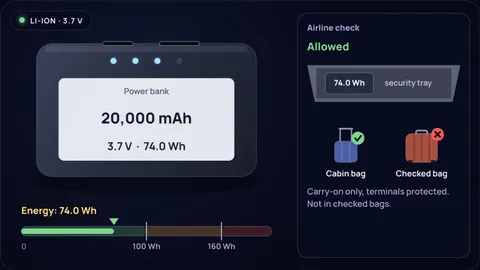
Yes, in your cabin bag: a 20,000 mAh power bank is 74 Wh, under the 100 Wh limit. How to convert mAh to Wh, the FAA and IATA rules, the 5 V mistake, and the newer limits on using power banks in flight.

How Does Wireless Charging Work? Coils, Coupling, Heat
Qi charging is a loosely coupled resonant transformer at 110 to 205 kHz. The coupling maths, why coils are not the main loss, and where heat comes from.