Can You Take a 20000 mAh Power Bank on a Plane?
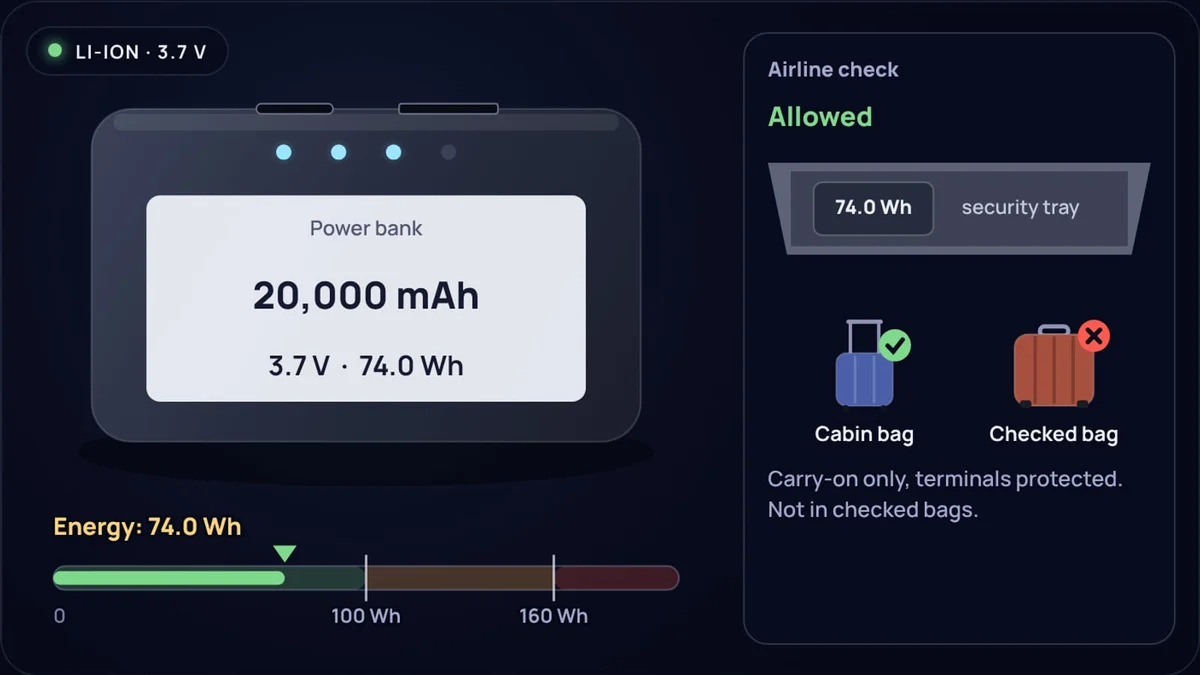
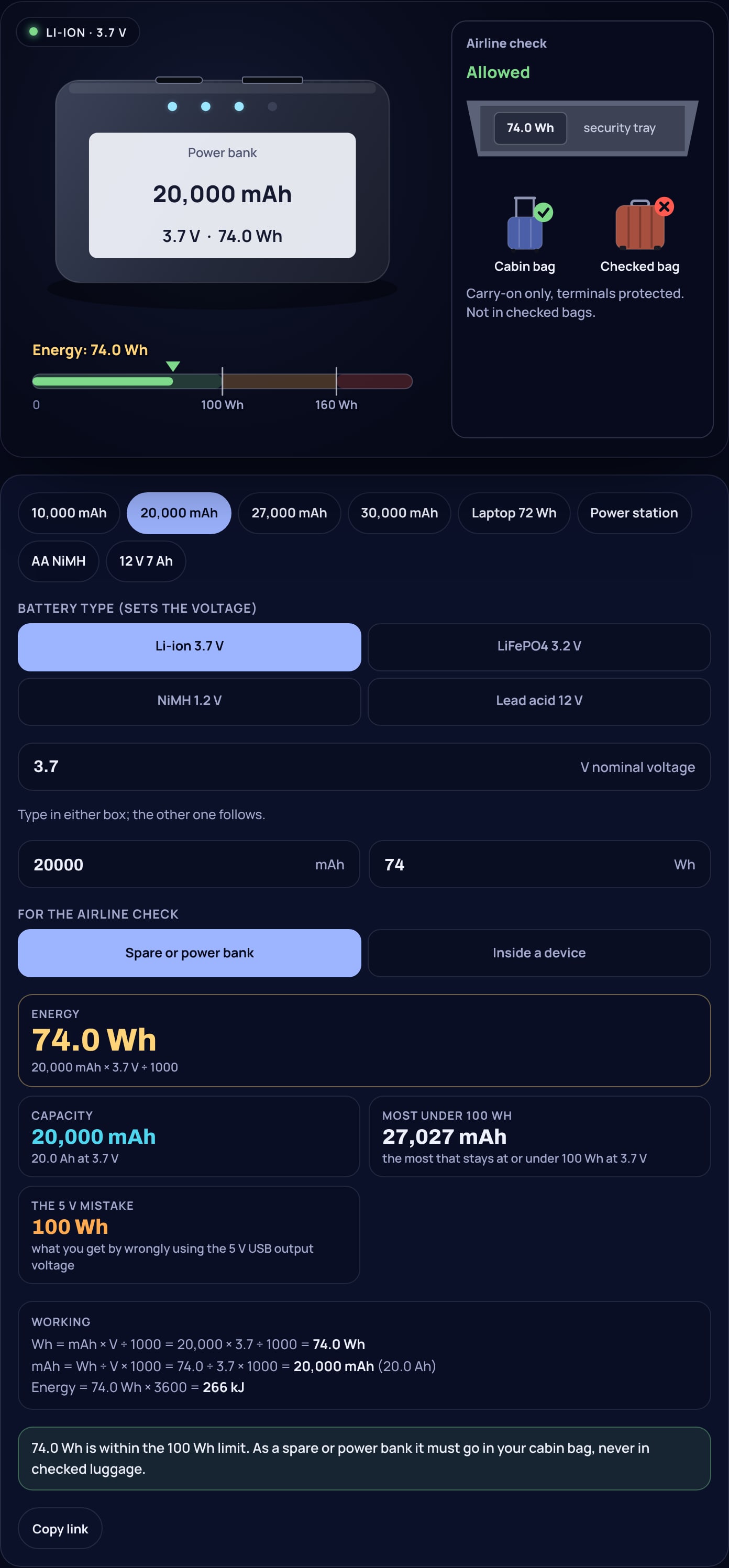
Airport security staff do not ask how many mAh your power bank has. The rules are written in watt hours, Wh, and the limit that matters is 100. A 20,000 mAh power bank sounds big, but its lithium ion cells run at 3.7 volts, and 20 amp hours at 3.7 V is 74 Wh. It flies, in your cabin bag.
This post shows how to turn the mAh number on a power bank into Wh, what the FAA and IATA rules actually say, and why a 30,000 mAh pack is a different story. You can check any battery in the mAh to Wh converter, which draws the battery with its label and runs the airline check for you.
How do you convert mAh to Wh?
A battery's mAh rating is its charge: how many milliamps it could supply for one hour. Energy also depends on the voltage at which that charge is delivered. The FAA's PackSafe page puts it in one line: to calculate Wh, multiply the battery voltage by the amp hours.
Example 1: a 20,000 mAh power bank
The cells inside are lithium ion with a nominal voltage of 3.7 V, which is printed on the label.
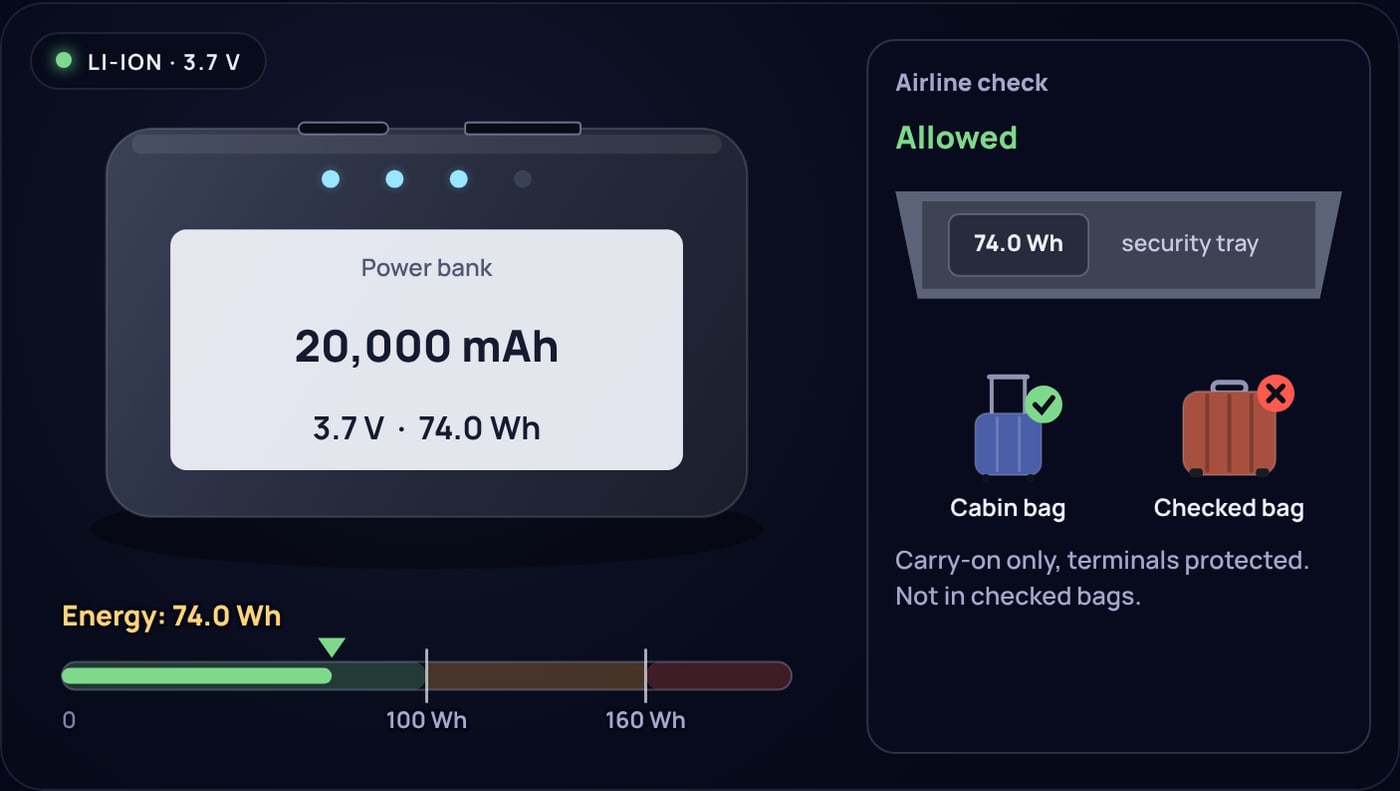
74 Wh is under 100 Wh, so no approval is needed. As a spare battery it goes in the cabin only.
What are the airline rules for power banks?
In the United States the FAA sets the rules, and most of the world follows the same numbers from IATA, the airline industry body. Both treat a power bank as a spare battery, because its job is to power something else. The FAA page, last updated in August 2026, and IATA's passenger guidance agree on four points:
- Spare lithium batteries and power banks are carry-on only. If your cabin bag is taken at the gate to go in the hold, you must take the power bank out first.
- Up to 100 Wh per battery is allowed without asking anyone. The FAA notes this covers nearly all batteries the average person uses.
- Over 100 Wh up to 160 Wh needs the airline's approval, and you may carry at most two such spares.
- Over 160 Wh is not allowed in passenger baggage. IATA's table says such batteries must be prepared and carried as cargo under the dangerous goods regulations.
The terminals must also be protected from short circuits: in the retail packaging, taped over, or in their own pouch. IATA's guidance also caps each passenger at 20 spare batteries of any type, unless the airline agrees to more.
| Battery | Wh | Cabin | Checked bag |
|---|---|---|---|
| Power bank up to 100 Wh | ≤ 100 | Yes | No |
| Power bank 100 to 160 Wh | 101 to 160 | With airline approval, max 2 | No |
| Laptop battery in the laptop | ≤ 100 | Yes | Yes, switched off |
| Anything over 160 Wh | > 160 | No | No |
Where is the 100 Wh limit in mAh?
Turn the formula round to find the largest capacity that stays within 100 Wh.
Example 2: the biggest power bank under 100 Wh
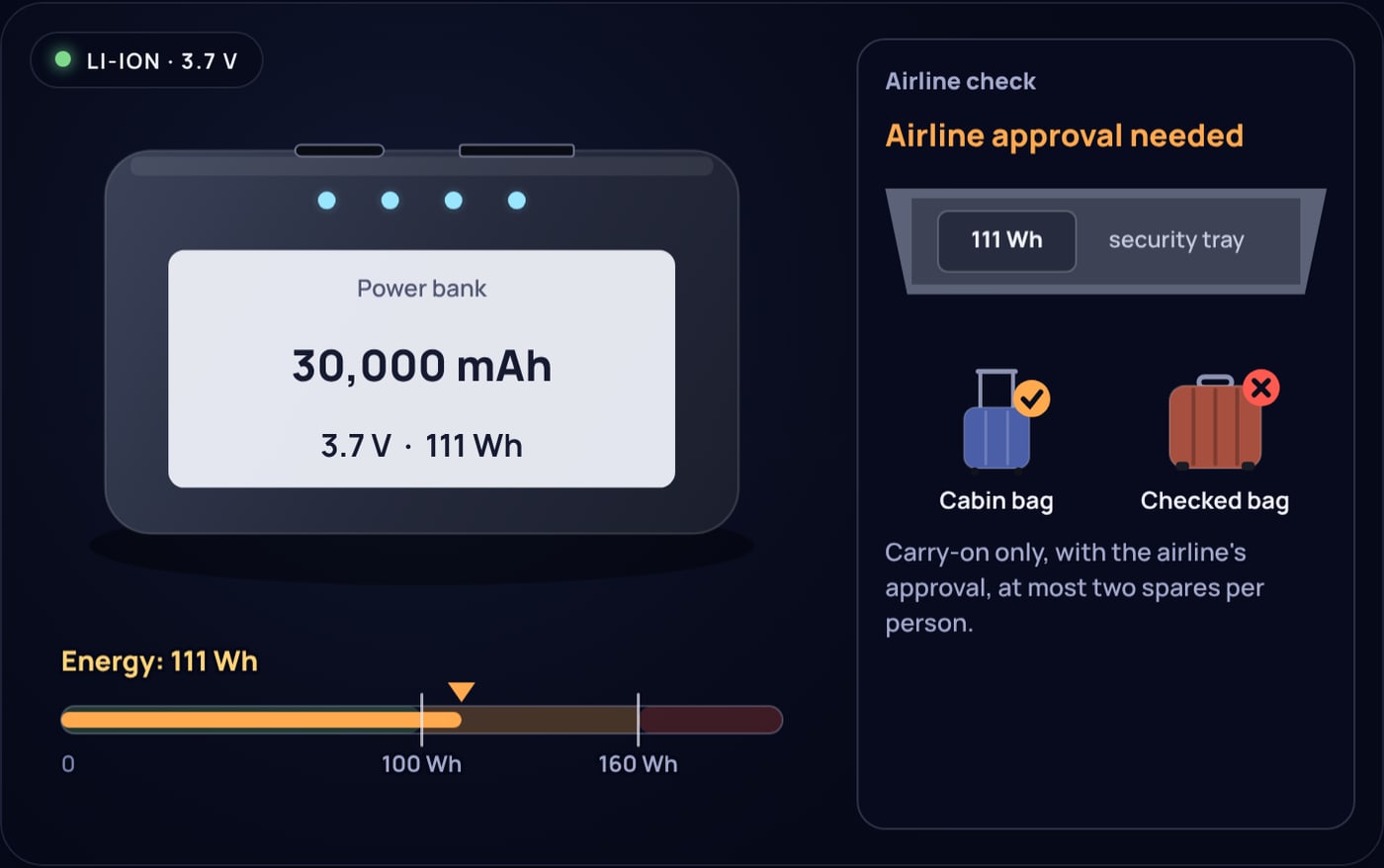
That is why the largest travel power banks stop at around 26,800 to 27,000 mAh. A 30,000 mAh pack at 3.7 V is 111 Wh.
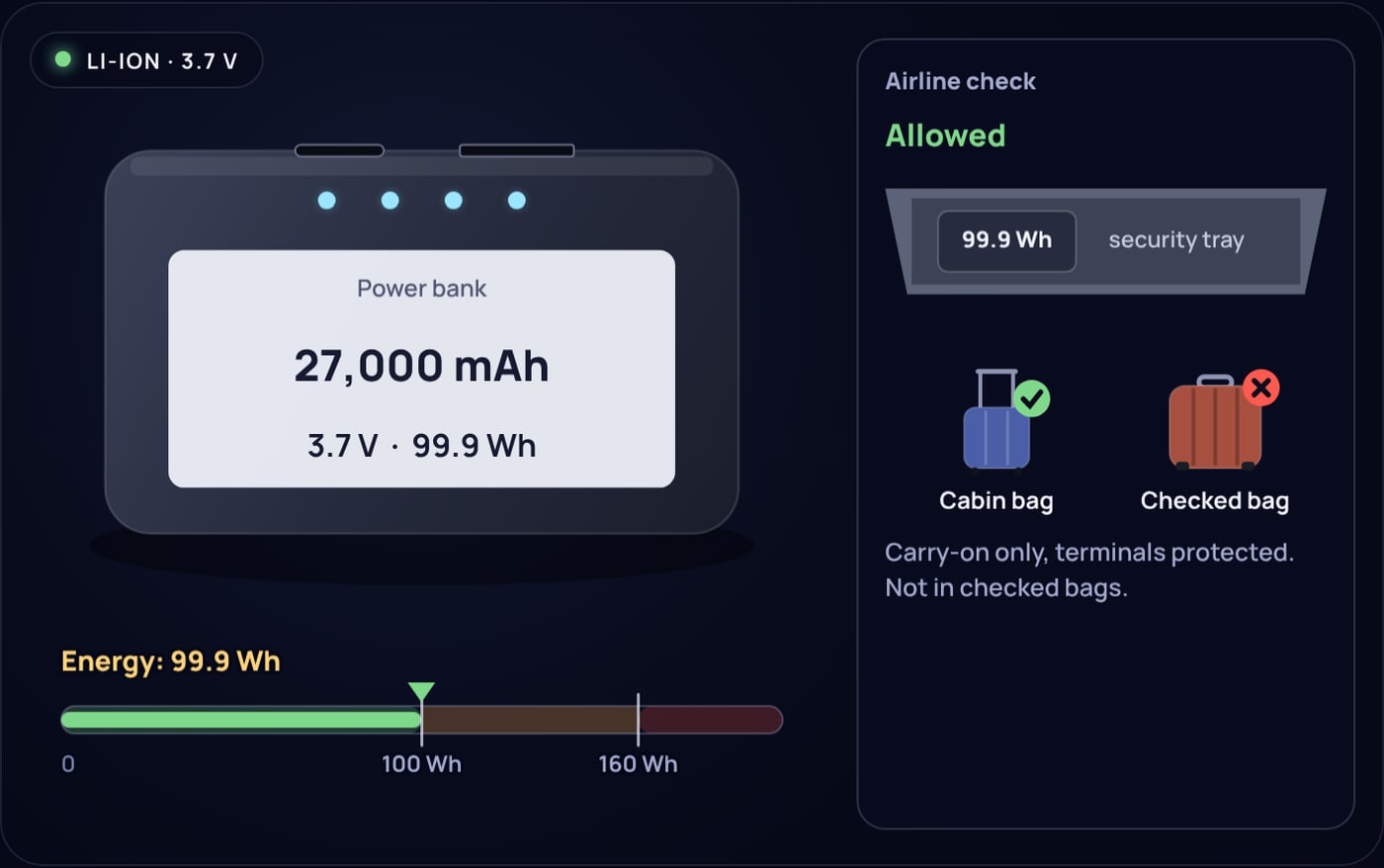
Cross 100 Wh and the rules change. A 30,000 mAh power bank needs the airline's approval, which means asking in advance, and some airlines will simply say no. Figure 3 shows it on the gauge.
Why not multiply by 5 volts?
Power banks charge phones through USB at 5 V or more, so it is tempting to use 5 V. That gives 20,000 mAh × 5 V = 100 Wh, right on the limit, and has sent plenty of people into a panic at the security belt.
The mAh figure on a power bank is the capacity of the cells inside, at their own voltage of about 3.6 to 3.7 V. The boost circuit raises that to 5 V for the USB port, and because energy is conserved (less some loss as heat), the current at 5 V is correspondingly smaller. The energy stored is set by the cells: 74 Wh. A well-made power bank prints the Wh figure on the label for exactly this reason, and the FAA notes that newer lithium ion batteries carry it.
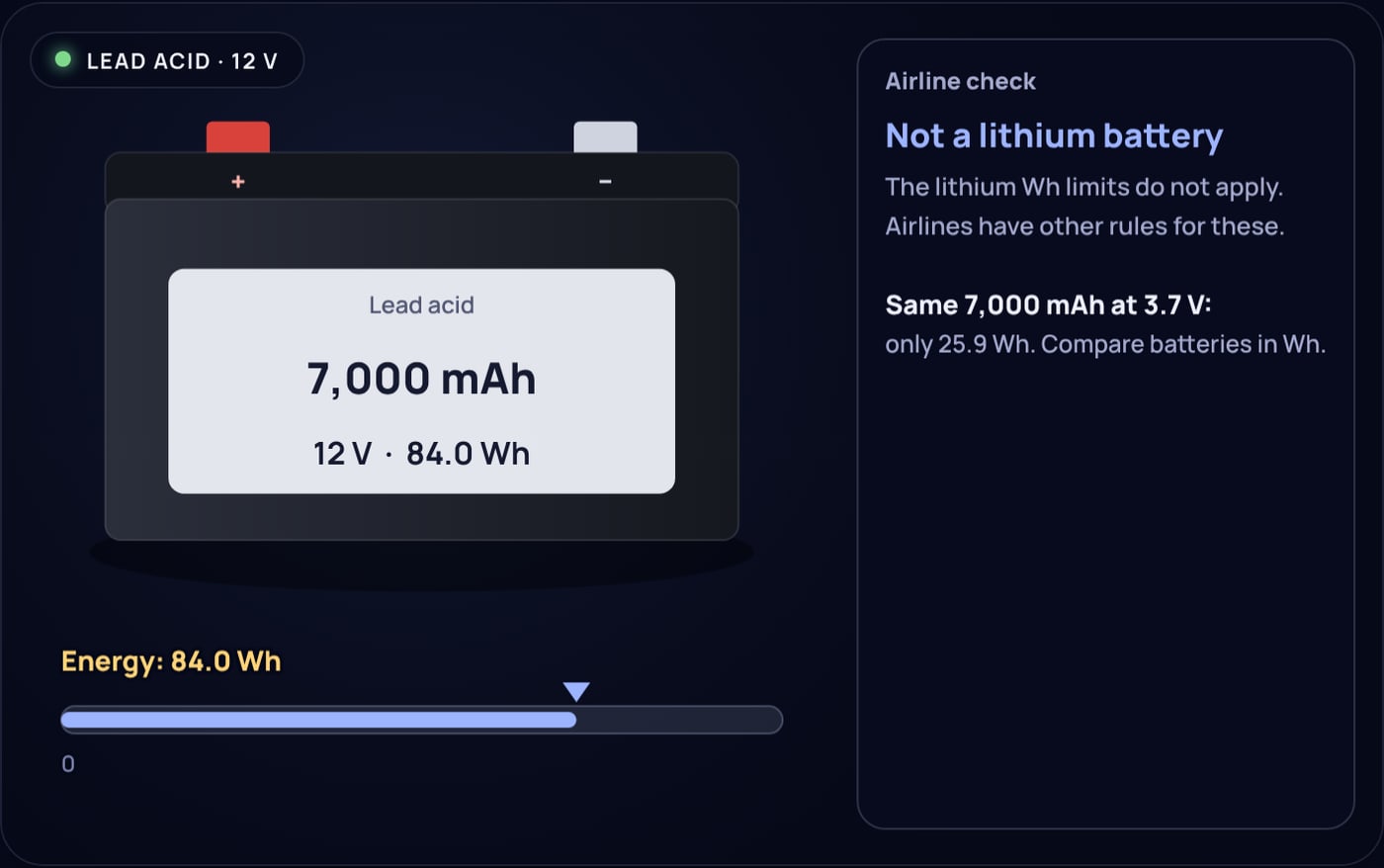
The same logic explains why the mAh number on its own tells you so little. A 12 V 7 Ah lead acid alarm battery is 7,000 mAh, and so is a modest 3.7 V lithium cell. One holds 84 Wh, the other 25.9 Wh (Figure 4). Always compare batteries in Wh.
What about power stations and laptop batteries?
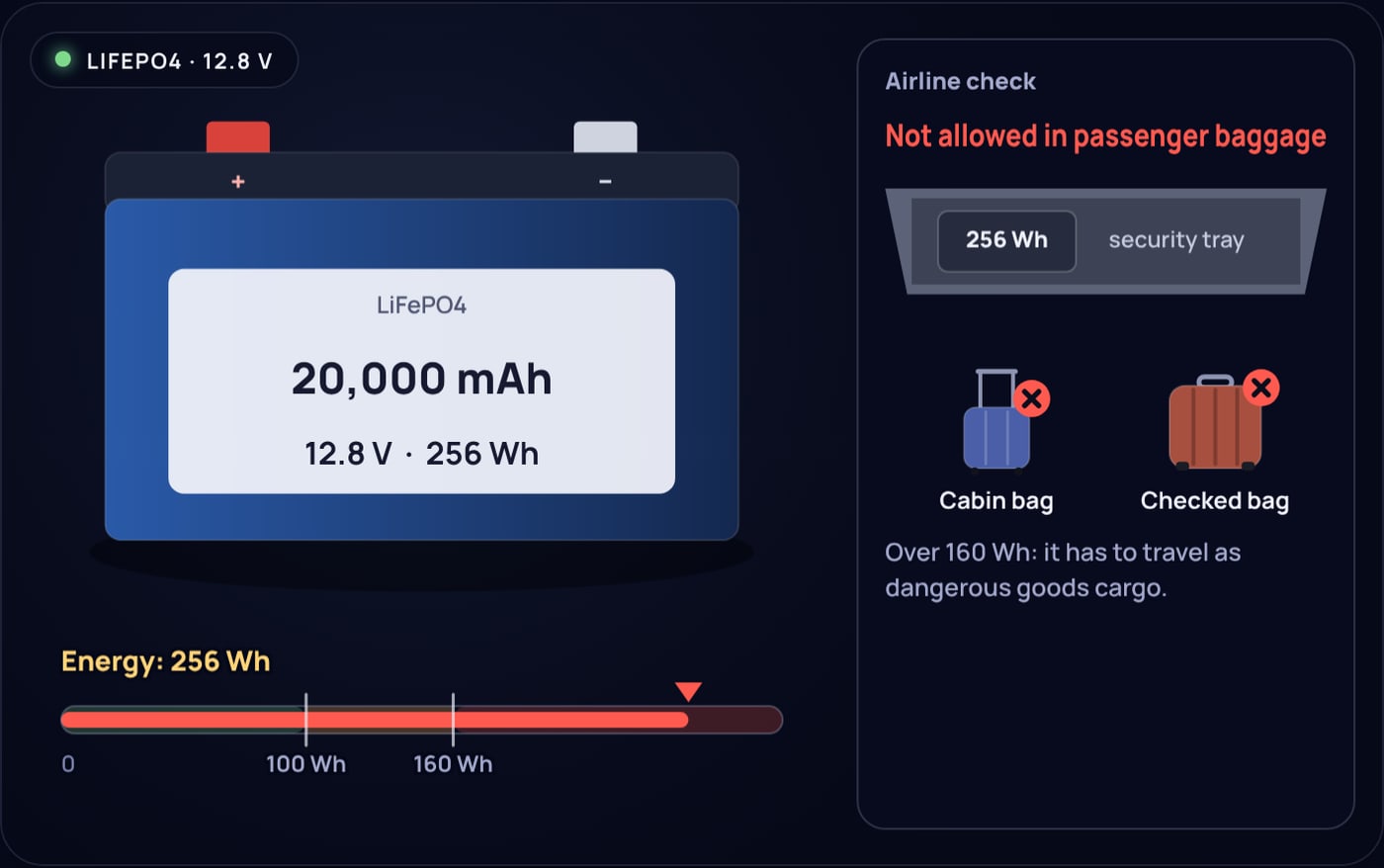
Camping power stations are a different class. Even a small one of 256 Wh, built from LiFePO4 cells at 12.8 V, is well over 160 Wh, so it cannot go in passenger baggage at all, in the cabin or in the hold (Figure 5).
Laptop batteries are usually labelled in Wh already, and nearly all are under 100 Wh. While installed in the laptop they count as a battery in a device, not a spare: the IATA table allows a device with a battery up to 100 Wh in either the cabin or checked bags. Spare laptop batteries follow the power bank rules.
Can you use a power bank during the flight?
The FAA and IATA rules cover carrying. Using a power bank in the air is increasingly up to the airline and the country. After a power bank was suspected of starting the fire that destroyed an Air Busan A321 before departure in January 2025, the airline banned power banks from overhead bins. In India, news reports in January 2026 described a DGCA Dangerous Goods Advisory Circular that stops passengers charging power banks from seat power sockets, and bans keeping power banks and spare lithium batteries in overhead bins.
The common thread is that a battery fire is easiest to deal with when someone can see it. Keep the power bank where you can reach it, in the seat pocket or your bag under the seat, and check the airline's own page before you fly, because these rules are changing quickly and the FAA itself warns that many airlines set stricter limits.
How to check your own power bank
- Look for the Wh figure on the label. If it is there, compare it with 100 and 160 and you are done.
- If only mAh is printed, find the cell voltage next to it, usually 3.6 V or 3.7 V, and multiply: mAh × V ÷ 1000.
- If no voltage is shown, assume 3.7 V for a lithium ion power bank, never the 5 V output.
- Pack it in your cabin bag with the cable unplugged and the ports protected.
Or type the numbers into the mAh to Wh converter, which does both directions and the airline check. How much of those 74 Wh actually reaches your phone is another question, since conversion and charging losses take a share; why phone charging slows after 80 percent covers what happens at the other end of the cable.
Sources
- FAA PackSafe: Lithium Batteries (carry-on only for spares and power banks, 100 Wh limit, 101 to 160 Wh with airline approval and two spares, Wh = V × Ah; last updated 11 August 2026)
- IATA: Passengers travelling with lithium batteries (table of limits, over 160 Wh as cargo, 20 spare batteries per person, power banks counted as spares; revision 3, 2019)
- India TV News: DGCA bans power banks for in-flight charging (4 January 2026 report on the DGCA Dangerous Goods Advisory Circular)
- Live from a Lounge: Indian aviation regulator implements ban on use of power banks on board (Air Busan fire, 28 January 2025, and overhead bin rules)
Frequently asked questions
Can I take a 20000 mAh power bank on a plane?
Yes, in your cabin bag. At the 3.7 V nominal voltage of its lithium ion cells it holds 74 Wh, under the 100 Wh limit set by the FAA and IATA. It must not go in checked luggage.
What is the biggest power bank I can take on a plane without approval?
Up to 100 Wh, which is about 27,000 mAh at 3.7 V. Between 100 and 160 Wh you need the airline’s approval and may carry at most two.
Can I put a power bank in checked luggage?
No. Spare lithium batteries and power banks of any size must be carried in the cabin, with their terminals protected from short circuits.
Can I use my power bank during the flight?
It depends on the airline and country. India’s DGCA, for example, stopped passengers charging power banks from seat sockets and banned keeping them in overhead bins in January 2026. Check your airline’s rules before you fly.
Why is my power bank’s Wh lower than mAh times 5 V?
Because the mAh figure is the capacity of the 3.6 to 3.7 V cells inside, not of the 5 V USB output. Wh is mAh times the cell voltage divided by 1000.