How Long Does a 10000mAh Power Bank Really Last?
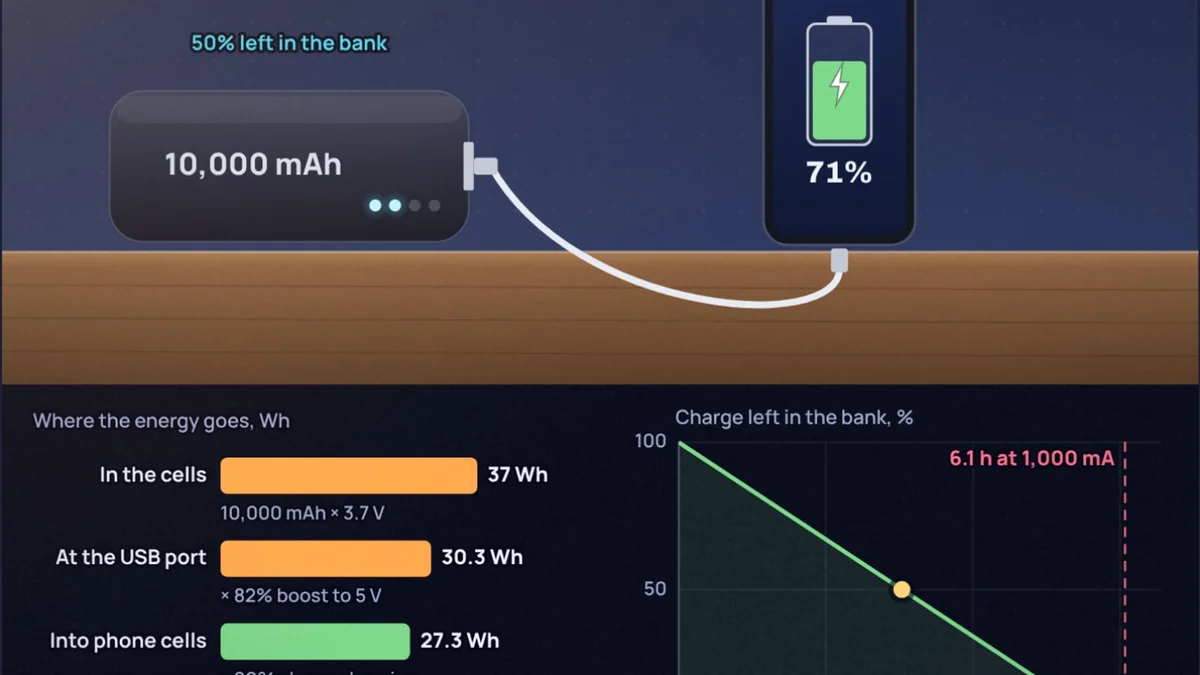
A power bank that says 10,000 mAh on the box will not put 10,000 mAh into your phone. It will not even put out 10,000 mAh at its USB port. Most people find that a 10,000 mAh bank fills a modern phone once and then gets about halfway through a second charge, and they assume the label is a lie. It is not a lie, but it is measured somewhere you never use it.
This post works through where the energy goes, with real numbers, and you can follow every step in the battery life calculator, which has a power bank mode that turns the label into watt-hours, then into what the USB port can deliver, then into phone charges.
What does the 10000 mAh on a power bank actually measure?
Milliamp hours measure electric charge: 10,000 mAh is a current of 10,000 mA (10 A) for one hour, or 1 A for ten hours. Charge on its own says nothing about energy. To get energy you multiply by the voltage the charge moves through.
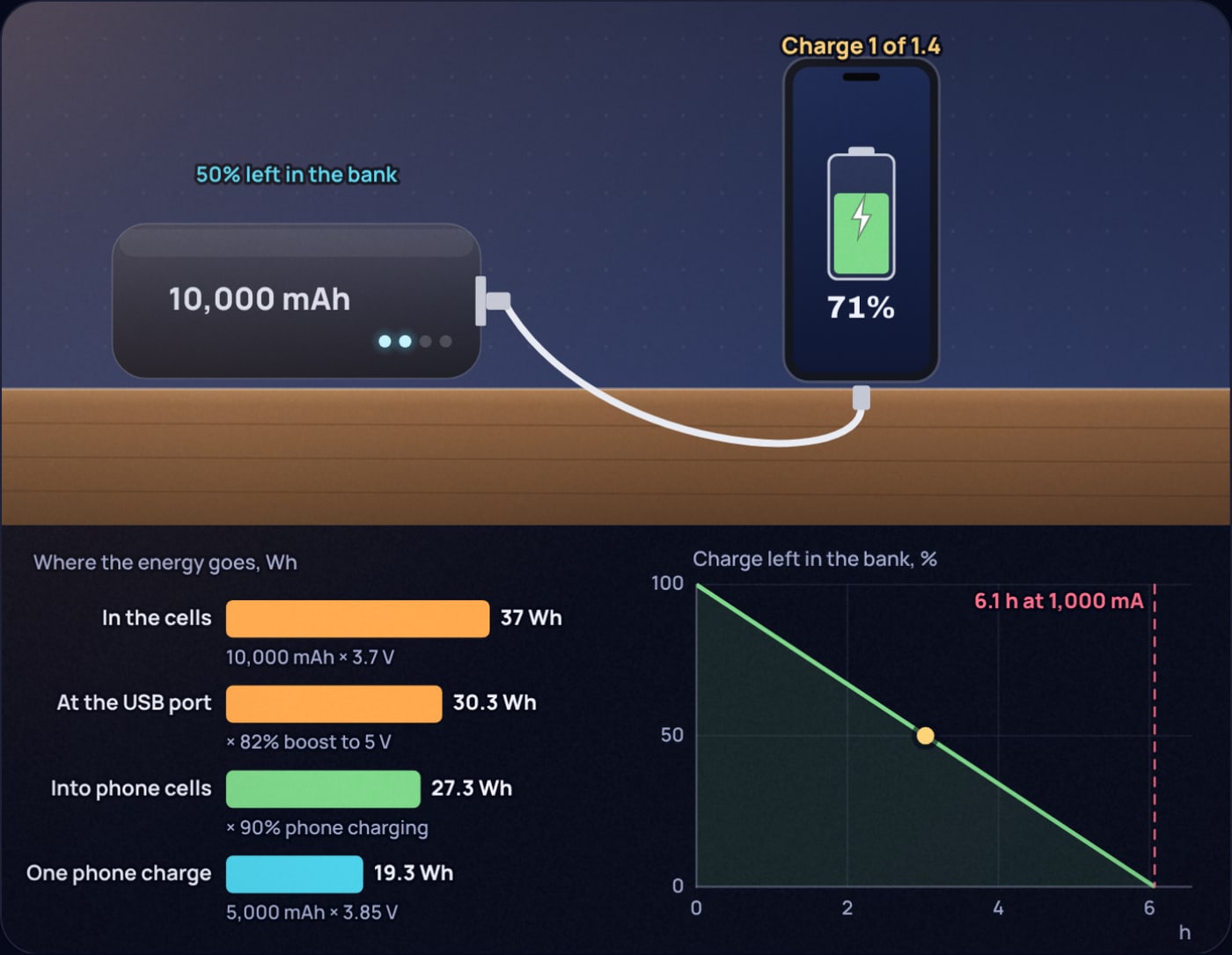
The 10,000 mAh on a power bank is the charge of the lithium-ion cells inside it, and those cells have a nominal voltage of about 3.6 to 3.7 V. Anker's support page on the subject uses 3.7 V, and so does almost every bank's fine print. So the energy in the cells is
That 37 Wh is the honest number. If the box printed it in watt-hours, nobody would be disappointed, because a phone battery's energy is also a matter of watt-hours. The trouble starts because the USB port does not run at 3.7 V.
Why does the voltage change the mAh?
A USB port supplies 5 V (more with fast charging, which comes later). To get 5 V out of 3.7 V cells the bank has a boost converter, a small switching circuit that raises the voltage. Energy is conserved, so if the voltage goes up, the charge at the higher voltage goes down in proportion. Even a perfect converter turns 37 Wh into
Nothing has been lost yet. The same energy is simply counted at a higher voltage. This is the single biggest reason a 10,000 mAh bank seems to shrink, and it is pure arithmetic. A battery tester plugged into the USB port measures milliamp hours at 5 V, so it will never read 10,000 even on a perfect bank.
How much does the conversion lose?
Real converters are not perfect. Anker's support article puts the typical efficiency at about 82 percent and works the same example: 10,000 mAh at 3.7 V becomes about 6,068 mAh at 5 V. The losses are heat in the converter's switch, inductor and diode, the cells' internal resistance, and the bank's own electronics, such as the indicator LEDs and the protection circuit.
Energy in the cells:
Energy out at 82 percent:
Charge at 5 V:
Share of the label:
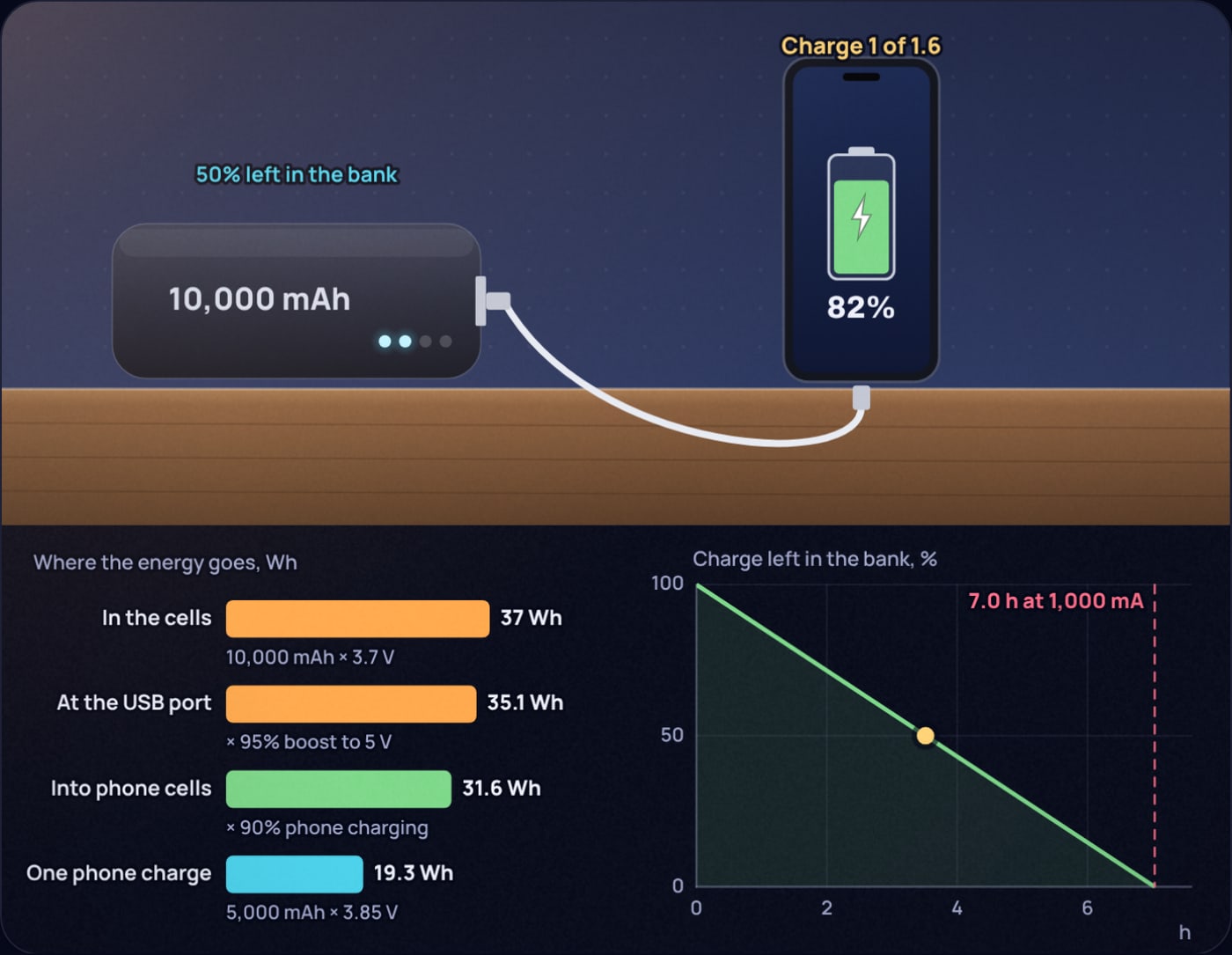
So about 61 percent of the label number arrives at the port. Many banks print this second figure in small type as a "rated capacity" at 5 V, and it is the more useful one. The efficiency varies with the design and the current. The simulator lets you move it; at 95 percent, the best a very good converter might manage at a moderate load, the port gets 35.1 Wh, which is 7,030 mAh. Even then, a perfect bank cannot beat 7,400 mAh at 5 V.
How many phone charges is that?
Now the other end of the cable. A phone battery is also a lithium-ion cell, and its label also gives mAh at its own nominal voltage, typically about 3.85 V for current phones (some older ones are 3.7 or 3.8 V). A 5,000 mAh phone battery, a common size in Android phones, holds
The phone does not store everything that arrives at its USB socket either. Its own charging circuit steps 5 V down to the cell voltage and warms up in the process. The simulator assumes 90 percent for that stage, which is a reasonable figure for a modern switching charger but varies from phone to phone.
Energy at the bank's port:
Energy stored in the phone at 90 percent:
One full phone charge:
Charges:
One and four tenths of a charge, from a bank whose label is exactly twice the phone's. Overall, about 74 percent of the energy in the bank's cells ends up in the phone's cell, and the rest is heat. That matches what most owners report from the real thing, which is reassuring: the arithmetic explains the disappointment without any need for fake ratings.
The table below runs the same sum for other phone sizes and for 5,000 and 20,000 mAh banks, all at 82 percent bank efficiency and 90 percent phone charging efficiency.
| Phone battery | Energy at 3.85 V | 5,000 mAh bank | 10,000 mAh bank | 20,000 mAh bank |
|---|---|---|---|---|
| 3,000 mAh | 11.6 Wh | 1.18 charges | 2.36 charges | 4.73 charges |
| 4,000 mAh | 15.4 Wh | 0.89 charges | 1.77 charges | 3.55 charges |
| 4,500 mAh | 17.3 Wh | 0.79 charges | 1.58 charges | 3.15 charges |
| 5,000 mAh | 19.3 Wh | 0.71 charges | 1.42 charges | 2.84 charges |
| 6,000 mAh | 23.1 Wh | 0.59 charges | 1.18 charges | 2.36 charges |
A handy rule from the table: divide the bank's mAh by the phone's mAh and multiply by about 0.7. That gives 1.4 for a 10,000 mAh bank and a 5,000 mAh phone, and works across the range because both batteries are lithium cells near 3.7 to 3.85 V.
How many hours will it run a device?
For things that draw a steady current from the USB port, such as a desk fan, an LED light, a camera or a Raspberry Pi, divide the 5 V charge by the current:
At 1,000 mA that is 6.1 hours, the case drawn in Figure 1. At 2,000 mA it is about 3 hours, and a small USB fan on 500 mA runs about 12 hours. Those currents are measured at 5 V. If your gadget's current is quoted at its own battery voltage, convert through watt-hours instead, the same way as the phone.
The bank's efficiency is not fixed. At high currents its own cells' internal resistance and the converter's losses grow, so 2 A or more tends to deliver a little less in total than 1 A. At very low currents a different problem appears.
Why does a power bank switch off with small gadgets?
Most power banks turn their output off when the current falls below some threshold, often a few tens of milliamps, because they assume the phone has finished charging. That saves the bank from draining itself through the converter's idle current, but it is annoying if you want to run a microcontroller project or a sensor that draws very little.
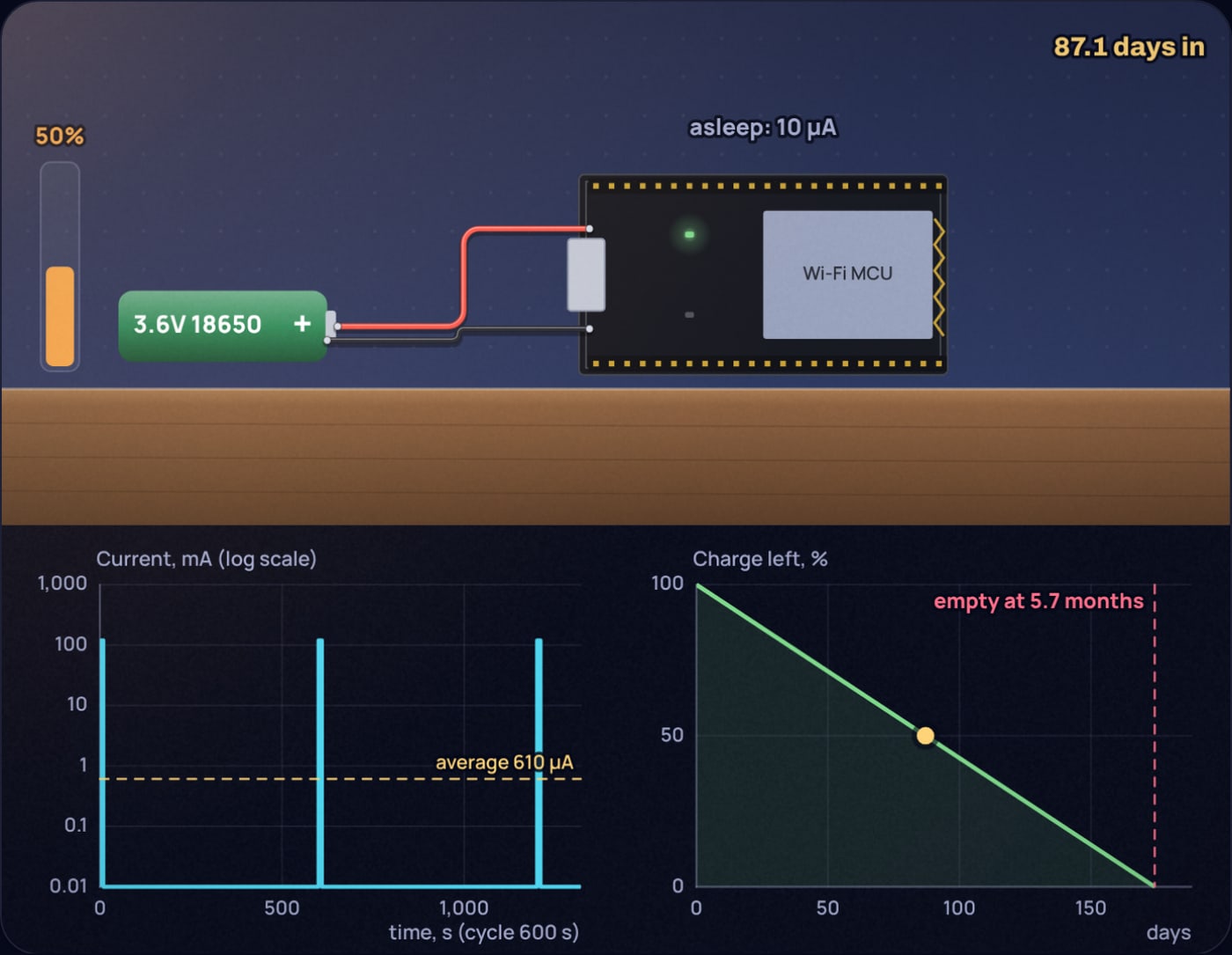
For those projects a bare lithium cell and a sleep and wake cycle usually beat a power bank. The battery life calculator's duty-cycle mode works out the average: an ESP32 sensor that wakes at about 120 mA for 3 seconds every 10 minutes and sleeps at 10 µA averages 610 µA, so a 3,000 mAh 18650 cell lasts about 5.7 months at 85 percent usable capacity.
Does fast charging waste more of the bank?
Fast charging over USB Power Delivery or Quick Charge raises the voltage, for example to 9 V, so the same power flows at a lower current. Counted at 9 V, the bank's 30 Wh is only about 3,370 mAh, which looks alarming but is the same energy again. What matters is the energy that reaches the phone's cell.
There is a real cost, but it is small. Higher power means more heat in the bank's converter and in the phone, and phones slow their charging as the battery fills, which is explained in why phone charging slows after 80 percent. Expect a few percent difference between slow and fast charging, not a third.
The misconception: “my power bank has fake capacity”
Some cheap banks really do overstate their cells. But a bank that delivers about 6,000 mAh at 5 V from a 10,000 mAh label is behaving exactly as physics and its datasheet say. The way to check a bank is a USB meter that reads watt-hours: a genuine 10,000 mAh bank should deliver around 30 Wh, roughly 26 to 33 Wh depending on its efficiency and the load. If yours delivers 15 Wh, then it is short.
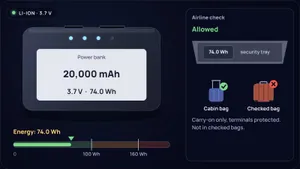
The deeper fix is to think in watt-hours. The airline rules for spare lithium batteries are written in Wh, with the common limit at 100 Wh, which is why bank makers print Wh on the case. A 20,000 mAh bank at 3.7 V is 74 Wh, comfortably under that limit. The same thinking applies to big batteries: the post on how long a 150 Ah inverter battery lasts does the identical sum at 12 V, and the LiPo C rating explainer covers what happens when a lithium cell is asked for a lot of current at once.
What else eats into the capacity?
Three things the simple sum leaves out are worth knowing about. Cold reduces what a lithium cell can deliver, so a bank left in a car in winter gives less. Ageing reduces capacity with each charge cycle; a two year old bank that has been charged most days has noticeably less. And lithium-ion cells slowly self-discharge on a shelf, so a bank charged months ago and left in a drawer will not be full.
None of these explains the 40 percent gap on a new bank, though. That gap is the 3.7 V to 5 V conversion plus about 18 percent of converter loss, and it applies to every honest power bank on the market.
Try it yourself
Open the power bank setup in the battery life calculator and change the phone size to your own phone's battery, or the efficiency to see what a better bank would give. Then switch to the steady load or sleep and wake modes to see how long a coin cell, a pair of AA cells or an ESP32 project would last on a battery of your choice.
Sources
- Anker support: why the rated capacity on a power bank is lower than expected (3.7 V cells, 5 V output, about 82 percent efficiency, 6,068 mAh from 10,000 mAh)
- Energizer E91 AA alkaline datasheet (capacity against discharge current)
- Espressif: low power mode fundamentals for ESP chips (active and deep sleep currents)
- Lucidar: measured power consumption of ESP32 boards in deep sleep
Frequently asked questions
How many times can a 10000mAh power bank charge a phone?
About 1.4 times for a phone with a 5000 mAh battery, about 1.8 times for a 4000 mAh battery and about 2.4 times for a 3000 mAh battery. The bank’s cells hold 37 Wh, about 30 Wh reach the USB port, and the phone loses roughly another 10 percent while charging.
Why does my 10000mAh power bank only give about 6000mAh?
The 10,000 mAh is measured at the 3.7 V of the lithium cells inside. The USB port runs at 5 V, so the same energy is only 7400 mAh at 5 V even with a perfect converter. The boost converter loses about 18 percent more, which leaves about 6068 mAh.
How many hours will a 10000mAh power bank last?
About 6 hours at a steady 1 A from the 5 V port, about 3 hours at 2 A and about 12 hours at 0.5 A, assuming 82 percent conversion efficiency. Divide about 6068 mAh by the current you draw in mA.
Is mAh or Wh the better way to compare power banks?
Wh. mAh only compares batteries at the same voltage, while Wh is energy and stays meaningful from the 3.7 V cells to a 5 V or 9 V output. A 10000 mAh bank with 3.7 V cells holds 37 Wh.
Does fast charging use more of the power bank?
Not much. Fast charging raises the voltage, for example to 9 V, which lowers the current, so the mAh at the port looks even smaller but the Wh delivered is about the same. Heat in the phone and the bank can cost a few percent extra.