How do I convert mAh to Wh?
Multiply the capacity in amp hours by the voltage. A 20,000 mAh power bank is 20 Ah × 3.7 V = 74.0 Wh, comfortably under the 100 Wh airline limit; 27,000 mAh is 99.9 Wh, just under it. The voltage to use is the battery's nominal voltage printed on the label, 3.7 V for most lithium ion power banks, not the 5 V of the USB port.
The converter works both ways and for other chemistries, and draws the airline check from the FAA and IATA rules. The companion post covers flying with power banks in detail; for how charging behaves once the energy is in the battery, see why phone charging slows after 80 percent.
Key results from the converter
- Common power banks at 3.7 V: 10,000 mAh is 37.0 Wh, 20,000 mAh is 74.0 Wh, 27,000 mAh is 99.9 Wh and 30,000 mAh is 111 Wh.
- The largest lithium ion battery under 100 Wh is 27,027 mAh at 3.7 V, or 31,250 mAh at 3.2 V for LiFePO4.
- Using 5 V is the classic mistake: 20,000 mAh × 5 V gives exactly 100 Wh, which would wrongly put a 20,000 mAh power bank at the limit.
- Airline rules (FAA, IATA): up to 100 Wh is allowed; spares and power banks in the cabin only; over 100 to 160 Wh needs airline approval with at most two spares; over 160 Wh only as cargo.
Eight batteries converted
Each example loads the capacity, the battery type and its voltage. The airline check treats power banks and loose batteries as spares.
10,000 mAh power bank
Pocket size10 Ah at 3.7 V is 37.0 Wh. It flies without question in your cabin bag, and you could carry two and still be far from any limit, though some airlines cap the number of power banks.
20,000 mAh power bank
Most common large size20 Ah at 3.7 V is 74.0 Wh, about three quarters of the 100 Wh limit. It is allowed in the cabin and forbidden in checked bags, like every power bank.
27,000 mAh: just under the line
Maximum size27 Ah at 3.7 V is 99.9 Wh, a hair under 100 Wh. That is why so many large power banks stop at around 26,800 to 27,000 mAh.
30,000 mAh: needs approval
Over 100 Wh30 Ah at 3.7 V is 111 Wh. Between 100 and 160 Wh the FAA and IATA allow it only with the airline's approval, at most two per person, and some airlines simply refuse.
Laptop battery, 72 Wh at 11.1 V
Inside a deviceLaptop batteries are usually labelled in Wh. A 72 Wh battery at 11.1 V (three 3.7 V cells in series) is 6,486 mAh. Installed in the laptop it may travel in the cabin or, switched off, in checked baggage.
Portable power station, 256 Wh LiFePO4
Too big to flyA small camping power station of 256 Wh at 12.8 V is 20,000 mAh. Over 160 Wh, it cannot go in passenger baggage at all.
AA NiMH rechargeable, 2,000 mAh
Not lithiumAt 1.2 V, 2,000 mAh is only 2.40 Wh. A big mAh number at a low voltage is very little energy: this AA holds about a thirtieth of a 20,000 mAh power bank.
12 V 7 Ah lead acid
Alarm and UPS battery7 Ah at 12 V is 84.0 Wh. The same 7,000 mAh in a 3.7 V lithium cell would be only 25.9 Wh: always compare batteries in Wh, not mAh.
Power bank mAh to Wh at 3.7 V
| Capacity | Wh at 3.7 V | Wh if 5 V were used | Airline (spare) |
|---|---|---|---|
| 5,000 mAh | 18.5 Wh | 25.0 Wh | Cabin only |
| 10,000 mAh | 37.0 Wh | 50.0 Wh | Cabin only |
| 15,000 mAh | 55.5 Wh | 75.0 Wh | Cabin only |
| 20,000 mAh | 74.0 Wh | 100 Wh | Cabin only |
| 25,000 mAh | 92.5 Wh | 125 Wh | Cabin only |
| 26,800 mAh | 99.2 Wh | 134 Wh | Cabin only |
| 30,000 mAh | 111 Wh | 150 Wh | Approval, max 2 |
| 40,000 mAh | 148 Wh | 200 Wh | Approval, max 2 |
| 50,000 mAh | 185 Wh | 250 Wh | Not allowed |
Airline column from FAA PackSafe and IATA guidance for spare lithium ion batteries and power banks. Individual airlines may set lower limits or cap the number of power banks.
How the converter works
Wh = Ah × V. The FAA's own tip: "To calculate Wh, multiply the battery voltage by the Amp hours (Ah)." mAh is thousandths of an amp hour, so Wh = mAh × V ÷ 1000.
Which voltage? The nominal voltage of the cells inside: 3.6 to 3.7 V for lithium ion, 3.2 V for LiFePO4, 1.2 V for NiMH, 12 V for a six-cell lead acid battery. Power banks quote their mAh at the cell voltage, so the 5 V USB output is the wrong number to use.
The reverse: mAh = Wh ÷ V × 1000. Type in either box and the other follows; choosing a battery type sets its usual voltage, which you can then change.
The airline check follows the FAA PackSafe page and IATA's passenger guidance for lithium ion batteries. Up to 100 Wh is allowed; spare batteries and power banks must be in carry-on baggage with their terminals protected. Over 100 Wh and up to 160 Wh needs the airline's approval, with a limit of two spares per person. Over 160 Wh must be shipped as dangerous goods cargo.
What the model leaves out
- Usable energy: the label is the cells' energy. A power bank delivers less to your phone after voltage conversion losses.
- Airline extras: many airlines now cap the number of power banks or ban using them in flight. Check with your airline.
- Lithium metal batteries: non-rechargeable lithium batteries are limited by lithium content (2 g), not Wh.
- Rules for non-lithium batteries: NiMH and lead acid batteries have their own airline rules, not covered here.
Common misconceptions
"More mAh always means more energy." Only at the same voltage. A 7,000 mAh 12 V battery holds over three times the energy of a 7,000 mAh 3.7 V cell.
"A 20,000 mAh power bank is 100 Wh." Only if you wrongly use 5 V. At its 3.7 V cell voltage it is 74 Wh.
"Power banks are fine in checked luggage if they are switched off." No: spare lithium batteries and power banks are carry-on only, whatever their size.
Frequently asked questions
How many Wh is 20,000 mAh?
At the 3.7 V nominal voltage of lithium ion cells, 74.0 Wh. That is under the 100 Wh airline limit.
How many mAh is 100 Wh?
About 27,027 mAh at 3.7 V. Any lithium ion power bank labelled up to about 27,000 mAh at 3.7 V is within 100 Wh.
Can I take a power bank in checked luggage?
No. The FAA and IATA require spare lithium batteries and power banks to be carried in the cabin only, with the terminals protected from short circuits.
What voltage should I use to convert mAh to Wh?
The battery's nominal voltage, printed on the label: usually 3.6 V or 3.7 V for lithium ion power banks and phone batteries. Not the 5 V USB output.
What happens with a battery over 160 Wh?
It cannot be carried in passenger baggage, in the cabin or checked. It has to be shipped as dangerous goods cargo.
Keep learning
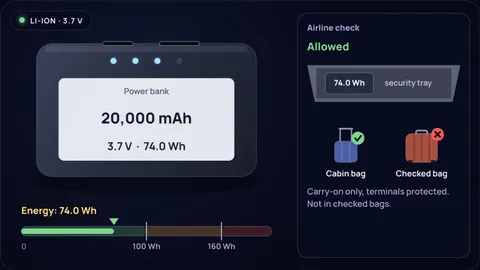
Can You Take a 20000 mAh Power Bank on a Plane?
Yes, in your cabin bag: a 20,000 mAh power bank is 74 Wh, under the 100 Wh limit. How to convert mAh to Wh, the FAA and IATA rules, the 5 V mistake, and the newer limits on using power banks in flight.

Why Phone Charging Slows After 80%: The CC-CV Curve
Fast charging fills a phone from 0 to 70% at full current, then a fixed voltage limit makes the current taper. The physics, the plating risk and the math.

LiPo C Rating Explained: Current, Sag and Real Limits
A 5000 mAh 50C LiPo is rated for 250 A, but at 3 milliohms per cell that current sags each cell by 0.75 V. What the C rating means and how to check it.
How Does Wireless Charging Work? Coils, Coupling, Heat
Qi charging is a loosely coupled resonant transformer at 110 to 205 kHz. The coupling maths, why coils are not the main loss, and where heat comes from.