Why a 10000 mAh Power Bank Does Not Give 10000 mAh to Your Phone
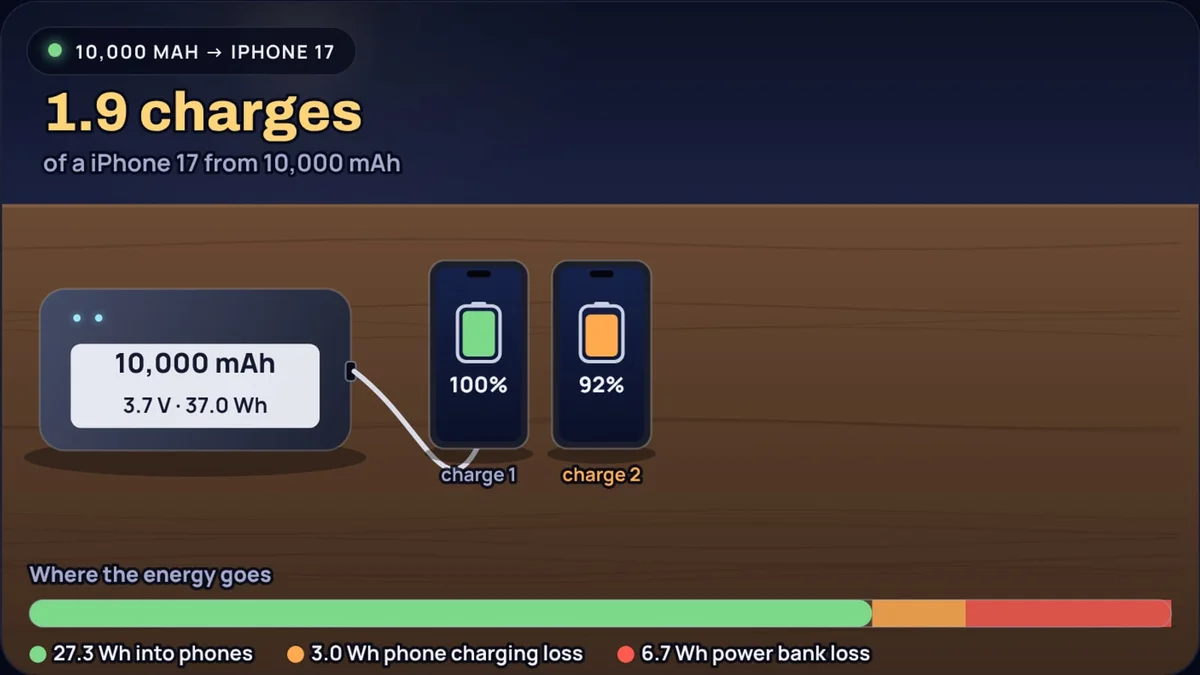
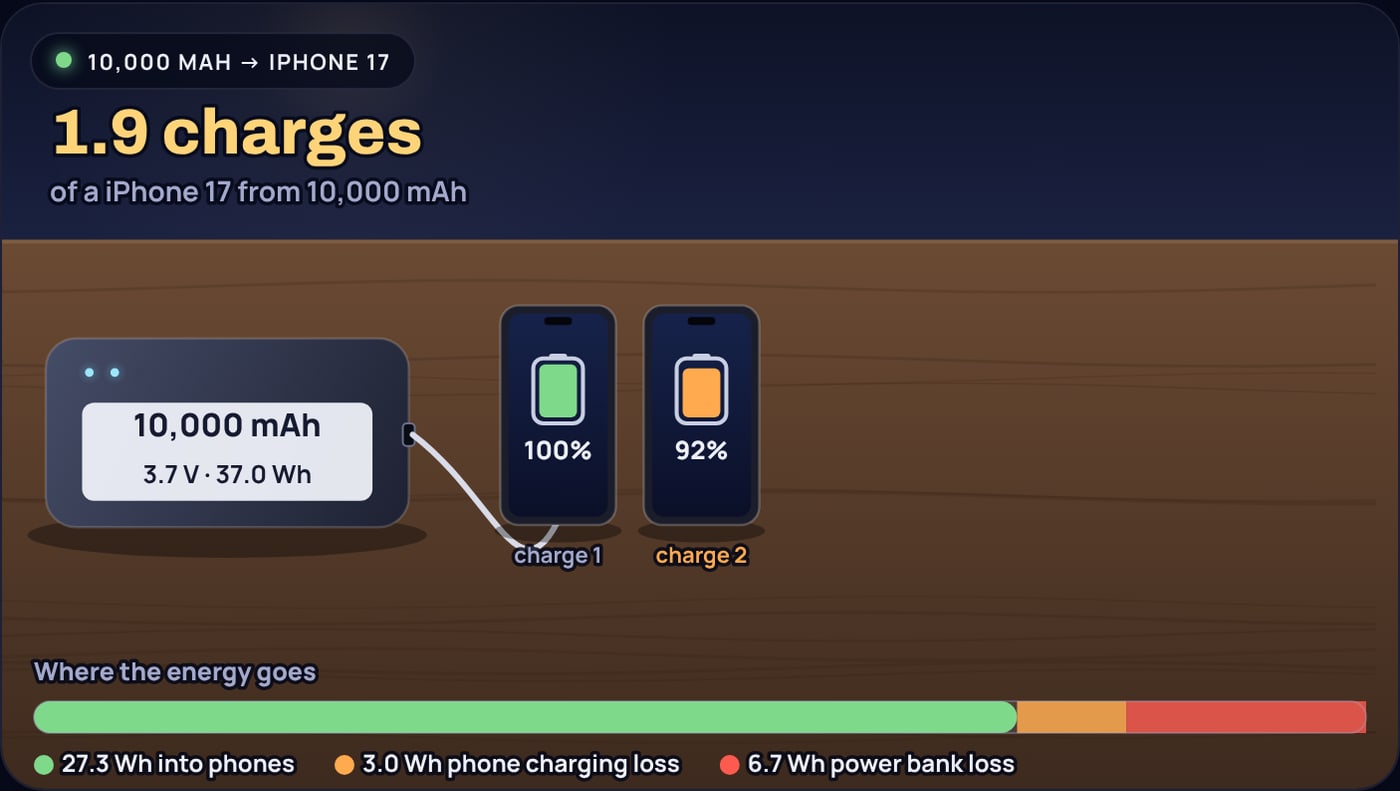
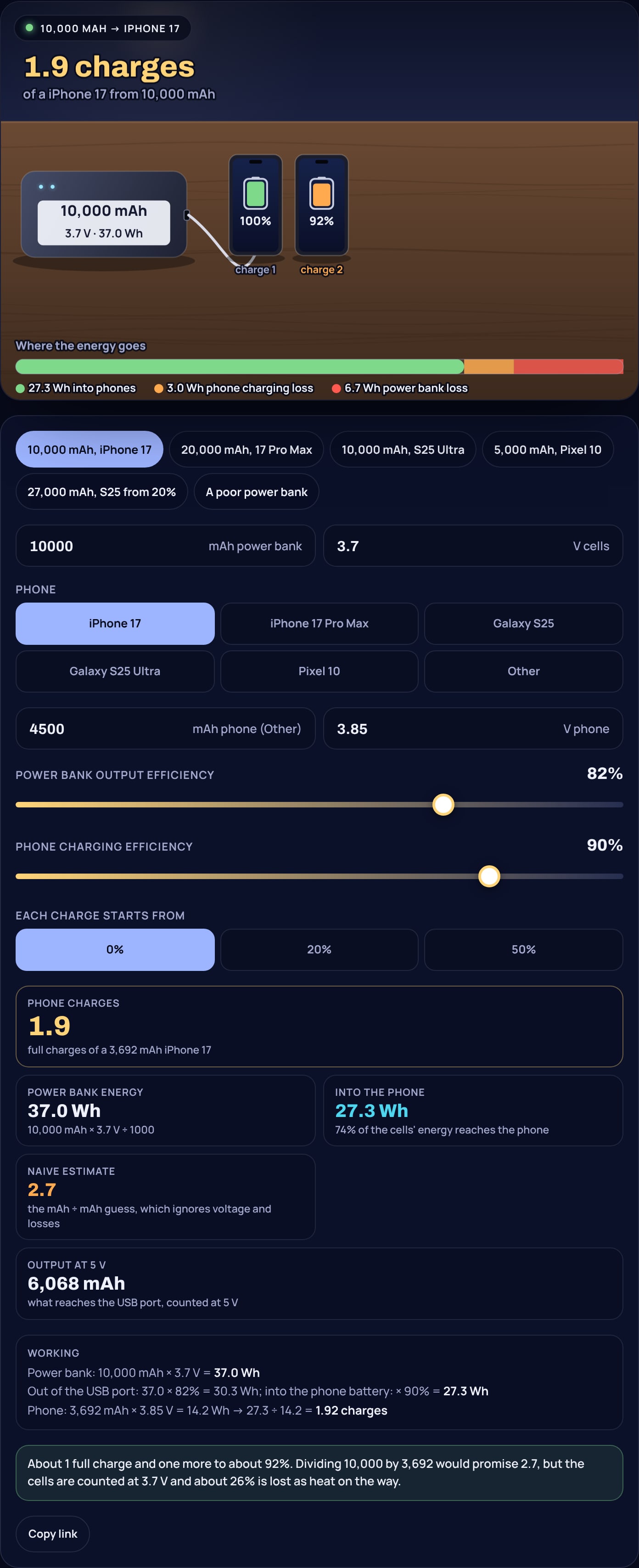
An iPhone 17 has a 3,692 mAh battery. A 10,000 mAh power bank, by simple division, should fill it 2.7 times. In practice you get a full charge and most of a second one, about 1.9. Nothing is broken. The 10,000 and the 3,692 are not measured the same way, and energy leaks out as heat at two stages between the power bank's cells and the phone's.
This post follows the energy from one to the other, with real phone capacities and the losses power bank makers themselves publish. Every number comes from the power bank calculator, which lines up the phones on a desk and shows how many full and partial charges you get.
Why mAh on its own misleads
A milliamp hour is a measure of charge, not energy. Energy is charge times voltage, so two batteries with the same mAh at different voltages hold different amounts of energy. The FAA's battery guidance puts the conversion simply: multiply the voltage by the amp hours to get watt hours.
A power bank's mAh rating is the capacity of its lithium ion cells at their nominal voltage, about 3.7 V. Anker's support page says exactly that: the 10,000 mAh figure refers to the total charge capacity of the internal cells. Your phone's battery is also a lithium ion cell, but it is charged through a USB cable at 5 V or more, and modern phone cells run a little higher than 3.7 V. So the first step is to put both in watt hours.
Loss 1: inside the power bank
USB delivers 5 V (or more with fast charging), so the power bank has to raise its 3.7 V to that. A boost converter does it, and no converter is perfect: some energy becomes heat, and some is lost in the cells' own internal resistance and the protection circuitry.
Example 1: what a 10,000 mAh power bank delivers at the port
Anker's support article works through this case with a typical 82% efficiency.
6,068 mAh at 5 V is the "rated capacity" some power banks print next to the cell capacity. It is the more honest number for what comes out of the port.
Not every power bank manages 82%. Zendure's guide to power bank efficiency proposes measuring the total energy a user actually gets divided by the rated energy, and works through an example pack that delivers 63.75%. It also warns that some brands quote over 90% for the circuit board alone, which leaves out the rest of the losses.
Loss 2: inside the phone
The phone then does the conversion in reverse: its charging chip brings the USB voltage down to what its battery needs, and the battery itself warms a little as it charges. Phone makers do not publish an efficiency for this, so the calculator uses 90% as a typical assumption, and you can change it. Whatever the exact figure, it is a second multiplication by a number below one.
The phone's battery energy is its mAh times its own nominal voltage. Current phone cells run a little above 3.7 V; the calculator takes 3.85 V, which you can also change.
Example 2: charges of an iPhone 17 from 10,000 mAh
The iPhone 17's battery is 3,692 mAh, from Apple's EU energy label as reported by MacRumors.
Compare the naive 10,000 ÷ 3,692 = 2.7. About 26% of the power bank's energy never reached the phone, and the phone's higher cell voltage takes a little more off the count.
How many charges for common phones?
Here is the same calculation for current phones, using each maker's published capacity: Apple's EU energy labels for the iPhone 17 (3,692 mAh) and 17 Pro Max (5,088 mAh), Samsung's newsroom specification for the Galaxy S25 (4,000 mAh typical) and S25 Ultra (5,000 mAh typical), and Google's spec page for the Pixel 10 (4,970 mAh typical).
| Power bank | iPhone 17 | iPhone 17 Pro Max | Galaxy S25 | Galaxy S25 Ultra | Pixel 10 |
|---|---|---|---|---|---|
| 5,000 mAh | 1.0 | 0.7 | 0.9 | 0.7 | 0.7 |
| 10,000 mAh | 1.9 | 1.4 | 1.8 | 1.4 | 1.4 |
| 20,000 mAh | 3.8 | 2.8 | 3.5 | 2.8 | 2.9 |
| 27,000 mAh | 5.2 | 3.8 | 4.8 | 3.8 | 3.9 |
A rule of thumb falls out of the table: with typical losses, divide the power bank's mAh by the phone's and multiply by about 0.7. The two figures below show the big-phone cases.
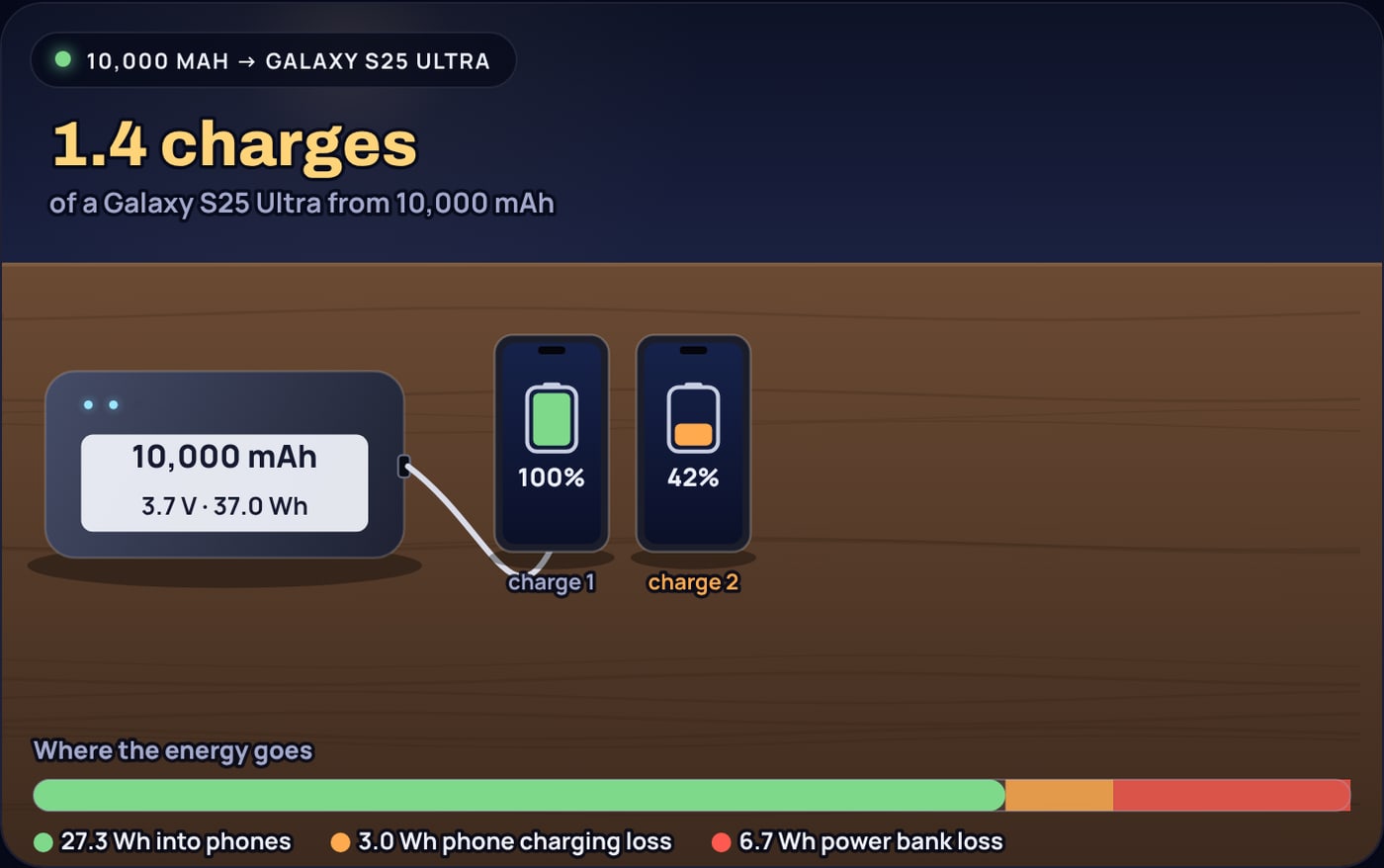
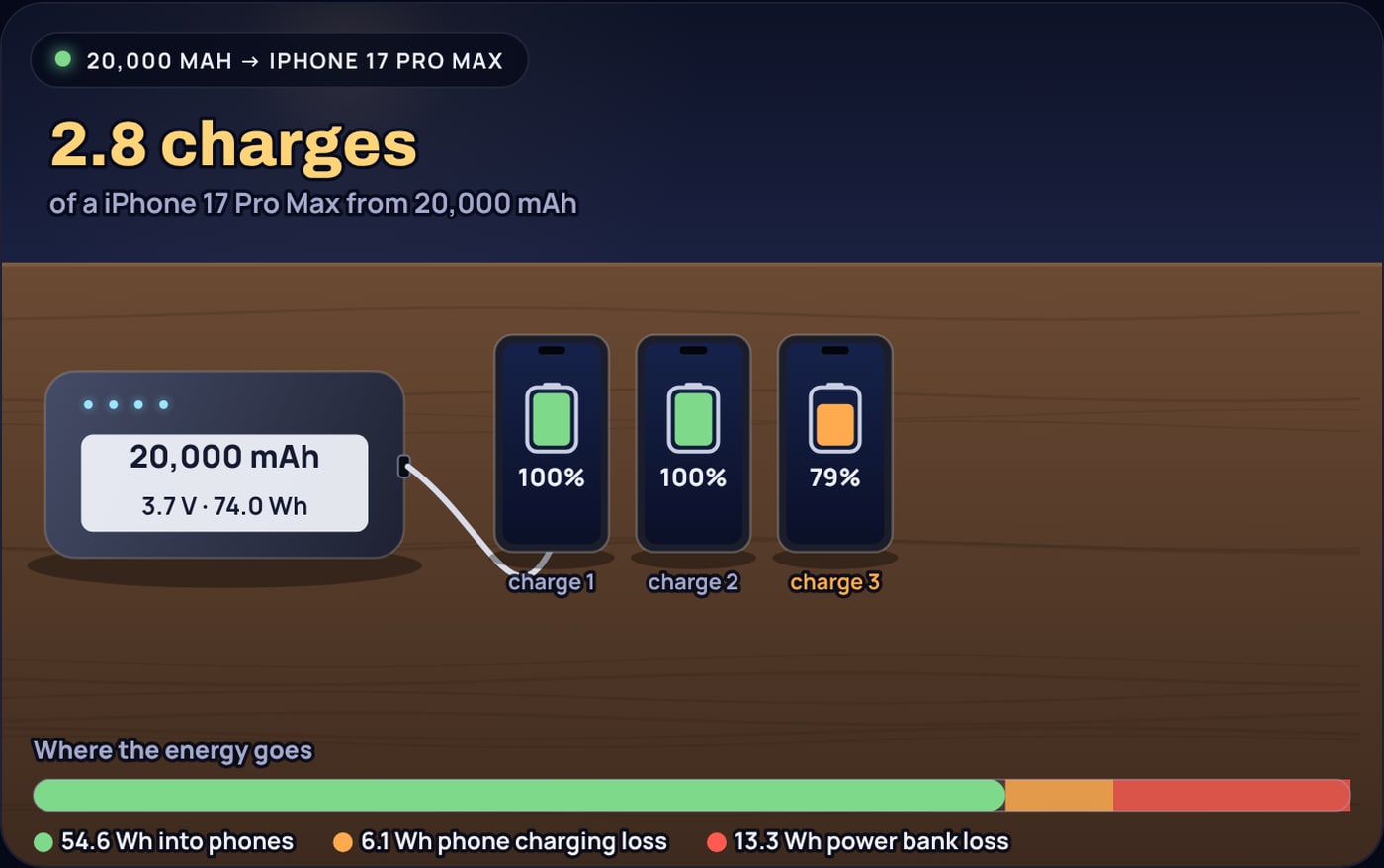
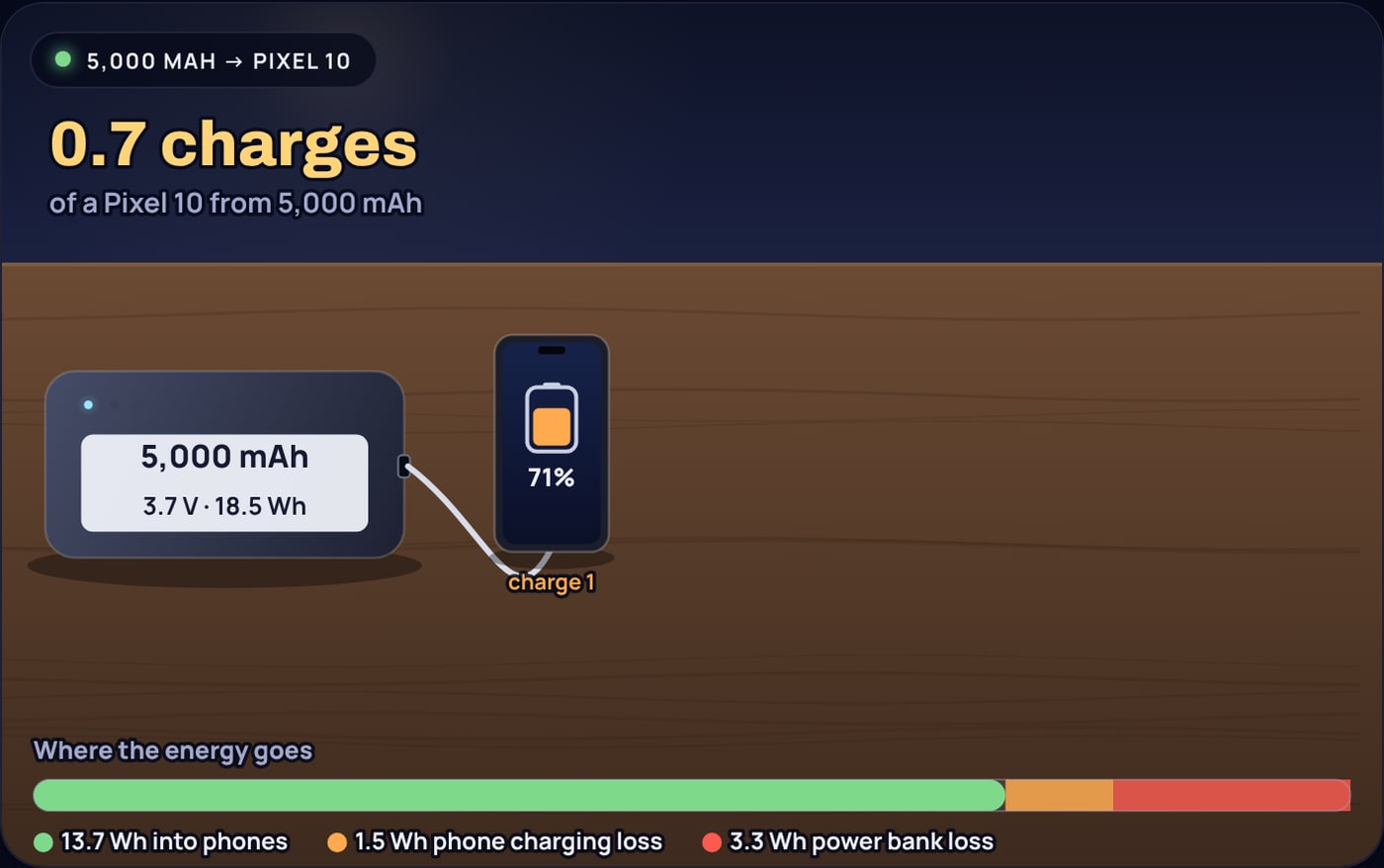
The small power bank case is the most surprising. A slim 5,000 mAh bank and a Pixel 10 with a 4,970 mAh battery have almost the same mAh, so it looks like one full charge. It is 18.5 Wh against 19.1 Wh, before any losses, and in practice it gets the phone to about 71% (Figure 4).
How much does a poor power bank cost you?
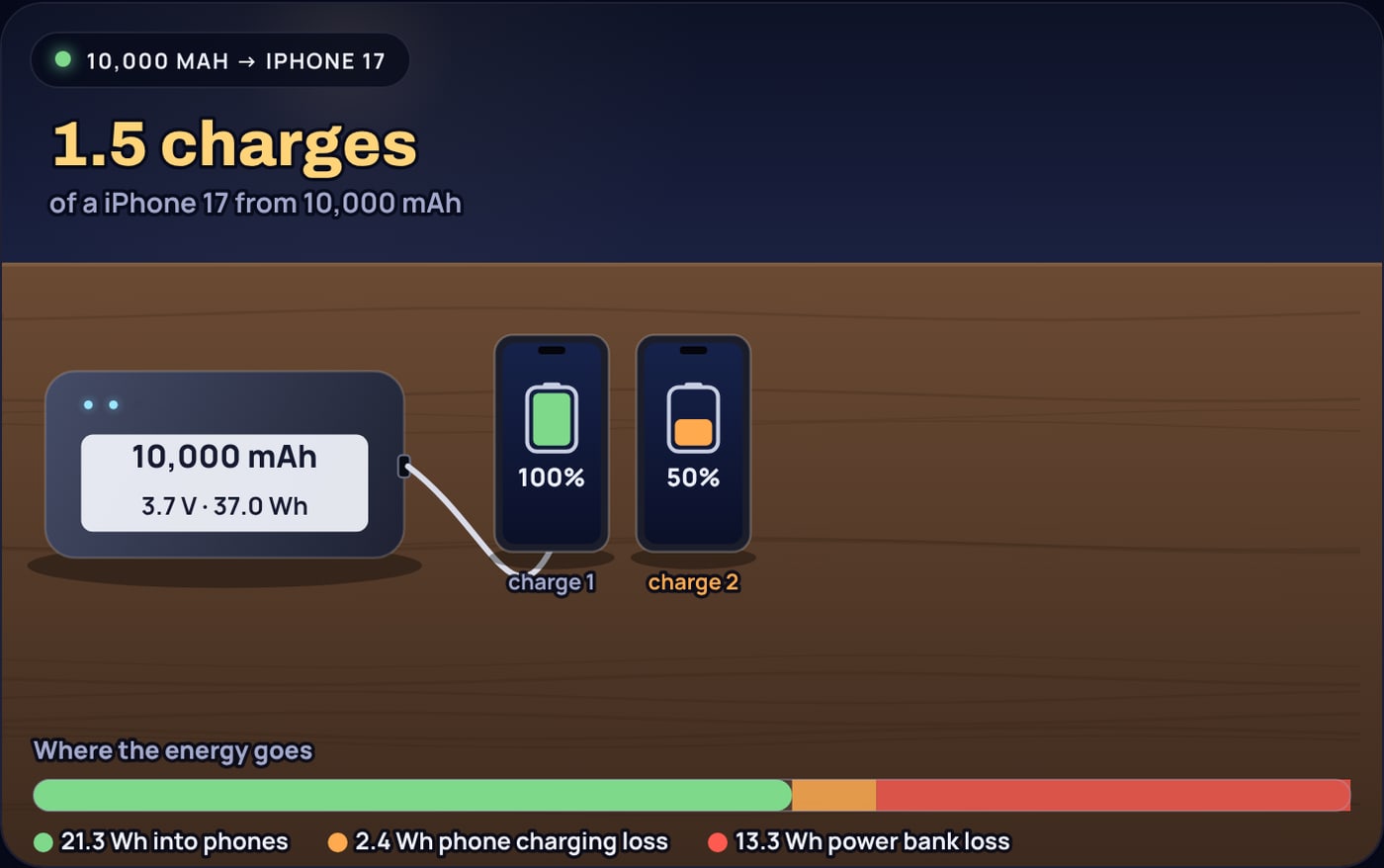
Efficiency matters more than a few hundred mAh. At the 64% of Zendure's worked example, the same 10,000 mAh bank charges an iPhone 17 about 1.5 times instead of 1.9. The difference is a fifth of the energy you paid for, lost as heat in the power bank (Figure 5).
Two things help you spot a good one. A power bank that prints both its cell capacity and a rated capacity at 5 V is telling you its efficiency: divide the 5 V figure by the cell figure and multiply by 5 ÷ 3.7. And a bank that runs noticeably warm during charging is turning energy into heat.
What else changes the number of charges?
- Starting point. Most people top up from 20% or so, not from empty. From 20%, each top-up needs only 80% of a full charge, so you get a quarter more of them.
- Using the phone while charging. The screen and radios take their share, so less goes into the battery.
- Wireless charging. Charging through a coil loses more than a cable; lower the phone efficiency in the calculator to see the effect. How wireless charging works explains why.
- Temperature. Cold cells deliver less, and a hot phone may pause charging.
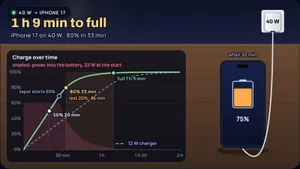
- The last 20%. Charging slows near full, but that changes the time, not the energy. Why phone charging slows after 80 percent covers the reason.
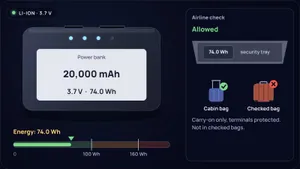
To check your own pairing, open the power bank calculator, type your power bank's mAh and pick your phone. If you are flying with it, the guide to power banks on planes covers the 100 Wh limit.
Sources
- Anker Support: Why is the rated capacity marked on a power bank lower than expected? (10,000 mAh × 3.7 V = 37 Wh, 7,400 mAh at 5 V, typical 82% efficiency, 6,068 mAh)
- Zendure: The guide to capacity and efficiency of portable chargers (total energy conversion rate, 63.75% worked example, board-only claims over 90%)
- MacRumors: iPhone 17 battery capacities from Apple's EU energy labels (iPhone 17 3,692 mAh, 17 Pro Max 5,088 mAh)
- Samsung Global Newsroom, Galaxy S25 series launch announcement, specification table (news.samsung.com/global) (S25 4,000 mAh typical, rated 3,885; S25 Ultra 5,000 mAh typical, rated 4,855)
- Google Store: Pixel 10 tech specs (typical 4,970 mAh, minimum 4,835 mAh)
- FAA PackSafe: Lithium Batteries (Wh = voltage × amp hours)
Frequently asked questions
How many times will a 10000 mAh power bank charge my phone?
About 1.9 times for an iPhone 17 with a 3,692 mAh battery, and about 1.4 times for a 5,000 mAh phone such as the Galaxy S25 Ultra, once the voltage difference and typical losses are counted.
Why does a power bank deliver less than its rated mAh?
Its mAh is counted at the 3.7 V of its cells. Raising that to the USB voltage, and the phone converting it back down, both lose energy as heat. Anker gives about 82% as a typical efficiency for the power bank alone.
Is my power bank faulty if it gives fewer charges than expected?
Probably not. Delivering two thirds to three quarters of the cells’ energy to the phone battery is normal. A good power bank prints its Wh and its output capacity, which help you set expectations.
What is rated capacity on a power bank label?
Many power banks print a rated capacity at 5 V, which is the energy that reaches the USB port divided by 5 V. For a 10,000 mAh bank Anker works it out as about 6,068 mAh.
Should I compare power banks in mAh or Wh?
Wh. It is energy and does not depend on the voltage it is counted at. A 10,000 mAh bank at 3.7 V is 37 Wh.