How do you calculate battery pack voltage and capacity?
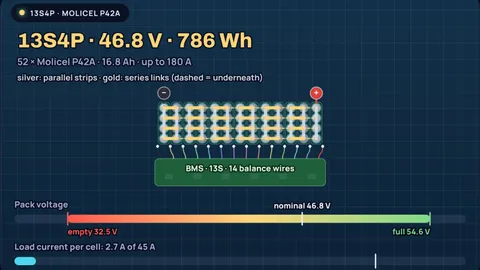
Multiply the cell voltage by the number in series, and the cell capacity by the number in parallel. A 3S2P pack of 3,000 mAh, 3.6 V cells is 10.8 V and 6 Ah, or 64.8 Wh; a 13S4P e-bike pack of Molicel P42A cells is 46.8 V, 16.8 Ah and about 786 Wh. Energy is the cell count times one cell's energy, however the cells are arranged.
Cell values come from each maker's datasheet. The companion post works through the examples, LiPo C ratings explained covers current limits, and the mAh to Wh converter handles single batteries.
Key results from the calculator
- Series sets the voltage: 13 Li-ion cells in series make 46.8 V nominal, 54.6 V full and 32.5 V empty, the "48 V" e-bike class.
- Parallel sets capacity and current: four P42A cells in parallel give 16.8 Ah and 180 A continuous.
- 4S LiFePO4 is 12.8 V nominal and 14.6 V full, close to a 12 V lead acid battery.
- Every series pack needs balancing: a 13S pack needs a BMS with 14 balance wires.
Six packs
Each example loads the cell, the S and P counts and a typical load.
3S2P of Samsung 30Q
Small robot or droneSix 18650 cells: three in series for 10.8 V, two in parallel for 6 Ah. At 150 W each cell carries 6.9 A of its 15 A rating, for about 26 min.
10S3P of Samsung 30Q
36 V scooterTen in series is the usual "36 V" pack: 36 V nominal, 42 V full. Three in parallel give 9 Ah and 324 Wh.
13S4P of Molicel P42A
48 V e-bike52 cells of 21700: 46.8 V nominal, 54.6 V full, 16.8 Ah and about 786 Wh. The cells alone weigh about 3.6 kg.
13S5P of Samsung 30Q
Same voltage, smaller cells65 smaller 18650 cells give 702 Wh, a little less than 52 P42A cells, and 75 A against 180 A.
4S LiFePO4 32700
12 V lead acid replacementFour 3.2 V LiFePO4 cells make 12.8 V, charged to 14.6 V. With 6 Ah cells that is 76.8 Wh.
4S4P LiFePO4 32700
Camping power boxFour groups of four: 12.8 V, 24 Ah, 307 Wh. A 200 W load runs for about 1.5 h.
Common Li-ion pack voltages (3.6 V cells, 4.2 V full, 2.5 V empty)
| Series | Nominal | Full | Empty | Sold as |
|---|---|---|---|---|
| 3S | 10.8 V | 12.6 V | 7.5 V | 12 V class |
| 4S | 14.4 V | 16.8 V | 10 V | 14.4 V / 14.8 V |
| 7S | 25.2 V | 29.4 V | 17.5 V | 24 V |
| 10S | 36 V | 42 V | 25 V | 36 V |
| 13S | 46.8 V | 54.6 V | 32.5 V | 48 V |
| 14S | 50.4 V | 58.8 V | 35 V | 52 V |
| 20S | 72 V | 84 V | 50 V | 72 V |
Packs are often sold at 3.7 V per cell (for example 13 × 3.7 = 48.1 V); the datasheets for the 30Q and P42A give 3.6 V. Full and empty voltages are the datasheet charge and cut-off voltages; most BMS boards cut off a little above the empty figure.
How the calculator works
Voltage: cells in series add their voltages: nominal, full (the datasheet charge voltage) and empty (the discharge cut-off).
Capacity and current: cells in parallel add their amp hours and their continuous current ratings. The pack current limit is the weakest group's, so all cells must match.
Energy: volts × amp hours, which equals the number of cells times one cell's energy. A Samsung 30Q holds 10.8 Wh; a P42A 15.1 Wh.
Load check: the load in watts divided by the nominal voltage gives the pack current, shared equally by the cells in parallel. Run time is the energy divided by the load, ignoring the lower capacity at high current.
What the model leaves out
- Capacity at high current: cells deliver less than their rated mAh at heavy loads; the 30Q datasheet gives 2,700 mAh at 10 A against 3,000 mAh at 0.2C.
- Voltage sag: internal resistance pulls the voltage below nominal under load.
- Pack hardware weight: nickel, BMS, wiring, insulation and the case are not counted.
- Temperature and ageing: both reduce capacity and the current a cell can safely give.
Common misconceptions
"Parallel cells raise the voltage." Only series does. Parallel keeps the voltage and adds capacity.
"A 48 V pack has 48 V." It swings from about 32.5 V empty to 54.6 V full for 13 Li-ion cells in series.
"Balancing is optional on small packs." Any pack with two or more groups in series can drift apart, and the highest group gets overcharged.
Frequently asked questions
How do I calculate battery pack voltage?
Multiply the cell voltage by the number of cells in series. 13 Li-ion cells at 3.6 V make 46.8 V nominal and 54.6 V when full at 4.2 V each.
How do I calculate battery pack capacity?
Multiply one cell's capacity by the number in parallel. Four 4,200 mAh cells in parallel make 16.8 Ah, whatever the number in series.
What does 3S2P mean?
Three cells in series and two in parallel, six cells in all. With 30Q cells it is 10.8 V, 6 Ah and 64.8 Wh.
Does a battery pack need a BMS?
Yes. A BMS cuts off overcharge, overdischarge, overcurrent and short circuits, and for packs with cells in series it balances the groups through one wire per junction.
Is a 4S LiFePO4 pack a 12 V battery?
Yes: four 3.2 V cells make 12.8 V nominal, close to a 12 V lead acid battery, but it charges to 14.6 V and needs a LiFePO4 charging profile.
Keep learning
How to Calculate Battery Pack Voltage and Capacity (Series vs Parallel)
Series cells add voltage, parallel cells add capacity and current. Worked examples for a 3S2P 18650 pack, a 13S4P 21700 e-bike pack and a 4S LiFePO4 12 V battery, from the cell datasheets.

LiPo C Rating Explained: Current, Sag and Real Limits
A 5000 mAh 50C LiPo is rated for 250 A, but at 3 milliohms per cell that current sags each cell by 0.75 V. What the C rating means and how to check it.
Can You Take a 20000 mAh Power Bank on a Plane?
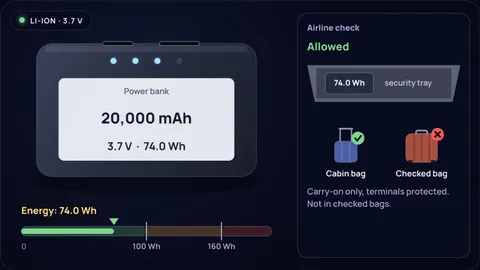
Yes, in your cabin bag: a 20,000 mAh power bank is 74 Wh, under the 100 Wh limit. How to convert mAh to Wh, the FAA and IATA rules, the 5 V mistake, and the newer limits on using power banks in flight.
Why a 10000 mAh Power Bank Does Not Give 10000 mAh to Your Phone
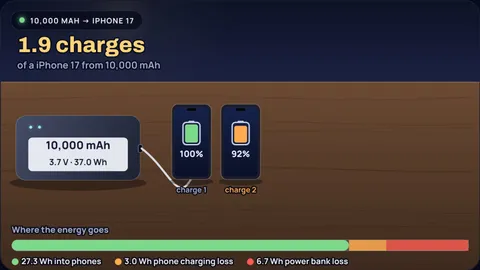
A 10,000 mAh power bank charges a 3,692 mAh iPhone 17 about 1.9 times, not 2.7. Where the missing energy goes: cell voltage, conversion losses and the phone's own charging.